Skin profile
Where this herb sits in skin practice: the pattern it corrects, the skin signs it suits, and what it should not be used for.
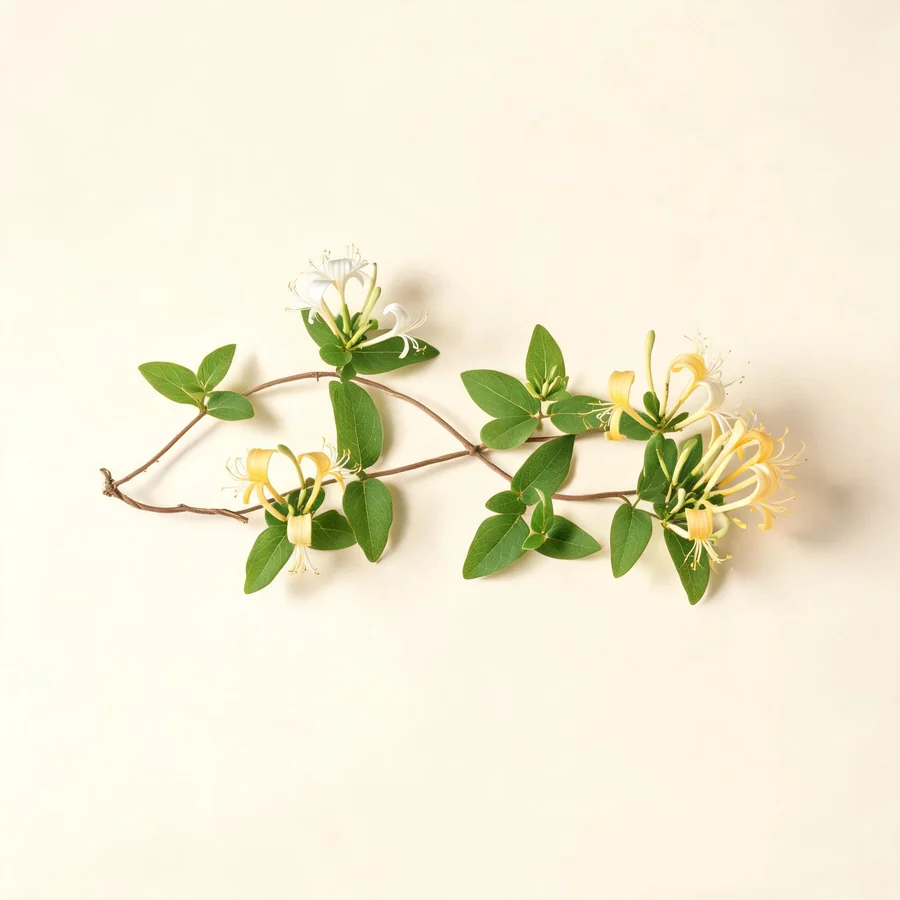
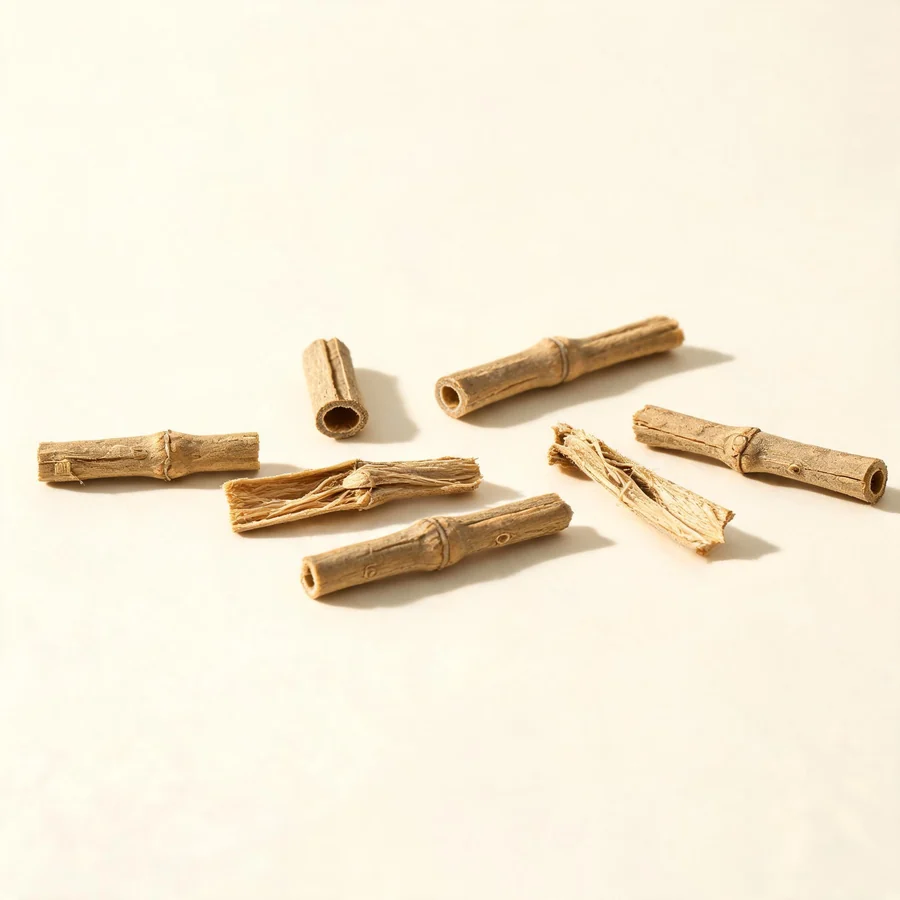
Ren Dong Teng is the mild, travelling half of the honeysuckle pair: cooling enough to clear heat toxin, sweet enough for a fortnight's course, and directed into the channels so that it reaches a hot lesion on a limb or over a joint. It is used as much in washes and baths as in decoctions, and its limits are cold digestion and pale, watery sores.
Skin signs that suggest it
- Red, hot, swollen and painful boils, carbuncles or abscesses
- Weeping or crusted eczema that feels hot and is worse in warmth
- An inflamed, tender patch around a wound or an insect bite
- A hot, swollen joint with red skin over it
- A red tongue with a yellow coating and a rapid pulse
When it is not the right herb
Not for pale, watery, slow-healing sores with no surrounding heat, and not for a chronic ulcer in a cold, depleted person. It is a poor choice where digestion is cold and loose, and it should not be continued for weeks in someone whose appetite is already poor. A hot swollen joint with fever, and any spreading redness of the skin, need medical assessment before a cooling vine is considered, because infection of a joint or of the deep skin is not a case for a decoction.
What it does for skin
Skin-relevant actions only. Each one describes a mechanism in TCM terms and what it looks like on the skin.
Clears heat and resolves toxin in the skin
The stem is used for the hot, red, swollen lesion: a boil, a carbuncle, an infected graze or an eczema that has become inflamed and tender. It is milder than the honeysuckle flower, so it suits a crop of small boils or a lesion that is settling rather than a fulminant infection. It is a supporting herb in a toxin-clearing formula, and the primary treatment for a spreading infection is medical.
Opens the channels and settles a hot, swollen joint
The climbing habit informs the reasoning: a vine that threads its way across a trellis is taken to find a path through the channels and collaterals, and the stem is chosen where heat has lodged in a limb or joint and the ache refuses to settle. The joint is red, hot and tender rather than stiff and cold, and the skin over it may be part of the complaint. A single hot joint with fever needs infection and gout excluded before any herb is used.
Cools the Blood and quiets a fine hot rash
The smallest of its actions, and no substitute for the blood-cooling specialists. It lets the stem sit inside a warm-febrile prescription without quarrelling with the heavier cooling herbs, and it adds a light touch to a fine rash, an early eruption or a heat-driven itch. Where the rash is dark and confluent, the stronger blood-cooling materials lead.
Cools and calms a weeping surface when used as a wash
A strong decoction is used as a bath, a compress or a wash for eczema, hot sores and haemorrhoids, and the traditional bath for infantile eczema is the best-known example. Applied this way a large amount of a mild cooling herb reaches the tissue while the digestion is spared, which is why the wash figures are much higher than the internal ones.
Skin conditions it is used for
Mapped to the condition pages on this site. The pattern column shows what the skin is doing when this herb is the right choice.
| Condition | Pattern | Why it suits | Typical setting |
|---|---|---|---|
| Boils | Heat toxin gathering in the skin | A boil is the simplest heat-toxin lesion, and the stem clears the toxin while opening the channels around it, which suits the early, hot, hard stage. It is milder than the flower, so it is used for recurrent crops and for lesions that are not spreading, usually with Lian Qiao or Jin Yin Hua. A boil with a spreading red edge or a fever needs medical review. | Wu Wei Xiao Du Yin with Ren Dong Teng, or the honeysuckle wine |
| Skin abscess | Toxic heat with pus and local obstruction | Chen Ziming's honeysuckle wine, from the Song, was built on the stem alone with licorice, and it is the plainest classical sign of how the stem clears toxin. The stem helps a swelling localise and discharge, and it is given before a collection is established. A tense, fluctuant abscess needs drainage, and the wine is not a substitute for it. | Ren Dong Teng Jiu, the honeysuckle wine of Chen Ziming, with Gan Cao |
| Eczema | Damp-heat with heat dominating a weeping flare | The stem is used as a wash and a bath for eczema that is hot, red and weeping, including the traditional bath for infantile eczema, and internally as a light cooling herb in a damp-heat formula. It is not the herb for dry, lichenified eczema of the cold type, and it is stopped once the ooze settles. A large weeping area, or one that is secondarily infected, needs assessment rather than a stronger bath. | Ren Dong Teng wash with Lian Qiao, or a modified Xiao Feng San with the stem added |
| Skin infection | Heat toxin in broken or inflamed skin | Infected grazes, bites and minor wounds that are red and hot are treated with the same cooling, toxin-resolving action, internally in a formula and externally as a wash. The stem is mild, so it is a support rather than a treatment for an established infection, and a spreading, painful or febrile infection needs medical care. | Ren Dong Teng and Lian Qiao decoction, internally and as a wash |
| Cellulitis | Spreading heat toxin in the deeper skin | The tradition treats spreading hot redness as toxin with heat, and the stem has a place among the cooling vines for it. The modern boundary is strict: cellulitis needs antibiotics and assessment, and can progress quickly. A cooled wash may be used alongside treatment for comfort, but the herb must not delay care, and an advancing red edge or a fever with rigors is an emergency. | Modified Huang Lian Jie Du Tang with Ren Dong Teng, alongside antibiotics |
Combinations for skin
Herbs it is paired with when the skin, not an internal organ, is the target.
| Partner | Ratio | Why the pair is used |
|---|---|---|
| Lian Qiao | 10 to 15 g each | The stem opens the channels and works on the lesion itself, while forsythia clears heat and toxin in the upper body, and together they are the classical response to heat toxin with obstruction. It serves for boils, infected eczema and hot swollen glands, and both herbs are mild enough for a short course in a depleted person. |
| Jin Yin Hua | 10 to 15 g flower with 15 to 30 g stem | Flower and stem grow on one plant and are combined more often than they are weighed against each other. The flower is light and rises to throat, eyes and surface; the stem is heavier and travels within the channels, so together they reach both the surface of a hot infection and its depth. The usual proportion gives more stem than flower. |
| Gan Cao | 5 to 1, as 30 g licorice to 150 g stem in the classical wine | This is the pair at the heart of Chen Ziming's honeysuckle wine, and the formula holds almost nothing else, which is what makes it such a plain statement of what the stem does to toxin. Licorice shields digestion from the cold herb and harmonises the formula, so a large dose can be taken without loosening the stool. |
| Ji Xue Teng | 15 to 30 g each | Two vines that open the channels, dividing the work between them: Ji Xue Teng moves and nourishes Blood where obstruction has lasted long enough for stasis to form, and the honeysuckle stem supplies the cooling and toxin-clearing the joint still needs. The pair suits chronic hot obstruction, a joint swollen for months, rather than a single acute flare. |
Formulas where it leads
- Ren Dong Teng Jiu (honeysuckle wine) - Chen Ziming's Song dynasty wine, built on the stem with licorice and steeped rather than boiled. It is the plainest classical statement of what the stem does to abscesses and hot swellings, and with so little else in the bottle the stem's own effect is not obscured.
- Wu Wei Xiao Du Yin (五味消毒饮) - The standard formula for heat toxin with boils and carbuncles, built on dandelion, viola, honeysuckle and chrysanthemum. The stem can replace or supplement the flower where the lesion is on a limb or over a joint, because its channel-opening action reaches the tissue around the lesion.
Topical use
Honeysuckle stem is used externally as a wash, a compress and a bath, and for a large weeping area this is often the better route. A strong decoction is made, cooled to skin temperature and poured over or applied to the affected skin, which puts a mild cooling herb directly on the surface and spares the digestion. The traditional bath for infantile eczema is the best-known example, and the same preparation is used for hot sores, itchy patches and haemorrhoids.
| Preparation | How and when it is used |
|---|---|
| Bath or soak for a wide area | Simmer 60 to 100 g of dried stem in 3 to 4 litres of water for 30 minutes, strain, and add the liquid to a bath of comfortable temperature. Soak for 10 to 15 minutes, pat the skin dry, and use a fresh batch each time. Keep the water warm rather than hot, and never leave a child unattended. |
| Compress for a localised lesion | Use 30 to 60 g in 1 litre of water, simmer for 20 minutes and cool. Soak clean gauze and hold it on the area for 10 to 15 minutes twice daily, then pat dry and discard the cloth or wash it thoroughly. |
| Wash for the scalp or hands | A weaker decoction can be poured over the scalp or used as a hand soak. Keep it out of the eyes, and stop if the skin stings or tightens. |
Patch test and cautions
Patch test on a small area before a first bath, and keep the water temperature comfortable rather than hot, since heat drives itch and redness. Do not use on broken, ulcerated or openly infected skin without supervision, keep the preparation away from the eyes and mouth, and stop at once if the skin becomes redder, tighter or more itchy. Baths should not be shared, and the liquid should be discarded after use.
Safety for skin use
What to check before recommending or using it, including the cautions that matter most for skin patients.
Do not use, or use with caution
- Cold, weak digestion with loose stools, a poor appetite and a chilly feeling in the abdomen. The stem is cold, and a course taken for a hot joint may loosen the bowel further and leave a heaviness after meals.
- Pale, watery, slow-healing sores and chronic ulcers with no surrounding heat. These are cold or deficient lesions, and a cooling vine does not help them and may slow healing.
- Long courses at high dose in a frail or older person. The coldness accumulates, and the appetite and stools are the first things to suffer.
- Known sensitivity to honeysuckle or to a previous herb bath. A contact reaction to the plant is uncommon but described, and a patch test is sensible before a full bath.
Pregnancy and breastfeeding
No specific contraindication is established, and the stem is absent from the lists of herbs avoided during pregnancy. What caution there is concerns digestion and how long it is taken: a lengthy course at a high dose can weigh on a digestion that pregnancy has already slowed. Short courses at ordinary doses, for a defined hot picture, are where it is described as acceptable; anything longer belongs to a practitioner following the pregnancy. Washing a limited area is a smaller exposure and still worth mentioning.
Interactions
- Anticoagulants and antiplatelet drugs. In the laboratory, chlorogenic acid and luteolin mildly reduce platelet aggregation, so anyone on warfarin or a direct oral anticoagulant should have clotting checked instead of assuming the herb does nothing. The reported effect is mild, which argues for monitoring rather than alarm.
- Immunosuppressants. Laboratory work describes extracts shifting T-cell differentiation and interfering with NF-kappaB signalling, a finding that matters to anyone taking an immunosuppressant, whether after a transplant or for autoimmune disease. Nothing of the kind has appeared in people taking decoction doses, but it should be raised with the treating team.
- Blood glucose-lowering medicines. Plant constituents have lowered glucose in the laboratory, so someone taking insulin or a sulphonylurea would be stacking two glucose-lowering effects and should monitor more closely.
Allergy and patch testing
A contact reaction to a honeysuckle bath is uncommon, but herb baths are a recognised cause of contact dermatitis and a first use should be a patch test on the forearm. Anyone who has reacted to another herb wash, or to honeysuckle flower, should avoid the stem preparation on a large area. Stop at once if the skin becomes red, swollen or itchy after a bath.
General safety references
General references for herbal hepatotoxicity and herb-drug interactions; they are not specific to this herb.
- Review article: Herbal hepatotoxicity - an update on traditional Chinese medicine preparations. Alimentary Pharmacology & Therapeutics, 2014. PMID: 24844799.
- Interactions between herbal medicines and prescribed drugs: an updated systematic review. Drugs, 2009. PMID: 19719333.
- Warfarin and food, herbal or dietary supplement interactions: a systematic review. British Journal of Clinical Pharmacology, 2021. PMID: 32478963.
Evidence
The classical record is quoted with its source. The modern note states the level of evidence plainly.
Classical record
忍冬,味甘,温,无毒。主寒热身肿。久服轻身,长年益寿。
Ren Dong is sweet, warm and free of toxicity. It governs chills and fever accompanied by swelling, and long use is said to make the body light and to lengthen life.
Ming Yi Bie Lu (Supplement to the Classic of Materia Medica) - The classical text calls the plant warm while later practice calls the stem cool, and both readings are recorded rather than reconciled.
治一切风湿气及诸肿毒,痈疽疥癣,杨梅恶疮,散热解毒。
It is used for Wind-Damp of every description and for all toxic swellings, for abscesses, for scabies and for the sores of syphilis; heat is dispersed and toxin resolved.
Ben Cao Gang Mu (Compendium of Materia Medica), Li Shizhen, 1578 - The breadth is remarkable: one passage fixes the herb's name for skin and joint problems together, and the reference to syphilis dates it to the late Ming.
驱风除湿,散热疗痹,消痈止痢之药也。此药清虚振肃,不寒不燥,补而不滞,利而不滑。
Ni Zhumo sets the vine down as a medicine for expelling Wind and clearing Dampness, dispersing heat, resolving abscesses and dysentery, and treating painful obstruction. He then sketches its character: clear and upright, neither over-cold nor over-drying, tonifying without stagnating and draining without loosening.
Ben Cao Hui Yan (Collected Sayings on Materia Medica), Ni Zhumo - That claim, that it strengthens and yet does not stagnate, is the classical reason for giving the stem to someone weak who nonetheless has a hot lesion.
Modern evidence
Evidence status
- Laboratory studies of the stem report anti-inflammatory and antimicrobial activity, credited in part to ochnaflavone, chlorogenic acid and the isochlorogenic acids. These are cell and animal findings and do not establish benefit in eczema, boils or any other skin condition.
- Clinical evidence is limited to small Chinese-language reports and to experience with multi-herb washes and baths, including the use of a strong decoction as a bath for infantile eczema. None of this is a controlled trial of the stem, and no conclusion about efficacy can be drawn from it.
- The safety record is reassuring but thin: the stem is classically non-toxic, and clinical reports at higher doses describe no significant adverse effects, yet there is no modern systematic safety dataset. The theoretical interactions with clotting, immunity and blood glucose come from laboratory work rather than from observed events.
PubMed records
Selected real PubMed records for this herb's species or its constituents, chosen by species name and title relevance. They are references for the non-TCM discussion above, not proof that the herb treats any skin condition.
- Fufang Shengdi mixture alleviates psoriasis-like skin inflammation via promoting Annexin-A proteins expression.. Journal of ethnopharmacology, 2023. PMID: 36940737 (skin-related record).
- Preparation and Characterization of Polysaccharide-Based Hydrogels for Cutaneous Wound Healing.. Polymers, 2022. PMID: 35566885 (skin-related record).
Dose and forms
Skin-practice dosing and the preparations that suit skin complaints.
| Form | Dose and notes |
|---|---|
| Decoction (internal) | 9 to 30 g of dried stem daily. Nine to fifteen grams where the fever is mild or the throat sore; fifteen to thirty where a joint is hot and painful or a skin lesion is active. Up to sixty grams is on record for acute toxic heat under supervision. |
| External wash or bath | 60 to 100 g simmered in 3 to 4 litres of water for a bath, or 30 to 60 g in 1 litre for a compress. Much more herb reaches the tissue this way while the digestion is bypassed, which is why the figures are larger than the internal ones. |
| Course length | Short courses, typically one to two weeks, with review. Most people tolerate a fortnight comfortably, and a longer run starts to show in appetite and stool. |
What matters here is duration more than grams. Most people take honeysuckle stem comfortably for a fortnight, and beyond that the coldness starts to show in appetite and stool, so a longer course is either reduced or balanced with a warming herb. The large figures recorded for dysentery and for baths belong to supervised or external use and are not a general licence. Children take less by age, often between a third and a half of the adult figure, and the bath route avoids the digestive question altogether.
Citations and further reading
Only real sources are listed: the classical materia medica passages quoted above, and the source works behind the botanical and safety statements.
- Ming Yi Bie Lu (Supplement to the Classic of Materia Medica), Tao Hongjing, Southern and Northern Dynasties - classical entry quoted above.
- Ben Cao Gang Mu (Compendium of Materia Medica), Li Shizhen, 1578 - classical entry quoted above.
- Ben Cao Hui Yan (Collected Sayings on Materia Medica), Ni Zhumo, Ming dynasty - classical entry quoted above.
- Caulis Lonicerae Japonicae monograph: Pharmacopoeia of the People's Republic of China - accepted botanical source, part used and quality requirements.
- Modern evidence statement: based on laboratory literature on Lonicera japonica stem constituents, summarised as a statement about the level of evidence rather than as a cited finding. No clinical trial is presented as proof of effect.
Educational reference for qualified practitioners. This page is not medical advice, and skin conditions should be diagnosed by a clinician before treatment.