Skin profile
Where this herb sits in skin practice: the pattern it corrects, the skin signs it suits, and what it should not be used for.
Ren Shen is on this page because skin heals badly when Qi is low, not because ginseng treats rashes. The signs that make it plausible are pallor, coldness, slow repair and a weak pulse. The signs that forbid it are heat, pus, a greasy coating and a red tongue, and they are far commoner in a skin clinic than the deficiency picture is. Used in the right person it is a support; used in the wrong one it is a cause of rash, insomnia and raised blood pressure.
Skin signs that suggest it
- Pale, cool, soft skin that heals slowly and bruises readily, in a person who tires quickly
- A chronic sore or boil that stays flat, does not come to a head and drains thin fluid
- Spontaneous sweating on slight effort with a cold, clammy surface and a weak voice
- Pale hives that appear when the person is tired rather than when they are hot
- A pale, swollen tongue with a thin coating and a weak, empty pulse
When it is not the right herb
Not while heat or a pathogen is active. A red, hot, spreading lesion, a fever, thick yellow pus, a greasy tongue coating or an acute infection all mean the herb should wait, because its tonifying warmth can hold the problem in place. It is wrong in Yin deficiency with heat, where the skin is dry and hot, the tongue is red without coating and sleep is poor; if a tonic is genuinely needed, the cooling American root is the safer choice. It is not a general vitality supplement for healthy skin, and it should not be used to compensate for a poor diet.
What it does for skin
Skin-relevant actions only. Each one describes a mechanism in TCM terms and what it looks like on the skin.
Supplies the Qi that builds and repairs tissue
Skin is the outermost thing the body has to supply, and it is the first to suffer when Qi runs low. Wounds close slowly, pressure leaves marks that last, and the surface looks pale and thin. Ginseng tonifies the Spleen, which turns food into the material the body rebuilds with, and that is the mechanism by which a tonic is expected to help a chronic ulcer or a slow-healing graze.
Holds the surface closed when Qi is leaking
Spontaneous sweating that comes on with the least effort is read as Qi failing to keep the pores shut. Ginseng is used with astragalus and oyster shell in that picture, and the aim is not to suppress sweat but to restore the holding force behind it. This is the one skin sign where the effect can be felt within days, although the sweat of an acute fever is a different matter and must not be held in.
Supports the discharge of a cold, deep sore
For a boil that is deep, pale, slow and does not come to a head, the classical strategy is to support the interior so that the sore can mature and drain rather than to attack it. Ginseng appears in the formulas that do this, beside astragalus, angelica and honeysuckle, in a person whose Qi is too low to push anything outward. The same herb is forbidden in a hot, rapidly spreading boil, which needs clearing and often drainage.
Steadies the Spirit that skin disease disturbs
Chronic itch and a visible rash wear a person down, and the resulting insomnia and anxiety are treated as part of the picture rather than as a separate problem. Ginseng enters the Heart channel and settles the Spirit, so it is included where restless sleep and palpitations accompany a long-standing skin complaint in a depleted person. It is a modest contribution, and it does not replace proper care of the skin or of the mood.
Skin conditions it is used for
Mapped to the condition pages on this site. The pattern column shows what the skin is doing when this herb is the right choice.
| Condition | Pattern | Why it suits | Typical setting |
|---|---|---|---|
| Chronic urticaria | Protective Qi Deficiency with an unstable surface | Hives that return for months, are pale rather than red, and appear when the person is tired, cold or run down are read as defensive Qi too weak to hold the surface steady. The formula that anchors this picture, Yu Ping Feng San, is built on astragalus; ginseng is added when the deficiency goes deeper than astragalus can reach, so that the shield is rebuilt from the root. It is not for hives that are red, hot and provoked by warmth. | Yu Ping Feng San with Ren Shen added |
| Boils | Qi and Blood Deficiency with a cold, deep sore that will not head | A boil that stays flat, drains thin fluid and heals over months is read as Qi too weak to push the toxin to the surface. The classical answer is to support the interior rather than to attack, and ginseng is among the herbs used for that, with astragalus and angelica in Tuo Li Xiao Du San. It is exactly wrong for the hot, red, rapidly spreading boil, where clearing and toxin-resolving herbs are needed and a tonic would entrench the problem. | Tuo Li Xiao Du San |
| Cool or clammy skin | Protective Qi Deficiency with spontaneous sweating | A surface that is cool and damp, with sweating on slight exertion and a weak voice, is read as the Qi that holds the pores shut giving way. Ginseng is used here for its tonifying rather than for any astringency of its own, and it is paired with astragalus and oyster shell so that the sweat falls while the underlying weakness is treated. Sudden cold sweat with chest pain or collapse is an emergency and has nothing to do with this pattern. | Modified Mu Li San with Ren Shen and Huang Qi |
| Purpura | Qi not controlling Blood | Bruise-like patches that appear without injury, in a pale, tired person with a soft pulse, are read as the Spleen failing to keep blood inside its vessels rather than as heat driving it out. Ginseng tonifies the Spleen Qi that does the holding, and it is a principal herb in Gui Pi Tang, the formula for this pattern. Heat-type purpura with bright blood, fever or a red tongue is the opposite picture and must not be treated with a warming tonic. | Gui Pi Tang |
| Wrinkled and shrunken skin | Spleen and Kidney Qi Deficiency | Thin, loose, sunken skin in an older person who is tired and cold is read as Qi and Essence falling short of the surface, and ginseng is one of the tonics used to restore the supply. Its contribution is to the Spleen that makes the material and the Heart that moves it, at low doses over months. No herb reverses sun exposure, and a rapid loss of skin firmness or of weight needs medical assessment first. | Modified Si Jun Zi Tang with Huang Qi and Ren Shen |
Combinations for skin
Herbs it is paired with when the skin, not an internal organ, is the target.
| Partner | Ratio | Why the pair is used |
|---|---|---|
| Huang Qi | 10 g Ren Shen with 15 to 30 g Huang Qi | Astragalus works at the surface, closing pores and lifting Qi outward, while ginseng rebuilds the Qi from the centre. Put together they cover the whole distance from the Spleen to the skin, which is why the pair appears in formulas for spontaneous sweating, slow-healing wounds and hives that come with fatigue. The usual balance is more astragalus than ginseng, since the surface is where the problem shows. |
| Bai Zhu | 10 g each, as in Si Jun Zi Tang | Atractylodes dries dampness while it tonifies, which suits the weak Spleen that produces pale, puffy, slow-healing skin. Ginseng supplies the Qi and atractylodes keeps the dampness from accumulating, so the pair does not simply add more fluid to a body that is already holding it. This is the core of the foundational Spleen formula, and the base on which skin tonics are often built. |
| Dang Gui | 10 g Dang Gui with 5 to 10 g Ren Shen | Angelica nourishes Blood and ginseng supplies the Qi that moves it, a division of labour the tradition states plainly: Qi is the commander and Blood the material. For skin this is the pairing used in pale, dry, thin skin with slow healing, and in purpura from deficiency. It is a formula-level pairing rather than a home combination, and the balance shifts towards angelica when dryness dominates. |
| Mai Dong | 5 to 10 g Ren Shen with 10 to 15 g Mai Dong | Ophiopogon moistens and cools, ginseng warms and tonifies, and the pair is used when Qi and fluid have both been depleted by illness, leaving a dry mouth, a dry throat and skin that has lost its suppleness. With schisandra added it becomes Sheng Mai San. The combination matters on a skin page because dryness after a fever is often the setting in which a chronic itch begins. |
Formulas where it leads
- Tuo Li Xiao Du San (托里消毒散) - The formula for supporting the interior so a cold, deep sore can discharge and close, with ginseng and astragalus as the tonics and honeysuckle and forsythia to resolve the toxin. It is the clearest classical statement that a boil can be a deficiency problem, and it is used only where the sore is pale and slow rather than red and spreading.
- Gui Pi Tang (归脾汤) - The formula for Qi not controlling Blood, used for purpura and petechiae in a pale, tired person, with ginseng as a principal herb beside astragalus, atractylodes and angelica. Its skin relevance is the bruise-like patch that appears without injury, and it is a formula for a deficient picture rather than for a hot one.
Safety for skin use
What to check before recommending or using it, including the cautions that matter most for skin patients.
Do not use, or use with caution
- Active heat or an unresolved infection: fever, a red spreading lesion, thick yellow pus, a sore throat or a greasy tongue coating. Tonifying warmth can hold the pathogen in place, and the herb is stopped until the acute phase has passed.
- Yin deficiency with heat: a red tongue without coating, a dry hot skin, night sweats, palpitations and irritability. Ginseng warms, and it adds to the heat rather than resolving it; American ginseng is the cooler alternative when a Qi tonic is genuinely needed.
- True excess with no deficiency. A robust person with a red face, a full pulse and constipation does not need the strongest tonic in the materia medica, and taking it produces headache, insomnia and a rise in blood pressure rather than benefit.
- Dampness or phlegm with a thick greasy coating. A sweet tonic adds to congestion, and the digestion has to be cleared before any tonic is given.
- Poorly controlled hypertension, a tendency to nosebleeds, and unexplained weight loss or a changing skin lesion. The last two need assessment, and they are not tonic problems at all.
Pregnancy and breastfeeding
Routine use as a tonic is avoided. Ginseng is warming and strongly tonifying, and in a woman who has heat, restless sleep or a red tongue it adds to the problem; it also raises Qi, which is not wanted where there is any threat of miscarriage. It does appear in some classical formulas for exhaustion and threatened miscarriage, but those are prescribed decisions rather than self-care. A short, targeted course under supervision is defensible where there is clear deficiency; a general supplement through pregnancy is not. There is no topical tradition, so the skin route offers no safer alternative.
Interactions
- Warfarin and other anticoagulants. Case reports describe a fall in INR and a loss of anticoagulant effect with ginseng, so clotting should be monitored rather than assumed stable, and the prescriber should know the herb has been started.
- Glucose-lowering medicines, including insulin and gliclazide. Ginseng can lower blood glucose, so the combination may push it too low, and more frequent testing is sensible at the start of a course.
- Stimulants, monoamine oxidase inhibitors and medicines for blood pressure. The herb is stimulating, so insomnia, irritability, headache and a rise in pressure are the effects to watch, and it has been reported to raise digoxin levels.
- Sedatives and calcium channel blockers. Ginseng affects several liver enzyme pathways in laboratory work, so the levels of some medicines can in theory shift, which matters most with concentrated extracts.
Allergy and patch testing
Genuine allergy is uncommon, but the root is not inert and can produce a rash as part of the misuse picture described above rather than as a true immune reaction. A rash that comes with agitation, insomnia and raised blood pressure suggests too much of the wrong herb for the pattern, and it settles when the herb is stopped. Anyone with a known sensitivity to the Araliaceae family, which includes ivy and some common houseplants, should be cautious, and a new rash after starting ginseng should be reviewed rather than continued through.
General safety references
General references for herbal hepatotoxicity and herb-drug interactions; they are not specific to this herb.
- Review article: Herbal hepatotoxicity - an update on traditional Chinese medicine preparations. Alimentary Pharmacology & Therapeutics, 2014. PMID: 24844799.
- Interactions between herbal medicines and prescribed drugs: an updated systematic review. Drugs, 2009. PMID: 19719333.
- Warfarin and food, herbal or dietary supplement interactions: a systematic review. British Journal of Clinical Pharmacology, 2021. PMID: 32478963.
Evidence
The classical record is quoted with its source. The modern note states the level of evidence plainly.
Classical record
人参,味甘微寒。主补五脏,安精神,定魂魄,止惊悸,除邪气,明目,开心益智。
Ginseng is sweet and a little cold. It supplements the five Zang organs, steadies the spirit and the hun and po, calms palpitations from fright, dispels pathogenic Qi, brightens the eyesight, and opens the Heart so that intelligence is improved.
Shen Nong Ben Cao Jing (Divine Husbandman's Classic of Materia Medica) - The oldest entry and the source of the upper-grade status. It says nothing about the skin, and the skin use on this page is an extension of supplementing the organs rather than a quoted indication.
人参能治男妇一切虚证,劳倦内伤,中风不语,发热自汗,眩晕头痛。
Ginseng treats all the deficiency patterns of men and women: internal injury from overwork, speech lost after a wind-stroke, feverishness with sweating that comes unbidden, giddiness and pain in the head.
Ben Cao Gang Mu (Compendium of Materia Medica), Li Shizhen, 1578 - The mention of fever with spontaneous sweating is the closest the classical record comes to a surface sign, and it is the basis for using the herb in sweating from deficiency.
人参,大补元气,兼能固脱。
Ginseng is a great supplement to the original Qi, and it can also hold a collapse.
Yi Xue Zhong Zhong Can Xi Lu (Records of Tradition and Modern Medicine), Zhang Xichun - Zhang Xichun's one line explains the emergency dose and, by extension, why a depleted person with a chronic sore is given a tonic at all.
Modern evidence
Evidence status
- The safety literature on ginseng is comparatively large and includes randomised trials. At standard doses the root is generally well tolerated, with headache, insomnia and gastrointestinal upset the effects most often reported; that is a safety record, not a demonstration of benefit for any skin condition.
- Laboratory and animal work on ginsenosides reports anti-inflammatory activity and effects on wound repair and on skin cell behaviour. Those studies do not measure clinical skin outcomes, and they are not evidence that a decoction heals an ulcer or clears a rash.
- No controlled trial of ginseng as a treatment for eczema, urticaria, purpura or wound healing in humans is cited on this page. The skin reasoning rests on the deficiency picture and on formulas in which ginseng is the tonic, and that is a weaker footing than the safety data.
PubMed records
Selected real PubMed records for this herb's species or its constituents, chosen by species name and title relevance. They are references for the non-TCM discussion above, not proof that the herb treats any skin condition.
- LC-MS-based 3 M profiling strategy and network pharmacology reveal ginsenoside diversity and bioactivity transformation during decoction of the Shengmai formula.. Journal of pharmaceutical and biomedical analysis, 2025. PMID: 40645037 (pharmacology or review record).
Dose and forms
Skin-practice dosing and the preparations that suit skin complaints.
| Form | Dose and notes |
|---|---|
| Decoction | Three to nine grams of dried root daily for skin support, in a formula. Lower amounts of three to five grams suit mild deficiency and are enough when the herb is a supporting ingredient rather than the point of the prescription. |
| Powder and slices | Ground root at one to two grams a dose with warm water, or thin slices steeped through the day. These are the forms used for a long, low-dose tonic course, and they are easier to stop than a decoction if heat signs appear. |
| Separate decoction | High-quality root is best decocted separately and the liquid added to the strained formula, so that its aromatic constituents are not lost in a large pot. It should never be boiled in iron or another reactive metal vessel. |
| Course length | Two to four weeks with review, and stop at once if the mouth dries, the face reddens, sleep breaks or the skin becomes hotter and redder. A tonic that is working makes the person calmer and better rested, not more agitated. |
Dose follows the pattern rather than a ceiling. Three to five grams is enough for mild deficiency and for fluid generation, five to nine grams for obvious fatigue with slow healing, and anything above that belongs to serious depletion under supervision. Red ginseng, which is steamed and dried, is warmer and more strongly Yang-restoring; the sun-dried root is milder and better where fluid is the problem. Neither form is a cosmetic ingredient, and a person with active skin inflammation should not be taking either.
Citations and further reading
Only real sources are listed: the classical materia medica passages quoted above, and the source works behind the botanical and safety statements.
- Shen Nong Ben Cao Jing (Divine Husbandman's Classic of Materia Medica), attributed compilation of the Han period - classical entry quoted above.
- Ben Cao Gang Mu (Compendium of Materia Medica), Li Shizhen, 1578 - classical entry quoted above.
- Yi Xue Zhong Zhong Can Xi Lu (Records of Tradition and Modern Medicine), Zhang Xichun, early twentieth century - classical entry quoted above.
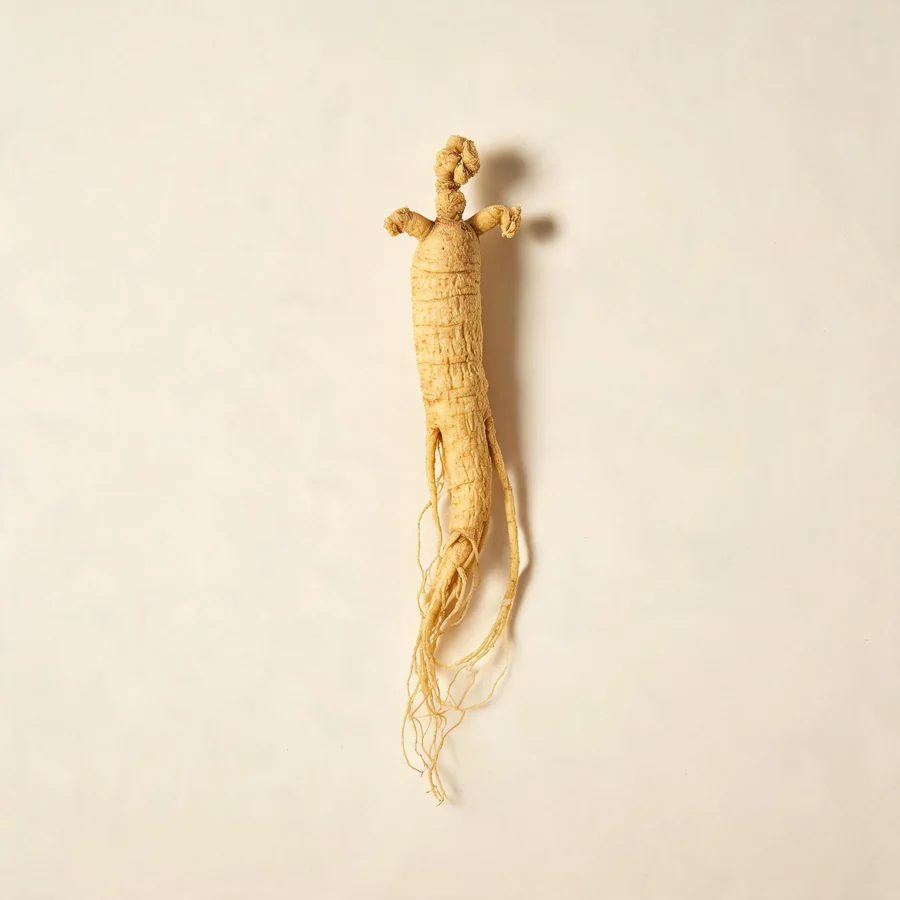
- Ginseng Radix et Rhizoma monograph: Pharmacopoeia of the People's Republic of China - accepted botanical source, part used and quality requirements.
- Modern safety statement: based on published randomised trial literature on Panax ginseng, summarised as a statement about tolerability rather than as a cited finding.
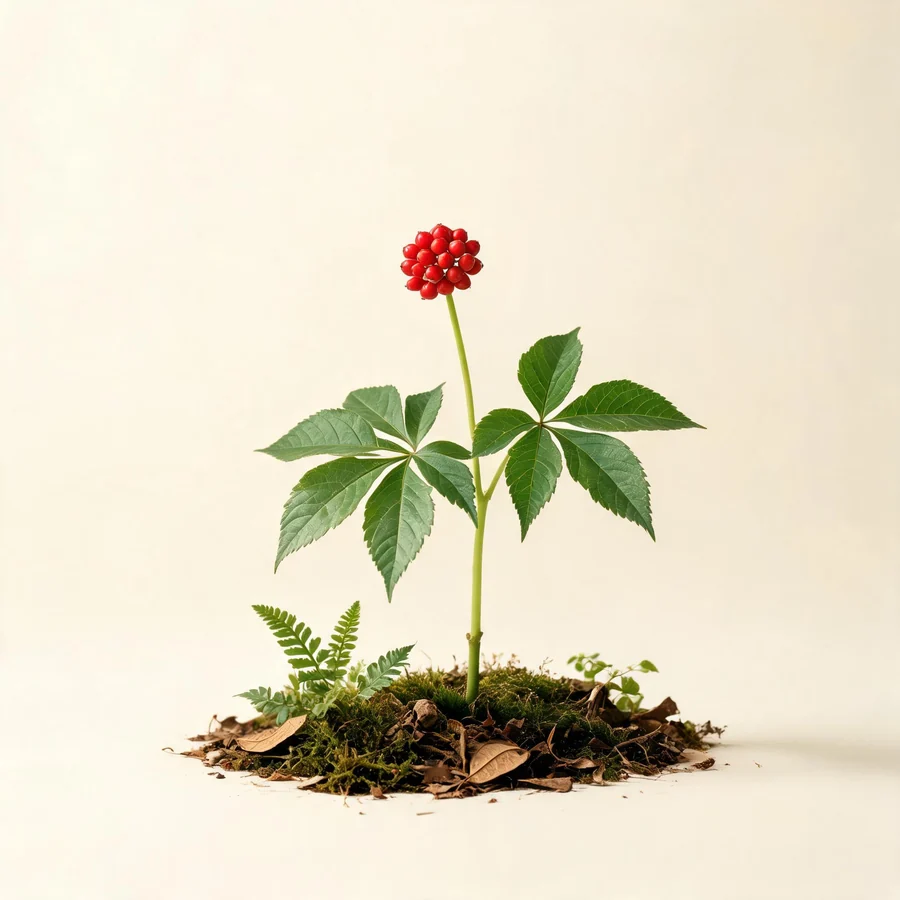
- Botanical description and identification: botanical literature on Panax ginseng, Araliaceae.
Educational reference for qualified practitioners. This page is not medical advice, and skin conditions should be diagnosed by a clinician before treatment.