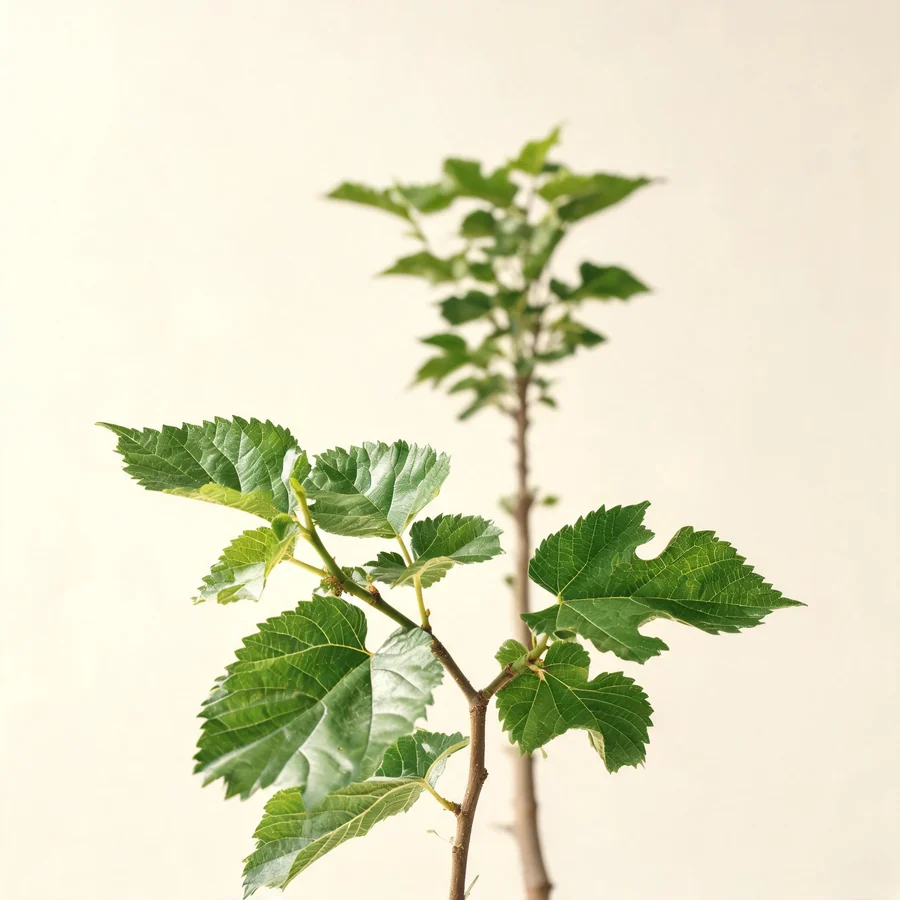
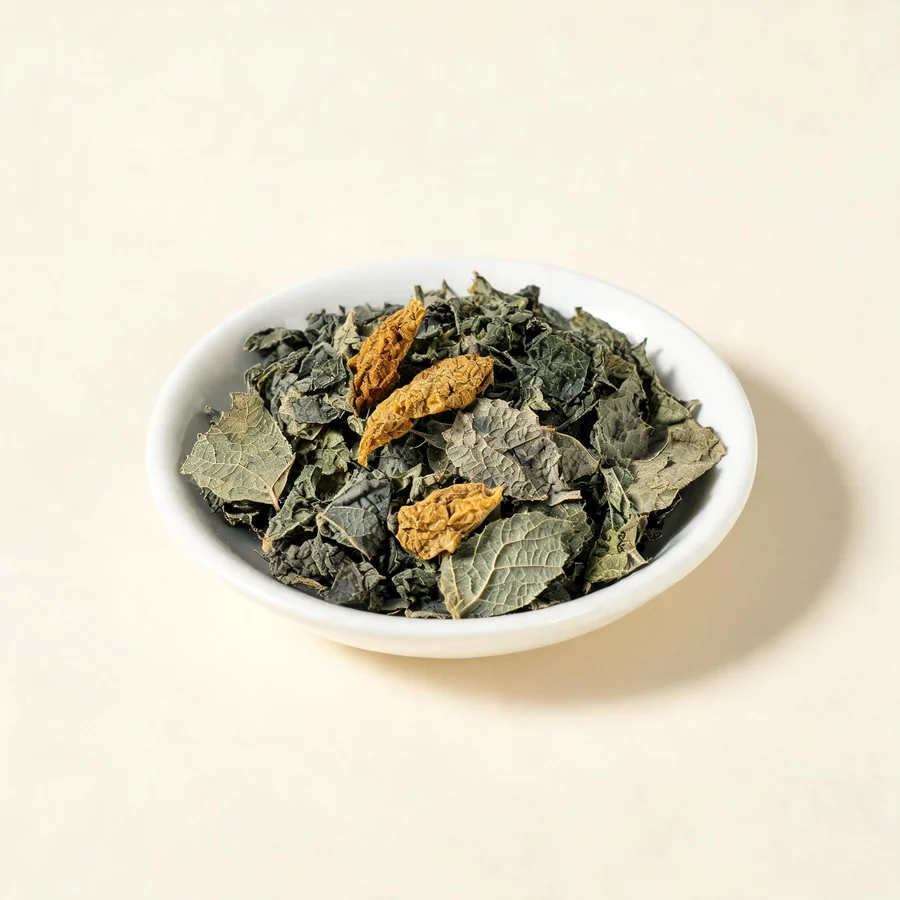
Skin profile
Where this herb sits in skin practice: the pattern it corrects, the skin signs it suits, and what it should not be used for.
Sang Ye is a light surface herb, and its skin use is limited to pictures that are moving and hot: wheals, early rashes, a hot dry itch and an irritable scalp. It is a support in a formula and a rinse rather than a leading treatment for any skin disease.
Skin signs that suggest it
- Itchy red wheals that appear suddenly, move about and fade within hours (wind-heat)
- A fine red rash arriving with a sore throat, feverishness and red, watering eyes
- Dry, hot, itchy skin in autumn or after a fever, rough but not weeping
- A red, itchy scalp with flaking, worse after heat or a hot shower
- Facial heat and red eyes alongside the skin complaint (Liver fire rising)
When it is not the right herb
Not for wind-cold: chills, body aches, a clear runny nose and pale wheals are the opposite temperature. Not for the dry, lichenified eczema of blood deficiency with no wind-heat, where the surface is already thin and dispersing empties it further. Not for weeping, crusted or infected skin. The leaf is cold, so it is used with care where the digestion is weak, and a rash with fever or mucosal involvement needs medical assessment rather than a rinse.
What it does for skin
Skin-relevant actions only. Each one describes a mechanism in TCM terms and what it looks like on the skin.
Lifts wind-heat off the surface
Wind-heat on the skin is read as something that arrives suddenly and moves: wheals that come up in one place and fade in another, itch that shifts, a rash that spreads quickly and is worse for warmth. Sang Ye is light and cold, and it opens the surface just enough to let that combination out. It is a mild disperser compared with mint, which is why it is chosen for a child, an elderly person or a first-day picture rather than a florid one.
Cools heat that is drying the skin
The leaf clears heat from the Lung, and in the tradition the Lung governs the skin. Where heat has dried the surface rather than inflamed it, the skin is rough, tight and itchy, often in autumn or after a fever, and a moistening coolness is what is wanted. Sang Ye supplies that without the heaviness of a mineral or a rich tonic, and the honey-fried form is used when dryness leads.
Cools the Blood and settles flushing
The Liver channel entry explains the effect on the head and eyes: heat that rises produces a flushed face, red eyes, headache and a scalp that itches and flakes. The Qing summary of its actions names a blood-cooling effect, which is the basis for using the leaf where heat is producing small bleeds or a red, hot surface rather than a weeping one. At leaf strength the action is modest and is used as a support.
Settles itch that rises to the scalp
Mulberry leaf has a long history in hair and scalp preparations, and the property recorded for it is encouraging hair growth, which in practice means it was used on the scalp as a rinse. Cool, light and slightly bitter, it reduces the heat and oiliness that make a scalp itch and flake. It is a support rather than a treatment: a scalp that is inflamed, broken or losing hair in patches needs a diagnosis.
Skin conditions it is used for
Mapped to the condition pages on this site. The pattern column shows what the skin is doing when this herb is the right choice.
| Condition | Pattern | Why it suits | Typical setting |
|---|---|---|---|
| Urticaria | Wind-heat wheals, red and provoked by warmth | The classic picture for the leaf: wheals that appear within minutes, itch intensely, are red rather than pale, and fade without leaving a mark. The herb disperses the wind and cools the heat together, and it is paired with other herbs that do the same. Antihistamines remain the treatment for an attack, and a wheal that swells the lips, tongue or throat is an emergency. | Sang Ye with Fang Feng and Chan Tui in a wind-heat formula |
| Chronic urticaria | Recurring wheals on a background of depleted blood and yin | Where wheals keep returning, the tradition stops chasing the trigger and looks at what is holding the surface. The leaf has a smaller role here: it clears the wind and heat that remain while enriching herbs rebuild the blood and yin that anchor the surface. It is not given alone for months, and a recurring eruption with fever, joint pain or breathlessness is investigated rather than treated at home. | Sang Ye with Hei Zhi Ma and Bai Shao in a blood-nourishing formula |
| Itchy skin | Itch from wind-heat, or from dryness with mild heat | The leaf suits two itchy pictures and not others. In wind-heat the itch moves and the skin is red but unbroken; in dryness with mild heat the surface is rough and hot but not weeping. It is not the herb for the thick, lichenified itch of long-standing eczema or for the itch of thin elderly skin, where dispersal takes away what little holds the surface together. | Sang Ye with Ju Hua and Bai Xian Pi, or with Hei Zhi Ma for dry itch |
| Skin rashes | An early hot rash with sore throat and red eyes | A rash that arrives with the first day or two of a febrile illness, red and fine, with a sore throat and watering eyes, is wind-heat on the surface. The leaf is used to lift it outward and cool it, gently enough for a child. A rash with fever that does not settle, blistering, or lesions in the mouth and eyes needs urgent assessment and is not a case for a leaf tea. | Sang Ye with Ju Hua and Lian Qiao in a wind-heat formula |
| Dandruff | Heat and oiliness on the scalp with flaking | The scalp is the part of the skin where the leaf is most often used, as a rinse after washing. Its cooling and light drying reduce the heat that drives oiliness and flaking, and the hair use recorded for it belongs here. Greasy yellow scale with redness at the hairline is a different, damp-heat picture that needs a drying herb as well, and a scalp that is broken or weeping is not a rinse case. | A cooled Sang Ye rinse, or with Ku Shen in a scalp wash |
Combinations for skin
Herbs it is paired with when the skin, not an internal organ, is the target.
| Partner | Ratio | Why the pair is used |
|---|---|---|
| Ju Hua | 6 to 10 g each in a decoction | Two cold, light leaves that both enter the Lung and the Liver, which is why they are the standard pair for wind-heat with headache and sore eyes. On the skin they suit a hot rash or an itchy scalp with facial flushing and red eyes, where the heat is clearly in the upper body. Chrysanthemum is the stronger at settling rising Yang and mulberry leaf the stronger at moistening dryness. |
| Fang Feng | 6 to 10 g Sang Ye with 6 to 10 g Fang Feng | Fang Feng releases wind from the surface and is the herb for itch that moves from place to place, while Sang Ye cools the heat underneath it. The pair is the backbone of a wind-heat urticaria formula. Fang Feng is warm and drying, so the proportion of the cold leaf is increased when the skin is dry. |
| Chan Tui | 6 to 10 g Sang Ye with 3 to 6 g Chan Tui | Chan Tui vents wind and clears heat from the head and eyes, and it is used where itch and redness are concentrated there. With Sang Ye it addresses a rash or wheals that come with red, watering eyes and a hot face. Both are light herbs, so the pair does not carry a severe picture on its own and sits inside a larger formula. |
| Hei Zhi Ma | 9 g Sang Ye with 9 to 15 g Hei Zhi Ma | One herb clears what has gathered above and the other rebuilds what is depleted below, which is why the pair is used for dry, itchy skin and dry eyes on a background of blood and yin deficiency. The leaf is the branch treatment and the seed the root treatment. In established depletion the seed leads and the leaf is a minor assistant. |
Topical use
The leaf is used on the skin as a cooled decoction, mostly on the scalp and on hot, itchy patches. It is a light preparation made from a leaf that is also drunk as a tea, and it is expected to cool and settle rather than to treat an infection. A rinse is the practical form for the scalp, and a compress is used where a patch of skin is hot and itchy.
| Preparation | How and when it is used |
|---|---|
| Scalp rinse | 20 to 30 g of dried leaf is simmered in a litre of water for 15 minutes, strained and cooled to a comfortable temperature. It is poured over the scalp after washing, left for a minute or two and rinsed, once daily or every other day, and kept out of the eyes. |
| Cooled compress for hot, itchy skin | 10 to 15 g of leaf to 500 ml of water, simmered for 10 minutes and cooled, is used to soak gauze for a 10 minute compress on a hot, itchy patch. It is made fresh, used on intact skin, and stopped if the area stings or reddens further. |
Patch test and cautions
The leaf is mild, but a wash is still a new exposure: patch test on the inner arm for 24 hours. Do not apply to broken, weeping or infected skin, keep it out of the eyes, and do not seal a compress under an airtight dressing. Stop if the skin becomes more irritated rather than calmer, and do not use a rinse on a scalp that is already inflamed or broken without advice.
Safety for skin use
What to check before recommending or using it, including the cautions that matter most for skin patients.
Do not use, or use with caution
- Wind-cold at the surface, with chills, body aches, a clear runny nose and pale wheals. A cold dispersing leaf deepens the chill and does not touch that pattern.
- Cold and weak digestion, with loose stools, a poor appetite and a cold abdomen. The leaf is cold and slightly bitter, and a long course further depresses digestion.
- Dry, lichenified, chronic eczema of blood and yin deficiency, where there is no wind-heat left to disperse. The surface is already thin, and dispersing it removes what little holds it.
- Known allergy to mulberry or other Moraceae pollen, and a history of contact reaction to a leaf or herb wash. The first rinse is a patch test on a small area.
Pregnancy and breastfeeding
Ordinary decoction doses are treated as safe. The leaf is mild, non-toxic and has food status; nothing in the tradition forbids it in pregnancy, and no uterine stimulation or fetal harm has been reported. Coldness is the one reservation, so it is used sparingly and with more care where the woman feels the cold or passes loose stools, and a qualified practitioner sets the dose as for any herb in pregnancy. Nothing specific is documented for breastfeeding either; the leaf has been drunk as a beverage for centuries, but a large or long-continued intake might in theory unsettle digestion, so ordinary amounts are used and the baby's stools watched.
Interactions
- Acarbose and other alpha-glucosidase inhibitors. The leaf inhibits the same intestinal enzyme, so it may add to the glucose-lowering effect and to the wind, bloating and loose stool that this drug class produces.
- Metformin. One animal study found that a leaf extract increased metformin's glucose-lowering action and delayed its removal by inhibiting a kidney transporter. One experiment of this kind cannot show harm in people, but it is a reason to tell the prescriber and to keep the intake steady.
- Insulin and sulfonylureas. Because the leaf lowers glucose in laboratory and animal work, the combination can in theory go too far; shakiness, sweating or hunger are reasons to test rather than to take more.
Allergy and patch testing
Mulberry pollen allergy and a contact reaction to the leaf are both possible, and a rinse is the form most likely to provoke one. Patch test on the inner arm for 24 hours, keep the first area small, and stop at once if the skin becomes more irritated rather than calmer. People who react to other Moraceae, including figs, are the ones most likely to react here.
General safety references
General references for herbal hepatotoxicity and herb-drug interactions; they are not specific to this herb.
- Review article: Herbal hepatotoxicity - an update on traditional Chinese medicine preparations. Alimentary Pharmacology & Therapeutics, 2014. PMID: 24844799.
- Interactions between herbal medicines and prescribed drugs: an updated systematic review. Drugs, 2009. PMID: 19719333.
- Warfarin and food, herbal or dietary supplement interactions: a systematic review. British Journal of Clinical Pharmacology, 2021. PMID: 32478963.
Evidence
The classical record is quoted with its source. The modern note states the level of evidence plainly.
Classical record
Mulberry leaf resolves alternating chill and fever and opens the pores to sweat.
Shen Nong Ben Cao Jing (Divine Husbandman's Classic of Materia Medica) - The first use on record, and the exterior-releasing action still rests on it; that is also what carries the leaf into rashes arriving with a cold.
Mulberry leaf belongs to the yangming channels of hand and foot. Boiled and drunk as a tea, its juice can stop wasting and thirsting. It treats cough from consumptive heat, brightens the eyes and encourages the growth of hair.
Ben Cao Gang Mu (Compendium of Materia Medica), Li Shizhen - Li Shizhen adds the eye and hair uses to the older record, which is how the leaf came into scalp washes and head preparations.
It moistens dryness, cools the Blood and halts bleeding.
Ben Cao Cong Xin (New Compilation of Materia Medica) - Qing dynasty writing that states the blood-cooling action outright, which is the ground for using the leaf where heat brings flushing and small bleeds.
Modern evidence
Evidence status
- Laboratory work on 1-deoxynojirimycin and other constituents of the leaf reports inhibition of intestinal alpha-glucosidase, along with antioxidant and anti-inflammatory activity in cell and animal models. None of it is a skin study, and none of it shows an effect on wheals or itch in people.
- No dermatological trial of mulberry leaf was identified. It appears in the literature as a tea and a glucose-lowering agent, and its skin use rests on the classical record and on scalp-wash tradition rather than on trial evidence.
- Safety position: the leaf carries a non-toxic classification and has official status as both food and drug in China. One old materia medica called it slightly toxic, which current classification does not accept, and an animal study at an enormous dose reported mild anaemia, far beyond anything a decoction supplies.
PubMed records
Selected real PubMed records for this herb's species or its constituents, chosen by species name and title relevance. They are references for the non-TCM discussion above, not proof that the herb treats any skin condition.
- Prenylated phenolics from Morus alba against MRSA infections as a strategy for wound healing.. Frontiers in pharmacology, 2022. PMID: 36532741 (skin-related record).
Dose and forms
Skin-practice dosing and the preparations that suit skin complaints.
| Form | Dose and notes |
|---|---|
| Decoction (internal) | 5 to 10 g of dried leaf daily in a formula, 5 to 6 g where the aim is only a light release of the surface, and 10 to 15 g under supervision where dryness is marked. |
| Leaf tea | 3 to 5 g of dried leaf steeped in hot water for five minutes, one or two cups a day for a short stretch. It is a beverage as much as a medicine, and it is stopped if the stools loosen. |
| Scalp or skin wash | 20 to 30 g simmered in a litre of water and cooled, used as a scalp rinse or a compress once daily for a hot, itchy surface. |
| Course length | One to two weeks, with review. The leaf is a surface herb and is not continued once the wheals or the itch have settled. |
Raw leaf is the dispersing, Liver-clearing form, and it is the one for hot itchy wheals and a red scalp. Frying it with honey makes it moister and slightly warmer, so the fried form goes where dryness leads: a dry hot itch calls for it, while a red wheal that moves about calls for the raw. Being light and aromatic, the leaf goes in once the decoction has been simmering for a while rather than at the outset.
Citations and further reading
Only real sources are listed: the classical materia medica passages quoted above, and the source works behind the botanical and safety statements.
- Shen Nong Ben Cao Jing (Divine Husbandman's Classic of Materia Medica), attributed compilation of the Han period - classical entry quoted above.
- Ben Cao Gang Mu (Compendium of Materia Medica), Li Shizhen, 1578 - classical entry quoted above.
- Ben Cao Cong Xin (New Compilation of Materia Medica), Qing dynasty - classical entry quoted above.
- Sang Ye monograph, Folium Mori: Pharmacopoeia of the People's Republic of China - source for the accepted botanical source, the part used and quality requirements.
- Modern evidence statement: based on laboratory literature on 1-deoxynojirimycin, Morus alba leaf and its glucose-lowering work, framed as a statement about the level of evidence rather than as a cited finding.
- Botanical description and identification: botanical literature on Morus alba, Moraceae.
Educational reference for qualified practitioners. This page is not medical advice, and skin conditions should be diagnosed by a clinician before treatment.