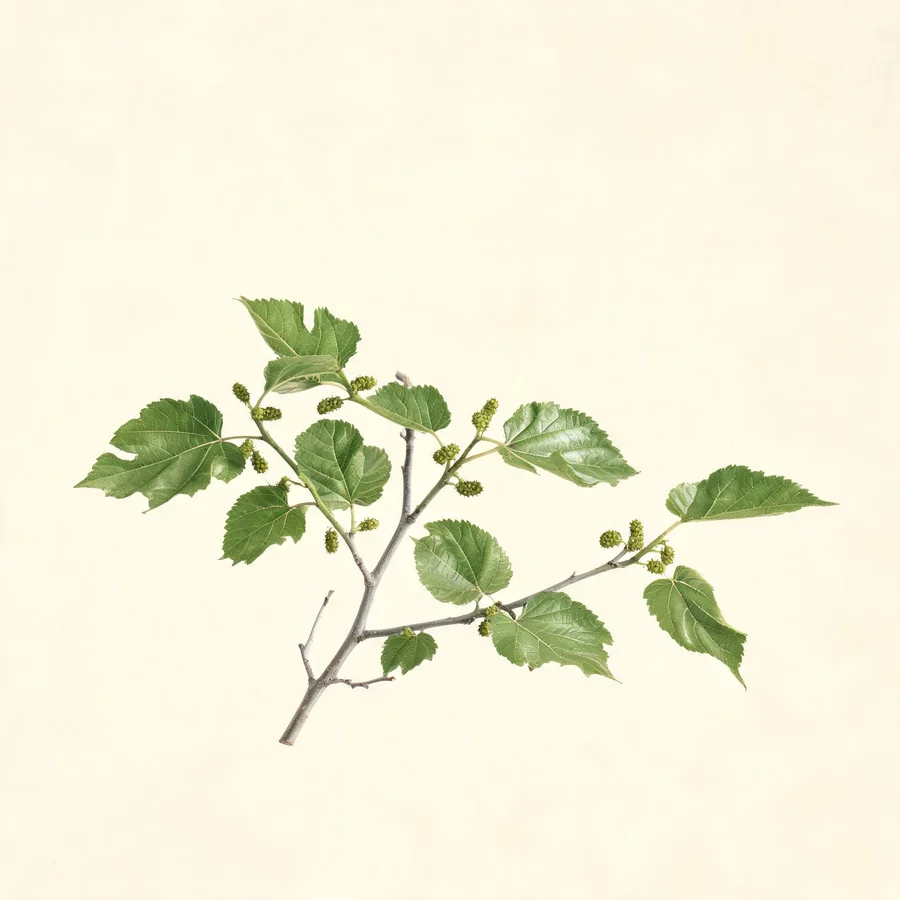
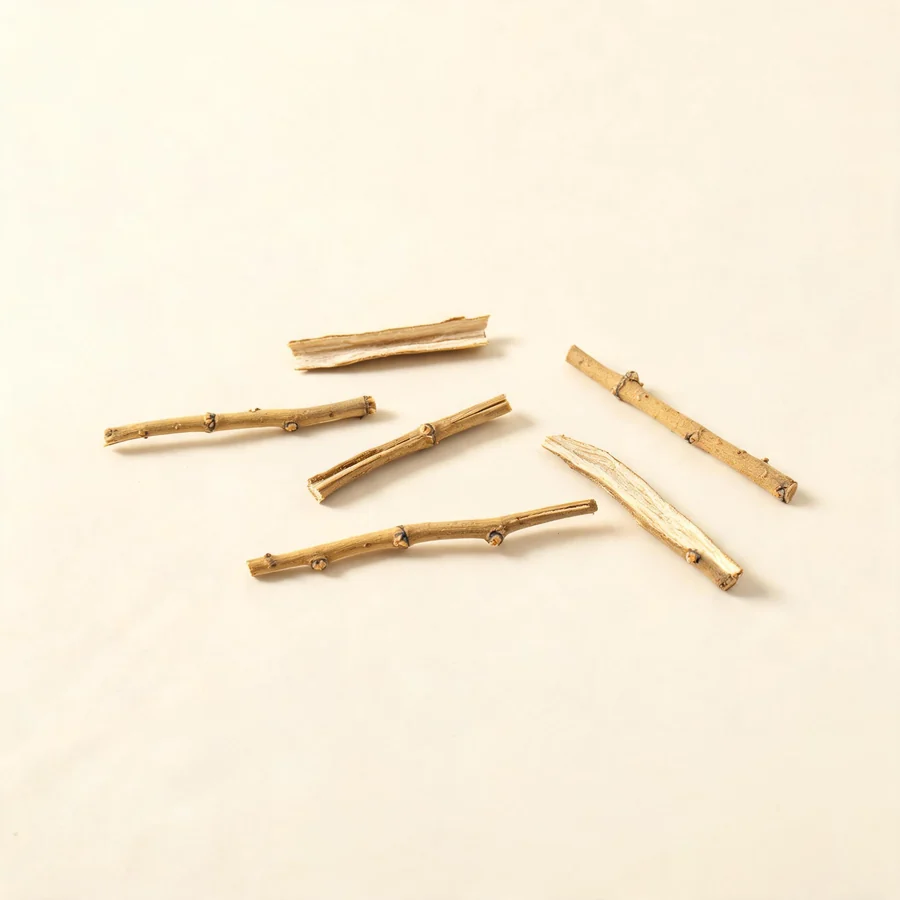
Skin profile
Where this herb sits in skin practice: the pattern it corrects, the skin signs it suits, and what it should not be used for.
Skin signs that suggest it
- Itching that moves around the body and is worse in damp or humid weather
- Dry, rough, thickened or lichenified skin with a dull, heavy ache in the limbs
- Wheals or a faint rash that come with heaviness, swelling and a sense of dampness
- Numbness, tingling or a dead feeling in the fingers and toes, with cool, sluggish skin
- A normal or pale tongue with a greasy coating, and no strong heat or cold signs
When it is not the right herb
Not for dryness that arises from thin Blood or from depleted Yin. Where the skin is dry because there is too little substance to hold it, a herb that disperses wind and drains dampness has nothing to remove and can leave the surface drier. It is also wrong for a hot, weeping, spreading lesion, which needs cooling and drying herbs rather than a neutral twig, and it is too mild to be the main herb for a severe flare. A deficiency of the Spleen and Stomach with loose stools is a further caution, because its bitter draining quality burdens a weak digestion.
What it does for skin
Skin-relevant actions only. Each one describes a mechanism in TCM terms and what it looks like on the skin.
Dispels wind-damp from the surface so itch settles
Wind-damp itch is worse in humid weather, moves about, and often comes with a heavy, swollen feeling in the limbs. Sang Zhi reaches the channels where that dampness lodges and disperses it, and the itch reduces as the surface dries. It is a gentle action, suited to a subacute or lingering itch rather than to an acute fiery eruption.
Treats generalised itching and dryness, internally and as a wash
The Song pharmacopoeia records the twig for itching and dryness over the whole body, and a later commentary lists it with other twigs in a wash for generalised itch. In practice that means a decoction taken internally for a widespread itch, and a stronger decoction used as a wash or a soak for the same problem. The two routes are used together for a stubborn itch that covers a large area.
Opens the collaterals so thickened, sluggish skin improves
Where the skin is lichenified, dusky and slow, the fine vessels that feed it are held to be obstructed. The twig opens them and is paired with a herb that moves blood, since on its own it clears obstruction without supplying the Blood. This is the reasoning behind its use in chronic rubbed and thickened patches.
Adds a neutral channel herb to a formula of any temperature
Because it is neither warm nor cold, the twig can be added to a cooling formula for a hot flare or a warming one for a cold, stiff limb without altering the direction of the prescription. That neutrality, plus its mildness, is why it can be continued for longer than the stronger wind-damp herbs.
Skin conditions it is used for
Mapped to the condition pages on this site. The pattern column shows what the skin is doing when this herb is the right choice.
| Condition | Pattern | Why it suits | Typical setting |
|---|---|---|---|
| Itchy Skin | Wind-damp with dryness, itching worse in humid weather | Generalised itch with a heavy, damp quality and no strong heat signs is the pattern the twig was recorded for. It is used internally and as a wash, often with herbs that move blood, and the itch usually settles slowly over weeks. A new, severe or generalised itch still needs a diagnosis, because the causes range far beyond wind-damp. | Sang Zhi with Ji Xue Teng and Fang Feng, plus a stronger decoction as a wash |
| Skin Dryness | Wind-damp with dryness: rough, itchy, thickened skin | The classical entry couples itching with dryness over the whole body, which describes skin that is dry and rough yet itchy and heavy rather than simply thin. The twig addresses the wind and dampness component and is combined with a blood-nourishing herb so that the dryness is treated as well. It is not a substitute for that nourishing herb in a person with clear blood deficiency. | With Dang Gui and Ji Xue Teng in a decoction, plus a twig wash |
| Urticaria | Wind-damp on the surface, wheals with heaviness and no strong heat or cold | Wheals that come with a heavy, damp feeling and settle slowly are read as wind-damp on the surface, and the neutral twig can be added to a wind-releasing formula without adding heat or cold. It is a supporting herb rather than the leading one, and it is most useful in the lingering, recurrent pattern. Acute swelling of the lips, tongue or throat is an emergency and has nothing to do with this approach. | Within a wind-releasing formula with Fang Feng and Jing Jie |
| Neurodermatitis | Blood stasis with wind-damp: lichenified, thickened, deeply itchy plaques | Long rubbing and scratching produces thickened, leathery plaques with fixed itch, which the tradition reads as wind-damp plus blood stasis. The twig opens the collaterals while a blood-moving partner addresses the stasis, and the pair is used for the chronic plaque rather than the acute flare. It is slow, and it works best alongside measures that stop the scratching. | With Ji Xue Teng, Dan Shen and Bai Xian Pi |
| Hand Eczema | Wind-damp with chronic dryness and thickening, no oozing | Chronic hand eczema that has become dry, cracked and thick, with itch but little ooze, suits a neutral wind-damp herb and a hand soak. The twig is used as a warm soak and internally, and it is combined with a blood-nourishing herb because the dryness is part of the picture. A wet, vesicular, weeping hand eczema is a different pattern and needs cooling, drying treatment instead. | A warm decoction soak with Sang Zhi, plus internal Ji Xue Teng and Dang Gui |
Combinations for skin
Herbs it is paired with when the skin, not an internal organ, is the target.
| Partner | Ratio | Why the pair is used |
|---|---|---|
| Gui Zhi | 9 to 15 g Sang Zhi with 6 to 10 g Gui Zhi | Gui Zhi warms the channels and moves Blood while the neutral twig disperses wind-damp and reaches the joints. The pair is recorded for a painful shoulder and arm, and in skin practice it suits cold, stiff, itchy limbs with poor circulation. Gui Zhi supplies the warmth that the twig cannot. |
| Ji Xue Teng | 9 to 15 g each | Sang Zhi removes the obstruction while Ji Xue Teng feeds and moves the Blood, so the pathogen and the underlying thinness are treated together. It suits chronic itch with thickened, dusky skin and numbness, where treating the channels by itself would leave the Blood thin. Neither herb is harsh, so the pair can run for weeks. |
| Huai Zhi and Liu Zhi | 15 to 30 g of each twig for a wash | The classical multi-twig wash for itching over the whole body, recorded with sophora, willow and peach twig alongside the mulberry. The twigs are decocted together, strained and used warm as a wash or a bath for generalised itch. It is an external preparation, and the liquid is discarded after use. |
| Bai Xian Pi | 9 to 15 g Sang Zhi with 6 to 10 g Bai Xian Pi | Bai Xian Pi is the skin herb that clears wind-heat and quiets itch, and the neutral twig adds reach into the limbs and the collaterals. The pair is used for a widespread itch with a damp quality, internally and in a wash. Bai Xian Pi is the stronger of the two and the twig moderates the formula. |
Topical use
Sang Zhi is used externally as a warm decoction wash or soak, most often combined with other twigs. The classical setting is itching over the whole body, and the same preparation is used for a hand or foot that is itchy, dry and thickened. Washes are made fresh, strained well and used warm rather than hot, and they are discarded afterwards.
| Preparation | How and when it is used |
|---|---|
| Whole-body twig wash | 30 to 60 g of dried twig, or a mix of mulberry, sophora, willow and peach twig, simmered in 2 litres of water for 20 minutes, strained and used warm as a wash or a shallow bath. Ten to fifteen minutes is enough, and the skin is patted dry rather than rubbed. |
| Hand or foot soak | A stronger decoction in a basin, used warm for 10 to 15 minutes once or twice daily for itchy, dry, thickened skin on the hands or feet. The liquid is discarded after each use and the basin is cleaned. |
| Cooled compress | For a smaller itchy area, gauze soaked in the strained, cooled decoction is laid on for 10 minutes. This is the mildest form and is used where a full soak is impractical. |
Patch test and cautions
Patch test a small area first, keep the liquid away from the eyes and broken skin, and stop if the skin stings, reddens or swells. Use warm rather than hot water, do not add strong essential oils, and do not share towels or basins where the itch may be infective until a diagnosis is clear.
Safety for skin use
What to check before recommending or using it, including the cautions that matter most for skin patients.
Do not use, or use with caution
- A cold, weak Spleen and Stomach, with loose bowels, little appetite and a chilly abdomen. A bitter, draining twig burdens a digestion that is already weak, and the stool loosens further.
- Dryness or itch from blood deficiency or depleted Yin. There is no wind-damp to disperse, and the drying quality can leave the skin rougher than before.
- Pregnancy: classical sources advise against the herb, with one text warning that excess may cause nosebleeds. No toxic mechanism has been identified, so the position is precautionary, and use would be short and supervised.
- An acute hot, weeping or spreading skin lesion. The twig is too mild and too neutral for active heat, and delay in using a cooling treatment lets the flare extend.
Pregnancy and breastfeeding
The classical sources advise against it rather than forbidding it outright, and the caution in the Ben Cao Sheng Chang concerns excess rather than proven harm. No toxic mechanism is known and the herb is gentle, so the position is precautionary: a practitioner who judged the indication clear would give a short, supervised course rather than routine treatment. While breastfeeding, no specific classical or modern warning exists and nothing has been recorded about transfer into milk, though formal studies in lactating women are lacking; a short course at ordinary doses is the usual compromise.
Interactions
- No well-documented drug interaction has been established at decoction doses, so any caution is theoretical and drawn from constituents. In the laboratory, mulberry twig alkaloids block alpha-glucosidase, the same target as acarbose, so an additive action with oral diabetes drugs or insulin is plausible. Blood glucose deserves closer watching at the start.
- The second concern is blood pressure. Both classical and modern reports describe a fall, so somebody already taking antihypertensives may drop further, with light-headedness on standing as the practical sign. No trial of the twig in people supports either caution, and the herb is no substitute for those medicines.
- A wash used alongside a prescribed topical treatment should be applied at a different time of day, and the skin allowed to dry fully before the prescribed product goes on. On broken skin the absorption of anything dissolved in the wash is greater, which is a reason to keep the preparation simple.
Allergy and patch testing
Reactions to mulberry twig are uncommon, but a warm wash can irritate skin that is already inflamed, and a reaction is often to a herb added to the wash rather than to the twig. Patch test a small area of normal skin for 24 hours, keep the preparation simple, and stop if there is stinging, redness or swelling. Pollen allergy to mulberry is reported, and a person with that history should be cautious with the first use.
General safety references
General references for herbal hepatotoxicity and herb-drug interactions; they are not specific to this herb.
- Review article: Herbal hepatotoxicity - an update on traditional Chinese medicine preparations. Alimentary Pharmacology & Therapeutics, 2014. PMID: 24844799.
- Interactions between herbal medicines and prescribed drugs: an updated systematic review. Drugs, 2009. PMID: 19719333.
- Warfarin and food, herbal or dietary supplement interactions: a systematic review. British Journal of Clinical Pharmacology, 2021. PMID: 32478963.
Evidence
The classical record is quoted with its source. The modern note states the level of evidence plainly.
Classical record
桑枝,平,不冷不热,可以常服。疗遍体风痒干燥,脚气风气,四肢拘挛……利小便。
The twig is neutral, neither cold nor hot, and can be taken over long periods. It treats generalised itching and dryness of the body, leg Qi and wind conditions, cramping of the four limbs, and it promotes urination.
Tu Jing Ben Cao (Illustrated Classic of Materia Medica) - The first full entry for the twig, and the sentence that gives the herb its skin use: itching and dryness over the whole body, from a herb mild enough to take for a long time.
功专去风湿拘挛,得桂枝治肩臂痹痛;得槐枝、柳枝、桃枝洗遍身痒。
Its work is to remove wind-dampness and relieve spasm; with Gui Zhi it treats painful obstruction of the shoulder and arm, and with Huai Zhi, Liu Zhi and Tao Zhi as a wash it treats itching over the whole body.
Ben Cao Cuo Yao (Essentials of Materia Medica) - The clearest statement of the multi-twig wash, and the source of the external preparation still used for generalised itch.
痈疽后渴,用嫩条细切一升,熬香煎饮,亦无禁忌。久服,终身不患偏风。
For thirst after a sore or abscess, finely slice a measure of tender twigs, toast until fragrant and decoct as a drink; there is nothing to forbid it. Taken over years it is said to prevent hemiplegia for life.
Ben Cao Gang Mu (Compendium of Materia Medica), Li Shizhen - Li Shizhen's entry ties the twig to recovery after sores, and adds the long-use claim that kept it in the household medicine cupboard.
利关节,养津液,行水祛风。
It benefits the joints, nourishes the body fluids, moves water and dispels wind.
Ben Cao Bei Yao (Essentials of Materia Medica) - Four actions in eight characters; the fluid action explains why a drying-looking twig is used where the skin is dry.
Modern evidence
Evidence status
- No clinical trial of Sang Zhi in itch, eczema or any other skin condition was identified. The skin uses described here are traditional, and the modern research on the twig has been directed at blood sugar rather than at the skin.
- Laboratory work reports that mulberry twig constituents inhibit alpha-glucosidase and show antioxidant and anti-inflammatory activity in cell and animal models. Those findings are metabolic and biochemical, and they do not predict an effect on itching.
- A medicine licensed in China in 2020 for type 2 diabetes was developed from the twig. That is a metabolic indication and should not be read across to skin disease, where the evidence remains traditional.
PubMed records
Selected real PubMed records for this herb's species or its constituents, chosen by species name and title relevance. They are references for the non-TCM discussion above, not proof that the herb treats any skin condition.
- Prenylated phenolics from Morus alba against MRSA infections as a strategy for wound healing.. Frontiers in pharmacology, 2022. PMID: 36532741 (skin-related record).
Dose and forms
Skin-practice dosing and the preparations that suit skin complaints.
| Form | Dose and notes |
|---|---|
| Decoction | 9 to 15 g of dried young twig daily in a formula for skin-related wind-damp itch. Cut slices give up more than whole segments, and the twig needs no special handling in the pot. |
| Higher range | 15 to 30 g is used for severe itch, thickening or numbness, and larger quantities go into an external wash rather than a drink. A few classical texts mention as much as 60 g for washing, which is not a dose to swallow. |
| External wash | 30 to 60 g simmered in 2 litres of water for 20 minutes, strained and used warm as a wash, soak or shallow bath once or twice daily, then discarded. |
A gentle herb needs only a modest dose: nine to fifteen grams is enough for most of the itch and channel work, and anything above that reflects how obstructed the channels are rather than a wish for speed. What matters most is the difference between what is drunk and what is used in a wash, since the external amounts are several times larger and are never swallowed. In skin practice the twig is usually paired with a herb that nourishes Blood, because by itself it clears obstruction without supplying substance.
Citations and further reading
Only real sources are listed: the classical materia medica passages quoted above, and the source works behind the botanical and safety statements.
- Tu Jing Ben Cao (Illustrated Classic of Materia Medica), Song dynasty - the entry on the twig is quoted above.
- Ben Cao Cuo Yao (Essentials of Materia Medica), Qing dynasty - the passage on the twig pairs and the wash is quoted above.
- Ben Cao Gang Mu (Compendium of Materia Medica), Li Shizhen, 1578 - the entry on sores and thirst is quoted above.
- Ben Cao Bei Yao (Essentials of Materia Medica), Qing dynasty - the eight-character summary is quoted above.
- Pharmacopoeia of the People's Republic of China, Ramulus Mori monograph - source for the accepted species and part used.
- Modern evidence statement: laboratory literature on mulberry twig alkaloids, summarised as a statement about the level of evidence rather than as a cited finding.
Educational reference for qualified practitioners. This page is not medical advice, and skin conditions should be diagnosed by a clinician before treatment.