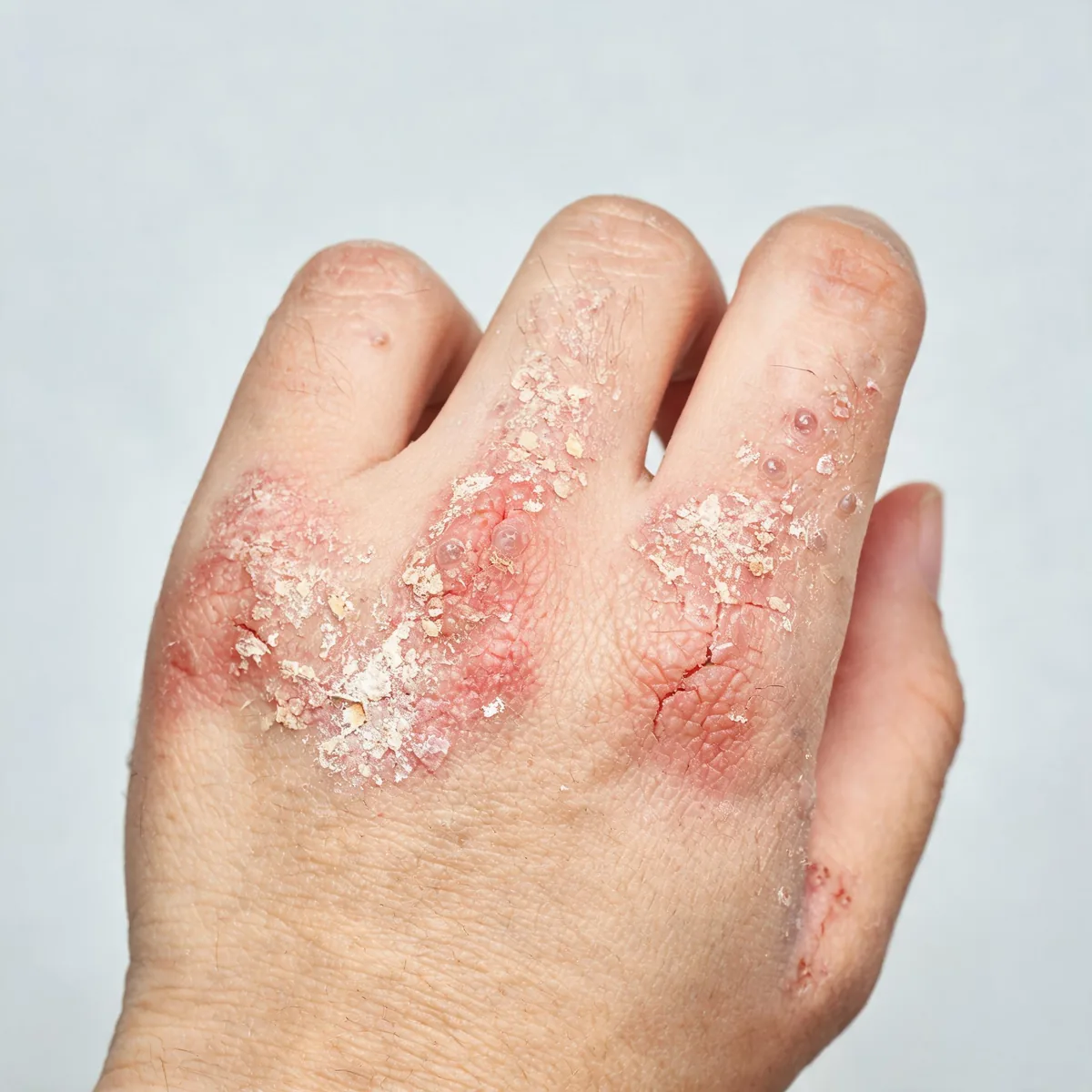
Understanding Hand eczema
The tradition describes hand eczema as involving a web of organs: the Lungs which govern the skin, the Spleen which manages fluids, and the Liver which stores Blood.
Damp-Heat gives weeping oozing blisters with intense burning itch, red swollen skin, a sticky bitter mouth, heaviness and loose stools. Spleen deficiency with dampness gives dull red scaly patches with less oozing, bloating, loose stools, fatigue and a pale swollen tongue with teeth marks.
Blood deficiency with external wind gives dry flaky cracked hands with itch worse at night, a pale complexion and dull brittle nails. Yin and Blood deficiency gives dry cracked fissured skin with intense itch worse at night or in dry weather, dry mouth, night sweats and warmth in the palms.
Blood Stagnation gives fixed stabbing pain in the hands with thickened lichenified cracked skin and purplish dark discolouration. Yang deficiency with cold-damp gives cold hands, pale skin-coloured lesions rather than red, and clear watery oozing - the picture of hands that cannot stay warm.
The classical literature builds the picture outward from the organs that supply the skin. The Lung governs the surface and the defensive Qi that holds it; the Spleen turns food into fluids and Blood; the Liver stores the Blood that keeps skin supple; the Kidney holds the Yin and Yang that decide whether the hands stay moist and warm. When any of those falter the skin is where the shortfall shows, which is why two people with the same rash may need opposite treatment.
The course of the illness moves between two poles. Acute, weeping flares are read as external Wind, Damp and Heat meeting Damp-Heat already brewing within, from a Spleen that is struggling, often after heavy wet work or a run of rich, spicy meals. Long-standing inflammation then consumes Blood and Yin, so the skin dries, cracks and thickens; the rash looks calmer but heals more slowly, because the reserves needed for repair have gone. Blood Stagnation and Yang Deficiency with Cold-Damp are the other chronic destinations, and the tradition describes both as later and less common stages.
Conventional view
Hand eczema is a chronic inflammatory condition of the skin of the hands, producing itching, redness, scaling, cracking and blisters in some cases. It usually reflects a mix of inherited susceptibility and repeated contact with irritants such as water, detergents and chemicals, or to allergens such as latex and nickel. A dermatologist usually makes the diagnosis from the appearance of the skin and the history of occupational and household exposure, and patch testing is used where a specific allergen is suspected.
Treatment starts with emollients that repair the skin barrier, together with avoidance of known irritants. Steroid creams are the mainstay for calming a flare, calcineurin inhibitors are used on sensitive areas, and severe or persistent cases may be offered phototherapy or systemic treatment with oral steroids, immunosuppressants or biologics.
The classical literature identifies two limits to this approach. Topical steroids calm acute inflammation without preventing the next flare, and use over years can thin the skin, while systemic drugs carry substantial side effects and are reserved for the worst cases. More fundamentally, conventional care treats all hand eczema as one process differing only in severity, so it does not allow that a weeping rash driven by wet work alongside a dry cracked rash that winter makes worse might each need a different strategy, which is exactly what TCM proposes.
Selected PubMed records
Real PubMed records for the conventional discussion above, selected by condition name and title relevance. They are references, not a claim that any treatment is proven for this condition.
- Guidelines for diagnosis, prevention, and treatment of hand eczema.. Contact dermatitis, 2022. PMID: 34971008.
- Hand eczema.. Lancet (London, England), 2024. PMID: 39615508.
- Topical Anti-Inflammatory Treatments for Eczema: A Cochrane Systematic Review and Network Meta-Analysis.. Clinical and experimental allergy : journal of the British Society for Allergy and Clinical Immunology, 2024. PMID: 39219446.
How it connects
Hand eczema rarely appears in isolation in TCM: it is often one piece of a larger atopic constitution. The same Spleen deficiency that fails to transform fluids into nourishing Blood instead generates Dampness, which can surface on the skin as eczema, in the nasal passages as rhinitis and in the lungs as asthma, which is why a personal or family history of these conditions is common. The connection is energetic as well as anatomical: the Lung governs the skin and Wei Qi, so weak Lung Qi leaves the skin vulnerable to external Wind and Dampness, while Kidney Yang deficiency can fail to warm the Spleen and perpetuate Dampness. Treating the root Spleen and Kidney patterns often improves the hands and the respiratory allergies together. The same constitution shows up elsewhere as allergic rhinitis, asthma and allergic conjunctivitis, and the tradition describes the pattern in seasonal terms as well: hands that flare during pollen season along with hay fever, or asthma that tightens when stress rises. The acute phase is usually read as Damp-Heat and the chronic phase as Spleen and Kidney deficiency, so a formula chosen for the hands is expected to ease the respiratory side too, and the practitioner asks about both when taking the history.
How it is assessed
The practitioner examines moisture, cracking and temperature, and asks about occupational exposure.
What a practitioner looks for
- Moisture: weeping blisters suggest Damp-Heat; dry fissures suggest Blood or Yin deficiency.
- Temperature: cold hands with pale lesions suggest Yang deficiency with cold damp.
- Thickening: lichenified dark skin with fixed pain suggests Blood stagnation.
- Red flags: infection with pain, warmth, pus or red streaks.
The classical literature starts from the skin and works inward. Whether the rash is red and weeping, dull and scaly, dry and cracked, or thick and leathery is the first division, and the timing of the itch sharpens it: itch that settles when the hands are warm and flares at night belongs with the dry patterns rather than the weeping ones. The tongue and pulse confirm the reading. Slippery and rapid with a red tongue under a yellow greasy coat supports Damp-Heat; soft or slippery-slow with a pale puffy tongue and a white sticky coat supports Spleen Deficiency with Dampness.
Chronic dryness then divides again. Rough, cracked, peeling skin with night itch and a pale tongue with a thin coat points to Blood Deficiency with External Wind, while fine cracks like a dried riverbed, a red tongue with little coat and thirst point to Yin and Blood Deficiency. Thick, leathery, purple-tinged skin with stabbing pain is read as Blood Stagnation, and cold hands with an aversion to cold and a pale tongue with white coat as Yang Deficiency with Cold-Damp. The classical literature notes that these last two usually appear only after years, and that mixed pictures are common.
TCM patterns in Hand eczema
The six patterns here are separated by three observations at the hands and two elsewhere. At the hands, moisture decides first: weeping blisters mean Damp-Heat, while dryness and cracking mean Blood or Yin deficiency. Colour and temperature decide next, because dull red scaly patches with cold tired limbs fit Spleen Deficiency with Dampness, pale skin-coloured lesions on cold hands belong to Yang Deficiency with Cold-Damp, and a dusky thickened cast points to Blood Stagnation. Away from the hands the practitioner reads digestion and rest: bloating with loose stools supports the Spleen, dizziness with brittle nails supports Blood Deficiency, and night sweats point to Yin Deficiency. Timing completes it, since itch that builds at night belongs to the dry patterns and burning that worsens with wet work belongs to Damp-Heat. Most people carry a mix, so surface and root are treated in turn.
| Pattern | Key signs | The itch | Tongue | Main formula |
|---|---|---|---|---|
| Damp-Heat | Weeping oozing blisters; Red swollen skin | Intense burning itch | Body: Red, often swollen with teeth marksCoat: Yellow, greasy and thick, usually in the middle and at the root | Not specified |
| Spleen Deficiency with Dampness | Dull red scaly patches on hands | Not specified | Body: Pale and swollen, often with teeth marks along the edgesCoat: White, greasy and moist, thick in the middle | Not specified |
| Blood Deficiency with External Wind | Dry flaky or cracked skin on hands | Itching worse at night | Body: Pale and thin, sometimes slightly dryCoat: Thin, white and a little dry | Not specified |
| Yin and Blood Deficiency | Dry cracked or fissured skin on hands; Dry mouth and thirst | Intense itch worse at night or in dry weather | Body: Pale to pale-red, thin, dry and crackedCoat: Scanty or peeled | Not specified |
| Blood Stagnation | Fixed stabbing pain in the hands; Pain worse at night | Not specified | Body: Purple, dusky or with dark stasis spots; sublingual veins dark and distendedCoat: Often thin white; a yellow coat would suggest Heat as the cause | Not specified |
| Yang Deficiency with Cold-Damp | Lesions pale or skin-coloured rather than red; Oozing of clear watery fluid | Not specified | Body: Pale, swollen and teeth-markedCoat: White, greasy and moist | Not specified |
Damp-Heat
Weeping oozing blisters with burning itch and a sticky mouth.
Damp-Heat is moisture and warmth trapped together under the skin. The tradition describes the Spleen failing to move fluids while Heat arrives from rich, spicy food or a hot constitution, and the two settle in the hands, where they inflame the tissue and produce red, swollen skin and blisters that weep. The itch is burning rather than merely irritating, and the accompanying signs are partly digestive: a bitter taste with a sticky mouth, heaviness and sluggishness, loose sticky stools. The tongue is red with a yellow greasy coat that is hard to scrape off and may be swollen with teeth marks, and the pulse is soggy and rapid, or slippery and rapid.
Wet work, humid weather, spicy and fried food, alcohol and emotional stress bring on a flare, while cold compresses, rest in a cool dry place, plain non-greasy meals and keeping the hands dry settle it. Long Dan Xie Gan Tang is the formula named, clearing Damp-Heat out of the Liver and Gallbladder channel and reducing oozing and redness. Long Dan Cao, Huang Qin and Ku Shen are its key herbs, the last chosen for itching. LI-11 Quchi and LI-4 Hegu clear Heat and disperse Wind from the hand, and SP-9 Yinlingquan drains Dampness from below.
Signs
- Weeping oozing blisters
- Intense burning itch
- Red swollen skin
- Bitter taste with sticky mouth
- Heaviness with loose stools
Diet and lifestyle for this pattern: Avoid alcohol and spicy, greasy and sweet food that generate Damp-Heat, and eat cooling, Dampness-draining food such as mung beans, cucumber and barley. Keep the hands dry without harsh soap, use a gentle moisturising cleanser, and manage stress with relaxation, since tension can aggravate the pattern.
Spleen Deficiency with Dampness
Dull red scaly patches with bloating and fatigue.
Here the Dampness comes from weakness rather than from excess. The Spleen cannot transform and transport fluids, so moisture accumulates and overflows to the skin, producing dull red papules and scaling rather than the angry weeping of Damp-Heat. Because deficiency sits at the root, the eczema lingers and worsens with fatigue or after a heavy meal that burdens the digestion. The classical literature pairs the skin with bloating and loose stools, fatigue and a heavy feeling in the limbs, and a tongue that is pale and swollen with teeth marks under a white greasy coat. The pulse is soggy and slow, sometimes slippery.
Cold, raw and greasy food weakens the Spleen further, as do overwork, damp weather, worry and long exposure to water, while warm cooked meals, rest, gentle exercise, a dry warm environment and warm drinks such as ginger tea relieve it. Wei Ling Tang strengthens the Spleen and drains Dampness, and Er Miao San is added when the Dampness is more pronounced. Bai Zhu, Fu Ling, Cang Zhu, Chen Pi and Yi Yi Ren form the herbal core. ST-36 Zusanli, SP-6 Sanyinjiao, SP-9 Yinlingquan and BL-20 Pishu are the points used to tonify the Spleen and move moisture out.
Signs
- Dull red scaly patches on hands
- Bloating and loose stools
- Fatigue with heaviness in the limbs
- Pale swollen tongue with teeth marks
Diet and lifestyle for this pattern: Eat warm cooked meals and avoid cold, raw or greasy food. Include barley, adzuki beans and ginger to help drain Dampness, keep the hands dry but away from harsh soap, using gentle moisturising cleansers instead, and take moderate exercise such as walking to move Qi and dry Dampness.
Blood Deficiency with External Wind
Dry flaky cracked hands with night itch.
Years of eczema consume Blood, and Blood is what keeps skin lubricated. The tradition describes the result as skin that has lost its moisture and become dry, flaky and brittle, and internal dryness then generates a kind of Wind that stirs outward and produces itching which wanders and grows worse while the body rests, especially at night. The associated signs are those of a Blood shortfall: a complexion that is pale or sallow, nails that are dull and brittle, dizziness or light-headedness. The tongue is pale and thin with a thin white, slightly dry coat, and the pulse is thin overall, a wiry quality showing at the left middle and a floating one at the right front.
Dry windy weather, stress, overwork, lost sleep, spicy or fried food, hot showers and harsh soaps all make the itch worse, while moisturising, rest, humid warmth and Blood-nourishing food make it better. Dang Gui Yin Zi is the classic choice, nourishing Blood, moistening dryness and dispelling Wind so that the itch settles. Dang Gui, Shu Di Huang, Bai Shao and Fang Feng are its key herbs. SP-10 Xuehai and SP-6 Sanyinjiao build Blood from the Spleen and Liver, while LI-11 Quchi and LI-4 Hegu treat the surface itch on the hands.
Signs
- Dry flaky or cracked skin on hands
- Itching worse at night
- Pale or sallow complexion
- Dull brittle nails
- Dizziness
Diet and lifestyle for this pattern: Eat regular meals with blood-nourishing food such as dark leafy greens, beetroot, black sesame, bone broth and moderate amounts of animal protein. Avoid drying habits such as very hot showers, harsh soap or long exposure to wind, moisturise the hands with a gentle fragrance-free cream, and wear gloves outdoors in cold dry weather.
Yin and Blood Deficiency
Dry fissured hands with intense night itch and sweats.
This is the deeper stage of the same drain. The tradition describes months or years of eczema consuming both Yin, the cooling and moistening substance, and Blood, so the hands become severely dry and thin and split into painful cracks. The shortfall also brings a mild internal heat that parches the skin further and shows as thirst, night sweats, warmth in palms and soles, and fatigue with a restless quality, and a pale or sallow complexion that may carry a malar flush. The tongue is pale-red, thin and dry with cracks and a scanty or peeled coat, and the pulse is fine and rapid.
Dry cold weather, hot water, spicy and fried food, stress and overwork deepen the deficiency, while a thick fragrance-free moisturiser, moistening food such as pears and congee, rest and a cool humid environment help. The classical literature names no single formula for this presentation, only a group of herbs: Dang Gui and Bai Shao to nourish Blood, the raw Rehmannia that cools Blood and nourishes Yin, and Xuan Shen to clear deficiency Heat. SP-6 Sanyinjiao, KI-3 Taixi, ST-36 Zusanli and SP-10 Xuehai rebuild Yin and Blood between them while calming the itch.
Signs
- Dry cracked or fissured skin on hands
- Intense itch worse at night or in dry weather
- Dry mouth and thirst
- Night sweats or warmth in the palms
Diet and lifestyle for this pattern: Focus on moistening, Yin-nourishing food such as pear, black sesame, tofu, congee and bone broth, and avoid spices, coffee and alcohol, which dry the body. Wash the hands in lukewarm water, apply a thick fragrance-free moisturiser straight afterwards, wear gloves for wet work, and protect sleep to rebuild Yin.
Blood Stagnation
Thickened lichenified hands with fixed night pain.
Chronic inflammation leaves the circulation sluggish. The tradition describes Qi and Blood stagnating until stasis blocks the channels in the hands, so the skin thickens and lichenifies, may turn purplish or dark, and develops cracks, while the pain is fixed and stabbing and worse at night. Cold exposure, prolonged inactivity, stress and the night itself all aggravate it, the last because blood flow slows in Yin time. The tongue is purple or dusky with stasis spots and distended dark sublingual veins under a thin white coat, and the pulse is choppy or wiry.
Warmth, gentle movement and rest relieve it, and the classical literature adds that stress tightens Liver Qi, which then impedes the Blood the Liver stores. Xue Fu Zhu Yu Tang invigorates Blood, dispels stasis and relieves pain, and Tao Hong Si Wu Tang is used where deficiency and stasis coexist. Tao Ren, Hong Hua and Dan Shen are the herbs named. SP-10 Xuehai and BL-17 Geshu move Blood, and LI-11 Quchi clears the heat that lingers in the skin.
Signs
- Fixed stabbing pain in the hands
- Pain worse at night
- Thickened lichenified skin with cracks
- Purplish or dark discolouration
Diet and lifestyle for this pattern: Warm the hands and avoid cold water exposure. Gentle daily movement such as walking or hand exercises promotes circulation, and blood-moving food such as turmeric, dark berries and leafy greens helps, while cold raw items that congeal blood are best limited.
Yang Deficiency with Cold-Damp
Cold hands with pale lesions and watery oozing.
When the body's Yang is depleted it cannot warm the skin or transform fluids, so Cold and Dampness collect in the channels of the hand. The tradition describes eczema that is pale or skin-coloured rather than red, moist, itchy and slow to heal, with cold hands and feet, an aversion to cold felt along the back, clear watery oozing, fatigue and a wish to lie down. This is the rare end of the spectrum, and it reflects a deep internal coldness that prolongs healing. The tongue is pale and swollen with teeth marks under a white greasy moist coat, and the pulse is deep, slow and possibly soggy.
Cold weather, cold water, raw and iced food and drink, overwork, damp conditions and long periods sitting or standing in the cold worsen it, while warmth, warm compresses, rest, gentle movement and hot drinks and soups help. Zhen Wu Tang warms the Kidney Yang and transforms Cold-Damp, addressing the cold extremities and heaviness. Zhi Fu Zi, Gan Jiang, Bai Zhu and Fu Ling are its herbs. DU-4 Mingmen and BL-23 Shenshu are warmed with moxibustion, ST-36 Zusanli and SP-9 Yinlingquan strengthen the Spleen's handling of Dampness, and REN-4 Guanyuan warms the core Yang.
Signs
- Cold hands and feet
- Aversion to cold along the back
- Lesions pale or skin-coloured rather than red
- Oozing of clear watery fluid
Diet and lifestyle for this pattern: Eat warm cooked food such as soups and stews, adding ginger, cinnamon and black pepper, and avoid raw cold food and iced drinks. Keep the hands warm with gloves in cold weather, and gentle exercise such as walking or tai chi moves Yang and dispels Dampness.
Treatment approach
How the tradition treats hand eczema, with the herbs, formulas and points used for it.
Principles
- Drain damp heat where the hands weep and burn.
- Nourish Blood and Yin where the skin is dry and fissured.
- Warm Yang where the hands are cold and the lesions pale.
- Reduce irritant exposure: gloves, gentler cleansers and emollients after washing.
- The branch is treated with draining, cooling and Wind-dispelling formulas while the skin is active, and the root with Blood and Yin tonics, Spleen support or Yang warming once it settles. The same herbs often go into a wash or a soak as well as a decoction, so the hands are treated from outside while the constitution is treated from within.
Herbs used
Formulas
- Long Dan Xie Gan Tang
- Wei Ling Tang
- Er Miao San
- Dang Gui Yin Zi
- Xue Fu Zhu Yu Tang
- Tao Hong Si Wu Tang
- Zhen Wu Tang
Acupoints
- LI-11 (Quchi)
- LI-4 (Hegu)
- SP-9 (Yinlingquan)
- ST-36 (Zusanli)
- SP-6 (Sanyinjiao)
- BL-20 (Pishu)
- SP-10 (Xuehai)
- KI-3 (Taixi)
- BL-17 (Geshu)
- DU-4 (Mingmen)
- BL-23 (Shenshu)
- guanyuan-ren-4
What to expect
- The tradition describes improvement over weeks once the pattern and exposure are addressed.
- Hand eczema tends to recur with water, soap and work exposure.
- Fissures that become infected need medical treatment.
- The classical literature adds two practical notes: a temporary flare as the pattern shifts is treated as a healing reaction rather than an adverse effect and usually passes quickly, and progress is judged on energy, digestion and sleep as well as on the skin, because the skin follows the interior.
Safety and when to get help
Seek medical help urgently for
- Increasing pain, swelling, warmth, pus or yellow crusting.
- Red streaks spreading from the rash, or fever.
- Widespread blistering or peeling.
For anything severe, sudden or spreading quickly, read when a skin problem needs urgent care.
Cautions
- Avoid harsh soaps and detergents; use gloves for wet work.
- Do not stop prescribed topical steroids abruptly.
- Frequent hand washing worsens the barrier; use emollients after washing.
Using this alongside conventional care
- TCM is described as complementary to conventional care: emollients and prescribed topical treatment continue alongside herbs.
- Emollients and prescribed topical steroids continue while herbs and acupuncture are added, and any reduction in steroid use is made under the dermatologist's supervision as the skin steadies. People taking oral immunosuppressants or biologics should tell both prescribers, so that interactions can be watched for. The classical literature flags Blood-moving herbs in particular: Dang Gui and Dan Shen may have mild anticoagulant effects, so anyone on blood thinners or with a bleeding disorder should say so, and a full medication and supplement list should come to the first consultation.
Diet and lifestyle
- Avoid spicy, greasy and fried food and excess sugar while the skin is active.
- Underneath the general rule about Dampness and Heat, the classical literature adjusts the plate to the pattern. Where the skin weeps and the pattern is Damp-Heat, mung beans, cucumber and celery help, with alcohol, sugar and fried food left out. Spleen Deficiency with Dampness calls for warm cooked meals with barley, adzuki beans and ginger, and no cold raw food. Blood Deficiency asks for dark leafy greens, beetroot, black sesame, bone broth and a moderate amount of animal protein, and Yin Deficiency for pears, black sesame, tofu and congee, with spices, coffee and alcohol reduced. Blood Stagnation is helped by turmeric, dark berries and leafy greens, and Yang Deficiency with Cold-Damp by soups and stews warmed with ginger, cinnamon and black pepper.
If you're pregnant
Pregnancy changes how hand eczema presents, because the Yin and Blood that nourish the fetus can leave the mother's Blood short, so Blood Deficiency with External Wind becomes more likely in the second and third trimesters, while hormonal shifts and changed eating can stir Damp-Heat. Strong Blood-moving herbs such as Hong Hua, Chi Shao and Tao Ren are avoided, and bitter-cold herbs such as Huang Qin and Long Dan Cao are used only with professional guidance; small doses of Dang Gui with Bai Shao and Fu Ling are the gentler options, and topical washes are generally safe. Points on the lower abdomen, Hegu LI-4 and Sanyinjiao SP-6, are traditionally avoided, while Quchi LI-11, Xuehai SP-10 used gently and Zusanli ST-36 can clear Heat and nourish Blood.
If you're breastfeeding
Milk production continues to draw on Blood and Yin, so Blood Deficiency patterns stay common while breastfeeding. Bitter-cold herbs such as Long Dan Cao or Huang Lian can pass into milk and cause diarrhoea or colic in the infant and are avoided, while Bai Shao, Dang Gui and Shu Di Huang are gentle enough to use and may even support milk production. Soaks and ointments are safe because absorption is minimal, and acupuncture carries no risk for the nursing infant.
If treating a child
In a child, hand eczema is usually part of a wider atopic picture, and Spleen Deficiency with Dampness or Damp-Heat are the usual patterns because a child's Spleen is immature. Food allergy and poor diet frequently trigger flares. Doses run at about a third to a half of the adult amount by age and weight, mild formulas such as Shen Ling Bai Zhu San for the Spleen, or a modified Xiao Feng San, are preferred, and harsh bitter herbs are avoided. Acupressure or gentle laser acupuncture can replace needles in very young children, with ST-36 Zusanli and SP-6 Sanyinjiao as safe choices.
If treating an elderly patient
In older patients the eczema is usually chronic and dry, with Blood Deficiency and Yin Deficiency, and sometimes Yang Deficiency, dominating. The skin is thinner and heals slowly, so moisturising and gentle treatment matter most, and strongly drying herbs such as Cang Zhu or Ku Shen are used sparingly because they can add to the dryness. Doses are cut to roughly two thirds of the usual adult amount to protect the Spleen and Stomach, interactions with other medicines are checked, and acupuncture is given gently, with moxibustion to warm Yang where Cold-Damp is present.
Urgent-sign guidance is based on standard sources: NHS anaphylaxis, NHS cellulitis, NHS Stevens-Johnson syndrome, NHS melanoma.
Evidence
Evidence status
Compiled for this page from the classical and modern literature; not a systematic review, so treat it as a pointer to sources rather than clinical guidance.
Evidence is moderate. A 2013 Cochrane review of oral Chinese herbal medicine for eczema found promising results but concluded the evidence was insufficient because of small samples and poor methodology. More rigorous trials have appeared since, particularly of Xiao Feng San and Dang Gui Yin Zi, showing improvement in symptom scores against placebo or conventional care, and systematic reviews of acupuncture in atopic dermatitis add supporting data.
Three named pieces of work sit behind that summary. A 2015 systematic review and meta-analysis of Chinese herbal medicine for atopic dermatitis found significant improvement in Eczema Area and Severity Index scores against placebo with a favourable safety profile; a 2018 randomised trial of Xiao Feng San in acute eczema reported falls in itching, redness and lesion area compared with antihistamines; and a 2016 systematic review of acupuncture for atopic dermatitis found that it may lessen itch intensity and that quality-of-life scores can improve, while small samples and risk of bias limit how far that can be pressed.
Studies often cited
Promising results, but evidence judged insufficient because of small samples and poor methodological quality. Cochrane review, 2013 (as recorded in the source)
Later, more rigorous trials report significant improvement in symptom scores versus placebo or conventional care. Randomised controlled trials (as recorded in the source)
Systematic reviews provide supporting data for itch and severity. Systematic reviews (as recorded in the source)
Pooled randomised trials showed significant improvement in Eczema Area and Severity Index scores against placebo, with a favourable safety profile. Tan HY, Zhang AL, Chen D, Xue CC, Lenon GB. Journal of Dermatological Treatment. 2015;26(1):63-69.
Patients with acute eczema had a significant reduction in itching, redness and lesion area compared with controls receiving conventional antihistamines. Zhang W, Li J, Wang Y, et al. Chinese Journal of Dermatology. 2018;51(4):278-283.
Acupuncture may lessen itch intensity and lift quality-of-life scores, though small samples and the risk of bias limit the evidence. Vieira BL, Lim NR, Lohman ME, Lio PA. Journal of Alternative and Complementary Medicine. 2016;22(5):345-354.
PubMed records for the TCM evidence
Real PubMed records for the TCM clinical evidence discussed above, selected by condition name and title relevance. They are references, not proof of benefit.
- Efficacy and Safety of Runzaozhiyang Lotion for Chronic Hand Eczema: Protocol for a Randomized Controlled Trial.. JMIR research protocols, 2025. PMID: 40991871.
- Topical 0.05% clobetasol cream in the treatment of chronic hand eczema: A protocol for systematic review and meta-analysis.. Medicine, 2021. PMID: 33725820.
Classical record
The spreading sore is due to Wind-Heat in the Heart, erupting on the skin. Initially very small, it first itches then becomes painful, forming a sore with oozing fluid that soaks the flesh, gradually spreading and covering the body.
- Zhu Bing Yuan Hou Lun (Treatise on the Origins and Symptoms of Diseases), Volume 35, Spreading Sore section. The Chinese original is not reproduced here: it could not be recovered reliably from the source record, and is not guessed.
浸淫疮,从口流向四肢者,可治;从四肢流来入口者,不可治。浸淫疮,黄连粉主之。
Where the spreading sore runs from the mouth out to the limbs it can be treated; where it runs from the limbs inward to the mouth it cannot. For the spreading sore, Coptis Powder is the governing treatment.
Jin Gui Yao Lue, Chapter 18 - Classical citation: which features it in its account of how TCM understands hand eczema. The direction of spread is the classical measure of prognosis, and the named treatment is a Coptis powder applied to the affected skin.
Common questions
Why are my hands worse than the rest of my skin?
Hands meet water, soap and friction constantly, so the barrier is repeatedly challenged - and the classical literature reads the underlying fluid and Blood pattern as the internal cause.
Can herbs help?
The tradition describes draining damp heat or nourishing Blood and Yin, with improvement over weeks.
Should I wear gloves?
For wet work, yes - protecting the barrier is part of care in both frameworks.
When should I see a doctor?
Infection signs, fever, or widespread blistering.
Does acupuncture help hand eczema?
The tradition describes it as effective, particularly for inflammation and itch. Points such as Hegu (LI-4) and Quchi (LI-11) on the arm and hand clear Heat and settle the itch locally, while Sanyinjiao (SP-6) and Zusanli (ST-36) treat the Spleen behind the Dampness. Many people notice less itching after a few sessions, though the skin itself takes longer to heal.
When will Chinese herbs start to work on hand eczema?
Eczema that weeps and burns from Damp-Heat usually begins to settle within one to two weeks of the right formula, with less oozing and redness. Dry chronic eczema moves more slowly, showing gradual improvement across four to eight weeks and often several months before it resolves, because the herbs are correcting the internal imbalance rather than suppressing the rash.
Can hand eczema clear completely with TCM?
Long remission is common, with skin staying clear for months or years, but a constitutional tendency can bring it back, so seasonal acupuncture or a short course of herbs may be needed when exposure to water, soap or cold dry weather returns. The aim is a body that reacts less, not a permanent prescription.