Skin profile
Where this herb sits in skin practice: the pattern it corrects, the skin signs it suits, and what it should not be used for.
Shui Zhi is for skin that is genuinely stuck: fixed dark bruising, hard raised scars, dusky congested extremities and the dry armour like scaling of chronic stasis. It is the strongest stasis-breaking material in the materia medica and the most dangerous, because it works by preventing clotting. It is never a cosmetic or a casual remedy, it is absolutely excluded in pregnancy, and a blue limb, a non-healing ulcer or a growing lump needs a diagnosis first.
Skin signs that suggest it
- A bruise that stays purple, brown or black for weeks, is fixed in one place and feels hard or tender to press
- A scar or keloid that is raised, firm, dusky red or purple, and tender or itchy when it is pressed
- Fingers, toes, lips or ear lobes that are dusky, blue-tinged or mottled, especially in the cold
- Skin that is dry, rough and scaly like fish scales, with dull colour and no rash, the old picture called armour like skin
- A patch of skin that is numb, wooden or insensitive, with a dark or purplish tinge and a fixed boring pain
When it is not the right herb
Not for fresh bleeding of any kind, and not for anyone with a bleeding disorder, low platelets, a recent haemorrhage or a stomach ulcer. Not with warfarin, heparin, a direct oral anticoagulant, aspirin, clopidogrel or regular anti-inflammatory painkillers, and not in the weeks before surgery, dental extraction or childbirth. Not in pregnancy at all, and not in children. It is wrong for pale, cold, dry or deficient skin with no fixed stasis, and for a red, hot, spreading lesion, which is heat and toxin rather than stuck blood. Ordinary bruising in a healthy person settles without it, and a keloid, a non-healing ulcer or a dusky limb is a diagnosis before it is a pattern. A sudden blue extremity, a cold pale painful limb or a new sore that will not heal needs urgent medical assessment, and the herb is never self-prescribed.
What it does for skin
Skin-relevant actions only. Each one describes a mechanism in TCM terms and what it looks like on the skin.
Breaks fixed Blood stasis and clears dark discolouration
A bruise or a patch that stays purple, hardens and stops changing is read as blood that has left the vessels and set. The leech is used where the discolouration is fixed and the area feels thick or tender, and it is combined with plant movers so that what is broken up can be carried away. It is given in a small dose over one to two weeks, and progress is judged by colour and by softening rather than by the disappearance of a mark that may take months to fade.
Softens raised, hard scars and nodules
A keloid or a firm nodule is read as stasis that has organised: the tissue is congested, hard and slow to change. The leech is one of the few materials the tradition calls penetrating, and it is used in small amounts inside a formula for scars and hard swellings, always with herbs that move Blood and soften hardness. It does not replace injection, pressure therapy or surgery for a keloid, and a new or growing lump needs assessment before any treatment.
Relieves the dusky congestion of poor circulation at the edges
The blue or mottled colour of fingers, toes and lips is read as blood that is not reaching the surface or not returning from it. The leech is used where the congestion is the main problem and the limb is still viable, and it is combined with warming and Qi moving herbs. A sudden blue, cold or painful limb is an emergency and belongs to hospital care, not to a prescription.
Clears the stagnant blood that keeps a surface from healing
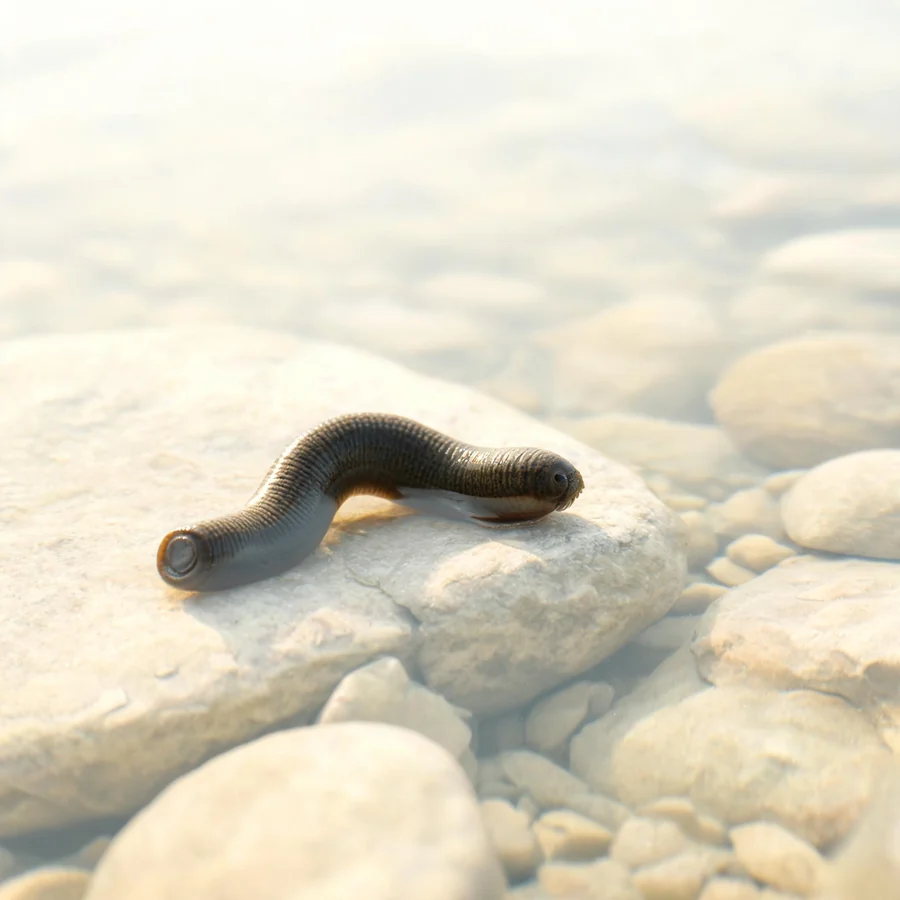
Where a flap, a graft or a slow ulcer stays congested and dusky, the tradition reads the dark colour as old blood blocking the new. Modern surgical practice uses medicinal leeches for exactly that problem, applied by a clinician to a congested flap, which is the clearest meeting of the old and the new. The herb is not applied at home and is not a treatment for an infected or an ischaemic wound.
Skin conditions it is used for
Mapped to the condition pages on this site. The pattern column shows what the skin is doing when this herb is the right choice.
| Condition | Pattern | Why it suits | Typical setting |
|---|---|---|---|
| Bruising | Static Blood fixed in the skin after injury | A bruise is blood that has left the vessels and stopped moving, and it is the simplest stasis picture on the skin. The leech is reserved for a bruise that is deep, hard, slow to fade or left after an operation, not for the ordinary bruise of a healthy person, and it is given in a small dose for a short course with plant movers. Cooling and elevation do more in the first days, and bruising without injury, or with bleeding elsewhere, needs a medical check. | Da Huang Zhe Chong Wan for chronic stasis, or a small dose with Tao Ren and Hong Hua |
| Keloids | Static Blood and hardness held in scar tissue | A scar that keeps growing and stays dusky or purple is read as stasis that has organised, sometimes with heat or toxicity left in the tissue. The leech is used in small amounts inside a softening formula for a mature keloid, and it is supporting rather than curative. Injection, silicone sheeting and pressure are the measures that change a keloid, and a scar that is painful, ulcerated or newly growing needs assessment. | Within a blood-moving, softening formula with E Zhu and Tao Ren |
| Cyanosis | Blood failing to move at the periphery, with stasis | Blue lips or fingertips mean the blood is not being oxygenated or is not moving, and the cause comes before the pattern. Where a chronic, cold-driven congestion has been assessed and the limbs are viable, the leech is used with warming herbs to break the stasis at the edges. Sudden cyanosis, breathlessness or chest pain is an emergency, and no herb belongs in it. | Within a warming, blood-moving formula with Gui Zhi and Dan Shen |
| Mottled Skin | Blood and fluids not reaching the surface, with armour like scaling | The traditional name for this appearance is armour like skin: dry, rough, scaly skin that looks like fish scales, read as blood and fluid failing to reach the surface. It is the classical sign attached to the leech's chronic stasis formula, and that is its best documented skin use. Fish-scale skin can also come from ichthyosis, thyroid disease or severe dryness, so the diagnosis comes first. | Da Huang Zhe Chong Wan, the classical setting for armour like skin |
| Thickened Or Insensitive Skin | Stasis lodged in the skin channels, with hardness and numbness | Skin that is hard, thick and numb is read as an obstruction lodged in the fine channels, with the tissue starved of what should reach it. The leech penetrates where plant movers do not, and it is used in small doses alongside herbs that open the collaterals and build Blood. Scleroderma and similar hardening conditions affect internal organs, so specialist care comes first and the herb is only an adjunct. | A collateral opening formula with Huang Qi and Dan Shen |
Combinations for skin
Herbs it is paired with when the skin, not an internal organ, is the target.
| Partner | Ratio | Why the pair is used |
|---|---|---|
| Tao Ren | 3 g leech powder with 9 to 12 g Tao Ren | Peach kernel is the plant mover and the leech is the animal breaker: the kernel moves blood that is sluggish and moistens the bowel, while the leech reaches blood that has set. The pair is the mildest way to introduce the leech into a formula, and it is used for a deep bruise or a hard scar rather than for a fresh injury. The proportion keeps the plant herb in the larger share, because the animal is stronger and more dangerous. |
| Hong Hua | 1 to 3 g leech powder with 6 to 9 g Hong Hua | Safflower moves blood and opens the channels, and the leech breaks what the safflower cannot shift, which is the logic of the pair in fixed, dark and painful skin. It is used for a lesion that has stayed purple for months, and it is stopped if bleeding gums, easy bruising or a heavier period appear. Both are moving herbs, so the pair is not used in a depleted person without tonics alongside. |
| Dan Shen | 3 g leech powder with 10 to 15 g Dan Shen | Dan Shen moves blood, cools it and settles the spirit, while the leech breaks fixed stasis. The combination is used where dusky, congested skin comes with a restless, hot quality. Dan Shen is the gentler partner and can be continued for longer, while the leech is added for a short course when the stasis is hard. Anyone on anticoagulants should not take either without medical advice. |
| E Zhu | 1 to 3 g leech powder with 6 to 9 g E Zhu | The two blood breakers of the materia medica, paired for hard, fixed masses and for tissue that has become firm and stubborn. E Zhu moves Qi and breaks blood, and the leech adds penetration into what has set. This is a strong pair that belongs to a practitioner, is not used in pregnancy or in anyone with a bleeding tendency, and is given for a short, reviewed course. |
Formulas where it leads
- Da Huang Zhe Chong Wan (大黄䗪虫丸) - The classical pill for chronic stasis in a thin, depleted patient, built on Da Huang, Zhe Chong, Tao Ren, Xing Ren, Huang Qin, Gan Cao, Bai Shao, Sheng Di Huang, Gan Qi, Qi Cao, Mang Chong and this leech. Its skin signature is armour like skin, dry and scaly as fish scales, with dark rings under the eyes, and that is the traditional justification for using the leech where blood is not reaching the surface. It is a prepared pill rather than a home decoction, and it contains several restricted materials.
Topical use
The leech is used topically in one way that matters, and it is a clinical procedure rather than a home remedy. A medicinal leech is applied by a trained clinician to a congested skin flap or graft after reconstructive surgery, where venous blood has pooled and the tissue has turned dusky. The leech removes a small volume of congested blood and leaves hirudin behind, which lets the flap drain for some hours. It is not used on an infected or an ischaemic wound, it is not a cosmetic treatment, and it is never applied by a patient.
| Preparation | How and when it is used |
|---|---|
| Clinical leech application | In specialist care a sterile medicinal leech is placed on a congested flap or graft for a controlled period under close observation, with the wound watched afterwards for bleeding and infection. The leech is used once and disposed of, and antibiotic cover is often given because the leech gut carries Aeromonas bacteria. Nothing in this description is a home instruction. |
Patch test and cautions
Live leech therapy carries a real risk of infection with Aeromonas and of prolonged bleeding from the bite. It is not used in anyone with a bleeding disorder or on anticoagulants, nor on an ischaemic or an infected wound, and a bite can ooze for hours and, rarely, needs a suture. Anyone allergic to leech protein should not be treated. The dried material taken internally carries the same bleeding hazard, and neither route belongs in self-treatment.
Safety for skin use
What to check before recommending or using it, including the cautions that matter most for skin patients.
Do not use, or use with caution
- Pregnancy, absolutely. The leech is classed as pregnancy prohibited: it is strong enough to unsettle a pregnancy, and hirudin is a small direct thrombin inhibitor, so crossing the placenta is a genuine worry.
- Active bleeding, a bleeding disorder, low platelets, a recent haemorrhage or a bleeding ulcer. The action of the herb is the action of an anticoagulant, so where clotting is already failing a manageable bleed can become an emergency.
- Anticoagulant or antiplatelet treatment, including warfarin, heparin, a direct oral anticoagulant, aspirin and clopidogrel. Together they can cause a bleed that is hard to control.
- Planned or recent surgery, dental extraction or childbirth, and children, and frail depleted patients who have no clear stasis picture. Clotting stays affected after the final dose, so the herb is withdrawn in good time before surgery.
Pregnancy and breastfeeding
Contraindicated, and there is no self-treatment role. Chinese sources list the leech as pregnancy prohibited, for two reasons that point the same way: the material can unsettle a pregnancy, and hirudin is small enough that crossing the placenta is a plausible worry for bleeding. Use after a serious condition would be a specialist decision in a hospital, not a course taken at home. While breastfeeding there are no safety data: the active proteins are big, which makes milk transfer unlikely without ruling it out, and a baby's clotting is not yet mature, so the herb is avoided.
Interactions
- Anticoagulants and antiplatelet medicines: the leech acts on clotting, and so do aspirin, warfarin, clopidogrel, heparin and the direct oral anticoagulants. Taken together they can cause a bleed that is hard to control. None of these should be combined with the leech, and the prescriber needs to know if it has already been taken.
- Thrombolytic drugs and regular anti-inflammatory painkillers: alteplase and similar medicines dissolve clots while the herb prevents new ones forming, and drugs such as ibuprofen irritate the stomach lining while impairing platelets, so both add to the bleeding risk.
- Other blood-moving herbs: Dan Shen, Chuan Xiong, Hong Hua and E Zhu are not drugs, but their effect on clotting adds up in a way that is not measured, so the combination deserves the same disclosure as a medicine.
Allergy and patch testing
Allergy to leech protein is recognised, with rash, itching, wheezing and, with injected extracts, a fall in blood pressure. Live leech therapy adds a bacterial risk rather than an allergic one, since the leech gut carries Aeromonas, and infection at the bite is the commonest complication. A history of reaction to a leech bite or to an earthworm preparation rules out both routes. Material that is gritty, musty or unusually heavy is a sign of poor cleaning rather than of strength.
General safety references
General references for herbal hepatotoxicity and herb-drug interactions; they are not specific to this herb.
- Review article: Herbal hepatotoxicity - an update on traditional Chinese medicine preparations. Alimentary Pharmacology & Therapeutics, 2014. PMID: 24844799.
- Interactions between herbal medicines and prescribed drugs: an updated systematic review. Drugs, 2009. PMID: 19719333.
- Warfarin and food, herbal or dietary supplement interactions: a systematic review. British Journal of Clinical Pharmacology, 2021. PMID: 32478963.
Evidence
The classical record is quoted with its source. The modern note states the level of evidence plainly.
Classical record
水蛭,味咸平,主逐恶血、瘀血、月闭,破血瘕积聚,无子,利水道。
Salty and neutral, the leech drives out foul, congested blood, restarts a stopped menstruation, breaks down blood masses and accumulations, addresses childlessness, and opens the water passages.
Shen Nong Ben Cao Jing (Divine Husbandman's Classic of Materia Medica), Han compilation - The line that matters for skin is the first: foul and stagnant blood is the old description of the fixed, dark discolouration for which the herb is still used.
水蛭最喜食人之血,而性又迟缓善入,迟缓则生血不伤,善入则坚积易破。
Leeches feed on human blood, but their nature is unhurried and penetrating: being unhurried, they do not injure the blood that is being formed, and being penetrating, they readily break hard accumulations.
Ben Cao Jing Bai Zhong Lu (Varied Record of the Classic of Materia Medica) - The classical explanation of why a material this strong is given in pills over weeks, and of why it is used for hardness rather than for fresh injury.
Modern evidence
Evidence status
- Hirudin, a direct thrombin inhibitor isolated from the leech salivary gland, is well characterised and was the model for a class of anticoagulant drugs. That is pharmacology rather than a skin trial, and it explains both the traditional use and the bleeding risk.
- Medicinal leech therapy for venous congestion of skin flaps and grafts is described in surgical and reconstructive literature and is used in specialist centres, with infection and prolonged bleeding as the recognised complications. No controlled trial of oral leech for bruising, scars or hardening of the skin was identified.
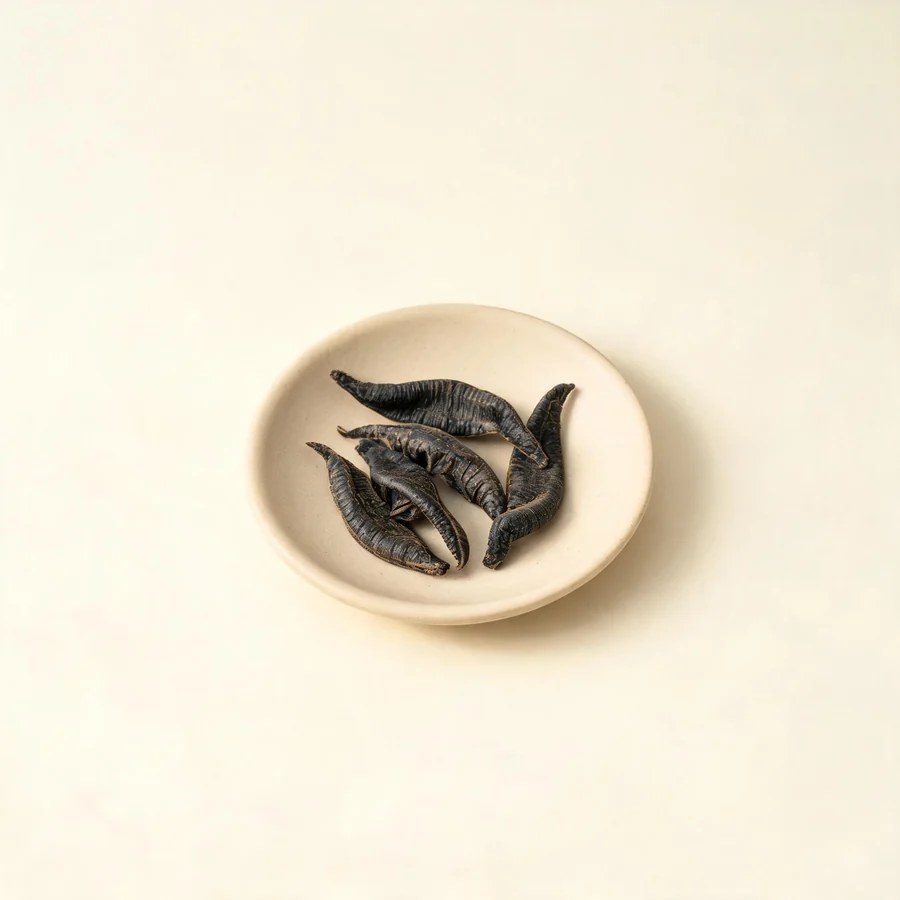
- Identity and sourcing are part of the safety question. The pharmacopoeia accepts three species, commercial material is padded with grit or swapped for species that never feed on blood, and dried leech is expensive, so an unprocessed powder carries more of the effect and more of the risk. None of this can be judged by eye.
PubMed records
Selected real PubMed records for this herb's species or its constituents, chosen by species name and title relevance. They are references for the non-TCM discussion above, not proof that the herb treats any skin condition.
- Zoology, traditional uses, processing technology, chemical compositions and pharmacological activities of Hirudo: A reviews.. Journal of ethnopharmacology, 2026. PMID: 42302938 (pharmacology or review record).
Dose and forms
Skin-practice dosing and the preparations that suit skin complaints.
| Form | Dose and notes |
|---|---|
| Powder | 1 to 3 g of the dried body daily, split into two or three doses and taken with water, not brewed. Modern practice favours this form for stasis in the vessels. |
| Decoction | 3 to 6 g, added for a short time with the rest. Long boiling damages the proteins that carry the effect, which makes the decoction the weaker preparation. |
| Ceiling and course | A hard ceiling of 6 g. Give for a week or two and then review instead of continuing indefinitely, and do not raise the dose just because progress is slow. |
The form changes the dose because the active constituents are proteins: boiling damages them, so the powder is roughly half the decoction dose and also the more concentrated. A reported toxic dose is 15 to 30 g, which is why the ceiling is fixed at 6 g, and the risk lies in bleeding that accumulates over days, not in one dramatic reaction. Anticoagulant medication is the question to ask before anything else, and the herb is withdrawn in good time before surgery, since clotting stays affected after the final dose. It is not a long-term medicine and is not increased when the response is slow.
Citations and further reading
Only real sources are listed: the classical materia medica passages quoted above, and the source works behind the botanical and safety statements.
- Shen Nong Ben Cao Jing (Divine Husbandman's Classic of Materia Medica), attributed compilation of the Han period - the entry on foul blood and blood masses is quoted above.
- Ben Cao Jing Bai Zhong Lu (Varied Record of the Classic of Materia Medica), Qing dynasty - the passage on the slow, penetrating nature of the leech is quoted above.
- Hirudo monograph, Pharmacopoeia of the People's Republic of China - the three accepted species, the part used and quality requirements.
- Supply note: the pharmacopoeia limits the accepted species and published surveys of commercial leech material describe substitution and added grit, summarised here as a statement about sourcing.
- Modern evidence statement: based on published pharmacological work on hirudin and on surgical reports of medicinal leech therapy, presented as a statement about the level of evidence rather than as a cited trial.
Educational reference for qualified practitioners. This page is not medical advice, and skin conditions should be diagnosed by a clinician before treatment.