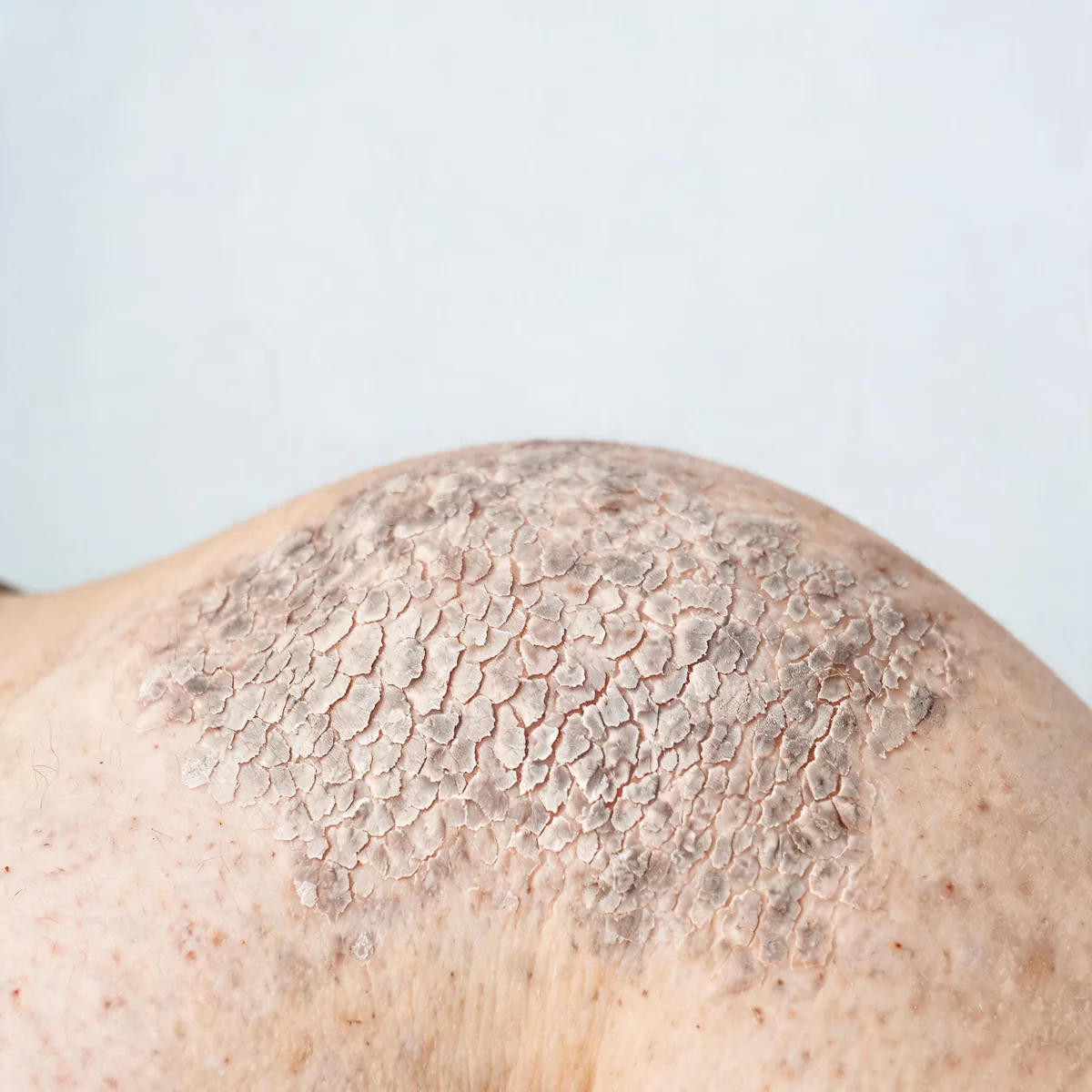
Understanding Mottled skin
The tradition describes mottled skin as the surface losing its nourishment from Blood, Qi and Body Fluids, so that it becomes dry, rough and scaly.
The Liver stores Blood and keeps it moving; when Blood is stagnant or depleted the skin loses its moisture and texture, and the classic fish-scale appearance develops.
Blood Stagnation gives dry rough scaly skin with fixed stabbing pain worse at night, a dark purplish tongue with stasis spots and dark clotty periods. Qi and Blood deficiency gives the same dry scaly skin but with a pale sallow tone, fatigue, pallor and dizziness.
Yin deficiency gives fish-scale dryness with night sweats, five-palm heat and a dry mouth. Damp heat gives the opposite texture, greasy oily skin with a heavy body and a sticky taste. Spleen deficiency with dampness gives rough mottled skin with fatigue, poor appetite and loose stools, and Bright Yang Stomach heat gives high fever, intense thirst and hot dry mottled skin.
Two ideas organise the TCM reading. The first is supply: skin needs Blood, Qi and Body Fluids, and any shortfall leaves it rough, dry and scaly. The second is traffic: even where supply is adequate, stagnant Blood cannot deliver it to the surface. Most cases combine the two, which is why a person can be undernourished and congested at once, and why nourishing alone sometimes fails until flow is restored.
The texture is the clue. Dry fish-scale roughness with a dark complexion and fixed pain means stasis is leading. Pale, fine scaling with fatigue and dizziness means deficiency. Dryness that feels hot, with night sweats and a dry mouth, means Yin has run low. Greasy, oily roughness with a heavy body means damp-heat has clogged the pores. A rough, puffy, not quite dry surface with bloating and loose stools means the Spleen is failing, and hot dry skin with high fever and raging thirst means Stomach heat is burning the fluids off.
Because the sign is a sign rather than a disease, the practitioner treats the pattern and watches the skin answer. The tongue is decisive: purple with stasis spots for Blood stagnation, pale and swollen with teeth marks for Spleen deficiency, red and uncoated for Yin deficiency, red with a greasy yellow coat for damp-heat.
Conventional view
Western medicine uses mottled skin as a description rather than a diagnosis: skin that looks patchy, blotchy or uneven in colour and texture. It appears in livedo reticularis, the lace-like purplish pattern linked to circulation, in ichthyosis, a genetic disorder of dry scaly skin, in eczema, and in severe ordinary dryness. Assessment looks for the underlying cause through examination, blood tests and sometimes a biopsy.
Care is aimed at the cause and at the barrier. Emollients and humectants hydrate the skin, topical corticosteroids or retinoids reduce scaling and inflammation, and where an autoimmune or circulatory disorder is found, systemic treatment such as immunosuppressants or vasodilators may be prescribed. Avoiding harsh soaps, using a humidifier and staying hydrated are the standard self-care measures.
Moisturisers and steroids smooth the skin while they are used, but they do not explain why it became dry and scaly, particularly when no named dermatological disease is present, and people commonly find the improvement lasts only as long as the cream is applied. The TCM reading treats the skin as a report on internal organ function and aims at the deeper imbalance, so that the surface can nourish itself.
Selected PubMed records
Real PubMed records for the conventional discussion above, selected by condition name and title relevance. They are references, not a claim that any treatment is proven for this condition.
- The terminology of skin disorders. Primary Care, 2000. PMID: 10815043.
How it connects
The clustering follows the patterns rather than the skin. Blood stagnation that roughens the surface can also obstruct the uterus, so amenorrhoea and abdominal masses appear alongside it, and treating the stasis with Xue Fu Zhu Yu Tang is expected to help the skin, the periods and the masses together. In Qi and Blood deficiency the same shortfall that leaves the skin dry and mottled underlies anaemia with pallor, fatigue and dizziness, and the Spleen's failure to make Blood is the common thread, so tonifying with Ba Zhen Tang addresses both.
How it is assessed
The practitioner assesses the texture, temperature and the constitutional picture.
What a practitioner looks for
- Texture: dry fish-scale skin suggests Blood stagnation or deficiency; greasy skin suggests Damp-Heat.
- Colour: pale suggests deficiency; dark purplish suggests stagnation.
- Systemic signs: fever with hot dry skin suggests Stomach heat; night sweats suggest Yin deficiency.
- Red flags: sudden widespread mottled skin with fever or severe pain.
The consultation begins with the roughness itself, because one word covers very different surfaces. Dry and fish-scale-like on the shins, dark in tone, with fixed stabbing pain or a history of injury, is Blood stagnation. Fine scaliness with a pale, lacklustre face, tiredness, dizziness and a poor appetite, often after illness or a long stretch of poor food, is Qi and Blood deficiency.
Yin deficiency shows as dry, cracked skin that feels warm, with night sweats, a dry mouth and heat in the palms and soles, worse in the afternoon and evening when Yin is naturally lower, and the tongue is red and uncoated while the pulse is thin and rapid. Damp-heat is the opposite: rough, oily skin that may itch, a heavy body, a bitter taste, a red tongue with a yellow greasy coat and a slippery, rapid pulse.
Spleen deficiency with dampness gives a rough, puffy surface that is neither intensely dry nor hot, with fatigue, a poor appetite, loose stools and drowsiness after meals, a pale swollen tongue with a white greasy coat and a soft, slow pulse. Bright Yang Stomach heat is acute rather than chronic: high fever that sweating does not relieve, intense thirst for cold water, a flushed face and profuse sweat, with a surging rapid pulse. That picture needs urgent medical assessment as well as treatment.
TCM patterns in Mottled skin
Six patterns produce the same rough surface, and texture narrows the field faster than any other sign. Dry and fish-scale-like with stabbing pain in fixed places, a dark complexion and a purple tongue is Blood stagnation, the classic form. Dry and pale with fatigue, dizziness and a poor appetite is Qi and Blood deficiency, where there is not enough material to nourish the surface. Dry, cracked and hot, with night sweats and a dry mouth, is Yin deficiency, a deeper loss of cooling fluids. Greasy, oily roughness with a heavy body and a bitter taste is damp-heat, which clogs rather than parches. A rough but not intensely dry surface with bloating, loose stools and drowsiness is Spleen deficiency with dampness. Hot, parched skin with high fever and unquenchable thirst is Bright Yang Stomach heat, an acute febrile picture needing medical care. Tongue and pulse decide the order of treatment.
| Pattern | Key signs | The itch | Tongue | Main formula |
|---|---|---|---|---|
| Blood Stagnation | Dry rough scaly skin like fish scales; Fixed stabbing pain worse at night | Not specified | Body: Purple, dusky or with dark stasis spots; sublingual veins dark and distendedCoat: Often thin white; a yellow coat would suggest Heat as the cause | Not specified |
| Qi and Blood Deficiency | Dry rough scaly skin with a pale sallow tone | Not specified | Body: Pale, possibly thin or with teeth marksCoat: Thin white | Not specified |
| Yin Deficiency | Dry scaly skin like fish scales; Dry mouth with small sips | Not specified | Body: Red, thin and dry, with cracksCoat: Little or none | Not specified |
| Damp-Heat | Skin feels greasy or oily to the touch | Not specified | Body: Red, often swollen with teeth marksCoat: Yellow, greasy and thick, usually in the middle and at the root | Not specified |
| Spleen Deficiency with Dampness | Rough mottled skin | Not specified | Body: Pale and swollen, often with teeth marks along the edgesCoat: White, greasy and moist, thick in the middle | Not specified |
| Bright Yang Stomach Heat | Flushed red face; Dry scaly mottled skin that feels hot | Not specified | Body: Red, dry, possibly with early cracksCoat: Yellow and dry | Not specified |
Blood Stagnation
Fish-scale dry skin with fixed night pain and dark tongue.
Stasis is Blood that has stopped behaving like a river. It cannot reach the fine vessels at the surface, so the skin dries from below and takes on the cracked, fish-scale look the classical texts call armour-like. The same obstruction shows as a dusky complexion, stabbing pain in fixed places, worse by night, and dark clotted periods.
The tongue is dark purple or dusky, sometimes with stasis spots and distended dark veins underneath, and the pulse is choppy or wiry. Cold weather, sitting still for long stretches, cold raw food and bottled-up frustration deepen it, while warm baths, warm clothing, gentle daily movement, turmeric and hawthorn in the diet and emotional release loosen it. Xue Fu Zhu Yu Tang is the main formula, with Da Huang Zhe Chong Wan reserved for severe chronic cases with emaciation and deeply scaly skin, and Tao Ren, Hong Hua and Chuan Xiong supply the movement. SP-10 Xuehai, SP-6 Sanyinjiao and LR-3 Taichong are the points used.
Signs
- Dry rough scaly skin like fish scales
- Fixed stabbing pain worse at night
- Dark purplish tongue with stasis spots
- Dark menstrual blood with clots
Diet and lifestyle for this pattern: Keep the body warm and avoid cold drinks and raw food that congeal Blood. Gentle daily walking, yoga or tai chi keeps Blood flowing, and blood-nourishing, stasis-dispersing food such as black fungus, turmeric, hawthorn and small amounts of ginger helps. Moisturise the skin externally if useful, but the real change comes from inside.
Qi and Blood Deficiency
Dry scaly skin with a pale tone and fatigue.
Where there is not enough Qi and Blood to go round, the surface is the first place to be short-changed. The skin loses moisture and lustre together, so it is dry and rough, pale and sallow rather than dark. The Spleen is usually the origin, since it is the organ that turns food into the Qi and Blood that the skin lacks.
The tongue is pale, thin or marked by teeth, with a thin white coat, and the pulse is fine and weak, without force. Overwork, skipped meals, a poor diet and cold raw food drain what little there is, while rest, sleep, warm cooked food and gentle movement rebuild it. Ba Zhen Tang is the formula, with Dang Gui and Huang Qi as the herbs that nourish and generate, and ST-36 Zusanli, SP-6 Sanyinjiao and REN-6 Qihai as the points that support absorption and replenish the source.
Signs
- Dry rough scaly skin with a pale sallow tone
- Persistent fatigue and lack of energy
- Pale complexion, lips and nail beds
- Dizziness with poor appetite
Diet and lifestyle for this pattern: Build meals around gently cooked, warming food such as bone broth, congee and stews with dark leafy greens, red dates and a little good quality protein. Avoid overwork and protect deep rest, since the body builds Blood while you sleep, and keep movement gentle such as walking or tai chi so Qi circulates without draining reserves.
Yin Deficiency
Fish-scale dryness with night sweats and dry mouth.
Yin is the cooling, moistening half of the body, and when it runs low the skin loses its water-bearing layer. Dryness follows, then roughness, then the fish-scale cracking that defines the picture, and because fluids are short, Empty Heat arises and dries the surface still further, especially at night.
The tongue is red and thin, cracked, with little or no coating and a dry surface, and the pulse is fine and rapid. Spicy, fried and dry food, alcohol, hot dry weather, overwork and late nights all consume Yin, while a cool humid environment, early nights, rest, water through the day, pear and cucumber and gentle movement help conserve it. Sha Shen Mai Men Dong Tang is the formula, with Bei Sha Shen, Mai Dong and Tian Men Dong, and KI-3 Taixi, SP-6 Sanyinjiao and KI-6 Zhaohai are the points that nourish Yin and clear the Empty Heat.
Signs
- Dry scaly skin like fish scales
- Night sweats
- Heat in palms, soles and chest
- Dry mouth with small sips
- Flushed cheekbones
Diet and lifestyle for this pattern: Eat plenty of moistening, cooling food such as pear, cucumber, tofu and millet congee, and avoid spicy, fried or very dry food. Drink water at room temperature through the day, go to bed early and avoid overwork or late-night screens that deplete Yin, and choose gentle exercise such as tai chi or walking over intense sweating workouts.
Damp-Heat
Greasy oily skin with a heavy body.
Damp-heat is heavy and greasy rather than dry, and it blocks the pores so the surface looks rough and feels oily at the same time. Because dampness and heat both impede circulation, the skin is starved of nourishment while being clogged, which is why this pattern looks so different from the dry ones despite sharing the same word, mottled.
The tongue is red, its coating yellow, greasy and hard to scrape off, and the pulse is soggy and rapid or slippery and rapid. Humid weather, greasy and fried food, alcohol, dairy and long sedentary days feed it, while light cooling food such as barley, mung beans and bitter greens, with plenty of cucumber, a dry airy room and regular gentle exercise drain it. Huo Xiang Zheng Qi San is used, and Yin Chen Hao Tang when the complexion looks yellowish and greasy, with Huang Qin, Ku Shen and Yi Yi Ren as the herbs. SP-9 Yinlingquan, ST-40 Fenglong and LI-11 Quchi are the points.
Signs
- Skin feels greasy or oily to the touch
- Body heavy and sluggish
- Sticky or bitter taste with poor appetite
- Chest and upper abdominal stuffiness
Diet and lifestyle for this pattern: Avoid greasy, fried and spicy food as well as alcohol and dairy, which generate Dampness and Heat. Favour light, cooling, Dampness-draining food such as barley, mung beans, cucumber and bitter greens, and keep exercise gentle and consistent to move Qi and drain Dampness.
Spleen Deficiency with Dampness
Rough mottled skin with fatigue and loose stools.
A weak Spleen makes two mistakes at once. It fails to transform food into Qi and Blood, leaving the skin underfed, and it fails to move fluids, so dampness collects and rises to the surface. The result is a surface that is rough and slightly puffy, neither parched nor greasy, and it arrives with the digestive signature of the underlying weakness.
The tongue is pale, puffy and marked by teeth, its coat white, greasy and moist, and the pulse is soggy and slow, sometimes slippery, soft and lacking force. Heavy, greasy, cold or raw food, overeating, humid weather and long inactivity burden the Spleen further, while warm light meals, warm dry surroundings, rest and gentle movement ease it. Shen Ling Bai Zhu San is the formula, with Bai Zhu, Fu Ling and Yi Yi Ren, and ST-36 Zusanli, SP-6 Sanyinjiao and SP-9 Yinlingquan are the points that strengthen the Spleen and drain the dampness.
Signs
- Fatigue and lack of energy
- Poor appetite or lack of taste
- Loose unformed stools
- Heaviness in body and limbs
- Rough mottled skin
Diet and lifestyle for this pattern: Favour warm, cooked, easy food such as congee, soups and steamed vegetables, and avoid cold, raw, greasy and sweet food that creates more Dampness. Gentle daily walking or stretching helps the Spleen move Qi and fluids, and keeping the body warm supports digestion.
Bright Yang Stomach Heat
High fever with hot dry mottled skin and intense thirst.
This is the acute pattern, and it looks different from every other on the page. Blazing Stomach heat burns through the fluids like a furnace, so the body loses water faster than it can be replaced and the skin is left parched and rough while feeling hot to the touch. Heat also drives Blood outward, which is why the face is flushed and the whole surface feels feverish.
The tongue is red under a dry yellow coat that may already show cracks, and the pulse is overflowing and surging, rapid, strongest at the right Guan position. Hot weather, spicy and greasy food, alcohol, stress and overexertion add heat, while cool drinks, rest in a cool room, light bland food and cold compresses on the skin relieve it. Bai Hu Tang is the formula, with Shi Gao and Zhi Mu, and ST-44 Neiting and LI-4 Hegu are the points that drain Stomach heat.
Signs
- High fever that does not improve with sweating
- Intense thirst craving cold water
- Flushed red face
- Dry scaly mottled skin that feels hot
Diet and lifestyle for this pattern: Drink plenty of cool water and eat water-rich food such as cucumber and watermelon, and avoid hot, spicy and greasy food that stokes internal Heat. Rest in a cool aired space and avoid overheating.
Treatment approach
How the tradition treats mottled skin, with the herbs, formulas and points used for it.
Principles
- Nourish Blood and Yin where the skin is dry and fish-scaled.
- Move Blood and resolve stasis where the pattern is stagnation with fixed pain.
- Clear Stomach heat where fever and intense thirst dominate, and treat that as acute illness.
- Protect and moisturise the skin barrier, which both frameworks treat as basic care.
- Root and branch are treated together: the formula corrects the internal imbalance, while points and external care address the skin itself, and where two patterns coexist the dominant one goes first. Because the picture shifts as stagnation drains Qi and Blood or as damp-heat damages Yin, the formula is reviewed rather than repeated indefinitely, and progress is judged from tongue and pulse as well as from the surface.
Herbs used
Formulas
- Xue Fu Zhu Yu Tang
- Da Huang Zhe Chong Wan
- Ba Zhen Tang
- Sha Shen Mai Men Dong Tang
- Huo Xiang Zheng Qi San
- Yin Chen Hao Tang
- Shen Ling Bai Zhu San
- Bai Hu Tang
Acupoints
- SP-10 (Xuehai)
- SP-6 (Sanyinjiao)
- LR-3 (Taichong)
- ST-36 (Zusanli)
- qihai-ren-6
- KI-3 (Taixi)
- KI-6 (Zhaohai)
- SP-9 (Yinlingquan)
- ST-40 (Fenglong)
- LI-11 (Quchi)
- ST-44 (Neiting)
- LI-4 (Hegu)
What to expect
- Nourishing patterns improve slowly over months.
- Acute febrile patterns need medical assessment and resolve with treatment of the underlying illness.
- Hereditary ichthyosis is managed rather than cured.
- Change is slow and uneven. Tightness and itching usually ease first, then the texture softens and the scaling lessens, and the deeper deficiency patterns take longest because reserves must be rebuilt before the surface benefits. Most people need at least two to three months of consistent treatment, and improvement often continues between courses, which is why a maintenance plan is more useful than a fixed end date.
Safety and when to get help
Seek medical help urgently for
- Sudden widespread mottled skin with fever - possible serious infection or systemic illness.
- Mottled skin with severe pain, cold limbs or confusion.
- Skin that becomes blistered, ulcerated or infected.
For anything severe, sudden or spreading quickly, read when a skin problem needs urgent care.
Cautions
- Persistent generalised mottling needs medical review.
- Do not use harsh exfoliants on dry scaly skin.
- Sudden skin changes in a seriously unwell person are an emergency.
Using this alongside conventional care
- TCM is described as complementary to conventional care: prescribed emollients and medical treatment continue alongside herbs.
- Emollients and topical treatments continue alongside the herbs, and where a steroid or immunosuppressant has been prescribed it is tapered only with the prescriber's agreement. The interaction to raise is Blood movement: Dang Gui and Chuan Xiong are mild, but anyone on an anticoagulant, an antiplatelet drug or an immunosuppressant should tell both practitioners and keep a single list of everything being taken. Keeping the dermatologist and the TCM practitioner in contact, rather than running two separate plans, avoids duplicated or conflicting advice.
Diet and lifestyle
- Favour foods that build Blood and Yin: dark leafy greens, beetroot, black sesame, goji berries, pear and bone broth.
- The shared principle is warm, cooked, easily digested food that builds Blood and Yin without creating dampness: dark leafy greens, beetroot, black sesame, goji berries, pear and slow-cooked broth, with iced drinks, raw salads, takeaway food and alcohol kept low. The pattern then decides. Stagnation responds to small amounts of turmeric, ginger, black fungus and hawthorn; Qi and Blood deficiency to congee, stews, red dates and a little good protein; Yin deficiency to pear, cucumber, tofu and millet congee with water at room temperature; damp-heat to barley, mung beans and bitter greens with cucumber, with dairy, sugar and fried food reduced; Spleen deficiency to warm light meals at regular times; and Stomach heat to cool water and watery fruit while hot spices and alcohol are withdrawn.
If you're pregnant
Blood stagnation patterns need particular care in pregnancy. Strong Blood-moving remedies, Tao Ren and Hong Hua among them, are contraindicated, and so are Xue Fu Zhu Yu Tang, or Da Huang Zhe Chong Wan, both of which may threaten the pregnancy. Gentler, Blood-nourishing herbs such as Dang Gui in small doses are preferred, and acupressure is safer than needling.
LI-4 Hegu and SP-6 Sanyinjiao are the points most often avoided during pregnancy. The deficiency pictures, Yin and Qi and Blood, are more common at this time, and nourishing formulas such as Ba Zhen Tang, modified, can be used under professional guidance.
If you're breastfeeding
Blood-moving formulas are used cautiously during lactation because their action is strong, and Da Huang Zhe Chong Wan or Xue Fu Zhu Yu Tang is avoided unless the case is compelling and closely supervised. Gentle tonics such as Ba Zhen Tang are generally considered safe and may even help establish milk supply. Acupuncture passes nothing into milk and is a useful alternative.
If treating a child
Mottled skin is uncommon in children and usually appears with long-standing poor nutrition or with a Spleen weakened by dampness. Doses are scaled to between a quarter and a half of the adult amount by age and weight, and gentle Spleen tonics such as Shen Ling Bai Zhu San are the usual choice. Needling is rarely used, with acupressure or paediatric tuina safer and better accepted, and a paediatric TCM specialist should be consulted.
If treating an elderly patient
In older patients the commonest pictures are a deficiency of Qi and Blood, or of Yin, and doses are usually cut to roughly two-thirds the adult amount so as not to overload digestion. Ba Zhen Tang is well tolerated, and so is Sha Shen Mai Men Dong Tang; blood-moving formulas need care in anyone taking anticoagulants, and acupuncture can be used at gentler stimulation.
Urgent-sign guidance is based on standard sources: NHS anaphylaxis, NHS cellulitis, NHS Stevens-Johnson syndrome, NHS melanoma.
Evidence
Evidence status
Compiled for this page from the classical and modern literature; not a systematic review, so treat it as a pointer to sources rather than clinical guidance.
Research specific to mottled skin is limited; most studies concern related conditions such as ichthyosis or xerosis. A few case reports and small trials suggest blood-moving and nourishing formulas improve skin texture and hydration, but high-quality randomised trials are lacking. Acupuncture has been shown to improve microcirculation, which may benefit skin health, though direct evidence is sparse.
Studies often cited
Case reports and small trials suggest improved skin texture and hydration, without high-quality trials. Case reports and small trials (as recorded in the source)
Shown to improve microcirculation, a plausible but indirect mechanism for skin benefit. Clinical studies (as recorded in the source)
Classical record
Mottled skin is due to stagnation of Qi and Blood, which cannot nourish and moisten the skin.
- Zhu Bing Yuan Hou Lun (General Treatise on the Causes and Symptoms of Diseases), chapter on skin roughness. The Chinese original is not reproduced here: it could not be recovered reliably from the source record, and is not guessed.
内有干血,肌肤甲错,两目黯黑。缓中补虚,大黄蛰虫丸主之。
Dry blood held inside makes the flesh coarse and armour-like, and darkens both eyes. Da Huang Zhe Chong Wan is the remedy, calming the middle while supplementing what is empty.
Jin Gui Yao Lue, Chapter on Blood Stasis and Dry Blood - Classical citation: (Jin Gui Yao Lue, Chapter on Blood Stasis and Dry Blood); the short Chinese original is quoted as the classical literature gives it.
Common questions
What does armour-like skin mean?
The Chinese name describes dry rough skin that looks like fish scales, read as Blood and fluids failing to nourish the surface.
Is mottled skin dangerous?
Chronic dry mottling is not, but sudden widespread mottled skin with fever or confusion is an emergency.
Can herbs soften the skin?
The tradition describes nourishing Blood and Yin, with gradual improvement over months.
Is it hereditary?
Some forms such as ichthyosis are, and those are managed rather than cured.
How long does treatment take to work?
Most people notice a difference within four to six weeks. Excess pictures, damp-heat and Blood stagnation among them, may respond sooner, while the deficiency patterns that require Qi and Blood to be rebuilt can take two to three months. Consistency with herbs and acupuncture matters, because skin renewal is a slow process.
Can I keep using my moisturiser and steroid cream?
Yes. The herbs work internally on the imbalance while emollients and prescribed topicals manage the surface, and there is no need to stop them. Tell both practitioners everything you are using so the two plans can be coordinated, and taper any steroid only on the advice of the prescriber.
Are there foods I should avoid?
The general advice is to go easy on deep-fried, greasy and very spicy food, and on excess dairy and sugar, because these create heat and dampness. Cold and raw food drains a weak Spleen and deepens deficiency pictures. Warm cooked meals and moistening foods such as pear, cucumber and congee are the mainstays.