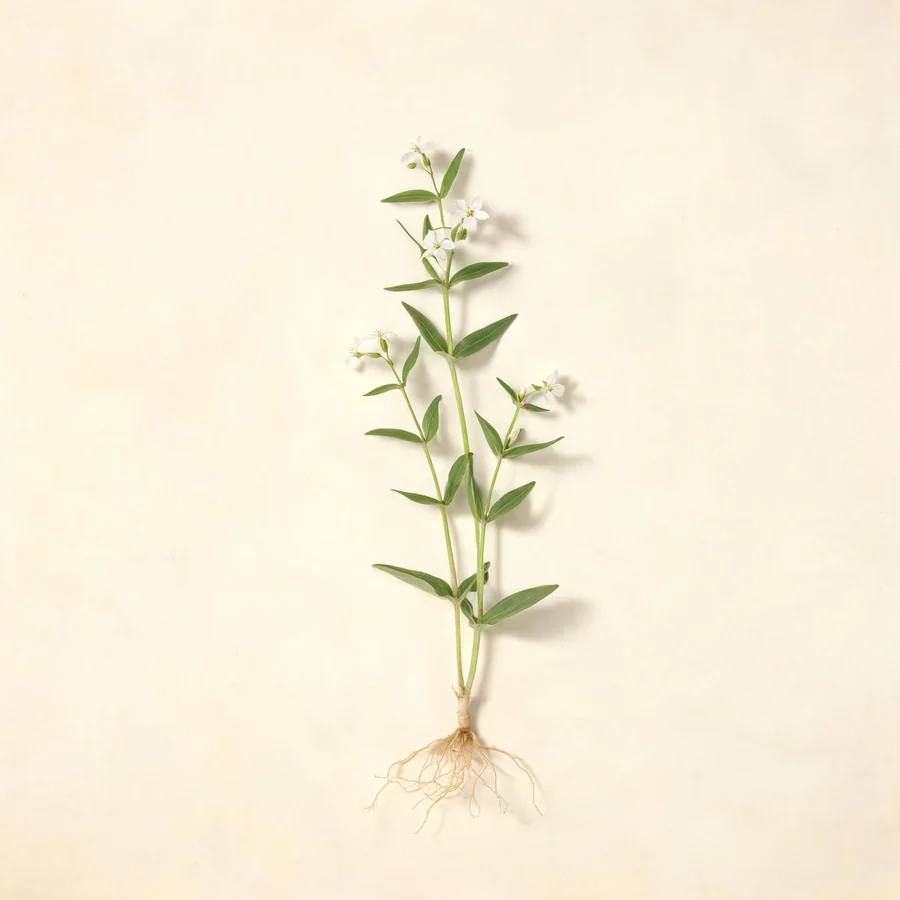
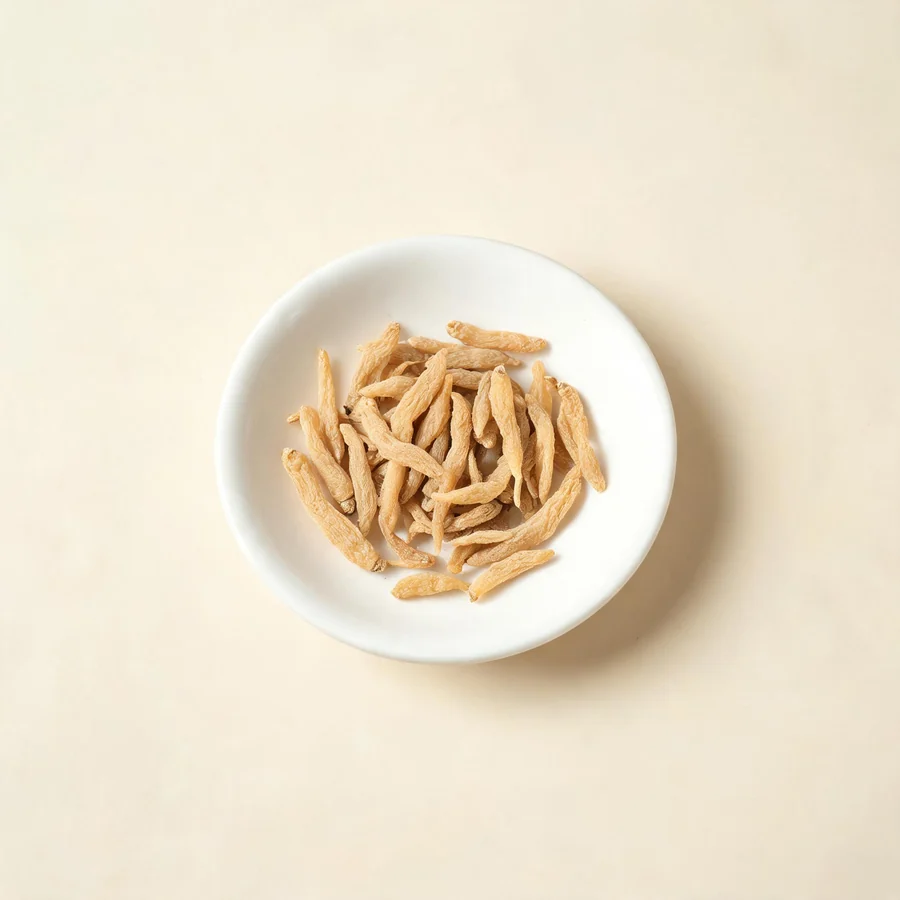
Skin profile
Where this herb sits in skin practice: the pattern it corrects, the skin signs it suits, and what it should not be used for.
Tai Zi Shen is here for the dry, thin, tired skin that follows depletion, not for the rash itself. The signs that make it plausible are dryness, pallor, a poor appetite, night sweating and a thin tongue coating. The signs that rule it out are grease, heat, pus and a thick coating. It is one of the few tonics that can be given to a child or an older person for months without stirring heat, and that is exactly the limit of its power.
Skin signs that suggest it
- Dry, thin, loose skin in a person who is tired, thirsty and has a poor appetite
- A child with dry eczema in the elbow and knee creases, pale, sweaty at night and slow to gain weight
- Small grazes and cracks that heal slowly, with a sallow complexion and low energy
- Skin that feels tight after washing, with a dry mouth and little desire for cold drinks
- A pale or slightly red tongue with little coating, and a fine, weak pulse
When it is not the right herb
Not while the skin is red, hot, weeping or infected, and not with a thick greasy coating: a sweet tonic given to a damp or hot picture adds to the congestion. Not for a rash that is spreading, and not during a fever. It is not a substitute for the stronger Yin tonics when dryness is severe, because it generates fluids gently and cannot restore a deep depletion on its own. Too much of it brings distension, a parched mouth, loss of appetite and irritability, and the correction is a smaller dose rather than a second herb.
What it does for skin
Skin-relevant actions only. Each one describes a mechanism in TCM terms and what it looks like on the skin.
Supplies Qi for repair without adding heat
Skin repairs with material and with force, and a depleted person has too little of both. This root tonifies the Spleen, where the material is made, and it does so while staying neutral, so it does not push a dry person further into dryness the way a warming tonic would. That neutrality is the whole reason to choose it over ginseng in a skin case.
Generates fluids that keep the surface supple
Its second action is to generate fluids, and on the skin that means suppleness rather than moisture in the greasy sense. Dryness after a fever, dry lips and a dry throat with a thin tongue coating are the signs, and a dry tight skin often follows them. The effect is gentle and slow, supported by ordinary drinking and eating rather than replacing them.
Strengthens the Spleen so that the material is made
Atopic skin in a child who is pale, thin, fussy and sweats at night is often read as a Spleen that does not make enough Qi and Blood to nourish the surface. The root is a mild Spleen tonic, usually given in congee, soup or powder across weeks rather than in a strong decoction. It is an addition to the treatment of the skin, not a replacement for it, and the child's growth and diet matter more than the herb.
Settles the night sweating of a depleted person
Night sweats in a thin, tired child or convalescent are read as deficiency failing to hold the surface at night. The root is used with astragalus and oyster shell in that picture, and its contribution is to the supply rather than to the holding. Sweating with fever, weight loss or a cough is a different matter and needs investigation before any tonic.
Skin conditions it is used for
Mapped to the condition pages on this site. The pattern column shows what the skin is doing when this herb is the right choice.
| Condition | Pattern | Why it suits | Typical setting |
|---|---|---|---|
| Atopic dermatitis | Spleen Qi deficiency with dryness and poor growth | Atopic skin in a child who is pale, thin and tired, with dry flexural patches and night sweating, is read as a Spleen that cannot supply the surface. The root tonifies gently and generates fluids, and it is chosen over the stronger ginsengs because it does not stir heat in a child who is already dry. Sleep, diet and emollients remain the mainstay, and the herb is an adjunct for months rather than a rescue treatment. | Modified Si Jun Zi Tang with Tai Zi Shen and Bai Zhu |
| Skin dryness | Fluids depleted after illness, with a dry mouth and a thin coating | Dryness that appears after a fever or a long illness, with thirst, a dry throat and a thin tongue coating, is read as fluids consumed rather than as a constitutional lack. The root generates fluids gently and is safe to continue, and it is used where a richer Yin tonic would sit heavily on a weak digestion. Dryness with red, itchy, scaly patches may also be eczema and needs its own treatment. | Sheng Mai San with Tai Zi Shen |
| Skin tightness | Qi and fluids failing to reach the surface | Skin that feels tight after washing, with no rash and no obvious dryness to see, is read as supply failing to reach the surface. The root supports the Spleen and the fluids together, which are the two deficiencies behind that sensation, and it is a slow treatment. Tightness with swelling, hardness or a change in the texture of the skin needs assessment rather than a tonic. | Modified Si Jun Zi Tang with Tai Zi Shen and Mai Dong |
| Wrinkled and shrunken skin | Deficiency of Qi and fluids in an older or convalescent person | Loose, thin, sunken skin in someone who has been ill or is frail is read as supply falling short of the surface, and the gentle tonics are the appropriate level of treatment. The root is used at the higher end of its range over months, in food as much as in decoction. No herb reverses sun damage or sudden weight loss, and a rapid change in skin firmness needs medical assessment. | Modified Si Jun Zi Tang with Huang Qi and Tai Zi Shen |
Combinations for skin
Herbs it is paired with when the skin, not an internal organ, is the target.
| Partner | Ratio | Why the pair is used |
|---|---|---|
| Bai Zhu | 10 to 15 g Bai Zhu with 9 to 15 g Tai Zi Shen | Atractylodes dries dampness while it tonifies, and the tuber supplies Qi and fluids without adding heat, so the pair suits a Spleen that is weak without being damp. On the skin it is used for dry, pale, thin skin with a poor appetite, and it is the base on which the paediatric skin tonics are usually built. The atractylodes is reduced when the skin is very dry. |
| Mai Dong | 10 to 15 g Mai Dong with 9 to 15 g Tai Zi Shen | Ophiopogon moistens and cools while the tuber supplies Qi and generates fluids, so the pair treats dryness with depletion behind it. It is used for dry skin, a dry throat and a thin tongue coating after illness, and it is the gentler cousin of the classical formula for Qi and fluid loss. It is stopped if the appetite dulls, because moistening herbs sit heavily. |
| Huang Qi | 15 to 30 g Huang Qi with 9 to 15 g Tai Zi Shen | Astragalus works at the surface and the tuber works on the supply, so together they cover the distance from the Spleen to the skin. The pair is used for slow-healing skin, night sweating and the pale, tired picture in which repair has stalled. The balance usually favours astragalus, since the surface is where the problem shows. |
| Shan Yao | 10 to 15 g Shan Yao with 9 to 15 g Tai Zi Shen | Chinese yam is a mild Spleen and Kidney tonic that is also food, and the two are combined in congee and soup for children and convalescents with dry, thin skin and a poor appetite. Both are neutral and gentle, so the combination can be continued for weeks. Neither will clear an active rash, and neither treats malnutrition, which needs a diagnosis. |
Formulas where it leads
- Si Jun Zi Tang (四君子汤) - The foundational Qi-tonifying formula, with ginseng, atractylodes, poria and liquorice, on which the gentler versions for children are built. The tuber replaces ginseng where the person is a child or is too dry for the warming root.
- Sheng Mai San (生脉散) - The formula for Qi and fluid depletion after illness or sweating, with ginseng, ophiopogon and schisandra. The tuber is substituted for ginseng in a dry, thin person who does not need the warmth.
Safety for skin use
What to check before recommending or using it, including the cautions that matter most for skin patients.
Do not use, or use with caution
- An acute exterior condition or an active infection, with fever, a spreading rash, a sore throat or thick yellow discharge. A tonic offered while the surface is still invaded may keep the pathogen there, so the tradition waits until the acute phase is over.
- Dampness or phlegm with a thick greasy coating, and a distended abdomen. A sweet tonic adds to congestion, so the digestion has to be cleared first.
- Deep dryness with exhausted fluids, where a stronger Yin tonic is needed. The tuber is gentle and cannot restore a severe depletion on its own, and using it alone delays proper treatment.
- Deep-rooted heat with a red tongue, a dry mouth and irritability. The root is neutral rather than cooling, and it is not the right tool for a hot, dry picture.
Pregnancy and breastfeeding
The tuber is among the mildest tonics, and nothing in the literature records uterine, teratogenic or embryotoxic effects, which is part of why it is so often chosen over stronger ginsengs during pregnancy. Ordinary doses are used for tiredness and a poor appetite, and the root is withdrawn if an infection appears. Supervision is still the rule, because the pattern, not the mildness of the herb, decides. While breastfeeding it is widely taken in food-grade preparations, and nothing has been reported about milk or the infant.
Interactions
- Digoxin and related cardiac glycosides. The root is held to strengthen their action, so it is not combined with them unless a prescriber is supervising.
- Opioids and sedatives, among them codeine, morphine and phenobarbital. Traditional compatibility advice warns of deeper sedation and respiratory depression, so the doses are separated or the pairing avoided.
- Niacin, glutamic acid, vitamin C and digestive enzyme products have also been flagged, with advice to leave two hours between them and the herb. None of this rests on trials in people; it comes from traditional compatibility rules and from pharmacology, so the working rule is simply to tell the prescriber everything that is being taken.
Allergy and patch testing
A true allergy is uncommon for a root that is also eaten as food. A rash or itching after starting it is more likely to be the skin condition itself or another ingredient in the formula, but any new rash should be reviewed rather than continued through. The plant belongs to the pink family, alongside carnations, so reactions are rare.
General safety references
General references for herbal hepatotoxicity and herb-drug interactions; they are not specific to this herb.
- Review article: Herbal hepatotoxicity - an update on traditional Chinese medicine preparations. Alimentary Pharmacology & Therapeutics, 2014. PMID: 24844799.
- Interactions between herbal medicines and prescribed drugs: an updated systematic review. Drugs, 2009. PMID: 19719333.
- Warfarin and food, herbal or dietary supplement interactions: a systematic review. British Journal of Clinical Pharmacology, 2021. PMID: 32478963.
Evidence
The classical record is quoted with its source. The modern note states the level of evidence plainly.
Classical record
The entry describes a root that is sweet with a little bitterness, neutral in nature and entering the Spleen and Lungs. It supplements Qi and generates fluids, and it is recommended for the weak, for those recovering from illness and for the young.
Ben Cao Cong Xin (Thoroughly Revised Materia Medica) - A summary rather than a quotation. Later practice credits this text with fastening the name Tai Zi Shen to the tuber, and its concern with the young and the exhausted is the reason this root, rather than ginseng, became the children's tonic.
The name means crown prince ginseng, and the confusion is old: undersized roots of the true ginseng were once sold under it, as the root judged fit for an heir rather than an emperor. The tuber displaced it during the Qing and inherited the reputation for gentleness.
Ben Cao Cong Xin, on the name and the material - A summary rather than a quotation. The history matters practically, because material sold as Tai Zi Shen has not always been the same plant.
Modern evidence
Evidence status
- The root is studied mainly for its polysaccharides and saponins, and laboratory work describes anti-fatigue, immune-modulating and antioxidant activity in cell and animal systems. None of that measures skin repair in a person.
- No controlled trial of Tai Zi Shen in atopic dermatitis, dry skin or any other skin condition was identified. Its skin use rests on the deficiency pattern and on its long use as a gentle tonic for children and convalescents.
- Regulatory status: the dried root is an accepted article in the Chinese Pharmacopoeia and is widely used in food preparations. Familiarity is not evidence of effect, and nothing on this page claims a proven benefit for the skin.
PubMed records
Selected real PubMed records for this herb's species or its constituents, chosen by species name and title relevance. They are references for the non-TCM discussion above, not proof that the herb treats any skin condition.
- Polysaccharides of Pseudostellaria heterophylla (Miq.) Pax ex Pax et Hoffm: Extraction, purification, structural characteristics, pharmacological activities, and structure-activity relationships: A review.. International journal of biological macromolecules, 2025. PMID: 41046896 (pharmacology or review record).
Dose and forms
Skin-practice dosing and the preparations that suit skin complaints.
| Form | Dose and notes |
|---|---|
| Decoction | Nine to thirty grams of dried root daily, in divided doses. The mild nature means the higher end is often used, and the range is wide because the root is gentle. |
| Powder and food | Six to fifteen grams as a powder, or cooked into soup and congee, which is how it is usually given to children. Food is the classical route for a long course. |
| Course length | Weeks to months, with review. A course is judged by appetite, energy and the suppleness of the skin rather than by a single symptom, and it is stopped if bloating or a dry mouth appears. |
What matters here is duration, not a ceiling. The root is mild enough for weeks of use, and the classical habit sits nearer food than medicine, but above 30 g it adds little and can leave the chest full, the mouth dry and the appetite dull. Where a cheaper, gentler stand-in for Xi Yang Shen is wanted, this root will serve, though its nourishing strength is less, so lengthen the course instead of raising the dose. It is stopped at the first sign of an acute infection.
Citations and further reading
Only real sources are listed: the classical materia medica passages quoted above, and the source works behind the botanical and safety statements.
- Ben Cao Cong Xin (本草从新), Wu Yiluo, 1757 - classical entry summarised above.
- Pseudostellariae Radix monograph: Pharmacopoeia of the People's Republic of China - accepted botanical source, part used and quality requirements.
- Modern evidence statement: based on published laboratory literature on Pseudostellaria heterophylla polysaccharides, summarised as a statement about the level of evidence rather than as a cited finding.
- Botanical description and identification: botanical literature on Pseudostellaria heterophylla, Caryophyllaceae.
- Historical naming and the confusion with small ginseng roots: materia medica commentary summarised on this page.
Educational reference for qualified practitioners. This page is not medical advice, and skin conditions should be diagnosed by a clinician before treatment.