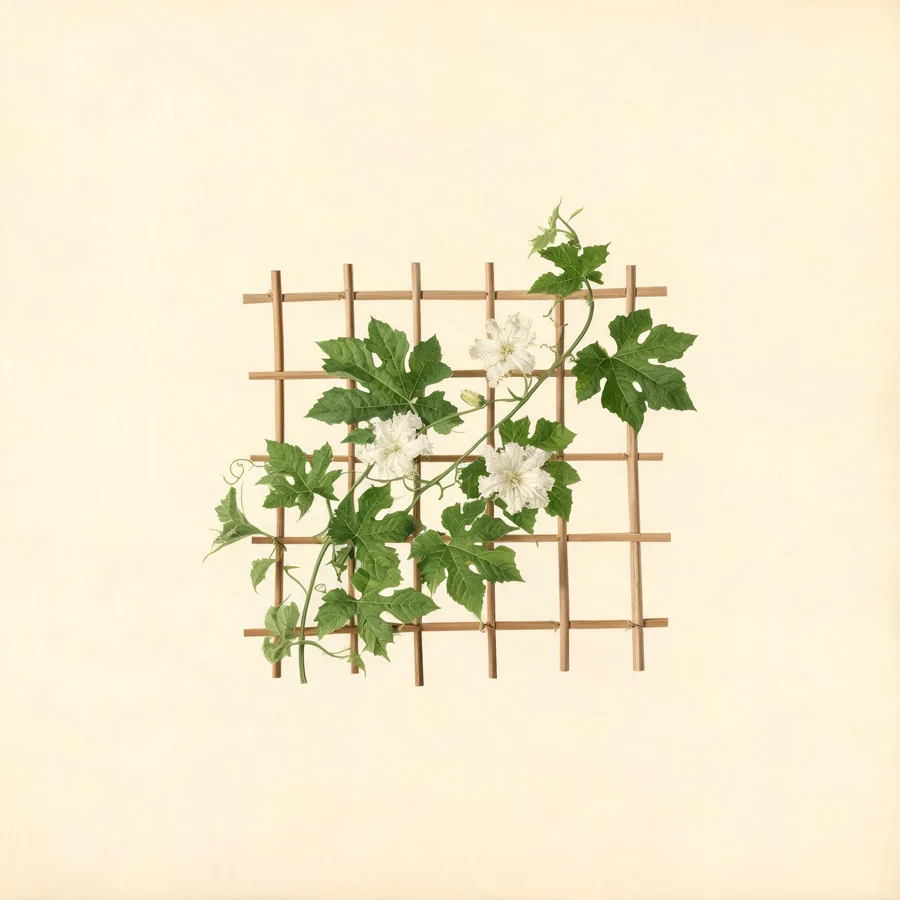
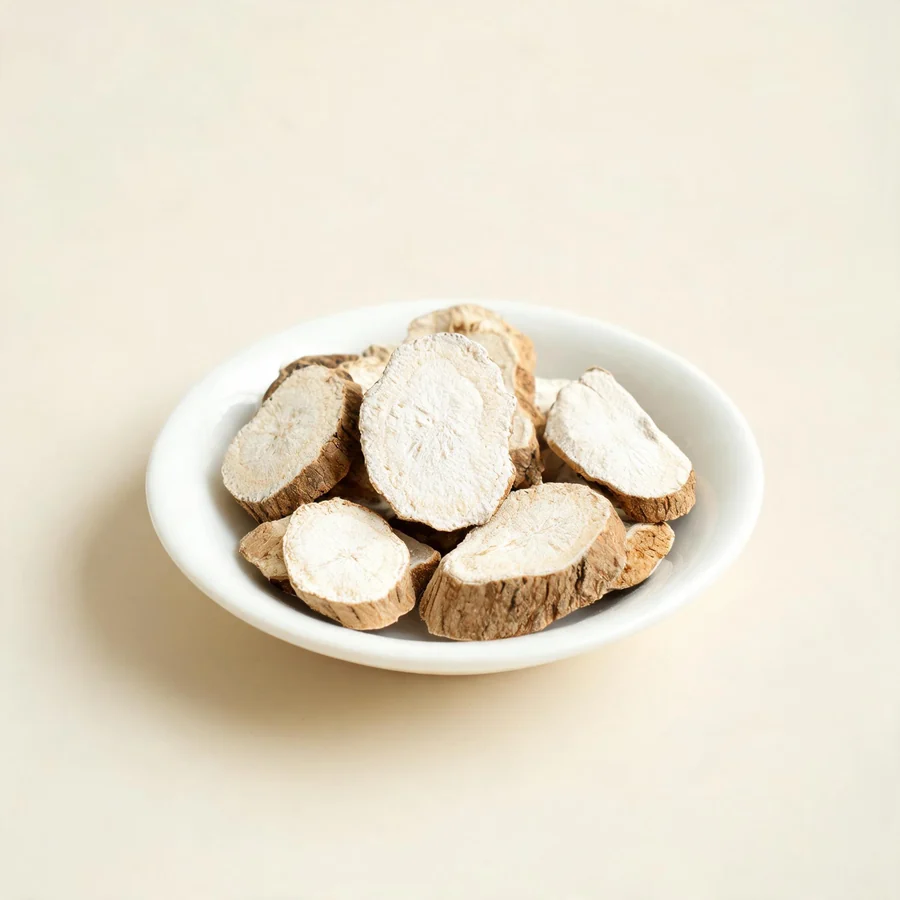
Skin profile
Where this herb sits in skin practice: the pattern it corrects, the skin signs it suits, and what it should not be used for.
Tian Hua Fen is a narrow skin herb: it is chosen for a hot swelling that will not point, for an abscess that drains badly, and for skin left dry and hot after heat has burnt the fluids. It clears and moistens at the same time, and it is oral only.
Skin signs that suggest it
- A hot, red, tense swelling that still has no point, or one that has softened but drains poorly (toxic heat in the flesh)
- A boil or carbuncle with thirst, a dry mouth and a red tongue carrying a dry yellow coat
- Skin that is hot, tight and dry, with cracked lips and a constant wish to drink (heat consuming the fluids)
- Pustular or crusted lesions appearing during a febrile illness, with scanty dark urine
- A rapid pulse with thirst that drinking does not relieve
When it is not the right herb
Not for a cold pattern: white, clear, watery discharge from a lesion and a feeling of cold are made worse by a cool, moistening root. Not for thirst that follows sweating, purging or blood loss, where the fluid has to be replaced rather than the heat cleared. Not for a weak Spleen with loose stools and a poor appetite, where the starchy coldness sits heavily. Never by injection, and never in pregnancy.
What it does for skin
Skin-relevant actions only. Each one describes a mechanism in TCM terms and what it looks like on the skin.
Clears Heat and drains Fire from the skin
The root cools excess heat in the Lung and Stomach, and on the skin that shows as a lesion that is hot to touch, bright red and throbbing, usually with fever and thirst behind it. It is not the strongest fire-clearing herb in the materia medica, and it is chosen when the heat is accompanied by dryness or by a collection forming, rather than for a raging fever on its own.
Reduces swelling and expels pus
This is the core skin action. A boil is heat toxin lodged in one spot, and the tradition separates two stages because the treatment differs. While the swelling is hard the aim is to scatter it, and once it has softened the aim is to help it drain and then to close. The root's faint bitterness is credited with a downward, draining pull that lets a collection empty, which is why it belongs among the medicines that move pus rather than those that only cool.
Generates fluids and moistens heat-dried skin
A sweet, cool root that generates fluid cools without drying the surface, which matters when heat has already left the skin tight, rough and finely cracked. It is a supporting action rather than a leading one: the herb is added to a formula for hot, dry skin with thirst, and it is chosen precisely because it will not strip the little moisture the skin has left. A purely bitter and cold herb would do the opposite.
Skin conditions it is used for
Mapped to the condition pages on this site. The pattern column shows what the skin is doing when this herb is the right choice.
| Condition | Pattern | Why it suits | Typical setting |
|---|---|---|---|
| Boils | Toxic heat in the flesh, early stage with a hard red swelling | A boil begins as a hard, tender, hot swelling that has not yet pointed, and the classical sore formulas put this root in for exactly that stage. It clears the heat, softens what has hardened and encourages the swelling to resolve rather than to gather. It works beside the toxin-resolving flowers and the pus-moving seeds, and a boil on the face or one with fever is a matter for medical assessment. | Xian Fang Huo Ming Yin |
| Skin abscess | Toxic heat with pus forming and draining badly | Once a collection has formed, the aim changes from scattering to emptying. The root's downward, draining quality is used to help a tense abscess discharge and then to support the growth of new tissue at its base. It does not replace incision or drainage, and a large, deep or rapidly enlarging collection needs a clinician rather than a decoction. | Xian Fang Huo Ming Yin with Zao Jiao Ci and Zhe Bei Mu |
| Pustules | Heat toxin producing pus in a tense lesion | A pustule is a small collection of heat toxin, and the same reasoning applies at a smaller scale: the root clears the fire, softens the lesion and encourages the pus to leave rather than to sit. It is added to a toxin-clearing formula when pustules are tense, painful and slow to settle, and it is not used for the dry, non-inflamed comedones of acne. | With Jin Yin Hua and Lian Qiao in a toxin-resolving formula |
| Hot skin swelling | Red, hot, painful swelling of skin and underlying tissue | The classical sore formulas treat a hot swelling of the flesh as toxic heat that has blocked the movement of Qi and Blood in one place. The root is one of the medicines that reduces that swelling, and its mild bitterness is held to move a collection downward and out. Any swelling that is spreading, or that comes with fever or breathlessness, needs urgent medical review rather than a formula. | Xian Fang Huo Ming Yin, with medical review for any spreading infection |
| Dry, hot skin | Heat consuming the fluids, leaving the skin hot, tight and dry | When a fever or a long hot illness has burnt through the body's moisture, the skin becomes hot, tight and rough, the lips crack and the thirst is hard to quench. A cool root that generates fluid suits that combination better than a drying cold herb, because it lowers the heat and replaces some of what the heat has taken. It is a supporting herb here, added to a fluid-generating formula rather than relied on alone. | With Mai Men Dong and Shi Gao in a fluid-generating formula |
Combinations for skin
Herbs it is paired with when the skin, not an internal organ, is the target.
| Partner | Ratio | Why the pair is used |
|---|---|---|
| Jin Yin Hua | 10 g Tian Hua Fen with 9 to 15 g Jin Yin Hua | Jin Yin Hua is among the strongest flowers for clearing heat and resolving toxin, but it does not move pus. The root supplies the swelling-reducing and pus-expelling work the flower lacks, which is why the two are used when a boil is still hard and red, with heat and pain. The flower leads on toxin and the root on the collection. |
| Zhe Bei Mu | 10 to 12 g each | Both soften what has hardened and both resolve swelling, and they divide the work: the bulb opens the lump and the root moves the pus and reduces the surrounding inflammation. The pair belongs to the classical sore formula and is used where a swelling is hard, well defined and painful. Zhe Bei Mu is the more drying of the two, so a dry-skinned person is watched for further dryness. |
| Zhi Mu | 10 g each | Zhi Mu cools the Lung and Stomach and nourishes Yin at the same time, and the root adds fluid-generating work of its own in the upper body. Between them they cover the fire that is drying the fluids and the shortage that fire leaves behind, which is why they are paired at equal weight for thirst with heat and for skin left hot and dry after a fever. |
| Mai Men Dong | 10 to 15 g Mai Men Dong with 9 to 15 g Tian Hua Fen | The two moisten the Lung from different directions. Mai Men Dong is a sticky, rich Yin tonic that restores deeper reserves and calms the spirit; this root is cooler and lighter and works nearer the surface, where skin and throat feel dryness first. They are used together for dry heat with scant phlegm and a tight, dry skin, and the lighter root balances the heavier one. |
Formulas where it leads
- Xian Fang Huo Ming Yin (仙方活命饮) - The classical formula for sores and hot swellings, in which the root works beside Zhe Bei Mu to soften the lump, clear the heat and promote drainage. It is used before a collection has formed to scatter it, and afterwards to help it empty, and it is always given with a view to the stage of the lesion rather than to the diagnosis alone.
- Ru Yi Jin Huang San (如意金黄散) - A traditional powder for external use on hot, red, painful swellings, in which this root is one of the cooling ingredients. Mixed with a liquid to a paste and applied to the skin, it is a topical companion to the internal sore formulas rather than a treatment for broken or deep infection.
Topical use
The dried root is used externally as a powder for hot, red, painful swellings, either alone or as part of a traditional cooling powder. Mixed with vinegar, egg white or cooled boiled water it forms a paste that is spread on the swelling and left for a short period. Topical use is limited to intact skin over a superficial lesion, and it does not make a deep or spreading infection safe to treat at home.
| Preparation | How and when it is used |
|---|---|
| Vinegar or water paste | A small quantity of finely ground root mixed with rice vinegar or cooled boiled water to a smooth paste, spread thinly over the swelling and covered with gauze. Left for 20 to 30 minutes once or twice daily, then washed off with lukewarm water. Vinegar is the traditional choice and stings on broken skin, so water is used when the surface is not intact. |
| Cooling powder blend | The root combined with other cooling powders in a traditional preparation such as Ru Yi Jin Huang San, mixed to a paste at the time of use. Applied to intact skin over a hot swelling, kept away from the eyes, mouth and genitals, and removed if the skin stings or reddens further. |
Patch test and cautions
Patch test on normal skin for 24 hours first, and do not apply to broken, ulcerated or deep infected skin without supervision. Keep the paste away from the eyes, mouth and genital skin, and do not cover it with an occlusive dressing. Stop if burning or spreading redness develops. The oral safety of this root says nothing about purified trichosanthin given by injection, which is a different medicine.
Safety for skin use
What to check before recommending or using it, including the cautions that matter most for skin patients.
Do not use, or use with caution
- Pregnancy, at every stage. Trichosanthin is selectively toxic to the placental trophoblast, and the tradition forbids the root itself, not just the protein, even in a boiled decoction where most of it is destroyed. This is a prohibition rather than a caution.
- The aconites, including Fu Zi, Chuan Wu and Cao Wu. The root comes from the Gua Lou plant and therefore falls under the classical Eighteen Incompatibilities rule against combining aconite with Gua Lou. That rule rests on tradition rather than on testing, yet no practitioner sets it aside.
- Loose stools, no appetite and a cold abdomen point to a weak Spleen, and a cold, moistening, starchy root can loosen the stool further and leave a heavy feeling after eating.
- Known allergy to Trichosanthes species, and any earlier rash, urticaria or swelling after taking the root or a related preparation. A reaction to the first dose means stopping, not continuing at a lower dose.
Pregnancy and breastfeeding
Absolutely contraindicated. The purified protein kills the syncytiotrophoblast cells of the placenta; that tissue necroses, the placental blood supply fails, pregnancy hormones drop, and the uterus contracts. The root has also been described as acting directly on uterine muscle and raising its sensitivity to oxytocin. The ban stands even where a decoction has been boiled and most of the protein destroyed, because the tradition forbids the root itself and not only the protein.
Interactions
- Blood sugar is the interaction to watch. Root extracts have been shown to lower glucose in laboratory and animal studies, and a review of Taiwanese diabetes prescribing recorded it as the single herb written most often. Anyone who uses insulin or a sulphonylurea would be combining two glucose-lowering agents, which argues for more frequent testing and a word with the prescriber.
- Anticoagulants such as warfarin, heparin and the direct oral agents are a theoretical concern. The clotting observations come from the injected protein rather than from a swallowed decoction, but the caution is retained, and anyone on these medicines should have the combination supervised rather than self-prescribed.
- Immunosuppressants are a further theoretical concern, because trichosanthin has shown immune activity in laboratory work. At decoction doses the protein is denatured, so the risk is small, but a person on a drug that suppresses immunity should disclose any herb before adding it.
Allergy and patch testing
Allergy to Trichosanthes species rules the root out, and reactions on record include rash, urticaria and, rarely, the kind of hypersensitivity seen with the injected protein. Serious heart, liver or kidney disease calls for caution because a high dose falls on those organs. A short standard course is still considered safe, but the material should come from a prescription rather than a home-made blend.
General safety references
General references for herbal hepatotoxicity and herb-drug interactions; they are not specific to this herb.
- Review article: Herbal hepatotoxicity - an update on traditional Chinese medicine preparations. Alimentary Pharmacology & Therapeutics, 2014. PMID: 24844799.
- Interactions between herbal medicines and prescribed drugs: an updated systematic review. Drugs, 2009. PMID: 19719333.
- Warfarin and food, herbal or dietary supplement interactions: a systematic review. British Journal of Clinical Pharmacology, 2021. PMID: 32478963.
Evidence
The classical record is quoted with its source. The modern note states the level of evidence plainly.
Classical record
主消渴,身热,烦满,大热,补虚安中,续绝伤。
Its indications are wasting and thirsting, heat in the body, restlessness with a feeling of fullness, and great heat. It is also held to supplement what is deficient, to calm the middle, and to mend an injury that has severed tissue.
Shen Nong Ben Cao Jing, under the plant name Gua Lou Gen - The earliest record, filed under the plant rather than under the root name in use today, and it carries both the thirst theme and the repair of damaged tissue.
最凉心肺,善解热渴,大降膈上热痰,消乳痈肿毒痔瘘疮疖,排脓生肌长肉……
It cools Heart and Lung more than anything else, resolves heat and thirst well, brings down hot phlegm above the diaphragm, and disperses breast abscess, toxic swelling, haemorrhoids, fistula and sores. It expels pus and encourages new flesh to grow.
Jing Yue Quan Shu (The Complete Works of Jing Yue), Zhang Jiebin - The clearest classical statement of the action that moves pus, and the line that places the root in the sore and abscess formulas.
栝楼根,味甘微苦酸,酸能生津,故能止渴润枯,微苦降火,甘不伤胃,昔人只言其苦寒,似未深察。
Li Shizhen describes the root as sweet, slightly bitter and sour. The sour taste, he argues, generates fluid and therefore relieves thirst and moistens what is parched; the slight bitterness sends fire downward; the sweetness means the Stomach is not harmed. Earlier writers, he adds, called it merely bitter and cold, and in his view they had not looked closely enough.
Ben Cao Gang Mu (Compendium of Materia Medica), Li Shizhen - The point is clinically important: a root that is merely bitter and cold drains, while one that is sweet and sour can restore what heat has burnt away.
Modern evidence
Evidence status
- The protein at the centre of this root's safety story is a ribosome-inactivating one: boiling denatures it and gut enzymes break it down. That is why a decoction and a purified injection are not the same medicine, and why the injection's hazards, anaphylaxis among them and its action on placental tissue, do not transfer to a swallowed decoction.
- Laboratory work on root extracts and on trichosanthin reports anti-inflammatory and immune activity, and the protein has been studied for effects on cell growth. None of this is a trial of the root in skin disease, and no claim about boils, abscesses or dry skin can be based on it.
- Clinical trial evidence for this root in skin conditions is absent or limited to small Chinese-language formula studies in which it is one ingredient. The root is an accepted herbal substance in the Chinese Pharmacopoeia, while purified trichosanthin is a separate regulated medicine with its own risks.
PubMed records
Selected real PubMed records for this herb's species or its constituents, chosen by species name and title relevance. They are references for the non-TCM discussion above, not proof that the herb treats any skin condition.
- Study on the mechanism of Trichosanthes kirilowii Maxim. against COPD based on serum chemical composition analysis, network pharmacology, and experimental study.. Phytomedicine : international journal of phytotherapy and phytopharmacology, 2025. PMID: 40023967 (pharmacology or review record).
- Trichosanthis Fructus: botany, traditional uses, phytochemistry and pharmacology.. Journal of ethnopharmacology, 2018. PMID: 29842965 (pharmacology or review record).
Dose and forms
Skin-practice dosing and the preparations that suit skin complaints.
| Form | Dose and notes |
|---|---|
| Decoction (oral only) | 9 to 15 g of dried root daily in a formula, with the lower end for a dry cough and a supporting job in the formula and the upper end for a febrile picture with marked thirst. Nothing but a decoction belongs in home use, because the protein hazard sits with the purified injection. |
| Higher range in fever | Up to 30 g for a short period when thirst and dryness are pronounced, under practitioner supervision. Historical sources describe far larger figures for wasting and thirsting, which are supervised measurements and not a dose to copy. |
| Powder for external use | A small quantity of finely ground root, often as part of a cooling powder blend, mixed to a paste at the time of use and applied to intact skin over a hot swelling for 20 to 30 minutes. |
| Course length | Short, typically one to two weeks, and stopped when the swelling resolves or the thirst settles. A cold starchy root taken for months is a reliable route to loose stools and a dull appetite. |
Route matters more than grams with this root. The decoction is oral only, since the protein hazard sits with the purified injection, and the dose is set by the digestion as much as by the lesion: a cold, moistening, starchy root sits heavily in a weak Spleen, so there the dose is kept small and the course short. Powdered root needs a smaller weight than a decoction, because nothing is lost in the water.
Citations and further reading
Only real sources are listed: the classical materia medica passages quoted above, and the source works behind the botanical and safety statements.
- Shen Nong Ben Cao Jing (Divine Husbandman's Classic of Materia Medica), attributed compilation of the Han period - classical entry quoted above under the name Gua Lou Gen.
- Jing Yue Quan Shu (The Complete Works of Jing Yue), Zhang Jiebin, 1624 - classical entry quoted above.
- Ben Cao Gang Mu (Compendium of Materia Medica), Li Shizhen, 1578 - classical entry quoted above.
- Radix Trichosanthis monograph: Pharmacopoeia of the People's Republic of China - accepted botanical source, part used and quality requirements.
- Modern evidence statement: based on pharmacological literature on trichosanthin and on the protein's route-dependent behaviour, summarised as a statement about the level of evidence rather than as a cited finding.
- Botanical description and identification: botanical literature on Trichosanthes kirilowii, Cucurbitaceae, including the related species sold as substitutes.
Educational reference for qualified practitioners. This page is not medical advice, and skin conditions should be diagnosed by a clinician before treatment.