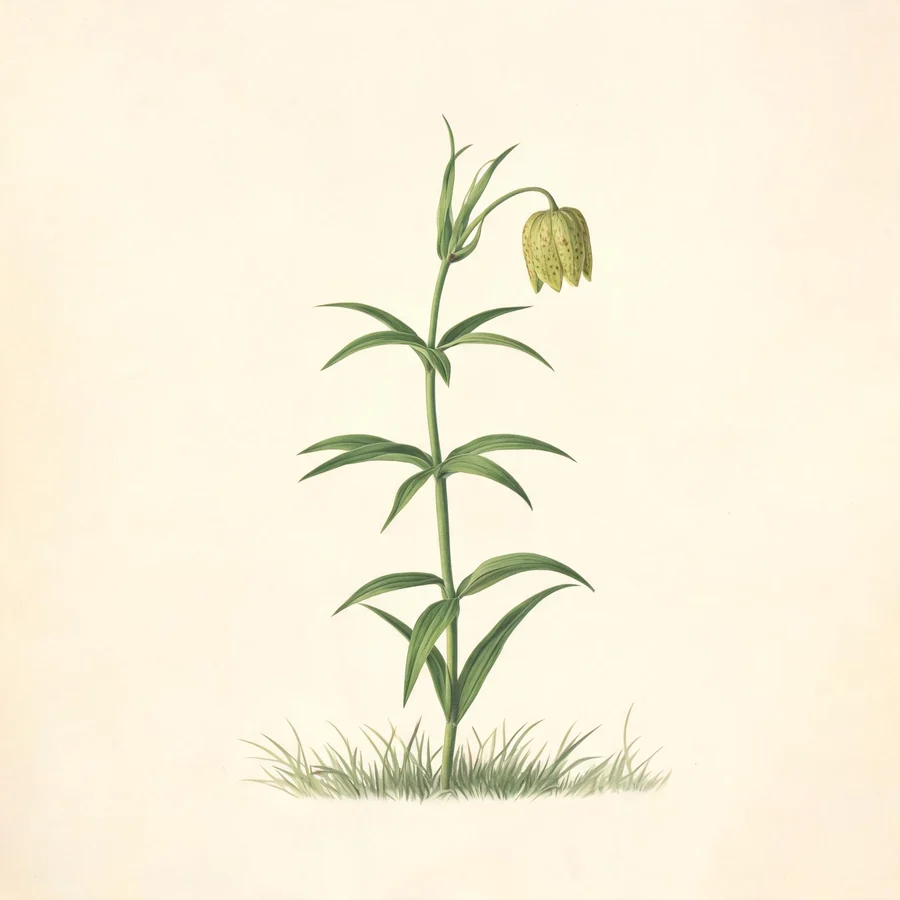
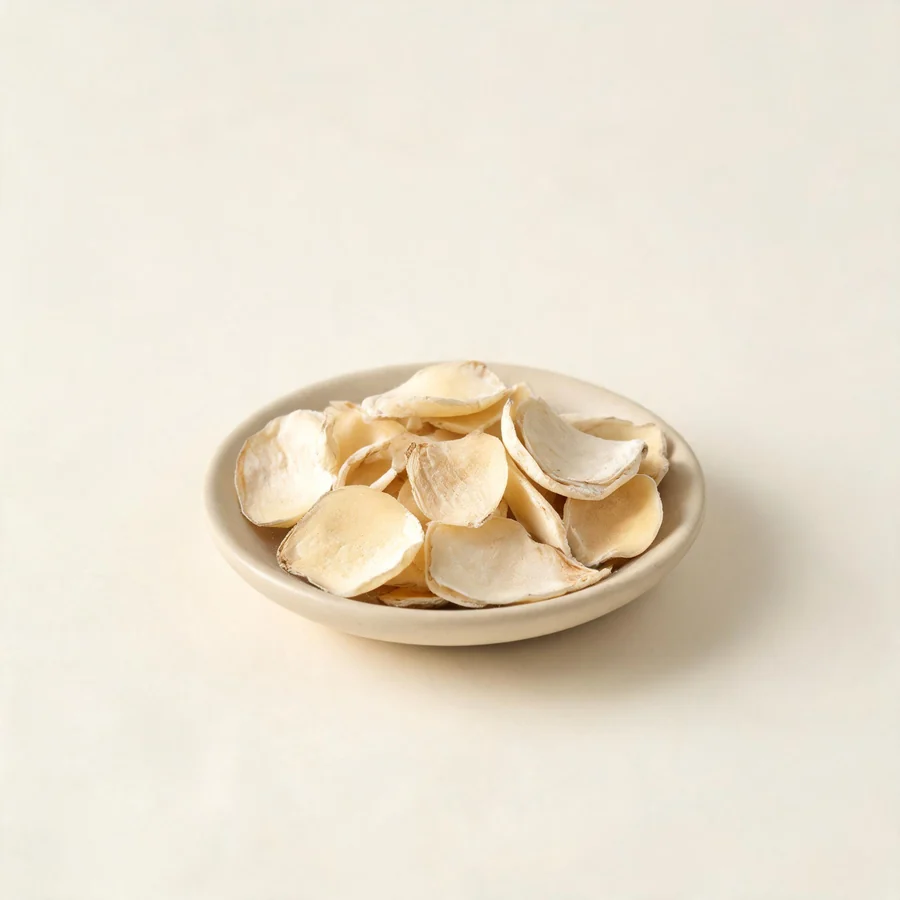
Skin profile
Where this herb sits in skin practice: the pattern it corrects, the skin signs it suits, and what it should not be used for.
Zhe Bei Mu is a nodule herb before it is a skin herb. The lesion it suits is hard, localised and inflamed rather than a general rash, and the most useful question in clinic is whether the lump is soft and inflammatory or firm and fixed, because only the first is likely to respond. The aconite rule is checked before anything else.
Skin signs that suggest it
- A hard, warm, tender lump under the skin that has not yet come to a head
- A boil or abscess with a red base, a dusky centre and thick pus that drains slowly
- Firm, rubbery or stony glandular swellings in the neck or under the jaw
- A nodule left behind after an inflamed lesion has settled, or a cyst that keeps refilling
- A yellow greasy tongue coating and a slippery, rapid pulse with local heat and swelling
When it is not the right herb
Not for a cold, thin, watery discharge or a pale swelling that pits on pressure: those are cold-phlegm pictures, and a bitter cold bulb makes them worse. It is also wrong for dry, scaly or weeping skin with no lump at all, where there is nothing for it to disperse, and for a depleted person with a poor appetite and loose stools. A painless, soft lump that has been present for months is a diagnosis before it is a prescription, and it should not be self-treated with any herb. The aconite rule is absolute rather than a caution: no Wu Tou, and none of Fu Zi, Chuan Wu or Cao Wu, in the same prescription or on the same day.
What it does for skin
Skin-relevant actions only. Each one describes a mechanism in TCM terms and what it looks like on the skin.
Breaks up nodules under the skin
Phlegm that has been thickened by fire and held in one place becomes a lump, and that is the lesion this bulb is chosen for: a firm, localised swelling that is warm and tender, whether it sits in the neck, the breast, the jaw or the subcutaneous fat. The bitter cold clears the heat that hardened it and the dispersing quality loosens the mass, so the lump softens, becomes less tender or comes to a head. It is the herb to reach for when a lesion is discrete and hard rather than a generalised rash.
Resolves heat toxin and discharges pus
Where heat toxin has concentrated into a boil, a carbuncle or a breast abscess, the bulb clears the toxin and helps the pus leave instead of being walled off. It suits the early spreading phase, when the lesion is red, hot and hard with a dusky centre, and it is combined with toxin-resolving herbs such as Pu Gong Ying and Lian Qiao. What changes on the skin is that the induration around the lesion softens and the pus finds a way out; a lesion that spreads despite this needs medical assessment.
Cools Lung and Heart heat behind facial lesions
The bulb enters the Heart and Lung channels, and the face and upper trunk are read as their territory, which is why it appears in formulas for stubborn facial papules, boils around the nose and mouth, and hot swellings of the head and neck. The heat it clears is the kind that produces a raised, tender, deep lesion rather than a flush, and it is usually combined with herbs that release the surface or drain the lower body so the heat has somewhere to go.
Works as a topical powder on hard sores
Ground to a fine powder, the bulb is applied directly to boils, sores and hard swellings, either dusted on or mixed into a paste with water or vinegar. The external use follows the same logic as the internal one: the powder is held to soften the hardness and draw the lesion to a head. It is a small-area application, and it belongs on intact skin or on a sore that is already draining, not on a deep or spreading infection.
Skin conditions it is used for
Mapped to the condition pages on this site. The pattern column shows what the skin is doing when this herb is the right choice.
| Condition | Pattern | Why it suits | Typical setting |
|---|---|---|---|
| Boils | Heat toxin with phlegm congealed into a hard boil | A boil that starts as a deep, hard, painful nodule and only slowly comes to a head is read as toxin held in congealed phlegm, which is precisely the combination this bulb addresses. It clears the heat, resolves the toxin and softens the induration, and it is used in the early phase before the lesion has discharged. A boil on the face, a boil with spreading redness or one accompanied by fever belongs to medical care, and the herb is an adjunct rather than the answer. | Xian Fang Huo Ming Yin, which contains Bei Mu among its toxin-resolving herbs |
| Skin abscess | Toxic heat with pus and a hard, indurated rim | An abscess is a collection of pus that the body has walled off, and the wall is the part this bulb works on: the firm, tender rim that stops the pus draining. Its nodule-dispersing action softens that rim while its toxin-clearing action addresses the heat driving the collection. It is used with herbs that discharge pus and move blood, and any abscess that is large, deep, facial or accompanied by fever needs drainage and antibiotics rather than a prescription. | Xian Fang Huo Ming Yin, or a modified Wu Wei Xiao Du Yin with Zhe Bei Mu |
| Subcutaneous lipomas and nodules | Phlegm congealed into a soft or firm subcutaneous nodule | A lipoma is read as phlegm that the Spleen has failed to transform, collecting in the space under the skin, and the traditional approach is to dry the dampness, move the phlegm and soften the mass. The bulb's dispersing quality makes it a natural partner for Mu Li and Xuan Shen, but the honest limit is that a slow-growing fatty lump rarely dissolves. The value of treatment is in nodules that are inflammatory, tender or changing, and a lump that is growing quickly, fixed or painful needs imaging before it needs herbs. | Modified Er Chen Tang with Zhe Bei Mu, Mu Li and Xuan Shen |
| Sebaceous cysts | Damp-phlegm nodule with a blocked follicle | A cyst that refills after being emptied is read as a pocket of damp-phlegm with a stubborn wall, and the bulb is used to dry the dampness and soften that wall rather than to suppress the swelling. It is combined with herbs that transform phlegm and with cooling herbs if the cyst has become inflamed. The clinical caution is that an inflamed or rapidly enlarging cyst can be infected or something else entirely, and a cyst that keeps returning is a matter for a dermatologist or a surgeon. | Modified Er Chen Tang with Zhe Bei Mu and Mu Li, or Xiao Luo Wan for a firm nodule |
| Folliculitis | Heat toxin lodged at the follicle, with small hard papules | Folliculitis that produces small, firm, tender papules rather than a weeping rash fits the bulb's combination of heat-clearing and nodule-dispersing. It is used where the bumps are hard and slow to settle, particularly on the back, shoulders and buttocks, and it is combined with herbs that clear heat toxin and with washes that keep the surface clean. Widespread, recurrent or antibiotic-resistant folliculitis needs a diagnosis, and a single herb is not a substitute for it. | Modified Wu Wei Xiao Du Yin with Zhe Bei Mu and Pu Gong Ying |
Combinations for skin
Herbs it is paired with when the skin, not an internal organ, is the target.
| Partner | Ratio | Why the pair is used |
|---|---|---|
| Xuan Shen | 1:1, often 15 g each | Xuan Shen feeds the Yin and cools the fire of deficiency, while the bulb clears heat and loosens phlegm, so the pair treats both the dryness that lets fire take hold and the lump that fire has hardened. It is the pairing chosen for hard masses, among them scrofula, thyroid enlargement and swollen lymph nodes, and it is the backbone of Xiao Luo Wan. For the skin it suits a nodule in a person who is dry, thirsty and restless rather than robust and damp. |
| Mu Li | 2:1, with Mu Li at 30 g and Zhe Bei Mu at 15 g | Oyster shell is heavy and mineral, and it softens hardness and settles rising fire, while the bulb dissolves the phlegm substance of the mass and clears the heat inside it. One works on the texture of the lump, the other on what the lump is made of, which is why the two form the fixed backbone of nodule-dispersing formulas. In skin practice the pair is used for firm cysts and indurated lesions that have not responded to drying herbs alone. |
| Pu Gong Ying | 9 to 15 g each | Dandelion is the workhorse for heat toxin with swelling and suppuration, and the bulb adds the ability to break up the hard core of the lesion. Together they suit boils, carbuncles and abscesses that are red, hot and slow to drain, and the pair is usually set inside a larger toxin-resolving formula rather than used alone. Dandelion is cooling and slightly draining, so the combination is kept short in a cold or depleted person. |
| Lian Qiao | 6 to 10 g each | Forsythia clears heat and resolves toxin, and it has its own classical use for scrofula and for hot, swollen glands, which is where it overlaps with the bulb. The pair is chosen when a boil or a chain of neck lumps sits on a background of feverishness and a red throat. Both are cold, so the combination is for the acute, hot phase, and it is reduced once the lesion has drained and the heat has gone. |
| Zhi Mu | 1:1, often 10 g each | This is the Er Mu pairing: Zhi Mu cools heat while feeding Yin, and the bulb cools heat while resolving phlegm, so one works on the source and the other on what the heat has produced. It is used where a dry mouth, night sweats or a low-grade fever accompanies a nodule or a stubborn boil, which is the picture of Yin deficiency with phlegm-fire rather than simple excess heat. It is a gentler combination than the toxin-resolving pairs, and it suits a thinner, drier patient. |
Formulas where it leads
- Xian Fang Huo Ming Yin (仙方活命饮) - The classical formula for the early stage of a boil or abscess, before it has suppurated, built on Jin Yin Hua and combined with herbs that move blood, resolve toxin and disperse swelling. Bei Mu sits among them to soften the induration, and the formula is the clearest illustration of how the bulb is used in practice: as one element in a coordinated attack on a hot, hard lesion rather than as a stand-alone remedy.
- Xiao Luo Wan (消瘰丸) - The three-herb formula of Xuan Shen, Mu Li and Zhe Bei Mu, used for scrofula and for firm nodules of the neck. Its logic is the same as the pairings above: soften the mass, dissolve the phlegm and clear the fire that hardened it. It is a formula for a diagnosed nodule, and any neck lump needs assessment before it is treated.
Topical use
Zhe Bei Mu is applied to the skin as a fine powder, either dusted directly onto a boil or a sore or mixed into a paste with water, vinegar or a little honey. The external use follows the internal logic: the powder is held to soften a hard swelling and to draw a lesion to a head. It is a small-area application for a discrete lesion, and it is not a wash or a bath herb, because the powder is drying and gritty and is not meant for a broad surface.
| Preparation | How and when it is used |
|---|---|
| Powder for a single lesion | One to two grams of the finely ground bulb is dusted onto the head of a boil or onto a hard swelling, once or twice daily, with a light clean dressing over it. The area is cleaned and dried first, and the powder is kept off the surrounding skin, which the drying material can irritate. Stop when the lesion drains freely or when the skin around it becomes redder. |
| Paste for a hard, unopened swelling | The powder is mixed with a little warm water or rice vinegar to a thick paste and spread over the swelling, leaving a margin of normal skin. It is left for twenty to thirty minutes and then washed off, once daily for a few days. Vinegar is more drying and more irritant, so water is the safer base for thin or sensitive skin. |
| Blended with cooling powders | In traditional practice the bulb is blended with other cooling, nodule-dispersing powders such as Mu Li or Xuan Shen and applied sparingly. Because the mixture is more drying than the bulb alone, it is used only on small, well-defined lesions and never on a broad area of dry skin. |
Patch test and cautions
Patch test on a small area of normal skin for twenty-four hours before the first application, and do not apply the powder to a deep, spreading or badly infected lesion without clinical supervision. Keep it away from the eyes, the mouth and broken skin, and stop at once if burning, stinging or spreading redness appears. A powder that cakes and cracks the skin should be removed and the area left bare, and no occlusive dressing should be used over it.
Safety for skin use
What to check before recommending or using it, including the cautions that matter most for skin patients.
Do not use, or use with caution
- Aconite in any form. Bei Mu is listed against Wu Tou in the Eighteen Incompatibilities, and that includes Fu Zi, Chuan Wu and Cao Wu, whether in a decoction or a patent medicine. Giving them together increases the release of toxic aconitine alkaloids, so the pairing is refused rather than monitored.
- Cold-phlegm and Spleen deficiency-cold: thin white watery sputum, a poor appetite, loose stools and cold limbs. The bulb is bitter and cold, and in this picture it damages the digestion without clearing anything that needs clearing.
- Dry, scaly or weeping skin with no lump. There is nothing for a nodule-dispersing herb to work on, and its drying quality makes a dry surface worse.
- A new, painless or rapidly growing lump that has not been assessed. Treatment with a herb before a diagnosis can delay the assessment of a lesion that needs imaging or a biopsy.
Pregnancy and breastfeeding
No classical prohibition is recorded for the bulb, and it is not listed among the strong blood-moving or toxic herbs, but it is bitter and cold and is therefore used cautiously in pregnancy. Short courses at standard doses for an acute hot swelling are the usual compromise, and only under practitioner supervision. Nothing is known about how its alkaloids behave in breast milk, so the same short-course, supervised approach applies while nursing, and a mother with a persistent or enlarging lump should be assessed rather than treated.
Interactions
- Aconitum-containing medicines are the interaction that matters, and it is absolute. This covers prescribed aconite decoctions and patent medicines that list Fu Zi, Chuan Wu or Cao Wu, because co-administration raises the release of toxic alkaloids and can turn a safe dose into a dangerous one.
- Blood pressure medicines. The bulb's alkaloids lower blood pressure at larger doses in animal work, so an additive fall is possible in someone already on antihypertensives, particularly an older person who is prone to dizziness on standing.
- Sedatives, opioid analgesics and other respiratory depressants. Peimine and peiminine show central depressant effects in animals and can depress respiration at high doses, so the combination is avoided in a person with breathing difficulty or in a frail older patient.
Allergy and patch testing
Contact reactions to the powder are usually irritant rather than allergic, because the ground bulb is drying and abrasive, but a genuine sensitivity is possible and a previous reaction to a herb-containing powder is a reason not to use it again. Patch test first, keep the application to a small area, and stop if the skin becomes more rather than less inflamed. A rash that spreads beyond the treated area suggests a true allergy and needs assessment.
General safety references
General references for herbal hepatotoxicity and herb-drug interactions; they are not specific to this herb.
- Review article: Herbal hepatotoxicity - an update on traditional Chinese medicine preparations. Alimentary Pharmacology & Therapeutics, 2014. PMID: 24844799.
- Interactions between herbal medicines and prescribed drugs: an updated systematic review. Drugs, 2009. PMID: 19719333.
- Warfarin and food, herbal or dietary supplement interactions: a systematic review. British Journal of Clinical Pharmacology, 2021. PMID: 32478963.
Evidence
The classical record is quoted with its source. The modern note states the level of evidence plainly.
Classical record
解毒利痰,开宣肺气,凡肺家夹风火有痰者宜此。
It neutralises toxin and disperses phlegm, and it opens and spreads the Qi of the Lungs. Wherever the Lungs hold Wind-Fire together with phlegm, this bulb is the appropriate choice.
Ben Cao Gang Mu Shi Yi (Supplement to the Compendium of Materia Medica), Zhao Xuemin, 1765 - The line joins toxin-clearing to phlegm-moving, which is exactly the combination a boil is read to represent: heat toxin held inside congealed phlegm. It is the classical warrant for the skin use rather than a description of it.
象贝母蓄寒泄降,而能散结。
Xiang Bei Mu holds cold within it and drains downward, and it has the capacity to break up and disperse gatherings and nodes.
Ben Cao Zheng Yi (Orthodox Materia Medica), late Qing dynasty - Dispersing nodes is the phrase later practice took for scrofula, cysts and hard lumps under the skin, and it remains the shortest statement of what the bulb does to a lesion that will not soften.
Modern evidence
Evidence status
- The alkaloids peimine and peiminine have been studied mainly in laboratory and animal work, where they show antitussive, expectorant and blood-pressure-lowering activity. None of that work tests the bulb against a skin condition, and it does not establish that the herb dissolves a cyst or a boil in a person.
- No controlled clinical trial of the bulb in boils, cysts or any other skin disease is available to cite. Its skin use is recorded formula practice, and the honest position is that a hard lump should be diagnosed before it is treated with a herb.
- Regulatory status: the dried bulb is an accepted herbal substance in the Chinese Pharmacopoeia and is classified as non-toxic at ordinary doses. The restriction attached to it is the aconite incompatibility rather than intrinsic poisoning.
PubMed records
Selected real PubMed records for this herb's species or its constituents, chosen by species name and title relevance. They are references for the non-TCM discussion above, not proof that the herb treats any skin condition.
- Fritillariae Thunbergii Bulbus: Traditional Uses, Phytochemistry, Pharmacodynamics, Pharmacokinetics and Toxicity.. International journal of molecular sciences, 2019. PMID: 30987173 (safety record).
- Elucidating anti-triple-negative breast cancer mechanisms and mitigating toxicity of Fritillaria thunbergii Miq.: A multi-omics and network pharmacology approach.. Journal of ethnopharmacology, 2026. PMID: 40953776 (safety record).
Dose and forms
Skin-practice dosing and the preparations that suit skin complaints.
| Form | Dose and notes |
|---|---|
| Decoction | Five to ten grams of the dried bulb, crushed, in a formula. Up to 15 g is on record for acute heat with a hard, painful swelling under supervision, and doses are kept lower where the digestion is weak. |
| Powder | One to two grams of the finely ground bulb, two or three times daily, stirred into warm water or taken with honey. Powder is the preferred route because the alkaloids extract poorly in water, and it is also the form used externally. |
| Topical | One to two grams dusted on a single lesion, or mixed to a paste, once or twice daily for a few days. |
| Course length | A short course of one to two weeks for an acute boil or swelling, or longer for a nodule under review. Stop and reassess if the lesion enlarges, if fever develops or if the digestion becomes loose. |
The bulb is bitter and cold, so the dose is kept small in someone prone to loose stools or a poor appetite, and it is nearly always given inside a formula rather than alone. Powder is preferred for its alkaloids and for external use, while decoction is used when other roots are being cooked anyway. The ceiling is not a toxicity ceiling but the aconite rule and the coldness of the herb: there is no safe way to combine it with aconite, and there is no advantage in exceeding the standard range.
Citations and further reading
Only real sources are listed: the classical materia medica passages quoted above, and the source works behind the botanical and safety statements.
- Ben Cao Gang Mu Shi Yi (Supplement to the Compendium of Materia Medica), Zhao Xuemin, 1765 - classical entry quoted above.
- Ben Cao Zheng Yi (Orthodox Materia Medica), late Qing dynasty - classical entry quoted above.
- Zhe Bei Mu monograph: Pharmacopoeia of the People's Republic of China - accepted botanical source, part used and the non-toxic classification.
- Eighteen Incompatibilities (shi ba fan), classical incompatibility list - the source of the rule against combining Bei Mu with Wu Tou.
- Modern evidence statement: based on pharmacological literature on peimine and peiminine, summarised as a statement about the level of evidence rather than as one cited finding.
- Botanical description and identification: botanical literature on Fritillaria thunbergii, Liliaceae.
Educational reference for qualified practitioners. This page is not medical advice, and skin conditions should be diagnosed by a clinician before treatment.