Skin profile
Where this herb sits in skin practice: the pattern it corrects, the skin signs it suits, and what it should not be used for.
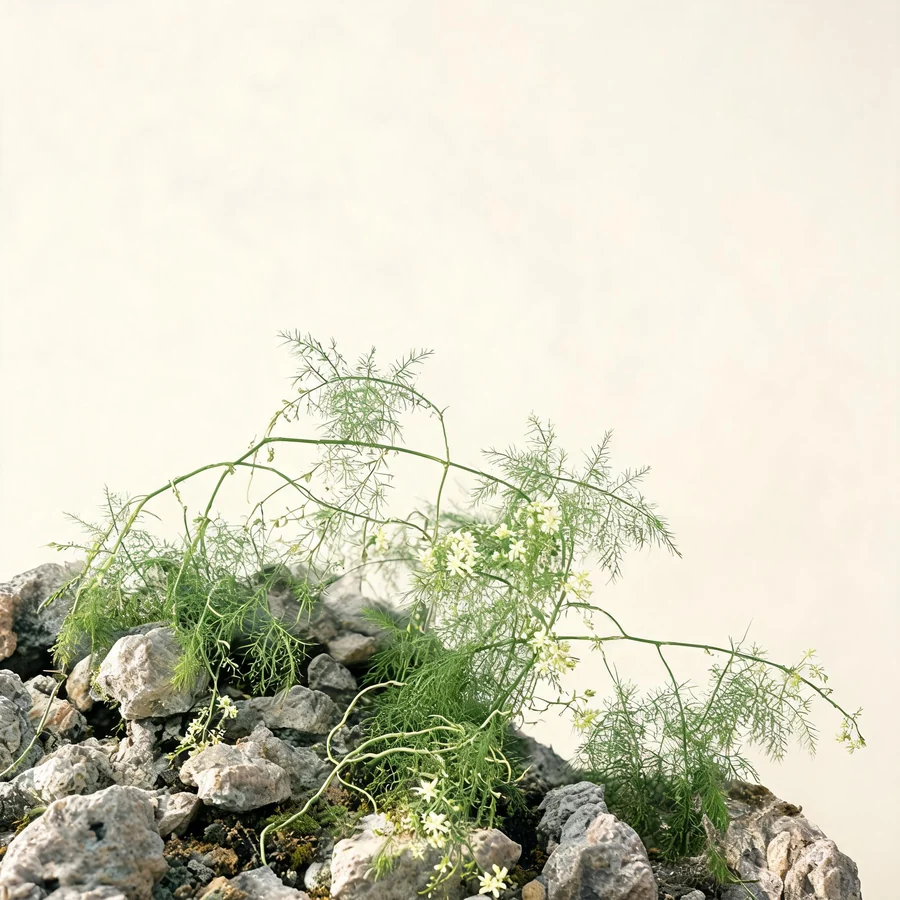
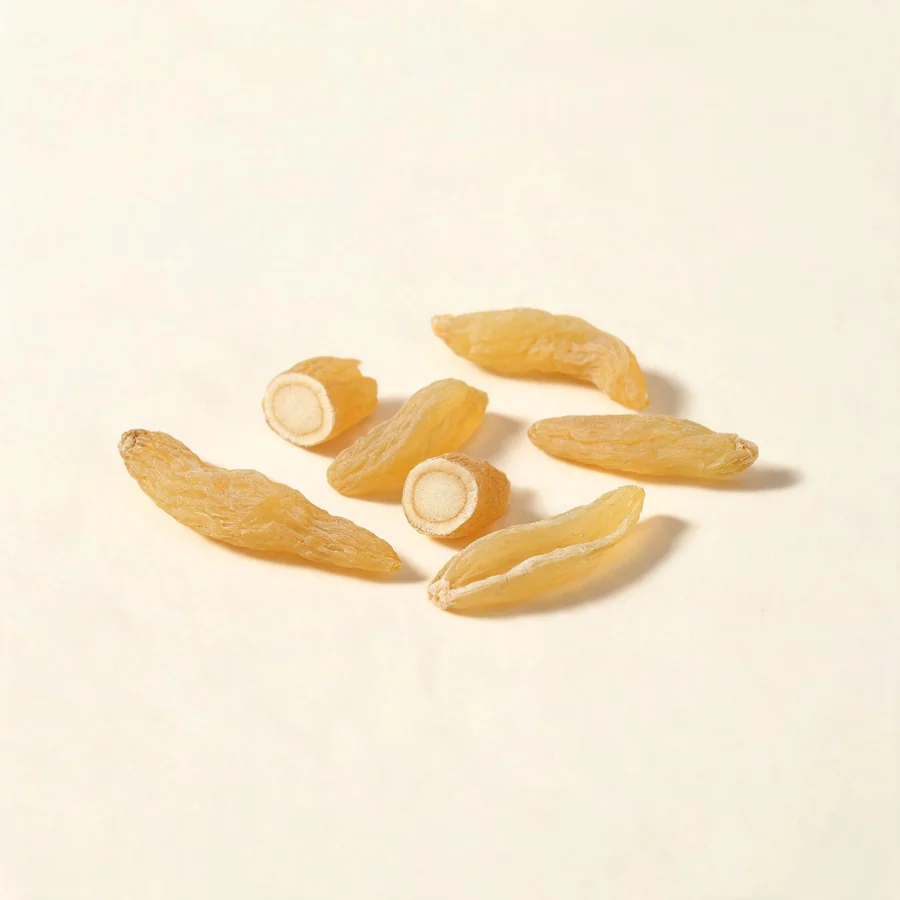
Tian Men Dong is for skin that has dried from within: thin, tight, scaling and itchy, with the low-grade heat, thirst and night sweats of Yin depletion behind it. It is slow, rich and cold, so it suits a depleted person with a steady digestion and not a damp, greasy or weeping skin.
Skin signs that suggest it
- Skin that is thin, tight and finely scaling, with a papery feel rather than redness or ooze
- Itch that is worse at night, in winter or in a heated room, with little to see beyond scratch marks
- Cracks at the knuckles, heels or lips that keep reopening, with a dry throat and thirst
- Dryness together with low-grade heat: warm palms and soles, night sweats and a dry mouth after dark
- A red tongue with little or no coating, and a thin, rapid pulse
When it is not the right herb
Not for greasy, weeping or swollen skin, and not where the tongue is thickly coated and the person feels heavy after eating, because a cold rich tuber adds to dampness. It is not for the opening stage of a cold with chills and clear watery sputum, where a moistening herb is held to drive the pathogen inward, and not for a throat that is fiery, swollen and purulent, a picture of heat toxin rather than dryness. It is also a poor choice in a small child’s cough or in anyone whose appetite falls on rich food.
What it does for skin
Skin-relevant actions only. Each one describes a mechanism in TCM terms and what it looks like on the skin.
Nourishes Yin and restores the moisture of the skin
Yin is the tradition’s term for the cooling, storing and moistening part of the body’s substance, and skin dried from within is its visible sign: thin, tight, finely lined and slow to heal. Its sweetness is read as building and its coldness as cooling, so it restores a reserve rather than wetting a surface. That is why it is given over weeks and why a single dose does nothing for the skin, with the change appearing as the tightness eases and the cracks close.
Clears the low-grade heat that dries the skin
Where dryness has been joined by deficiency heat, the skin is dry and warm to the touch, the face flushes in the afternoon, the palms and soles are hot and the person sweats at night. The bitter element of the taste is described as draining, so rising heat is drawn down while the sweet element supplies what the heat has consumed. Skin that is hot and dry in this way is a different picture from skin that is hot and red, and the tuber suits the first and not the second.
Moistens the Lung so that the skin is supplied from above
The tradition pairs the Lung with the skin, holding that the Lung disperses moisture out to the surface, so a dry Lung shows as dry skin. The action of the tuber on the Lung is why it is chosen when the dryness began with a long dry cough or a fever that left the throat raw. Treating the upper source is the classical strategy, and it explains why the herb appears in formulas for dry skin that follow a respiratory illness.
Eases the dry bowel that comes with dry skin
Fluid depletion dries the bowel as well as the skin, and hard dry stool without heat or spasm belongs to the same picture. The tuber lubricates rather than purges, so it is used where a laxative would be too violent and where the stool is dry rather than sticky. Skin and bowel are read together, and easing one is taken as evidence that the other is being supplied, which is why the herb is continued for a fortnight before it is judged.
Skin conditions it is used for
Mapped to the condition pages on this site. The pattern column shows what the skin is doing when this herb is the right choice.
| Condition | Pattern | Why it suits | Typical setting |
|---|---|---|---|
| Skin dryness | Lung and Kidney Yin deficiency with dryness | Skin that is dry, tight and finely scaling in a person with a dry throat, thirst and a tongue with little coating is read as Yin depletion rather than as a surface problem. The tuber restores the moistening reserve at its source, which is why it is a slow internal treatment rather than a cream. It is used where the dryness is general and the person depleted, not for a single dry patch on an otherwise healthy skin. | Modified Sha Shen Mai Dong Tang with Tian Men Dong |
| Dry and hot skin | Yin deficiency with empty heat showing at the surface | Skin that is dry but also warm, with flushing in the afternoon, hot palms and night sweats, is read as empty heat rising from a shortage of fluid. The tuber cools without the harshness of the bitter cold herbs and supplies the fluid the heat has consumed, so the warmth and the dryness settle together. It is not for dry skin that is cold, and it is not for the flushed, papular face of excess heat. | Modified Zhi Bai Di Huang Wan with Tian Men Dong and Mai Dong |
| Senile pruritus | Yin and blood dryness in older skin | Itch in an older person with thin, dry, finely wrinkled skin and no rash to explain it is read as dryness from depleted Yin and blood. The tuber moistens and cools, and its effect on the Lung fits the tradition's view that the skin is supplied from above. It is given with blood-nourishing partners, and itch that comes with weight loss, jaundice or a new medicine needs medical assessment rather than an internal tonic. | Modified Dang Gui Yin Zi with Tian Men Dong and Bai Shao |
| Ichthyosis | Dryness fixed in the skin from Yin and blood depletion | A fish-scale pattern of dry, cracked skin that is present from early life or worsens with age is read as dryness fixed in the tissue, needing moisture supplied from within over a long period. The tuber is used as a supportive internal herb, with ointment and emollient care doing the surface work, and the aim is to reduce the dryness rather than to change the skin's inherited pattern. Response is slow and partial at best. | Yin-nourishing formula with Tian Men Dong, Sheng Di Huang and Mai Dong |
| Cracked skin | Dryness with loss of the skin's moisture barrier | Fissures at the knuckles, heels and lips that reopen when the weather turns dry are read as fluid depletion showing where the skin is thinnest and moves most. The tuber supplies moisture from within, and it is given with a honeyed paste applied to the cracks, since internal treatment alone is too slow for an established fissure. Cracks that bleed, become painful or show signs of infection need emollient and wound care rather than a tonic. | Internal Yin-nourishing formula with a honeyed paste applied locally |
Combinations for skin
Herbs it is paired with when the skin, not an internal organ, is the target.
| Partner | Ratio | Why the pair is used |
|---|---|---|
| Mai Dong | 6 to 12 g each, equal parts in Yin-nourishing formulas | Both are called winter herbs, and they are paired for dryness of the Lung and Stomach. Mai Dong is gentler and sits better on a weak digestion, while Tian Men Dong is colder, richer and reaches the Kidney. Together they cover the dry throat, the dry cough and the dry skin of a depleted person, and the mixture is taken in small frequent sips. |
| Sheng Di Huang | 10 to 15 g Sheng Di Huang with 6 to 12 g Tian Men Dong | Raw rehmannia and the asparagus tuber are the two great restorers of Yin. Rehmannia is colder and heavier and works on the blood and the Kidney, while the tuber is lighter and more respiratory. Between them the surface dryness and the deeper depletion are covered, which is why the pair appears in formulas for night sweats with a dry mouth and a red peeled tongue. |
| Bai Zhu | 10 g Bai Zhu with 6 to 12 g Tian Men Dong | A rich cold tuber needs a Spleen partner, and Bai Zhu is the usual one: it dries dampness and keeps fluids moving so that the richness does not settle into heaviness. The pairing is used for dry skin in a person whose digestion is not strong, and it is the practical answer to the cloying quality that limits the tuber's use. If the belly feels heavy after eating, the proportions are wrong. |
| Xing Ren | 6 to 9 g Xing Ren with 6 to 12 g Tian Men Dong | Apricot kernel moistens the Lung and disperses its Qi while the tuber supplies the moisture, and the two are recorded together in a honeyed skin preparation for cracked and scaling skin. One moves what has thickened, the other restores what has dried out, so a dry cough and a dry skin are treated by the same pairing. The kernel is used in modest amounts because of its own toxicity. |
Topical use
The tuber is used externally as a rich, honeyed paste for dry, cracked and scaling skin, a preparation recorded in the compendium together with apricot kernel. The paste is sticky and heavy and is kept to small areas of dry, intact skin; it is not for weeping, infected or freshly broken skin, and it does not replace treatment of a rash that is inflamed or spreading.
| Preparation | How and when it is used |
|---|---|
| Honeyed paste | The dried tuber is cooked until soft, mashed and worked with a little honey into a thick paste. Apply a thin film to dry, cracked skin at night, cover with a clean cloth if needed, and wash it off in the morning. Make small batches, keep them cold and discard after a few days. |
| Warm decoction compress | Ten to fifteen grams simmered for twenty minutes, strained and cooled to skin temperature, makes a compress for dry, tight, itchy areas, held for ten minutes. It is a comfort measure for dryness rather than a treatment for an inflamed rash, it is discarded after use, and it is not kept for a second day. |
| With apricot kernel | The classical pairing is the tuber with apricot kernel and honey, ground together into a soft application for cracked and scaling skin. Keep the mixture off broken skin and away from the eyes, use it on limited areas, and stop if it produces redness, stinging or a spreading itch. |
Patch test and cautions
Patch test on a small area of normal skin for twenty four hours. A honey and tuber paste supports microbial growth once mixed, so it is made fresh, kept cold and thrown away quickly. Do not apply to weeping, infected, ulcerated or freshly broken skin, and stop if the area becomes red, hot, swollen or more itchy rather than calmer.
Safety for skin use
What to check before recommending or using it, including the cautions that matter most for skin patients.
Do not use, or use with caution
- A cold and damp digestion, with a thick greasy coating, heaviness after eating and loose stool, tolerates it badly: a cold rich tuber adds to that load, and the classical caution is blunt that a cold Spleen can be pushed into the very looseness the tuber relieves in other people.
- Damp or cold phlegm: copious white or grey sputum, a heavy chest and a greasy tongue. Here the problem is phlegm, not dryness, and a cloying herb makes the sputum harder to shift.
- Wind-cold on the surface: a cough opening with chills, an achy neck and thin clear sputum. Given that early, a cold moistening herb is held to drive the pathogen inward, so the tuber belongs to the later, drier stage of an illness.
- False heat from deficiency cold: flushing with cold limbs, a pale moist tongue and a weak pulse. Cooling deepens the cold at the root, and the desire for warmth is the sign that the herb is wrong.
Pregnancy and breastfeeding
Generally avoided as a precaution rather than on the strength of demonstrated harm. The tuber is strongly cold, and cold cloying herbs are held to burden a digestion that needs to be steady in pregnancy; one related species has produced uterine activity in laboratory work, which is a theoretical concern rather than anything shown for this species. A practitioner may still choose it inside a short, carefully judged formula, yet it is not for self-prescription in pregnancy, and a topical paste on a small patch of dry skin does not change that.
Interactions
- Blood sugar medicines: in animals the tuber lowered blood glucose, and a handful of small human studies have examined type 2 diabetes. On insulin or a sulfonylurea, a concentrated preparation may take glucose lower than expected, so readings are watched and any change of dose is made by the prescriber.
- Immunosuppressants and diuretics: cell and animal studies describe modulation of immune responses and a mild increase in urine output. Anyone on ciclosporin, tacrolimus or a similar drug, or whose fluid balance is being managed, should have the tuber checked rather than assumed safe, since no clinical interaction study exists.
- Medicines that dry the body: antihistamines, anticholinergics and diuretics all reduce fluid, and adding a moistening tuber does not correct a dryness the drug is causing. If a medicine is the reason for dry skin, the medicine is the thing to review, and the tuber is a poor substitute for that review.
Allergy and patch testing
True allergy to the tuber is uncommon, and the reactions that matter in practice are contact reactions to a honeyed paste or to herb washes rather than systemic allergy. The tuber comes from a plant in the asparagus family, so anyone who reacts to asparagus or to related plants should patch test first. Stop the preparation if it causes redness, stinging or swelling, and do not continue it through an acute flare.
General safety references
General references for herbal hepatotoxicity and herb-drug interactions; they are not specific to this herb.
- Review article: Herbal hepatotoxicity - an update on traditional Chinese medicine preparations. Alimentary Pharmacology & Therapeutics, 2014. PMID: 24844799.
- Interactions between herbal medicines and prescribed drugs: an updated systematic review. Drugs, 2009. PMID: 19719333.
- Warfarin and food, herbal or dietary supplement interactions: a systematic review. British Journal of Clinical Pharmacology, 2021. PMID: 32478963.
Evidence
The classical record is quoted with its source. The modern note states the level of evidence plainly.
Classical record
润燥滋阴,清金降火。
It moistens dryness, enriches Yin, clears the Lung’s metal and draws fire down.
Ben Cao Gang Mu (Compendium of Materia Medica), Li Shizhen - Li Shizhen’s summary is barely a dozen characters long, yet it became the working definition of the tuber, repeated in almost every later manual. It is also the line behind its use on skin that is dry, thin and finely scaling.
润燥滋阴,降火清肺之药也。统理肺肾火燥为病。
This is a medicine that moistens dryness, nourishes Yin, lowers fire and clears the Lung, and it governs the whole picture in which fire and dryness trouble the Lung and Kidney.
Ben Cao Hui Yan (Collected Sayings on Materia Medica) - This later commentary names the Lung and Kidney together far more plainly than the earlier texts do, and ties both organs to the single problem of dryness.
Modern evidence
Evidence status
- In animals the tuber lowered blood glucose, and a handful of small human studies have examined type 2 diabetes. Those findings concern glucose handling rather than skin, and no trial has tested the tuber in a skin condition.
- Immune-modulating and mildly diuretic activity is described in laboratory studies, with the polysaccharides of the tuber the usual subject of the work. These are cell and animal findings, and they do not establish benefit for dry skin or for any dermatosis.
- On status and evidence level: the dried tuber is an accepted substance in the Chinese Pharmacopoeia, and in 2024 it joined the national list of materials recognised as both food and medicine. Nothing reviewed for this page is a controlled trial in skin disease, so the page records traditional practice rather than proven effect.
PubMed records
Selected real PubMed records for this herb's species or its constituents, chosen by species name and title relevance. They are references for the non-TCM discussion above, not proof that the herb treats any skin condition.
- Asparagus cochinchinensis: A review of its botany, traditional uses, phytochemistry, pharmacology, and applications.. Frontiers in pharmacology, 2022. PMID: 36532772 (pharmacology or review record).
- Engineering Exosome-Like Nanovesicles Derived from Asparagus cochinchinensis Can Inhibit the Proliferation of Hepatocellular Carcinoma Cells with Better Safety Profile.. International journal of nanomedicine, 2021. PMID: 33664572 (safety record).
Dose and forms
Skin-practice dosing and the preparations that suit skin complaints.
| Form | Dose and notes |
|---|---|
| Decoction | Six to twelve grams of the dried tuber daily inside a formula. Six to nine grams is usual when it is one line of a larger prescription, and the higher figure is for a cough or a bowel that has stayed dry despite treatment. |
| Prepared forms | The dried slices go straight into the pot and soften as they cook; honey-processed slices are the choice when the throat and the dry cough are the target, and the fresh root is pounded and the juice taken where it is available. |
| Course length | Weeks rather than months. A dry picture usually eases within a fortnight, and anything longer is reviewed rather than simply continued, because what limits it is the stomach, not a toxic threshold. |
Cold, rich and slow, the tuber is judged by how the digestion answers rather than by how fast the skin settles. If the belly feels heavy or the stool loosens within a few days, the amount is too much, and the response is to reduce it or to use a processed form, not to add more. Amounts above about twenty grams belong to marked dryness under supervision, and a course is judged at a fortnight rather than at a few days.
Citations and further reading
Only real sources are listed: the classical materia medica passages quoted above, and the source works behind the botanical and safety statements.
- Ben Cao Gang Mu (Compendium of Materia Medica), Li Shizhen, 1578 - classical entry quoted above.
- Ben Cao Hui Yan (Collected Sayings on Materia Medica), Ming period - classical entry quoted above.
- Tian Men Dong (Radix Asparagi) monograph: Pharmacopoeia of the People's Republic of China - source for the accepted botanical source, part used and quality requirements.
- Modern evidence statement: based on laboratory literature on Asparagus cochinchinensis and its polysaccharides, summarised as a statement about the level of evidence rather than as a cited finding.
- Botanical description and identification: botanical literature on Asparagus cochinchinensis, Asparagaceae.
Educational reference for qualified practitioners. This page is not medical advice, and skin conditions should be diagnosed by a clinician before treatment.