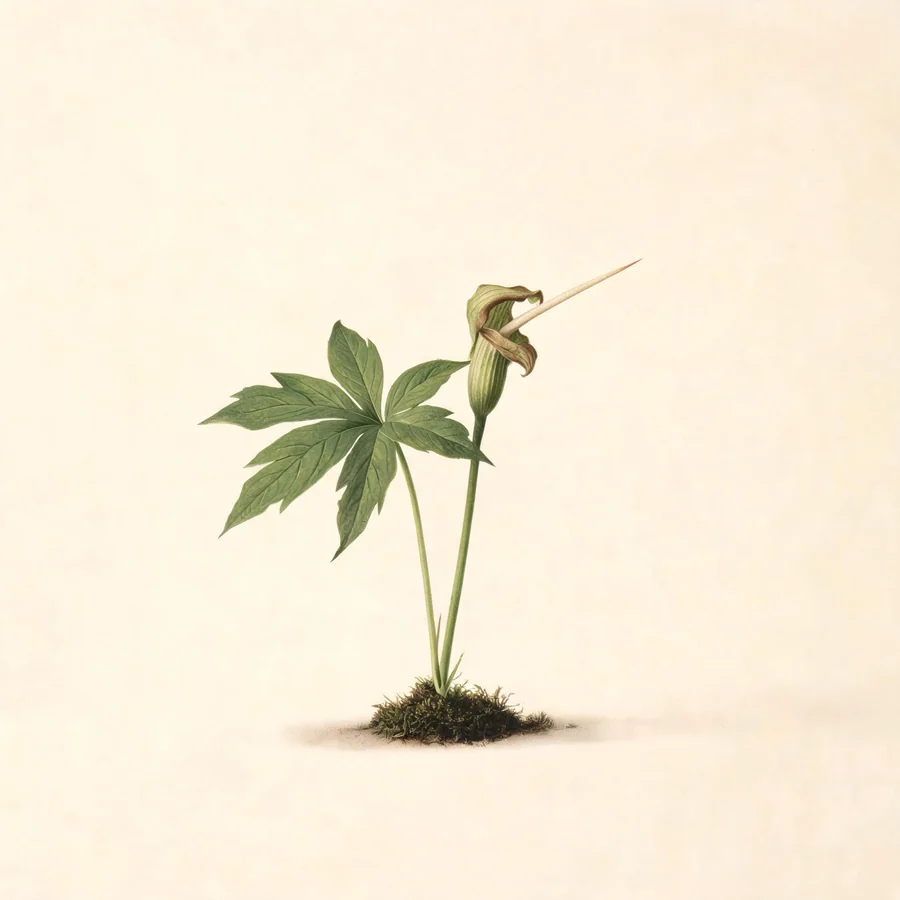
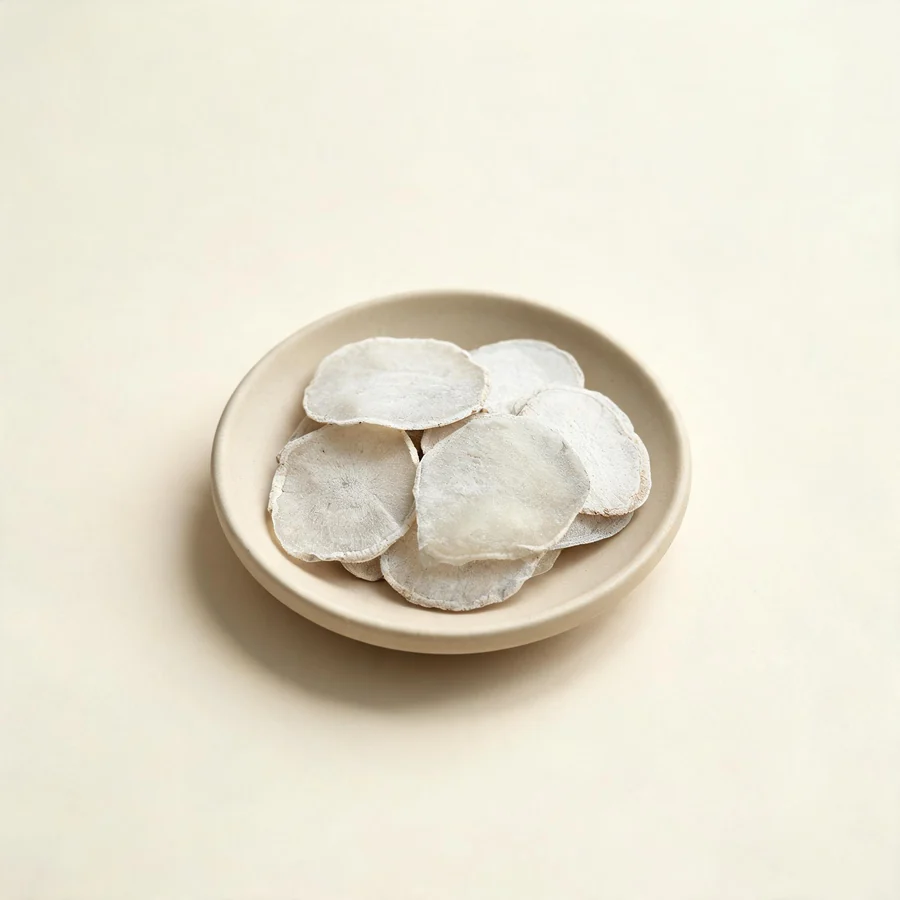
Skin profile
Where this herb sits in skin practice: the pattern it corrects, the skin signs it suits, and what it should not be used for.
This is a herb for phlegm that has set: a lump under the skin, a boil that will not point, a patch of skin that has gone numb and thick. It is not a herb for a rash, and it is one of the few in this library whose raw form is a poison rather than a medicine.
Skin signs that suggest it
- Firm, well-defined lumps under normal-coloured skin: a cyst, a lipoma or an old hardened swelling (phlegm nodule)
- A boil or carbuncle that is hard, deep and slow to point, with little discharge so far
- Numbness or a patch of skin that feels thick, woody and half asleep (wind-phlegm in the channels)
- Pale, puffy, boggy skin with a dull colour and a heavy feeling in the limbs
- A greasy white tongue coat with a slippery pulse
When it is not the right herb
Wrong for any hot, red, weeping or eroding lesion, where the warmth and the fierce drying add to inflammation and leave the surface tighter and more painful. Wrong for thin, dry skin short of fluid, and for the pale exhaustion of Blood deficiency, because a drying herb finds nothing to dry in either and only takes moisture away. Wrong in pregnancy in every form. The raw tuber is never swallowed and never put on broken, ulcerated or infected skin, and a lump that is new, growing or unexplained needs assessment before any herb is considered.
What it does for skin
Skin-relevant actions only. Each one describes a mechanism in TCM terms and what it looks like on the skin.
Disperses swelling and draws out a boil
This is the classical external use. The raw corm is ground and mixed with vinegar into a thick paste, then laid on the skin around a carbuncle or a boil that is swollen and hard, and the tradition holds that it pulls the swelling and the pain down. The action is local and physical as much as pharmacological: the needles of calcium oxalate irritate the surface, which reddens it and brings blood to the area. That is why the paste goes on intact skin around the lesion, stays for a short time, and is never put on an open surface, near the eyes or over a mucous membrane.
Scatters phlegm nodules
A phlegm nodule is a firm lump that formed because Dampness and Phlegm collected where they should not have: a sebaceous cyst, a lipoma, an enlarged lymph node, or the hard little bodies that appear along an old scar. The processed tuber is given in a formula with herbs that also soften hardness, and the expectation is slow, measured in weeks rather than days. It is a reasonable use for a lump that has been examined and found benign; it is never a reason to leave a new or changing lump unexamined.
Dries dampness that has settled in the skin
Where Dampness collects, the skin looks waterlogged rather than inflamed: pale, puffy, boggy, dull, with a greasy sheen and a heavy, tired body behind it. Tian Nan Xing dries that ground, and because it enters the Spleen it is aimed at the organ the tradition holds responsible for making the Dampness in the first place. It is a strong drying herb, so it is given with herbs that protect the fluids, and that same strength is why it is not reached for when the skin is merely a little greasy.
Dispels wind-phlegm from the channels
Numbness, a woody patch of skin, a face that feels heavy or pulls to one side are read as Wind carrying Phlegm into the small channels, where it blocks the flow that keeps sensation normal. The acrid quality opens those channels and the drying quality removes what is blocking them, and the tuber is paired with herbs that move Wind and with herbs that nourish Blood. On the skin this means numb, thick, poorly sensitive patches rather than a rash, and it belongs to supervised treatment rather than to a household remedy.
Skin conditions it is used for
Mapped to the condition pages on this site. The pattern column shows what the skin is doing when this herb is the right choice.
| Condition | Pattern | Why it suits | Typical setting |
|---|---|---|---|
| Boils | Phlegm-damp swelling with a hard, deep centre | A boil that swells without pointing is the classical target of the raw paste: powder mixed with vinegar is laid on the surrounding skin to pull the swelling and ease the pain. It is an external measure that sits alongside proper care rather than replacing it, and a boil on the face, a boil with spreading redness or a boil with fever needs medical attention rather than a poultice. | Vinegar paste of the raw tuber around the lesion, for 20 to 30 minutes |
| Skin abscess | Hard, deep swelling with little discharge | An abscess that feels tense and is slow to localise is treated in the same way, the paste being used to disperse the swelling before it points. The tuber disperses rather than drains, so it does not replace the drainage an established collection needs, and it comes off the skin once the surface has broken. A hot, spreading or febrile abscess is a medical problem, not a case for a herbal paste. | Raw-tuber paste locally, with a toxin-clearing formula such as Xian Fang Huo Ming Yin internally |
| Subcutaneous lumps and nodules | Phlegm nodule: firm, smooth and not inflamed | The firm, smooth, non-tender lump is the textbook phlegm nodule, and it is where the softening and scattering action is most often invoked. The processed tuber is combined with herbs that soften hardness, and the course is long and unspectacular. The important half of the advice comes first: a lump is examined and usually imaged before it is called phlegm, because no herb can tell a cyst from anything else. | Processed tuber with Zhe Bei Mu and Ban Xia in a modified formula |
| Localised skin swelling | Wind-phlegm or dampness gathering in one place | A swelling that is neither hot nor red, that came up slowly and feels doughy or firm, is read as Phlegm and Dampness gathering where the Qi has stopped moving. The dispersing action is directed at exactly that, locally as a paste and internally in a formula that also moves Qi and dries Dampness. A swelling that is hot, tender, spreading or accompanied by fever is a different problem and needs urgent assessment. | Dao Tan Tang, or the raw paste applied around the swelling |
| Numb skin | Wind-phlegm lodged in the small channels | Numbness that is fixed, with a heavy or woody feeling, is read as Wind-Phlegm in the fine channels, and this is one of the herbs the tradition sends into them. It is used with herbs that move Wind and with herbs that nourish Blood, since drying the channels without feeding them leaves them drier still. On the skin the sign is a patch that feels dead or half asleep rather than a rash, and persistent numbness needs a neurological opinion before it is treated as phlegm. | Modified Dao Tan Tang with Tian Ma and Fang Feng |
Combinations for skin
Herbs it is paired with when the skin, not an internal organ, is the target.
| Partner | Ratio | Why the pair is used |
|---|---|---|
| Ban Xia | 6 g processed Tian Nan Xing with 12 g Ban Xia | The two warm, drying arums, and the pair is the backbone of the phlegm-nodule approach: Pinellia carries the drying of the middle and the descent of Stomach Qi, the arisaema the fiercer penetration of the channels and the harder lumps. The usual proportion gives the gentler herb the larger weight, so the more toxic one is present in the smaller amount and the work is shared between them. |
| Zhe Bei Mu | 6 to 9 g each | Zhe Bei Mu clears heat and softens hardness while the arisaema dries and disperses, so the pair covers a nodule that is firm but slightly warm or tender. Both are used for scrofula and for lumps, and the combination treats a phlegm nodule without loading the formula with a single fierce drying herb. |
| Bai Jie Zi | 6 g each | White mustard seed warms and scatters phlegm that sits under the skin or between the ribs, while the arisaema drives at the channels themselves. The pair is used for nodules below the surface and for the sensation of something stuck under the skin, and mustard seed's own blistering quality means both herbs are handled with care and neither is left on the skin for long. |
| Jin Yin Hua | 6 g processed Tian Nan Xing with 15 g Jin Yin Hua | For a boil that is hard and also red, the arisaema paste does the local work while honeysuckle clears heat toxin inside. The arisaema is not a heat-clearing herb, so this pairing is what allows it to be used on a lesion that is warm as well as swollen, with the cooling herb carrying the component the tuber cannot address. |
Topical use
External use is not an afterthought with this tuber: for boils, carbuncles and swollen injury it is the main traditional application, and it is also the clearest illustration of its hazard. The raw corm is a handling poison, so every preparation below assumes gloves, a patch test, intact skin and short contact.
| Preparation | How and when it is used |
|---|---|
| Vinegar paste of the raw tuber | The raw corm is ground to a powder and mixed with rice vinegar to a thick paste, then spread on the intact skin around a boil or a hard swelling and left off the centre. Keep it on for 20 to 30 minutes, remove it and wash the area with water. Wear gloves to grind and apply it, keep it away from the eyes and mouth, and never swallow any part of it. |
| Processed tuber paste | Zhi Tian Nan Xing powder is mixed with water, honey or fresh ginger juice to a softer paste for a firm nodule or a patch of numb, thick skin. It is milder than the raw paste and can be repeated for longer, but the skin still needs a patch test and the area should be checked each day for redness, dryness or blistering. |
Patch test and cautions
Patch test a small amount on the inner forearm for 24 hours before it goes near a lesion. Never apply it to broken, ulcerated, blistered or infected skin, never near the eyes, mouth or genitals, and never leave it on overnight or under an airtight dressing. Stop at once and wash the area if the skin burns, stings, blisters or spreads red. Keep the raw corm away from children and pets, and never take the preparation by mouth.
Safety for skin use
What to check before recommending or using it, including the cautions that matter most for skin patients.
Do not use, or use with caution
- Pregnancy, in every form. The old texts say the tuber breaks up Blood, and breaking Blood is how a pregnancy can be lost; the raw material adds an oxalate and lectin load on top of that, and the bile-processed kind is no safer.
- Any internal use of the raw tuber. The raw corm swells the mouth and throat within minutes and can close the airway, so there is no safe home dose and no amount of boiling makes an unsupervised preparation acceptable.
- Dry, hot or blood-deficient skin with no nodule and no greasiness. A fierce drying herb in a person short of fluid tightens the skin, worsens itch and can leave the mouth dry and the stool hard.
- Active heat toxin with fever and spreading redness. The tuber is warm and acrid and adds to heat; the cooler bile-processed form is the one a practitioner might consider, and even that belongs inside a formula.
- Broken or ulcerated skin under an external paste, and any previous reaction to an Araceae plant such as taro or konjac.
Pregnancy and breastfeeding
Contraindicated, and not a question of weighing benefit against risk. Breaking Blood is the mechanism by which the old sources say a pregnancy can be ended, and a toxic tuber supplies a second and independent reason. The bile-processed form is not an escape route, and neither is a paste on the skin: oxalates over a wide area can irritate and be absorbed. A boil in pregnancy is therefore managed by other means and with medical advice rather than by reaching for this herb in any preparation.
Interactions
- Sedative and opioid medicines. Animal work shows the tuber drawing out sleep induced by barbiturates, so opioid painkillers, benzodiazepines and sleeping tablets may together deepen drowsiness and slow breathing.
- Anticoagulants and antiplatelet drugs. The old phrase about scattering Blood was never tied to a measured effect, yet warfarin, aspirin or clopidogrel are watched whenever this tuber is in the formula, above all in someone who has already bled.
- Heart rhythm medicines. Work on the genus has shown antiarrhythmic activity in the laboratory, so digoxin or amiodarone could in theory interact, and an arrhythmia under treatment should be reviewed before the herb is added.
- Strong external irritants, including mustard plasters and capsaicin creams, should not be used on the same area as a raw arisaema paste.
Allergy and patch testing
Contact with the raw corm causes itching, redness and a burning sensation in most people, which is irritation rather than allergy but is reason enough for gloves. A true allergy is possible, and people who react to other Araceae plants, including taro, konjac and Dieffenbachia, are the most likely to react. Patch test a processed paste for 24 hours, keep it off the face, and stop at the first sign of blistering.
General safety references
General references for herbal hepatotoxicity and herb-drug interactions; they are not specific to this herb.
- Review article: Herbal hepatotoxicity - an update on traditional Chinese medicine preparations. Alimentary Pharmacology & Therapeutics, 2014. PMID: 24844799.
- Interactions between herbal medicines and prescribed drugs: an updated systematic review. Drugs, 2009. PMID: 19719333.
- Warfarin and food, herbal or dietary supplement interactions: a systematic review. British Journal of Clinical Pharmacology, 2021. PMID: 32478963.
Evidence
The classical record is quoted with its source. The modern note states the level of evidence plainly.
Classical record
It governs pain in the heart, alternating cold and heat, knotted Qi, gatherings and accumulations, damage to the sinews, flaccidity, cramping and slackness, and it frees the water passages.
Shen Nong Ben Cao Jing (Divine Husbandman's Classic of Materia Medica), under the name Hu Zhang - The oldest entry, filed under the earlier name Tiger's Palm, already treats the tuber as a breaker of knotted accumulations.
It governs wind-stroke, removes phlegm, lifts numbness and paralysis, lowers Qi, breaks hard accumulations, disperses abscess and swelling, frees the chest and diaphragm, and scatters Blood so that pregnancy is lost.
Kai Bao Ben Cao (Materia Medica of the Kai Bao Era) - One sentence carries the wind-stroke use, the abscess and swelling use, and the pregnancy prohibition that still governs practice.
Nan Xing opens knotted blockage and disperses wind phlegm. It is acrid, dry and fierce like Pinellia but more toxic: Pinellia is dry and gentler, Nan Xing dry and more urgent, and where wind phlegm or phlegm that has dammed up must be scattered, nothing else will do it.
Ben Cao Hui Yan (Elaborations on the Materia Medica) - A Ming commentary explaining why the stronger and more toxic of the two arums is chosen for a nodule that will not shift.
Modern evidence
Evidence status
- Laboratory work on Arisaema species reports anti-inflammatory, analgesic, anticonvulsant and sedative activity in animal models, and the irritant calcium oxalate raphides and lectins are well characterised as the source of the toxicity. These are laboratory and animal findings rather than evidence of benefit in skin disease.
- No clinical trial of Tian Nan Xing in a skin condition was identified. The dermatological use rests on the classical external practice for carbuncle and on the phlegm-nodule reasoning, and the published literature on the herb is pharmacological and toxicological rather than dermatological.
- Regulatory status: the processed tuber is an accepted herbal substance in the Chinese Pharmacopoeia, where the raw material is classified as toxic. The external raw paste is a traditional practice and not a licensed preparation, which is one reason it stays in practitioner hands.
PubMed records
Selected real PubMed records for this herb's species or its constituents, chosen by species name and title relevance. They are references for the non-TCM discussion above, not proof that the herb treats any skin condition.
- Main active constituents and mechanism of toxicity of raphides from Arisaema erubescens against Oncomelania hupensis.. Ecotoxicology and environmental safety, 2024. PMID: 39029218 (safety record).
- Purification of a lectin from Arisaema erubescens (Wall.) Schott and its pro-inflammatory effects.. Molecules (Basel, Switzerland), 2011. PMID: 22083235 (skin-related record).
Dose and forms
Skin-practice dosing and the preparations that suit skin complaints.
| Form | Dose and notes |
|---|---|
| Decoction (processed tuber) | 3 to 9 g of processed tuber daily inside a formula, and 3 to 6 g for the bile-processed Dan Nan Xing, which is the cooler form used when there is any heat in the picture. These figures are written for processed weight and mean nothing if the material has not been processed. |
| External paste | Raw or processed powder mixed to a paste with vinegar, water or ginger juice, applied to intact skin around a swelling for 20 to 30 minutes once or twice daily. Keep the area small, wash afterwards and check the skin between applications. |
| Course length | Short courses of two to four weeks for a nodule, with review. Stop if the mouth tingles, the skin burns, the stool dries or the appetite falls, and do not continue a drying herb simply because a lump is slow to change. |
The figures above are for processed material only. Processing is the safety step and not a refinement: the corms stand in water that is changed daily for weeks, then in alum, then boil with ginger until the numbing quality has gone. If the tongue still stings, the batch is unfinished, and careful dosing cannot rescue it. The external paste is measured in minutes and in area rather than in grams.
Citations and further reading
Only real sources are listed: the classical materia medica passages quoted above, and the source works behind the botanical and safety statements.
- Shen Nong Ben Cao Jing (Divine Husbandman's Classic of Materia Medica), attributed compilation of the Han period - classical entry quoted above, where the tuber is filed under the name Hu Zhang.
- Kai Bao Ben Cao (Materia Medica of the Kai Bao Era), Song dynasty - classical entry quoted above.
- Ben Cao Hui Yan (Elaborations on the Materia Medica), Ming dynasty - classical entry quoted above.
- Tian Nan Xing monograph: Pharmacopoeia of the People's Republic of China - source for the accepted Arisaema species, the processed forms, the 3 to 9 g dose and the toxic classification.
- Modern evidence statement: based on laboratory, animal and toxicological literature on Arisaema constituents and on calcium oxalate raphides, summarised as a statement about the level of evidence.
- Botanical description and identification: botanical literature on Arisaema erubescens and related species, Araceae.
Educational reference for qualified practitioners. This page is not medical advice, and skin conditions should be diagnosed by a clinician before treatment.