
Skin profile
Where this herb sits in skin practice: the pattern it corrects, the skin signs it suits, and what it should not be used for.
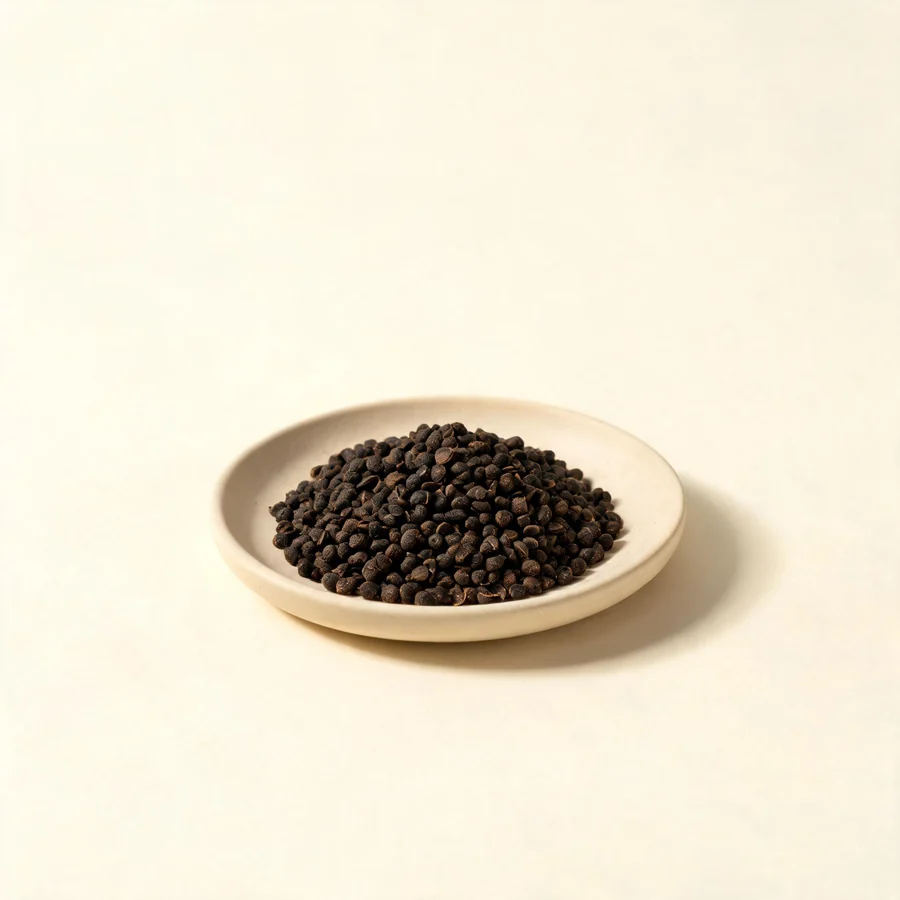
Wu Ling Zhi is a strong stasis herb with a narrow skin role. It suits fixed, dark, painful changes: a bruise that will not clear, a purple patch, an old injury that still aches. It is contraindicated in pregnancy, wrong for Blood deficiency without stasis, and its source material demands processed, hygienic product. It is not a general bruise remedy for a depleted or pregnant person.
Skin signs that suggest it
- Bruises that are dark purple, fixed and tender after a knock or strain (Blood stasis)
- A stabbing, fixed pain in one spot with purple or mottled skin over it (stasis with pain)
- Purplish spots or patches under the skin that do not fade on pressure, with a dark, choppy pulse (stasis with bleeding)
- Small dilated veins or a persistent dark mark where an injury has healed (old stasis in the vessels)
- A purple tongue with dark spots, and skin that is cool and mottled (Blood stasis with cold)
When it is not the right herb
Not for pregnancy, and not for a person with Blood deficiency and no stasis, where the pain is dull, relieved by pressure and accompanied by a pale face and a thin tongue. It is not a general bruise remedy for a depleted patient, and it is not for a hot, red, spreading swelling. Untreated faecal material is unacceptable, and any unexplained or recurrent purpura needs medical assessment.
What it does for skin
Skin-relevant actions only. Each one describes a mechanism in TCM terms and what it looks like on the skin.
Moves Blood and breaks up stasis in the skin
Where Blood no longer flows smoothly, it collects and darkens, and the skin over it looks purple, mottled or bruised. Wu Ling Zhi reaches the Blood level of the Liver channel and is said to open the vessels and disperse what has lodged there. It is a strong mover, used for a bruise or a fixed discolouration that has not cleared, and it is paired with nourishing herbs so that moving the Blood does not leave the person depleted.
Stops stasis pain
The pain of stasis is sharp, stabbing and fixed in one place, and it is worse for pressure. Wu Ling Zhi is one of the strong pain-relieving Blood movers, and it is chosen when the pain and the discolouration sit together, as in a deep bruise or an old injury that still aches. It is not an analgesic in the modern sense: the pain is addressed by restoring movement to what has stagnated, which is why the herb is continued rather than taken only at the moment of pain.
Stops bleeding that comes from stasis
The fried form is used where bleeding and stasis coexist, as in purplish spots under the skin with a dark, choppy pulse or a heavy period with clots. The reasoning is that blood which has leaked can itself stagnate, and simply astringing it would seal the stale blood inside. Frying turns the mover into a bleeding-checking medicine, so the same material can move or stop depending on how it is prepared.
Resolves swelling and old lumps from injury
An old injury can leave a firm, tender lump where Blood has collected and never dispersed. Wu Ling Zhi is used to break up that kind of old stasis, usually with other moving herbs and with a topical or manual treatment alongside. It is not a treatment for a new lump of unknown cause, and any swelling that is growing, hot or painful needs a diagnosis before it is treated as old Blood.
Skin conditions it is used for
Mapped to the condition pages on this site. The pattern column shows what the skin is doing when this herb is the right choice.
| Condition | Pattern | Why it suits | Typical setting |
|---|---|---|---|
| Bruising | Static Blood in the skin after injury | A bruise is the simplest picture of static Blood: the skin is dark, fixed and tender, and the mark fades only slowly. Wu Ling Zhi moves the Blood that has collected and relieves the pain that goes with it, and it is used in compounds for injury with other moving herbs. It is not for a bruise on a person with Blood deficiency and no stasis, and a bruise that is spreading or very painful after a blow needs assessment. | Fu Yuan Huo Xue Tang with Wu Ling Zhi added |
| Purpura | Blood stasis with bleeding, showing as purplish patches | Purpura is read as blood that has left its vessels and then stagnated under the skin. The fried form of Wu Ling Zhi checks the bleeding while it disperses the stale blood, which is the combination needed when the two appear together. It is a supporting herb in a compound, and any widespread, unexplained or recurrent purpura needs medical assessment before treatment. | Shi Xiao San with the fried form, in a compound for stasis with bleeding |
| Petechiae | Small static-blood spots with a dark, choppy pulse | Pinpoint purplish spots that do not fade on pressure can be read as Blood failing to stay in its vessels, with stasis in the small vessels. Wu Ling Zhi in its fried form is used where the spots come with a purple tongue and a choppy pulse, and it is combined with herbs that cool or nourish the Blood according to the underlying picture. Petechiae can signal a serious blood disorder and must be investigated. | A modified Shi Xiao San with blood-cooling herbs |
| Spider veins | Chronic stasis in the small superficial vessels | Small dilated veins and persistent dark marks are read as Blood that has stagnated in the fine vessels near the surface. Wu Ling Zhi is used to move that old stasis, usually in a compound with other Blood movers and with herbs that support the vessels. It is a slow, supportive action, and visible veins that are new, painful or ulcerated need a clinical opinion rather than a herb. | A modified Xue Fu Zhu Yu Tang with Wu Ling Zhi |
Combinations for skin
Herbs it is paired with when the skin, not an internal organ, is the target.
| Partner | Ratio | Why the pair is used |
|---|---|---|
| Pu Huang | Equal parts, as in Shi Xiao San | Pu Huang is a pollen that transforms stasis and checks bleeding, and Wu Ling Zhi is the stronger mover and pain reliever. Together they cover pain and loss at once, which is why the pair makes up the whole of Shi Xiao San. Where bleeding dominates both are used in the fried form; where pain dominates the raw or vinegar-processed material leads. It is the most famous partnership for stasis in the materia medica. |
| Dang Gui | Equal parts in decoction | Dang Gui nourishes and moves Blood, while Wu Ling Zhi breaks up what has become fixed and painful. The pair is used where moving alone would leave the person depleted, as in a thin patient with an old injury or a chronic bruise, and Dang Gui supplies the substance that the mover spends. It is a balanced combination: one herb gives, the other clears, and together they treat stasis on a background of deficiency. |
| Yan Hu Suo | 1 : 1, as in Shou Nian San | Yan Hu Suo is the strongest analgesic in the materia medica and works on Qi and Blood together, while Wu Ling Zhi works on the Blood alone. For severe stabbing pain with both constraint and stasis the pair gives more relief than either alone, and it is used for injury pain and for intractable pain that stays in one place. The ratio is equal, and both are strong enough that the combination belongs in a supervised formula. |
| Rou Gui | 2 : 1, Wu Ling Zhi 6 g to Rou Gui 3 g | Rou Gui warms the channels and drives out cold, which is often what congealed the Blood in the first place. The pairing is aimed at the lower body, where cold constriction and stasis so often sit together, and it appears inside Shao Fu Zhu Yu Tang for painful periods made worse by cold. On the skin it suits a cool, mottled, fixed discolouration rather than a hot, red bruise. |
Formulas where it leads
- Shi Xiao San (失笑散) - The two-herb formula of Wu Ling Zhi and Pu Huang, and the clearest statement of the pair's logic. In skin practice it is the context for stasis with bleeding, such as purplish patches with a choppy pulse, rather than for period pain alone.
- Fu Yuan Huo Xue Tang (复原活血汤) - A formula for traumatic injury with static Blood and pain. Wu Ling Zhi can be added when the bruising is deep and fixed, and the formula is the setting in which the herb's pain-relieving and stasis-breaking actions are used together.
Safety for skin use
What to check before recommending or using it, including the cautions that matter most for skin patients.
Do not use, or use with caution
- Pregnancy. Avoid: it is a strong Blood-moving herb that can stimulate uterine contractions, and the classical warning against using it where there is no stasis rules out the routine antenatal case altogether.
- Blood deficiency without stasis. Dull pain relieved by pressure, a pale complexion and a thin rather than purple tongue describe a lack of Blood, and a strong mover will leave the person more tired rather than better.
- Untreated or poorly processed material. The faeces of wild flying squirrels may carry zoonotic pathogens, so only material that has been cleaned, dried and stir-fried with vinegar or wine should be used.
- Weak digestion. The taste and smell are strong enough to nauseate, and the herb is then given as a pill or a powder with Stomach-supporting herbs rather than as a decoction.
- Ren Shen. The Nineteen Mutual Fears lists ginseng as fearing Wu Ling Zhi, and the two are generally kept apart rather than combined by default.
Pregnancy and breastfeeding
Avoid. Wu Ling Zhi is listed as contraindicated in pregnancy rather than as suitable in standard doses. Laboratory work shows it raises uterine tone, its Blood-moving strength is among the greater ones in the materia medica, and the classical rule against using it where there is no stasis excludes the routine antenatal case. Any use in pregnancy would be a deliberate specialist decision, never a standard dose. While breastfeeding the caution is less absolute but still real: short courses, a clear stasis pattern and supervision are the conditions, and nothing is known about whether its constituents pass into milk.
Interactions
- Anticoagulants and antiplatelet drugs. The flavonoids in the material have shown antithrombin and antiplatelet activity in the laboratory, so on top of warfarin, heparin, aspirin or clopidogrel the combined effect may be more bleeding than either alone. Unusual bruising or bleeding is a reason to stop and seek advice.
- Ginseng. The classical Nineteen Mutual Fears puts the two in opposition, and most practitioners still keep them apart, so anyone taking red ginseng, American ginseng or a ginseng supplement should mention it. This is a traditional incompatibility rather than a measured pharmacokinetic one, but it is recorded consistently.
- Laxatives and gut irritants. A strongly Blood-moving material can loosen the stool and cause abdominal discomfort at higher doses, so it may add to the effect of laxatives.
General safety references
General references for herbal hepatotoxicity and herb-drug interactions; they are not specific to this herb.
- Review article: Herbal hepatotoxicity - an update on traditional Chinese medicine preparations. Alimentary Pharmacology & Therapeutics, 2014. PMID: 24844799.
- Interactions between herbal medicines and prescribed drugs: an updated systematic review. Drugs, 2009. PMID: 19719333.
- Warfarin and food, herbal or dietary supplement interactions: a systematic review. British Journal of Clinical Pharmacology, 2021. PMID: 32478963.
Evidence
The classical record is quoted with its source. The modern note states the level of evidence plainly.
Classical record
五灵脂,足厥阴肝经药也,气味俱厚,阴中之阴,故入血分。肝主血,故此药能治血病,散血和血而止诸痛。
Wu Ling Zhi is a medicine of the foot jue yin Liver channel. Both its Qi and its flavour are thick, a Yin within Yin, so it enters the Blood level. The Liver governs Blood, and for that reason the medicine can treat Blood disorders, scatter and harmonise Blood, and stop pain of every kind.
Ben Cao Gang Mu (Compendium of Materia Medica), Li Shizhen - Li Shizhen's reasoning is the source of the claim that the herb acts at the Blood level rather than at the level of Qi. It is the classical basis for using it on fixed, purple, painful skin changes rather than on moving or diffuse ones.
生用行血而不推荡,非若大黄之力迅而不守。炒用以理诸失血证,令血自归经而不妄行。
Used raw, it moves Blood without the violent shoving of Da Huang; used fried, it governs the various patterns of blood loss, returning Blood to its channels so that it no longer strays.
Yao Pin Hua Yi (Materia Medica Explained), raw and fried forms - This is the classical warrant for the processing distinction: frying turns a Blood-moving medicine into a bleeding-checking one. On the skin it explains why the fried form is chosen for purplish spots and the raw or vinegar form for a bruise.
主疗心腹冷气,小儿五疳,辟疫、治肠风,通利气脉,女子月闭。
It treats cold Qi in the heart and abdomen, the five childhood wasting patterns, epidemic illness and intestinal wind, frees the Qi vessels, and opens menstruation that has stopped.
Kai Bao Ben Cao (Materia Medica of the Kai Bao Era), Song dynasty - The earliest entry already carries the idea of freeing the vessels, which is the ancestor of its later use for stasis in the skin. The other clauses are internal and are not the subject of this page.
Modern evidence
Evidence status
- Laboratory work reports that flavonoids in the material have antiplatelet and antithrombin activity, which is consistent with the traditional Blood-moving action but does not establish a benefit for bruising or purpura.
- The best-documented modern concern is hygiene. Wild flying squirrel faeces have been found to harbour zoonotic pathogens including Leptospira and Blastocystis, and cleaning, drying and stir-frying with vinegar or wine are the steps that reduce the risk. That is a safety finding, not an efficacy one.
- No clinical trial evidence supports Wu Ling Zhi for skin disease. The skin uses on this page are traditional and narrow, and the material is a processed animal product whose quality and hygiene matter as much as its dose.
PubMed records
Selected real PubMed records for this herb's species or its constituents, chosen by species name and title relevance. They are references for the non-TCM discussion above, not proof that the herb treats any skin condition.
- The Chronic and Acute Toxicity of Traditional Medicines Containing Terminalia chebula.. Journal of pharmacopuncture, 2023. PMID: 37007288 (safety record).
- Cytotoxic triterpenes from a Chinese medicine, Goreishi.. Chemical & pharmaceutical bulletin, 1989. PMID: 2752475 (safety record).
Dose and forms
Skin-practice dosing and the preparations that suit skin complaints.
| Form | Dose and notes |
|---|---|
| Decoction | 3 to 10 g of the processed material in decoction, wrapped in cloth so that the fine particles do not cloud the liquid. Up to 15 g is used towards the top of the range for acute stasis pain under supervision. |
| Powder | 1.5 to 3 g of the processed powder at a time, taken with warm water. The powder is the form to choose when the taste and smell are the obstacle. |
| Processed material only | Vinegar- or wine-stir-fried material only. Cleaning, drying and stir-frying are the steps that reduce the hygiene risk, and the block grade should be rinsed before use. |
The processing decides the action. The vinegar form is the ordinary clinical choice, because vinegar carries the action into the Liver and takes the edge off the smell. Wine processing is chosen when the stasis sits in the upper body or the limbs, because wine moves upward and outward. The charred form is kept for bleeding with stasis and is not a routine pain herb. Because the material is an animal excreta, a supplier who cannot name the animal and the processing cannot answer the hygiene question either.
Citations and further reading
Only real sources are listed: the classical materia medica passages quoted above, and the source works behind the botanical and safety statements.
- Kai Bao Ben Cao (Materia Medica of the Kai Bao Era), Song dynasty - classical entry quoted above.
- Ben Cao Gang Mu (Compendium of Materia Medica), Li Shizhen, 1578 - classical entry quoted above.
- Yao Pin Hua Yi (Materia Medica Explained), Qing dynasty - classical entry on raw and fried forms quoted above.
- Wu Ling Zhi monograph, Faeces Trogopteri: Pharmacopoeia of the People's Republic of China - source for the processed article and its quality requirements.
- Hygiene literature on Trogopterus faeces and zoonotic pathogens, including Leptospira and Blastocystis - source for the processing caution.
Educational reference for qualified practitioners. This page is not medical advice, and skin conditions should be diagnosed by a clinician before treatment.