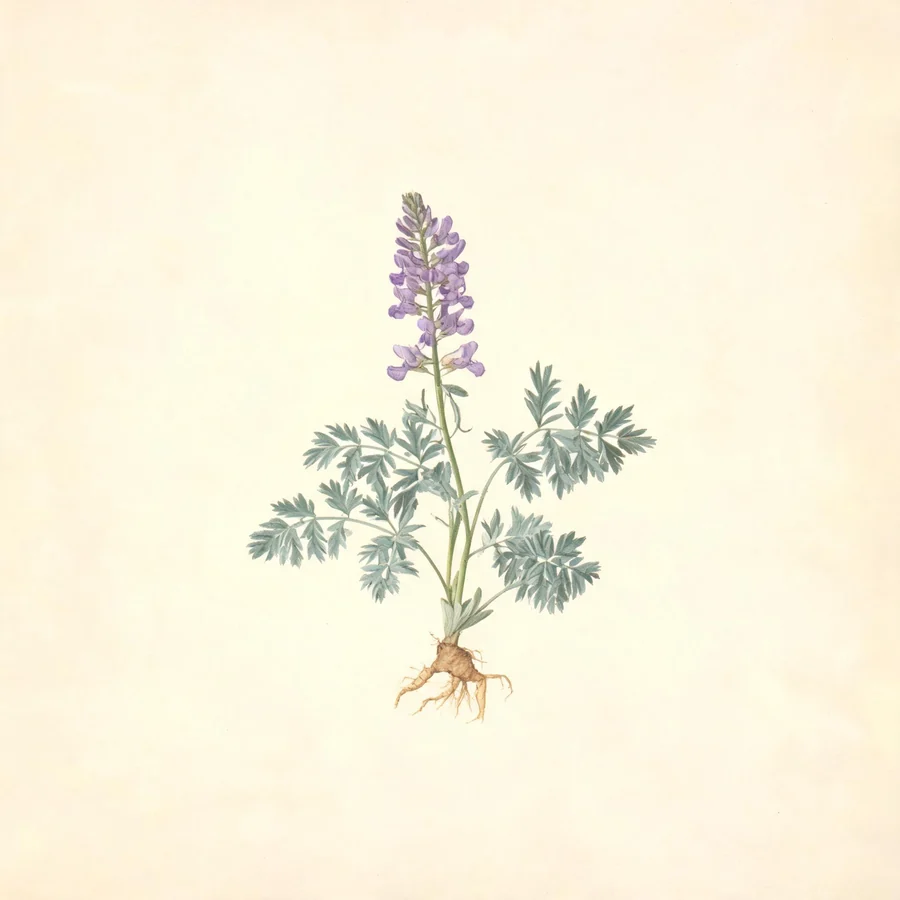
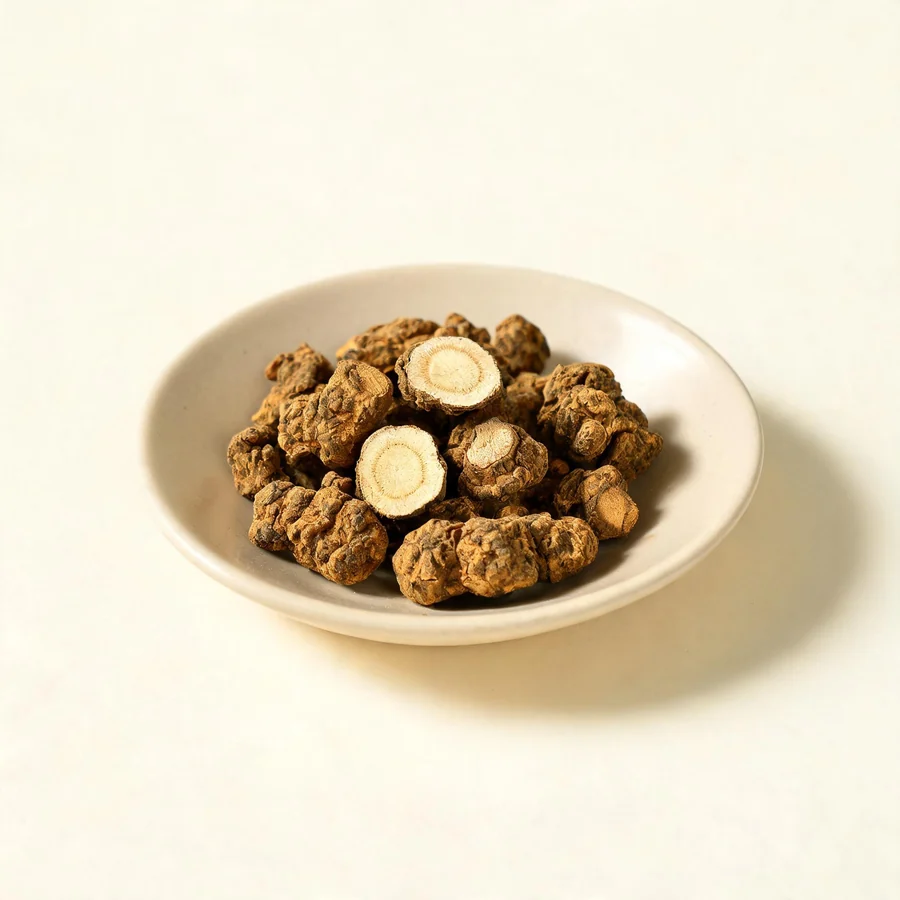
Skin profile
Where this herb sits in skin practice: the pattern it corrects, the skin signs it suits, and what it should not be used for.
Yan Hu Suo is the analgesic of the blood-moving herbs: on skin it is for dark, hard, fixed and painful lesions, and it is withheld wherever blood is escaping or a pregnancy is in progress.
Skin signs that suggest it
- Bruises that stay purple-black for weeks, feel hard and tender, and fade only slowly
- Purple or brown-red patches, and pinpoint spots that come with a fixed, aching pain
- Firm, raised scars that itch, ache or sting, worse in cold weather and at night
- Deep, tender nodules beneath the skin of the shins, a wiry pulse and a dusky tongue
- Skin pain that stays in one place, sharp at night and worse on pressure
When it is not the right herb
Not where blood is actively escaping. The root moves blood forcefully, so it is withheld in heavy periods, in bleeding gums or nose, in a diagnosed bleeding disorder and around surgery. It is also wrong for a hot, spreading, weeping rash that needs cooling and clearing, since warmth and movement push such an eruption further. Pale, thin, dry skin with no fixed pain has no stasis to move and no use for it. Pain in a lesion that is changing shape, ulcerating or bleeding needs a dermatologist, not an analgesic decoction.
What it does for skin
Skin-relevant actions only. Each one describes a mechanism in TCM terms and what it looks like on the skin.
Moves blood that has stalled in the skin
The herb is chosen when a lesion has the marks of stasis: a colour that is dark rather than red, a border that is hard, a site that does not change, and pain that is fixed and worse at night. Its warming, dispersing character is read as loosening what has congealed, and it is used with other blood-moving herbs rather than alone. The aim is a lesion that softens and fades, and the response is judged over weeks.
Settles fixed pain in and under the skin
Of all the herbs that move blood, this one is the most reliable at stopping pain, and on skin it is used for the ache of a bruise, the sting of a scar and the tenderness of a nodule. It is not a local anaesthetic and it does not act at once on the surface; it is given internally, and the relief builds as the stasis clears. Where pain is severe, spreading or unexplained, assessment comes first.
Softens firm scars and stubborn nodules
A scar that stays raised, hard and tender is read as blood and fluid knotted in the tissue after the wound has closed. The root is combined with peony, salvia and shell medicines that soften hardness, and it is used for months rather than weeks. It is a supporting herb in that work, and a scar that is growing, ulcerating or painful without cause should be seen before it is treated.
Keeps a stasis formula from becoming a drying one
Moving blood can consume it, so the root is nearly always given with a nourishing partner such as angelica or white peony, which supplies what the movement spends. That balance is why the classical stasis formulas contain both a mover and a builder, and why the root is a poor choice as a single herb for a thin, dry person whose skin is already short of blood.
Skin conditions it is used for
Mapped to the condition pages on this site. The pattern column shows what the skin is doing when this herb is the right choice.
| Condition | Pattern | Why it suits | Typical setting |
|---|---|---|---|
| Bruising | Blood that has left its course and gathered: a dark, hard, tender swelling after injury | A bruise is the plainest picture of stasis: blood has leaked from its vessels and now sits in the tissue as a purple, tender patch that takes weeks to fade. The root moves that gathered blood and relieves the ache, and it is used with angelica, peony and safflower in the classical injury formulas. A bruise that swells rapidly, is extremely painful, or follows a fall in an older person on blood-thinning medicine needs assessment before it is treated with herbs. | Tao Hong Si Wu Tang, with Yan Hu Suo added for pain |
| Purpura | Blood stasis in the small vessels: purple macules with fixed pain and a purple tongue | Non-blanching purple spots can be read in two ways, and the distinction matters: heat in the blood that forces it out, or stasis that holds it in place. The root belongs to the second picture, where the spots are dark rather than bright, the pain is fixed and the tongue is purple. It is used alongside cooling and stasis-moving medicines, and any new purpura should have its platelet count checked before a herbal course begins. | Tao Hong Si Wu Tang, modified with Yan Hu Suo and Chi Shao |
| Keloids | Stasis knotted in a healed wound: a firm, raised, itchy or painful scar | Once a wound has closed, a scar that keeps growing, hardens and stings is read as blood and fluid knotted in the tissue, with the movement of the area never fully restored. The root is used to move what is stuck and to settle the ache, always with softening and nourishing herbs, and it is given for months. A scar that ulcerates, bleeds or changes colour needs a dermatologist first, and the root does not remove an established keloid. | With Chuan Xiong, Chi Shao and Mu Li in a softening, stasis-moving formula |
| Erythema nodosum | Tender nodules on the shins from stasis with damp-heat beneath | The deep, bruised-looking nodules of erythema nodosum are painful to touch and slow to resolve, and the tradition reads them as damp-heat sitting above a layer of stasis. The root moves the blood and eases the pain while cooling, drying herbs deal with the heat, and the combination is used once the acute phase has settled. Because the eruption can accompany infection, sarcoidosis or inflammatory bowel disease, the diagnosis belongs with a doctor and the herbal role is supportive. | Si Miao Yong An Tang, modified with Yan Hu Suo and Dan Shen |
Combinations for skin
Herbs it is paired with when the skin, not an internal organ, is the target.
| Partner | Ratio | Why the pair is used |
|---|---|---|
| Chuan Xiong | 1 to 1, about 10 g of each | Chuan Xiong moves blood in the upper body and the head, and this root settles the pain wherever the stasis sits. Together they are the standard pair for a fixed headache after injury, for a bruise on the face and for dark patches that ache. Chuan Xiong is the lighter and more ascending of the two, and the analgesic strength in the pair belongs to the corydalis. |
| Dang Gui | 9 to 15 g of angelica to 6 to 10 g of the corydalis | Angelica both nourishes and moves blood, so it supplies what the corydalis spends. The pair is used for thin, pale people with stubborn bruises, dark patches and dry skin, where moving alone would leave the surface drier. Shift the proportion towards angelica for a depleted person and towards corydalis where the pain is sharp and the lesion is dark. |
| Wu Yao | 1 to 1, about 9 g of each | Lindera heats the lower abdomen and gets the Qi there moving again, while corydalis opens the blood beneath it. This is the pairing for cold cramping pain with dark clots, where warmth eases the pain and a hot water bottle helps. One works at the Qi level and the other at the blood, and together they explain why the two herbs so often appear in the same period formula. |
| Chi Shao | about 10 g of each | Red peony cools the blood while it moves it, which makes it the right partner when a stasis lesion is also hot, tender and red at the edge. The corydalis supplies the pain relief and the peony keeps the movement from adding heat, so the pair suits nodules and dark patches that are warm to the touch. |
Formulas where it leads
- Tao Hong Si Wu Tang (桃红四物汤) - Four-substance decoction with safflower and peach kernel added, the standard prescription for stasis with a dark, fixed quality. Skin practice uses it for bruises that will not fade, for purpura of the stasis type and for dark discolouration left after inflammation. The corydalis is added when pain is the main complaint rather than the discolouration.
- Si Miao Yong An Tang (四妙勇安汤) - Four herbs in large doses for a hot, dark, painful lesion with a threatened or ulcerated surface, built on honeysuckle, scrophularia, angelica and liquorice. Skin practice uses it for nodules and for red, painful extremities, adding corydalis for the stasis component. It is a formula for a hot picture, not for cold, pale skin.
Safety for skin use
What to check before recommending or using it, including the cautions that matter most for skin patients.
Do not use, or use with caution
- Pregnancy, at any stage. It breaks up stasis, and its alkaloids excite smooth muscle; the old sources forbid it outright, so pain in pregnancy is not treated with it.
- Active bleeding and bleeding disorders: haemorrhage, heavy periods without clots, a low platelet count, or treatment with warfarin, heparin or a newer anticoagulant.
- Breastfeeding, because the main alkaloids are fat-soluble and sedating and no safety data exist for a nursing infant.
- Deficiency without stasis, and liver impairment, where concentrated alkaloid products have been linked to hepatitis and a lower dose with monitoring is needed.
Pregnancy and breastfeeding
Contraindicated. The root is a strong stasis-dispersing medicine and its alkaloids excite uterine muscle at low doses, so the classical texts prohibit it and modern practice follows them even for severe pain. It is also withheld in the weeks after birth while bleeding is still settling. Anyone who has taken it before recognising a pregnancy should stop and tell their practitioner, and no topical preparation containing it should be used on the abdomen or breasts.
Interactions
- Sedatives and other central depressants. Tetrahydropalmatine dulls the nervous system on its own, so a benzodiazepine, an opioid painkiller, a barbiturate or a sedating antihistamine may pile on top of it, and the danger is oversedation with shallow breathing.
- Dopamine-related medicines. The alkaloid occupies dopamine receptors, so levodopa may work less well and the blockade produced by an antipsychotic may deepen, with more chance of movement side effects.
- Anticoagulants and antiplatelet drugs. Platelets clump less readily in laboratory tests after exposure to the herb, so warfarin, aspirin and clopidogrel may bleed more and need monitoring.
- Liver-stressing medicines. Concentrated alkaloid products have been followed by rare hepatitis, so high-dose paracetamol, a statin or another liver-handled drug deserves caution alongside it.
Allergy and patch testing
Reactions to corydalis are uncommon, but a powdered herb is more likely than a decoction to provoke contact or digestive sensitivity, and a person who reacts to other poppy-family plants should be cautious. Any new rash, swelling of the lips or wheeze after a dose means stopping and seeking advice rather than continuing at a lower dose.
General safety references
General references for herbal hepatotoxicity and herb-drug interactions; they are not specific to this herb.
- Review article: Herbal hepatotoxicity - an update on traditional Chinese medicine preparations. Alimentary Pharmacology & Therapeutics, 2014. PMID: 24844799.
- Interactions between herbal medicines and prescribed drugs: an updated systematic review. Drugs, 2009. PMID: 19719333.
- Warfarin and food, herbal or dietary supplement interactions: a systematic review. British Journal of Clinical Pharmacology, 2021. PMID: 32478963.
Evidence
The classical record is quoted with its source. The modern note states the level of evidence plainly.
Classical record
Where pain in the heart is grave enough to threaten life, this is the tuber to reach for at once.
Lei Gong Pao Zhi Lun (雷公炮炙论) - The line that fixed the analgesic reputation of the root, quoted ever since in Chinese practice.
Qi shut inside the Blood, and Blood shut inside the Qi, are both released by it, which is why it answers pain wherever that pain is seated. Used with judgement its effect is hard to put into words, and among remedies that quicken the Blood and transform Qi it is ranked first.
Ben Cao Gang Mu (Compendium of Materia Medica), Li Shizhen, 1578 - Li Shizhen names the two-level action that later authors treat as this root's signature.
Whether the disorder sits in the Blood or in the Qi, once it has clumped and will not disperse, this herb reaches it; warmth keeps both moving and the acrid taste scatters them, and that is why it quiets pain from the crown to the soles.
Ben Cao Qiu Zhen (本草求真), Qing dynasty - A Qing commentary that explains the effect through taste and temperature instead of through named prescriptions.
Modern evidence
Evidence status
- Laboratory work on the tuber and on tetrahydropalmatine, its best known alkaloid, reports analgesic and sedative activity and effects on dopamine receptors, largely in animals and cell models. These are not trials in people and they do not establish benefit for bruising, purpura or scars.
- No controlled clinical trial of Yan Hu Suo in a skin condition was identified. Its skin use rests on the classical reading of stasis and on the formula tradition of the injury and blood-moving prescriptions, so the page describes traditional practice rather than demonstrated outcomes.
- Regulatory status: the vinegar-processed rhizome is an accepted article in the Chinese Pharmacopoeia as Rhizoma Corydalis, and the quality question is acute, since powdered material is often diluted or exhausted of alkaloids.
PubMed records
Selected real PubMed records for this herb's species or its constituents, chosen by species name and title relevance. They are references for the non-TCM discussion above, not proof that the herb treats any skin condition.
- Alkaloid extract of Corydalis yanhusuo inhibits angiogenesis via targeting vascular endothelial growth factor receptor signaling.. BMC complementary and alternative medicine, 2019. PMID: 31823762 (pharmacology or review record).
Dose and forms
Skin-practice dosing and the preparations that suit skin complaints.
| Form | Dose and notes |
|---|---|
| Decoction | 3 to 10 g of dried rhizome daily in a formula, crushed before decocting because the hard tuber gives up very little when it is left whole. |
| Powder | 1.5 to 3 g of powder taken with warm water, which is stronger than the same weight boiled, the alkaloids being poorly soluble in water. |
| Vinegar-processed form | Vinegar preparation is the clinical default: acetic acid converts the alkaloid bases to soluble salts, and a given weight therefore yields more of the active constituent. |
| Ceiling and course | Fifteen grams in decoction is the ceiling for severe pain under supervision, and a single powder dose is kept below 3 g. Two to four weeks is a usual course, then review. |
The processed tuber, not the raw one, is what the old and modern prescriptions assume, and vinegar is the reason: it changes the alkaloids into a form water can carry. Two practical measures get them into the patient, crushing the tuber before decoction and swallowing powder instead of boiling it. Because drowsiness is what increases with dose, the powder is kept small and not raised without supervision.
Citations and further reading
Only real sources are listed: the classical materia medica passages quoted above, and the source works behind the botanical and safety statements.
- Lei Gong Pao Zhi Lun (雷公炮炙论), on processing - the line on pain threatening life is rendered above.
- Ben Cao Gang Mu (Compendium of Materia Medica), Li Shizhen, 1578 - the passage on moving Qi and Blood together is rendered above.
- Ben Cao Qiu Zhen (本草求真), Qing dynasty - the commentary on taste, temperature and pain is rendered above.
- Rhizoma Corydalis monograph, Pharmacopoeia of the People's Republic of China - accepted source, processed form and quality requirements.
- Modern evidence statement: drawn from published laboratory work on Corydalis yanhusuo and tetrahydropalmatine, presented as a statement about the level of evidence rather than as a cited finding.
- Botanical description and identification: botanical literature on Corydalis yanhusuo, family Papaveraceae.
Educational reference for qualified practitioners. This page is not medical advice, and skin conditions should be diagnosed by a clinician before treatment.