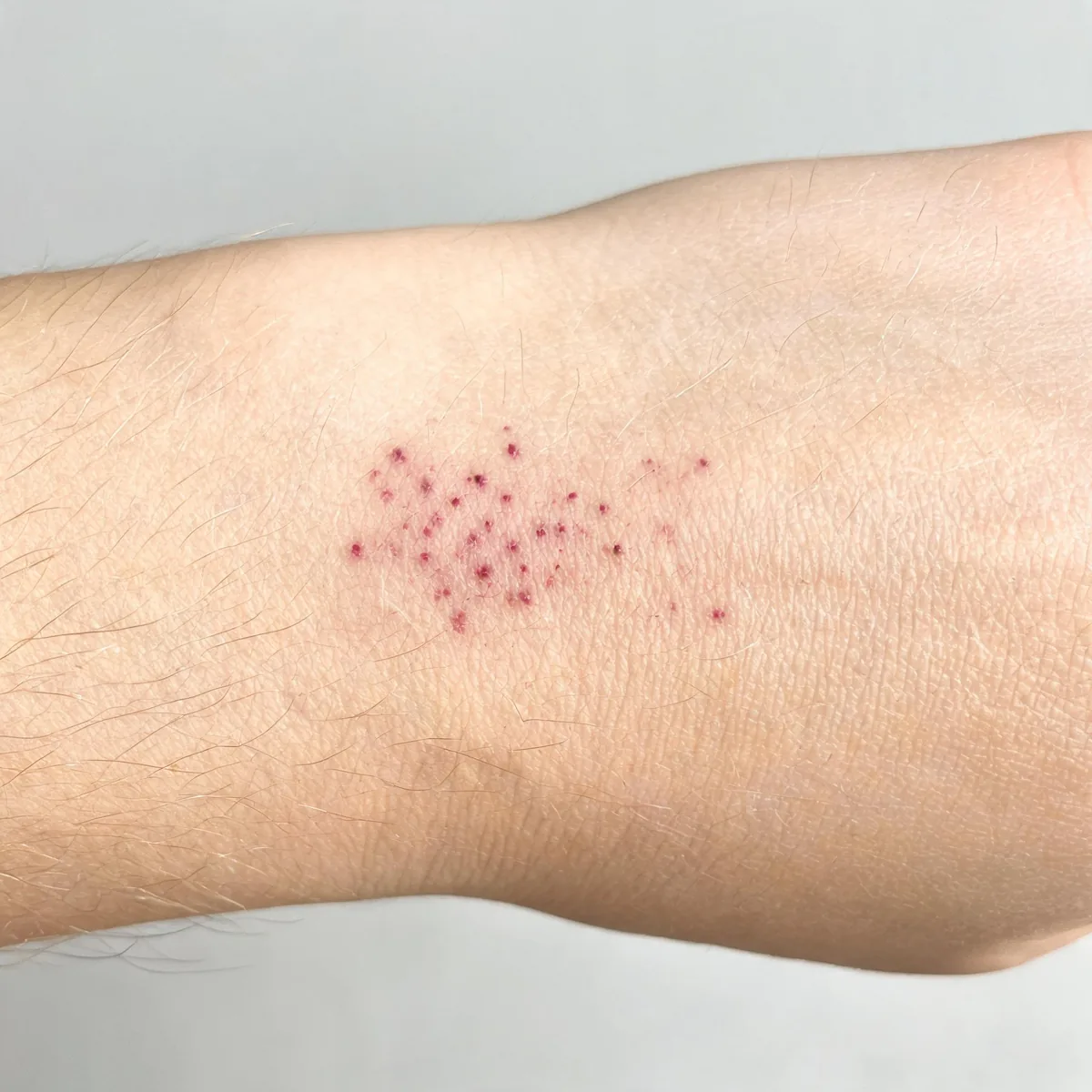
Understanding Petechiae
The tradition describes petechiae through blood management: blood should flow smoothly inside the vessels, held by the Spleen grasp and guided by the Liver free flow.
When containment fails, whether from external heat, internal fire or a weak Spleen, blood seeps out and appears as pinpoint spots. Wind-Heat gives acute spots after a cold or sore throat, with itching and mild fever.
Heat in the Blood gives bright or dark red spots with bleeding from the nose or gums and a sensation of internal heat. Spleen not controlling Blood gives pale purple or brownish spots that appear gradually with chronic fatigue and loose stools.
Empty-Heat from Yin deficiency gives dark red rather than bright spots, with night sweats and five-palm heat. Damp-Heat gives purple spots on the lower legs with heaviness and a sticky taste, while Blood Stagnation gives dark purple spots that persist and do not fade, with fixed stabbing pain.
The colour and behaviour of the spots carry much of the diagnosis. Bright red spots that appear quickly suggest fresh heat driving blood out with force; pale spots that arrive slowly suggest a failing grasp in the Spleen; dark spots that linger suggest deeper stagnation or a Yin deficiency that keeps the heat smouldering. Where the spots sit and what accompanies them narrow it further.
More than one organ system can be responsible. The Spleen holds blood inside the vessels, so when overwork, poor diet or long illness deplete Spleen Qi, the spots tend to be pale purple and to appear and fade as energy rises and falls. The Liver, which stores blood and keeps it moving, can agitate it into leaking when Qi stagnates or fire builds. The Heart governs the vessels, and heat that reaches the blood level damages them directly. Wind-Heat from outside can also invade the small collaterals of the skin and produce an acute, itchy crop of spots after a cold or an allergic reaction.
The same Western finding therefore has several possible roots. One person develops spots after a sore throat, another during a stretch of stress and spicy food, a third who has been worn down for months and has lost their appetite, and each needs a different strategy: cool and disperse, cool and stop the bleeding, or tonify and hold. Tongue, pulse and accompanying signs are what separate them, and they are what a practitioner reads before choosing herbs or points.
Conventional view
Western medicine describes petechiae as flat, round, pinpoint spots on the skin or on mucous membranes after bleeding from capillaries. They do not lose colour when pressed and run from red to purple. They are not themselves a disease; they signal an underlying problem such as an infection, a medication effect, a clotting disorder, a low platelet count or vasculitis. Assessment means examination and a full history, usually with a complete blood count and clotting studies, and a skin biopsy in some cases.
The cause dictates the treatment: a medicine is stopped, an infection is treated, or a blood disorder is managed. Where immune thrombocytopenia is responsible, corticosteroids or other immunosuppressants may be used to lift the platelet count, and a clotting factor deficiency may need replacement therapy. In many mild or viral cases no specific treatment is needed beyond rest and monitoring, and the spots resolve over days to weeks.
Western medicine is strong at identifying dangerous causes and at treating the underlying disease, but it has less to offer when the spots are chronic, recurrent or idiopathic. Corticosteroids bring their own side effects and do not always prevent further outbreaks. The approach also treats the spots as a downstream consequence of one measurable parameter, such as platelet count or clotting time, and can overlook the wider terrain that leaves a person prone to capillary fragility and bleeding, which is where TCM offers a complementary view.
Selected PubMed records
Real PubMed records for the conventional discussion above, selected by condition name and title relevance. They are references, not a claim that any treatment is proven for this condition.
- The terminology of skin disorders. Primary Care, 2000. PMID: 10815043.
How it connects
Petechiae often sit inside a wider pattern. A person can carry Spleen deficiency, with its fatigue and poor appetite, and still notice spots flaring after spicy food, which is a layer of heat on top of the deficiency; the practitioner treats the layer that is active while keeping the root in view. Timing and triggers are the practical compass: spots that follow a cold or an allergen lean toward Wind-Heat, those that get worse when the person is tired and better after rest toward Spleen deficiency, and those that burn and arrive with other bleeding toward Heat in the Blood. Dark spots that persist for weeks with night sweats or a purplish tongue suggest Empty-Heat or Blood Stagnation. Sudden widespread spots, especially with fever or bleeding elsewhere, need medical assessment before any herbal plan.
How it is assessed
The first question is whether the petechiae are acute with fever, which is an emergency.
What a practitioner looks for
- Fever and speed: widespread petechiae with fever is a medical emergency, not a herbal consultation.
- Colour: bright red suggests heat; pale purple with fatigue suggests Spleen weakness; dark persistent spots suggest stasis.
- Bleeding elsewhere: nose, gums, urine or stool increases urgency.
- Constitutional picture: night sweats, fatigue, low back soreness and digestion decide the chronic pattern.
Spots that appear suddenly with itching and a feeling of heat, often bright red or slightly raised, with a slight fever or a sore throat, suggest Wind-Heat. Its tongue shows a thin yellow coating over a red body, and the pulse floats and runs fast, and the episode usually follows a cold or an allergy flare.
Intensely bright red or purple spots with bleeding gums, nosebleeds or heavy periods point to Heat in the Blood, where the person feels hot, thirsty and irritable. The tongue body is deep red under a yellow coat, and the pulse runs rapid and forceful. Pale purple spots that arrive gradually against a background of tiredness, poor appetite and a sallow face suggest Spleen not controlling Blood, with a pale tongue, a thin white coat and a weak thready pulse that worsen with tiredness.
Dark red spots with night sweats and a mild fever that returns each afternoon indicate Empty-Heat from Yin deficiency, with a red tongue that has little or no coat and a thready rapid pulse, often after a long illness. Purple spots on the lower legs with heaviness, fullness and loose stools suggest Damp-Heat, with a thick greasy yellow coat and a slippery pulse. Persistent dark purple spots that will not fade, a purplish tongue with distended sublingual veins and a choppy pulse indicate Blood Stagnation.
TCM patterns in Petechiae
Six patterns explain most petechiae, and the first division is between excess and deficiency. Wind-Heat, Heat in the Blood and Damp-Heat push blood out of the vessels, so their spots tend to be brighter, to arrive faster and to come with heat, itching or a febrile illness. Spleen not controlling Blood and Empty-Heat from Yin deficiency fail to keep blood in place, so their spots are paler or darker, arrive gradually and come with fatigue, night sweats or a long illness. Blood Stagnation is the sixth possibility, where flow itself is obstructed and the spots stay dark and fixed. Colour, speed of onset, where the spots sit and what accompanies them separate these pictures, and because patterns can be layered, the practitioner reads them alongside the tongue and pulse rather than trusting the spots alone.
| Pattern | Key signs | The itch | Tongue | Main formula |
|---|---|---|---|---|
| Wind-Heat | Red or bright purple spots | Itching | Body: Red at the tip and edgesCoat: Thin yellow or white turning yellow | Not specified |
| Heat in the Blood | Bright red or dark red spots | Not specified | Body: Deep red, often with red points or pricklesCoat: Thin, yellow and dry | Not specified |
| Spleen not controlling Blood | Not specified | Not specified | Body: Pale, puffy and tender with teeth marksCoat: Thin white | Not specified |
| Empty-Heat caused by Yin Deficiency | Dark red spots; Dry mouth and throat at night | Not specified | Body: Red, thin and dry, often crackedCoat: Little or none; the tongue may look peeled | Not specified |
| Damp-Heat | Not specified | Not specified | Body: Red, often swollen with teeth marksCoat: Yellow, greasy and thick, usually in the middle and at the root | Not specified |
| Blood Stagnation | Fixed stabbing pain in the area | Not specified | Body: Purple, dusky or with dark stasis spots; sublingual veins dark and distendedCoat: Often thin white; a yellow coat would suggest Heat as the cause | Not specified |
Wind-Heat
Acute spots after a cold, with itching and mild fever.
Wind-Heat belongs among the external pathogens that settle on the surface of the body. When it settles in the skin, the blood beneath is heated and the small collaterals are damaged, so blood leaks out and forms red or purple spots. The itch comes from the wind, whose nature is to move, which is why the spots may itch and shift and why the episode often follows a cold or a throat infection.
The tongue is red at the tip and edges with a thin yellow coat that may start white, and the pulse floats and runs fast. Hot weather, wind exposure, spicy fried food and exhaustion make it worse, while a cool room, rest, cooling drinks and avoiding wind help. Yin Qiao San is the formula, often modified with herbs that stop bleeding, and the points are LI-4 Hegu, LI-11 Quchi and SP-10 Xuehai.
Signs
- Acute onset after a cold or sore throat
- Itching
- Red or bright purple spots
- Fever with mild chills and thirst
Diet and lifestyle for this pattern: Avoid spicy, greasy and fried food that creates Heat, and eat cooling food such as mung beans, cucumber and watermelon. Stay hydrated, rest, and stay out of wind.
Heat in the Blood
Bright or dark red spots with bleeding and internal heat.
When intense heat reaches the blood level, the blood is agitated until it leaves the vessels. That reckless movement pushes blood under the skin, where it shows as bright red or purple spots which do not blanch under pressure, and the same heat drives bleeding from the nose, the gums or the uterus. A feeling of internal heat that is worse at night belongs to the picture.
The tongue is deep red with red spots or prickles under a thin dry yellow coat, and the pulse is rapid, wiry and forceful. Spicy food, alcohol, coffee, anger, hot weather and lost sleep all add fuel, while cooling food and drink, rest and a cool room ease it. The classical literature names the formula only by its action, clearing heat from the blood level and stopping bleeding, with Chi Shao and Mu Dan Pi as the key herbs; the points are SP-10 Xuehai, PC-3 Quze and LR-3 Taichong.
Signs
- Bright red or dark red spots
- Bleeding from nose or gums
- Internal heat worse at night
- Thirst for cold drinks
- Restlessness and irritability
Diet and lifestyle for this pattern: Avoid heating food and drink such as spicy peppers, alcohol, coffee and fried food, which add fuel to the fire. Favour cooling, Yin-nourishing food such as mung beans, cucumber, chrysanthemum tea and pear, stay well hydrated, rest adequately especially at night so the body can cool the Blood, and keep exercise gentle such as walking or tai chi so Qi circulates without overheating.
Spleen not controlling Blood
Pale spots appearing gradually with chronic fatigue.
The Spleen is what keeps blood within the vessels. When Spleen Qi is weakened by overwork, poor diet or long illness it loses that grip, and blood seeps out through the small vessels into pale purple spots that come on slowly and fade again. Because this is a deficiency, the spots are light in colour rather than bright red, and the same weak Qi leaves the person tired, pale and short of breath.
The tongue is pale, swollen and tender, its edges indented by teeth, under a thin white coating, and the pulse is fine and weak, most of all at the right middle position. Overwork, raw and cold food, worry and irregular meals make it worse, while rest, warm cooked meals, gentle exercise and stress reduction help. Gui Pi Tang is the formula, with Dang Shen, Huang Qi, Xian He Cao and Bai Zhu as key herbs, and the points are REN-12 Zhongwan, ST-36 Zusanli, SP-6 Sanyinjiao and BL-20 Pishu.
Signs
- Pale purple or brownish spots appearing gradually
- Chronic fatigue and shortness of breath
- Poor appetite with loose stools
- Pale or sallow complexion
Diet and lifestyle for this pattern: Eat warm, cooked, easy meals such as congees, soups and stews, and avoid raw, cold and greasy food that taxes the Spleen. Gentle daily walking rather than overexertion suits this pattern, and regular rest plus stress management matter because worry and overthinking weaken Spleen Qi directly.
Empty-Heat caused by Yin Deficiency
Dark red spots with night sweats and five-palm heat.
A deficiency of Yin leaves the body without its cooling, moistening anchor, and empty heat then rises and disturbs the blood. Blood is pushed out through the small vessels, and because the heat smoulders rather than blazes, the spots are dark red rather than bright. Night sweats and a low-grade afternoon or evening fever usually accompany them.
The tongue is red, slender and dry with hardly any coating, and cracks may be present; the pulse is fine and rapid. Stress, overwork, spicy food, late nights and hot dry weather fan the heat, while rest, a cool environment, moistening foods such as pear and lily bulb and plenty of water help. Da Bu Yin Wan is the formula, often combined with Er Zhi Wan, with Sheng Di Huang, Zhi Mu and Mu Dan Pi as key herbs; the points are KI-3 Taixi, SP-6 Sanyinjiao and SP-10 Xuehai.
Signs
- Dark red spots
- Night sweats
- Low-grade afternoon or evening fever
- Heat in palms, soles and chest
- Dry mouth and throat at night
Diet and lifestyle for this pattern: Rest and avoid late nights, since sleep is when the body rebuilds Yin. Eat moistening, cooling food such as pear, lily bulb and tofu, and avoid spicy, fried or overly warming food and stimulants such as coffee and alcohol.
Damp-Heat
Purple spots on the lower legs with a heavy sticky picture.
Dampness and heat accumulate and obstruct the channels, so Qi and blood no longer move freely, and the heat then damages the small vessels so that blood leaks under the skin. Dampness is heavy and sticky, so the spots gather on the lower legs and come with a sense of heaviness and sluggishness. The spots are purple rather than bright, and the mouth tastes sticky and greasy.
The tongue body is red with a yellow greasy coat and may be swollen with teeth marks, and the pulse is soggy and rapid or slippery and rapid. Humid weather, greasy and spicy food, alcohol and coffee, and a lack of exercise make it worse, while light bland meals, cool dry weather, gentle exercise and barley or coix seed tea help. Si Miao San is the formula, modified with blood-cooling herbs, with Huang Bo, Cang Zhu, Yi Yi Ren and Di Yu as key herbs; the points are SP-9 Yinlingquan, SP-10 Xuehai, LI-11 Quchi and ST-40 Fenglong.
Signs
- Purple spots on lower legs
- Heavy sensation in the limbs
- Chest and upper abdominal stuffiness
- Sticky greasy taste
- Loose sticky stools
Diet and lifestyle for this pattern: Avoid greasy, fried and spicy food as well as dairy and sugar, which generate Dampness and Heat. Eat more lightly cooked vegetables, whole grains and bitter or bland food such as celery, cucumber, mung beans and Job's tears, avoid alcohol, and keep exercise gentle and regular to move Qi and drain Dampness.
Blood Stagnation
Dark persistent spots that do not fade, with fixed pain.
If blood flow turns sluggish or meets an obstruction, the small vessels that feed the skin are blocked and the back-up forces blood out of them. The result is dark purple spots that fade slowly, unlike the acute spots of a heat pattern, and they come with a fixed stabbing pain in the area they occupy. Pain and spots both tend to worsen at night.
The tongue is dark purple or dusky, dotted with stasis spots and marked by distended dark veins beneath, under a thin white coating; the pulse feels choppy, rough and uneven, as if a knife were scraping bamboo. Cold weather, prolonged sitting and emotional stress make it worse, while gentle exercise, warmth and light massage help. Xue Fu Zhu Yu Tang is the formula, with Dan Shen and Tao Ren as key herbs, and the points are SP-10 Xuehai, BL-17 Geshu and LR-3 Taichong.
Signs
- Dark purple spots that persist and do not fade
- Fixed stabbing pain in the area
- Worse at night
- Dark purplish tongue with stasis spots
Diet and lifestyle for this pattern: Keep the body warm and avoid cold raw food that can congeal the Blood. Gentle daily walking, tai chi or yoga keeps Qi and Blood flowing, and moderate amounts of blood-nourishing food such as dark leafy greens, beetroot and small portions of lean meat or eggs help.
Treatment approach
How the tradition treats petechiae, with the herbs, formulas and points used for it.
Principles
- Exclude an emergency first: petechiae with fever needs immediate medical assessment.
- Cool the Blood and stop bleeding where heat is driving it.
- Strengthen the Spleen where containment is failing.
- Nourish Yin where Empty-Heat causes recurrent spots.
- Treatment has two aims that run together: stop blood escaping the vessels and correct the imbalance that let it escape. Heat is cooled, stasis is moved so that old blood does not obstruct new circulation, and a failing holding function is strengthened. Mixed pictures are common, and a formula is modified so that it addresses the dominant problem without aggravating the secondary one. Excess patterns call for clearing, cooling and dispersing; deficiency patterns call for tonifying, nourishing and astringing, and the choice is reviewed at each visit as the tongue, pulse and spots change.
Herbs used
Formulas
Acupoints
- LI-4 (Hegu)
- LI-11 (Quchi)
- SP-10 (Xuehai)
- PC-3 (Quze)
- LR-3 (Taichong)
- zhongwan-ren-12
- ST-36 (Zusanli)
- SP-6 (Sanyinjiao)
- BL-20 (Pishu)
- KI-3 (Taixi)
- SP-9 (Yinlingquan)
- ST-40 (Fenglong)
- BL-17 (Geshu)
What to expect
- The tradition describes gradual improvement once the pattern is treated, but petechiae always need medical review of the cause.
- Recurrence follows the underlying pattern.
- Widespread petechiae with fever is an emergency regardless of pattern.
- Timelines follow the pattern. Acute pictures, whether Wind-Heat or heat that has entered the Blood, often begin to fade within one to two weeks, deficiency pictures, whether the Spleen has stopped holding blood or Yin has run low, usually need six to twelve weeks, and Damp-Heat or Blood Stagnation tend to improve over four to eight weeks. Acupuncture is usually weekly and herbs daily, and consistency matters because missed doses slow progress. Once the spots have cleared, treatment often continues for a few more weeks to consolidate the result, while the medical cause is reviewed alongside.
Safety and when to get help
Seek medical help urgently for
- Sudden widespread petechiae with fever, which can indicate meningitis or sepsis.
- Petechiae with bleeding from the nose, gums, urine or stool.
- Petechiae with a severe headache, neck stiffness, confusion or a rapidly spreading rash.
For anything severe, sudden or spreading quickly, read when a skin problem needs urgent care.
Cautions
- Do not delay emergency care for a feverish rash.
- Petechiae need a medical cause identified, including a platelet count.
- Herbs that move Blood are used cautiously where bleeding is active.
Using this alongside conventional care
- TCM is described as complementary to conventional care: . Any feverish or widespread petechial rash needs emergency assessment; herbal treatment belongs to the recovery or chronic phase.
- TCM is used alongside conventional care, not instead of it. Where the spots come from a known cause, an infection or immune thrombocytopenia for instance, both the doctor and the TCM practitioner need to know every treatment in use. Chi Shao and Mu Dan Pi both have a mild antiplatelet action, so anyone taking warfarin, aspirin or clopidogrel should raise it with both practitioners before starting a formula. Prescribed medicines are never stopped without the doctor's advice.
Diet and lifestyle
- Avoid spicy food, alcohol, fried food and excess sugar, and favour cooling food.
- Diet is chosen to cool what is heating and support what is holding. Spicy peppers, alcohol, fried food and large amounts of red meat aggravate blood heat and should be reduced, while cooling foods that nourish the blood are favoured: mung beans, lotus root, watermelon, cucumber, pear and dark leafy greens. Where the Spleen is deficient, meals should be warm and cooked, with raw, cold and heavy food avoided. Damp-Heat calls for lighter eating with less dairy, sugar and alcohol, and coix seed or barley helps; Blood Stagnation does better with warmth and modest amounts of beetroot, greens and lean meat or eggs. Water and mild cooling teas such as chrysanthemum or dandelion support the general principle.
If you're pregnant
Petechiae in pregnancy always need medical attention, because they can point to preeclampsia. The two patterns seen most often are Heat in the Blood and Spleen not controlling Blood. For the Spleen picture, Gui Pi Tang is usually preferred, built on herbs such as Dang Shen and Huang Qi that are generally considered safe in pregnancy. Strongly cooling, blood-moving formulas are avoided or used only with strict professional supervision, and Xi Jiao Di Huang Tang, with its Chi Shao and Mu Dan Pi, is the example. Acupuncture is the safer first line, particularly in the first trimester, with ST-36 Zusanli and SP-6 Sanyinjiao used cautiously, and the obstetrician should be told of any plan so that serious causes are excluded.
If you're breastfeeding
Most of the herbs used for petechiae are regarded as safe while nursing, though the bitter-cold ones need care. The Huang Bo in Si Miao San may change the taste of milk and may loosen an infant's stools, and for Heat in the Blood the milder cooling options are preferred to the strong blood-cooling preparations. Gui Pi Tang is usually well tolerated by nursing mothers, and so is Yin Qiao San. Acupuncture transfers nothing through milk. Watching the infant's stools and mood after a formula starts is sensible, and a qualified practitioner can adjust the prescription.
If treating a child
Petechiae are fairly common in childhood, particularly the purpura that follows a respiratory infection, and Wind-Heat and Damp-Heat are the patterns seen most. A child may not describe itching or discomfort, so the colour and spread of the spots, with any fever or abdominal pain, carry the assessment. Paediatric amounts are usually between a half and two-thirds of the amount given to an adult, gentle formulas such as Yin Qiao San are preferred, and strong blood-moving herbs are avoided. Acupressure or paediatric tuina can take the place of needles. Recovery is often quick, though the spots can return while Spleen Qi is still weak.
If treating an elderly patient
In older adults the spots often reflect fragile vessels together with a deficiency picture, whether the Spleen has stopped holding blood or the Blood has begun to stagnate. They can appear after very little trauma and may take longer to fade. Polypharmacy has to be considered, since anticoagulant and antiplatelet drugs make bleeding more likely and can interact with herbs that move blood, Dan Shen and Tao Ren among them. Herbal amounts are usually cut to about two-thirds of the usual adult amount, acupuncture is often better tolerated, and the pace is slower, aiming at gentle Spleen strengthening with Yin or Blood nourished alongside. A sudden increase in spots needs immediate medical assessment.
Urgent-sign guidance is based on standard sources: NHS anaphylaxis, NHS cellulitis, NHS Stevens-Johnson syndrome, NHS melanoma.
Evidence
Evidence status
Compiled for this page from the classical and modern literature; not a systematic review, so treat it as a pointer to sources rather than clinical guidance.
Evidence mostly comes from allergic purpura (HSP) and immune thrombocytopenia research. Systematic reviews of formulas including Xi Jiao Di Huang Tang and Gui Pi Tang suggest reduced purpura recurrence and improved platelet counts when combined with conventional therapy, though trials are small, Chinese-language and of variable quality. Acupuncture has been less studied for petechiae specifically, though its immune-modulating effects are documented elsewhere.
Studies often cited
Systematic reviews suggest reduced purpura recurrence and improved platelet counts combined with conventional therapy, with methodological limits. Systematic reviews (as recorded in the source)
Less studied for petechiae specifically; immune-modulating effects documented in other conditions. Indirect evidence (as recorded in the source)
Classical record
Purple spots belong to exuberant heat in the blood level, erupting on the skin; they should be treated by cooling the blood and invigorating its flow.
- Yi Zong Jin Jian, Surgical Heart Methods. This classic description underlies the modern use of formulas such as Xi Jiao Di Huang Tang for Heat in the Blood petechiae. The Chinese original is not reproduced here: it could not be recovered reliably from the source record, and is not guessed.
血动之由,惟火惟气耳。故察火者但察其有火无火,察气者但察其气虚气实。
The causes of blood moving out of place are fire and qi alone. To examine fire, establish only whether fire is present; to examine qi, establish only whether qi is deficient or excessive.
Jing Yue Quan Shu, Blood Syndromes - Classical citation: for this page: Jing Yue Quan Shu, Blood Syndromes chapter.
Common questions
Are petechiae dangerous?
They can be. Widespread petechiae with fever can indicate a serious infection, and petechiae with bleeding elsewhere can indicate a platelet problem. Both need urgent medical assessment.
What causes petechiae in TCM terms?
The tradition describes heat pushing blood out of the vessels, or a weak Spleen failing to hold it in, with stagnation and Yin deficiency as further patterns.
Can herbs stop them appearing?
The classical literature treats the underlying pattern. The cause still needs conventional investigation, especially where platelets are involved.
Should I press on them?
Petechiae do not blanch under pressure, which is one way they are distinguished from other red spots. That test is a medical assessment, not a self-diagnosis.