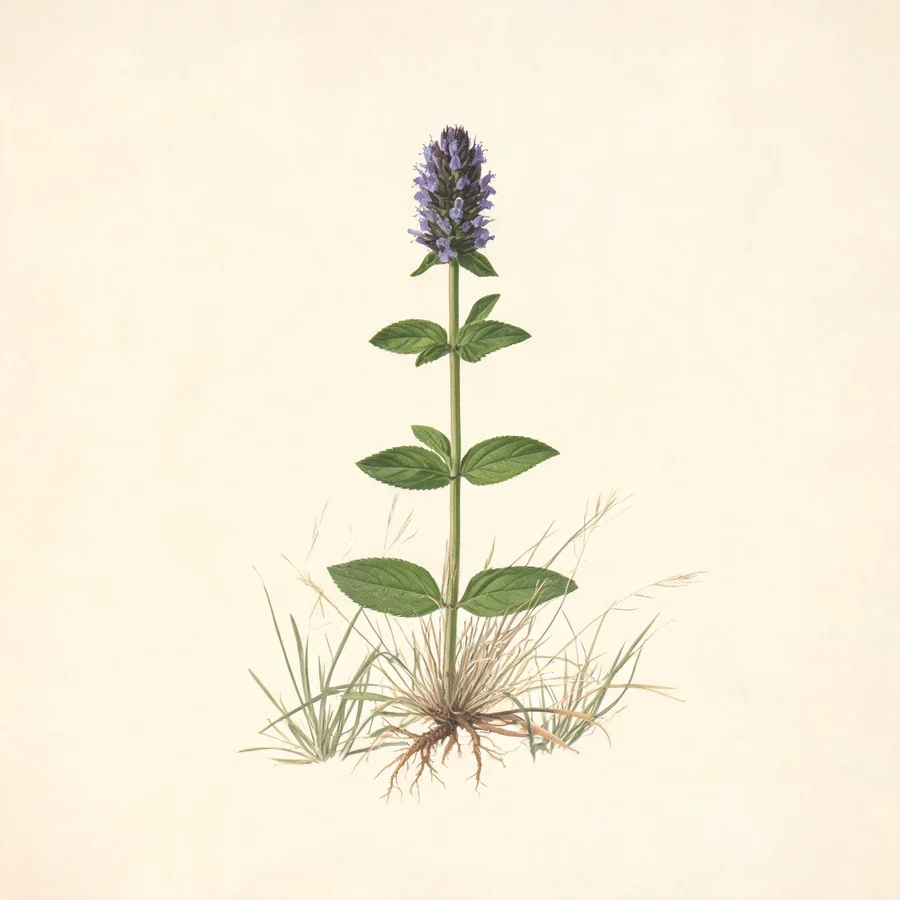
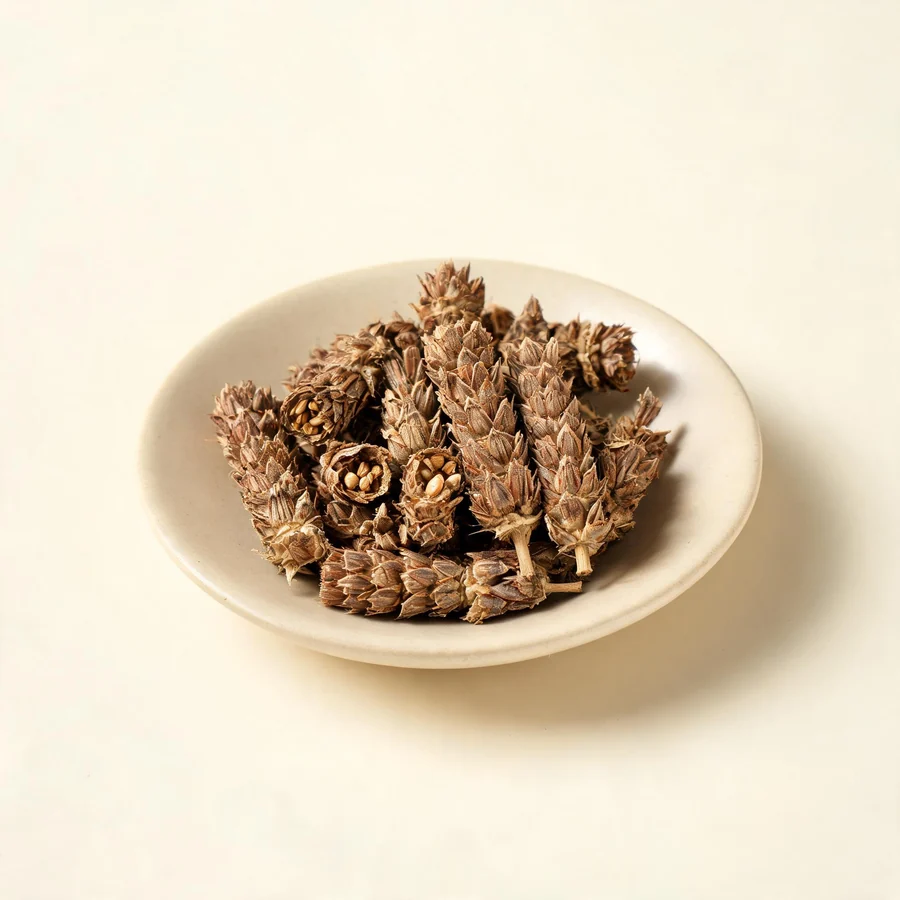
Skin profile
Where this herb sits in skin practice: the pattern it corrects, the skin signs it suits, and what it should not be used for.
Xia Ku Cao is the herb for the lesion that has set: the cyst, the nodule, the hard wart, and the flushed face that comes with them. It is slow, cold and dispersing, and it works only where heat is part of the picture.
Skin signs that suggest it
- Firm, movable lumps under the skin, tender only on pressure, often on the neck, jaw, breast or scalp
- Deep painful acne nodules and cysts on an oily, flushed face, with scarring from old lesions
- A cyst that refills after being drained, with a small central pore and a dull ache
- Flushing and heat in the face with irritability, temple headache and sore red eyes
- Dark, hard warts that have resisted treatment in a person who runs hot
- A wiry, rapid pulse and a red tongue with a yellow coat
When it is not the right herb
Not for a pale, cold, painless lump in a tired person, and not for a soft swelling that pits on pressure and shifts with gravity; those are another pattern, and a cold dispersing herb will not help them. It is not for dry, thin, cold skin without heat, nor for someone with a poor appetite, loose stools and a cold abdomen, in whom the bitterness weakens digestion further. A new lump, a lump that is growing or fixed, or any breast lump needs medical assessment first, and the herb is no substitute for that.
What it does for skin
Skin-relevant actions only. Each one describes a mechanism in TCM terms and what it looks like on the skin.
Disperses nodules and softens hardness
The defining skin action. A nodule is what is left when heat, phlegm and stagnant qi have been pressed together long enough to set, and the spike is described as loosening that knot while the cold removes the fire inside it. It is used for the deep indurated lesion rather than the surface pustule, and it is paired with herbs that soften hardness, such as Zhe Bei Mu and Mu Li, so the mass is worked from two directions at once. Improvement is measured in months, and a lesion that instead grows, ulcerates or bleeds needs investigation.
Cools Liver fire that shows in the face
Liver fire rises, and the face is where it can be seen: flushing, heat, a greasy shine, red eyes, headache and a short temper. The spike clears the fire at the channel that carries it, which is why it appears in formulas for a flushed and oily face and for redness that flares with stress and anger. It is a cooling herb and not a sedative one, and the emotional component is read as part of the same heat rather than as a separate problem.
Clears heat from a mass that has become inflamed
A nodule that turns hot, red and tender has heat on top of congelation, and the spike addresses both: the cold lowers the inflammation while the dispersing quality works on the lump. That is the reasoning behind using it when a cyst, a lipoma or a lymph node becomes sore, and why it is combined with toxin-resolving herbs at that stage. It is not a treatment for an abscess that needs drainage, and any collection of pus under the skin belongs with a clinician.
Acts on hard, thickened lesions
Warts and thickened plaques are read as the same congelation in a smaller package, and the spike is added to blood-moving formulas when the lesion is dark, firm and stubborn. It is an adjunct rather than a cure: destructive treatments such as cryotherapy remain the main option for warts, and the herb is used beside them or after they have failed. Expect slow softening, and do not delay assessment of a lesion that changes colour or bleeds.
Skin conditions it is used for
Mapped to the condition pages on this site. The pattern column shows what the skin is doing when this herb is the right choice.
| Condition | Pattern | Why it suits | Typical setting |
|---|---|---|---|
| Acne | Phlegm-heat congealed into nodules and cysts | Deep, painful lesions that leave scars are read as heat that has thickened fluids into phlegm and bound them in the skin. The spike is used in that nodular and cystic phase rather than for surface pustules, and it is combined with herbs that transform phlegm and soften hardness, as in Hai Zao Yu Hu Tang. It is not the herb for the early red papular stage, where cooling and wind-releasing herbs do the work, and severe nodulocystic acne still needs dermatological care. | Hai Zao Yu Hu Tang, with Zhe Bei Mu and Mu Dan Pi |
| Subcutaneous lipomas and nodules | Phlegm-fire knotted into a firm lump | A soft, movable lump is usually read as phlegm, and the spike is not the first choice for a cool, doughy one. It is added when the lump is firm, has been present for months, or becomes tender and warm, because the acrid taste breaks the binding and the cold removes the heat that keeps it bound. The distinction that matters is clinical: a painless lump that never changes is often left alone, while a hard, fixed or fast-growing lump needs imaging and a diagnosis before any herb. | With Zhe Bei Mu, Mu Li and Dan Shen |
| Sebaceous cysts | Phlegm nodule with recurrent low-grade heat | A cyst that keeps refilling is a sac of thickened fluid, and the tradition treats it as phlegm that has settled in a channel. The spike is used when the cyst is repeatedly inflamed or tender, aiming at the heat and the lump together, and it is combined with herbs that transform phlegm and soften what has hardened. A cyst that becomes hot, spreading and painful is infected, and that needs antibiotics or drainage rather than a dispersing herb. | With Ban Xia, Chen Pi and Zhe Bei Mu |
| Warts | Hard dark lesions on a background of heat and stasis | The spike is a recognised addition to blood-moving formulas for warts that are dark, hard and resistant, where the lesion is read as heat and stasis held in a small area. It is given alongside destructive treatment rather than instead of it, and the expectation is slow softening rather than disappearance. Flat warts on the face of a hot, irritable person are the picture in which it is most often chosen. | Tao Hong Si Wu Tang with Xia Ku Cao and Ban Lan Gen |
| Oily skin with facial flushing | Liver fire blazing upward to the face | Greasy shine on a hot, red face, with a throbbing temple and a short temper, points to Liver fire pushing heat and oil upward. The spike cools the fire, which suits a face that is flushed rather than dull, and it sits in the Liver-draining formulas with Long Dan Cao, Huang Qin and Zhi Zi. It is not for the pale, cold, clammy face, and it will not by itself change a constitution that is producing oil for other reasons. | Long Dan Xie Gan Tang, with Xia Ku Cao and Ju Hua |
Combinations for skin
Herbs it is paired with when the skin, not an internal organ, is the target.
| Partner | Ratio | Why the pair is used |
|---|---|---|
| Zhe Bei Mu | 9 to 12 g each in decoction | Zhe Bei Mu transforms phlegm and softens what has hardened, but it has little cooling power of its own, so the spike supplies the cold that keeps phlegm from re-forming as quickly as it is moved. The two together are the usual response to a hard mass in the neck, and they serve scrofula, goitre and the persistent nodule in the skin alike. Phlegm and heat together need one herb to shift the phlegm and a second to take out the heat that congeals it. |
| Mu Li | 15 to 30 g Mu Li with 9 to 15 g Xia Ku Cao | Oyster shell is salty and heavy: it softens a mass that has already set and settles a spirit that cannot rest. With the spike it addresses a swelling that is hot and firm at once, the shell working on texture and the spike on the fire behind it. The same pair is chosen when palpitations and irritability accompany a lump, since the shell calms what the spike has already cooled. |
| Ban Lan Gen | 9 to 15 g of each | Ban Lan Gen clears heat toxin and is the herb most used for warts and viral skin lesions in modern practice. The spike adds the dispersing action a nodular, hard lesion needs, so a flat wart or a stubborn verruca is treated with both. The two are also used together for a hot, tender lymph node in the neck. |
| Ju Hua | 6 to 10 g Ju Hua with 9 to 15 g Xia Ku Cao | Both reach the Liver and the head. Chrysanthemum is the gentler eye and head herb, clearing wind-heat and easing red, gritty eyes, while the spike is colder and is the one that works on a mass. Together they cover the flushed face with headache and sore eyes that comes with Liver fire, and they are the usual pair in a cooling tea. |
Formulas where it leads
- Hai Zao Yu Hu Tang (海藻玉壶汤) - The classical formula for scrofula and goitre, built on seaweed and kelp to soften hardness, with the spike added to disperse the nodule and cool the fire. In skin practice it is the model for a phlegm-heat nodule that has been present for months, and the same approach is used for a firm lymph node or a cystic lesion. The iodine load of the seaweeds is a consideration in thyroid disease.
Topical use
The spike is used externally as a cooled decoction for hot, inflamed lumps and for the flushed, oily face that comes with them. It is a dispersing wash rather than a healing ointment: the aim is to take heat out of a lesion that is warm and tender, and it is never applied to broken or ulcerated skin. One area is treated at a time, the wash is kept away from the eyes, and it does not replace assessment of a lump.
| Preparation | How and when it is used |
|---|---|
| Cooled decoction compress | 15 to 30 g of the dried spike simmered in 500 ml of water for 20 minutes, strained and left to cool. Clean gauze is wrung out and held against a warm, tender lump for 10 minutes once or twice daily, and the skin is left to dry in the air afterwards rather than rubbed. |
| Wash for an oily, flushed face | A weaker decoction, about 10 g to 500 ml, cooled and used as a quick splash or wipe rather than a soak. It is stopped if the skin feels tight or stings, because the herb is drying, and it does not replace a gentle cleanser. |
Patch test and cautions
Patch test on the inner forearm for a day before the first use. Do not apply to broken, ulcerated or infected skin, do not add heat, and do not massage a lump. Stop if the area becomes redder, more painful or starts to weep, and never let a herbal wash delay assessment of a lump that is growing or fixed.
Safety for skin use
What to check before recommending or using it, including the cautions that matter most for skin patients.
Do not use, or use with caution
- Spleen and Stomach deficiency-cold: a poor appetite, loose stools, a cold abdomen and a pale, swollen tongue. Bitterness and cold of this order dull digestion further over weeks, so a long course is paired with a warming digestive tonic, usually Ren Shen or Bai Zhu.
- A cold, painless lump with no heat signs, and any unexplained or changing lump. Dispersing what is cold does nothing for it, and a hard, fixed or growing mass needs imaging and a diagnosis before herbs are considered.
- Pregnancy, unless a practitioner has deliberately prescribed it. Laboratory work finds the spike strengthening contractions of the isolated uterus, and its cold descending nature is regarded as unfriendly to a pregnancy.
- Kidney impairment or a potassium-restricted diet. The spike carries a relatively high potassium load, which matters in reduced kidney function and alongside medicines that raise serum potassium.
Pregnancy and breastfeeding
Kept out of pregnancy unless a practitioner has decided on it for a clear reason. The objection rests on a laboratory finding, stronger contractions of uterine muscle in an isolated preparation, and on the cold descending character, not on any observed harm in women. A small topical area is unlikely to matter, but it is still checked with a practitioner. While breastfeeding, transfer into milk has not been measured, and short courses at standard doses are regarded as low risk, with the infant's stools the thing to watch.
Interactions
- Pressure-lowering drugs. Animal and laboratory work shows the spike reducing blood pressure, so an ACE inhibitor, a calcium blocker or a diuretic may drop it further than intended. Watch for dizziness on standing when treatment starts or a dose is altered, and check readings instead of guessing.
- Warfarin and antiplatelet medicines. Additive bleeding risk has been suggested, though the evidence behind it is weak. Someone already taking warfarin should not begin a daily cooling tea with the spike in it until the prescriber who manages the anticoagulant has been told and the INR checked.
- Diabetes medicines and anything that raises potassium. Early work points to blood glucose falling, so insulin or a sulphonylurea may act more strongly than intended. The herb's potassium load also matters with potassium-sparing diuretics, with digoxin, whose safety margin shifts as serum potassium moves, and in kidney impairment.
Allergy and patch testing
The spike is a mint-family herb, so a person who reacts to mint, basil or rosemary may react to it. Contact reactions to herbal washes are common and are usually irritant rather than allergic, especially when the wash is strong or applied to broken skin. Patch test first and stop at once if the skin becomes more irritated rather than calmer.
General safety references
General references for herbal hepatotoxicity and herb-drug interactions; they are not specific to this herb.
- Review article: Herbal hepatotoxicity - an update on traditional Chinese medicine preparations. Alimentary Pharmacology & Therapeutics, 2014. PMID: 24844799.
- Interactions between herbal medicines and prescribed drugs: an updated systematic review. Drugs, 2009. PMID: 19719333.
- Warfarin and food, herbal or dietary supplement interactions: a systematic review. British Journal of Clinical Pharmacology, 2021. PMID: 32478963.
Evidence
The classical record is quoted with its source. The modern note states the level of evidence plainly.
Classical record
主寒热,瘰疬,鼠瘘,头疮,破癥,散瘿结气,脚肿湿痹。
It is used when chills and fever alternate, for scrofula and for the running sores of the neck, for sores on the head, to break fixed abdominal masses, to scatter goitre and the qi knotted with it, and for swollen legs with damp painful obstruction.
Shen Nong Ben Cao Jing (Divine Husbandman's Classic of Materia Medica), Han compilation - The oldest entry already holds both halves of the herb's later reputation, the neck swellings and the damp swelling of the legs, and says nothing about the eyes.
夏枯草,补养厥阴血脉,又能疏通结气。目痛、瘰疬皆系肝症,故建神功。然久用亦防伤胃,与参、术同行,方可久服无弊。
The spike nourishes the blood vessels of the Jueyin, the Liver, and it opens qi that has knotted. Pain in the eye and scrofula both belong to Liver disease, which is where its striking effect comes from. Yet used for a long time it may injure the Stomach, and only when it travels with Ren Shen and Bai Zhu can it be continued without harm.
Ben Cao Tong Xuan (Thorough Comprehension of Materia Medica) - The passage that ties the eye use and the nodule use to one channel and, in the same breath, sets the rule for long courses.
夏枯草可代柴胡升发,可代甘菊清肝。
Where Chai Hu would raise and disperse, the spike can take its place; where chrysanthemum would clear the Liver, it can stand in for that as well.
Ben Cao Jing Jie - A comparison rather than a description, and a useful correction to the idea that the herb only ever descends: it was also used for restrained heat that needed lifting out.
Modern evidence
Evidence status
- Laboratory work on Prunella vulgaris extracts reports anti-inflammatory, antioxidant and antiviral activity, mostly in cell and animal systems. None of it establishes a clinical effect on nodules, cysts or warts, and no trial of the single herb in skin disease was identified.
- The potassium content is the practical pharmacological point: it is high enough to matter in kidney impairment and alongside medicines that raise serum potassium, and it is the reason the herb is not a free daily tea for everyone.
- Regulatory status: the dried spike is an accepted article in the Chinese Pharmacopoeia, which specifies the fruiting spike rather than the whole aerial part. The information here describes traditional practice and is not a claim of proven benefit.
PubMed records
Selected real PubMed records for this herb's species or its constituents, chosen by species name and title relevance. They are references for the non-TCM discussion above, not proof that the herb treats any skin condition.
- Uncovering Active Ingredients and Mechanisms of Spica Prunellae in the Treatment of Colon Adenocarcinoma: A Study Based on Network Pharmacology and Bioinformatics.. Combinatorial chemistry & high throughput screening, 2021. PMID: 32748741 (pharmacology or review record).
Dose and forms
Skin-practice dosing and the preparations that suit skin complaints.
| Form | Dose and notes |
|---|---|
| Decoction | 9 to 15 g of dried flower spike a day, taken inside a formula rather than on its own. This range covers a flushed face and a small nodule, and the daily amount is divided through the day. |
| Higher range | For a mass that has resisted treatment and carries clear heat signs, up to 30 g is used under supervision, and the old paste preparations went far higher. Anything above 30 g is a specialist decision rather than a home measure. |
| Form and timing | It is simmered with the rest of the prescription like any other herb, and it is also sold as a ready-made paste or a cooling tea. A long course needs a warming, digesting herb in the formula. |
| Course length | Six to twelve weeks for a nodule, with review, rather than years. Stop or reduce if the appetite falls, the stool loosens or the hands and feet feel cold. |
Dose follows the target rather than the scale. A flush and a headache respond to the ordinary range; a lump that has been there for months needs a larger amount for a longer time, alongside herbs that soften and break it up. Digestion sets the second limit: a cold bitter spike taken daily over months dulls appetite and loosens stool, which is why the old commentators insisted on a tonic beside it, and why a tea drunk as a habit is still a dose.
Citations and further reading
Only real sources are listed: the classical materia medica passages quoted above, and the source works behind the botanical and safety statements.
- Shen Nong Ben Cao Jing (Divine Husbandman's Classic of Materia Medica), Han compilation - classical entry quoted above.
- Ben Cao Tong Xuan (Thorough Comprehension of Materia Medica), 1644 - classical entry quoted above.
- Ben Cao Jing Jie - classical entry quoted above.
- Spica Prunellae monograph: Pharmacopoeia of the People's Republic of China - accepted source, part and quality requirements.
- Modern evidence statement: based on published laboratory work on Prunella vulgaris; no clinical trial in skin disease is presented as proof.
- Botanical description and identification: botanical literature on Prunella vulgaris, Lamiaceae.
Educational reference for qualified practitioners. This page is not medical advice, and skin conditions should be diagnosed by a clinician before treatment.