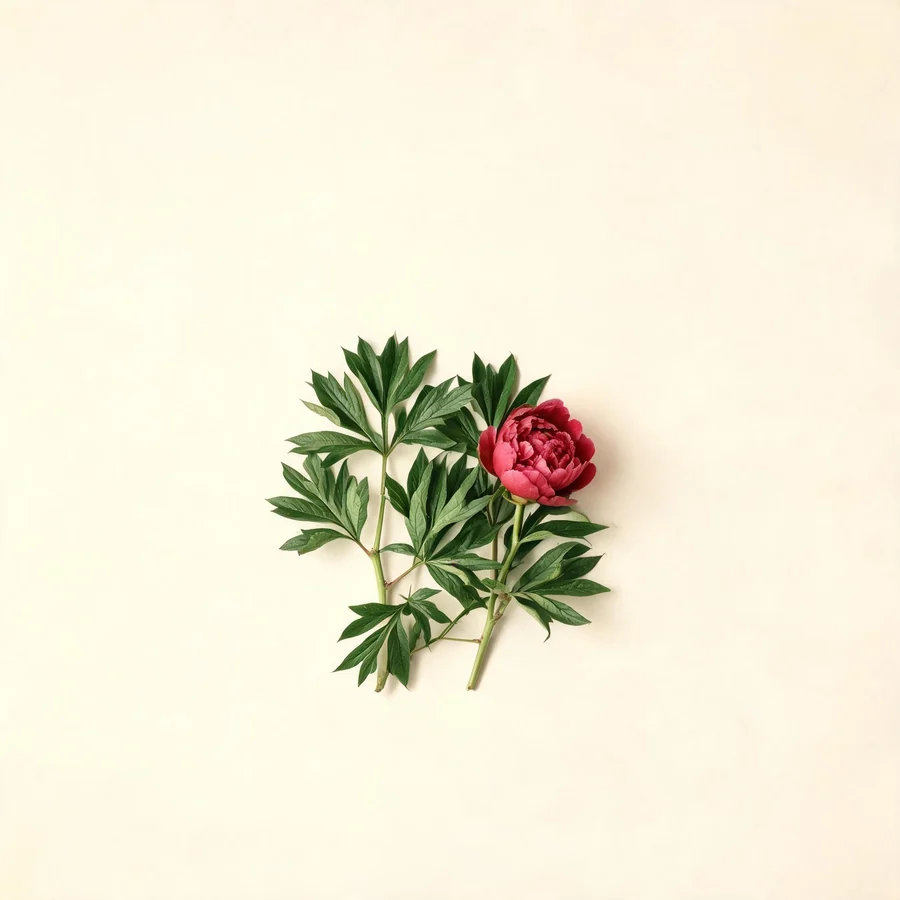
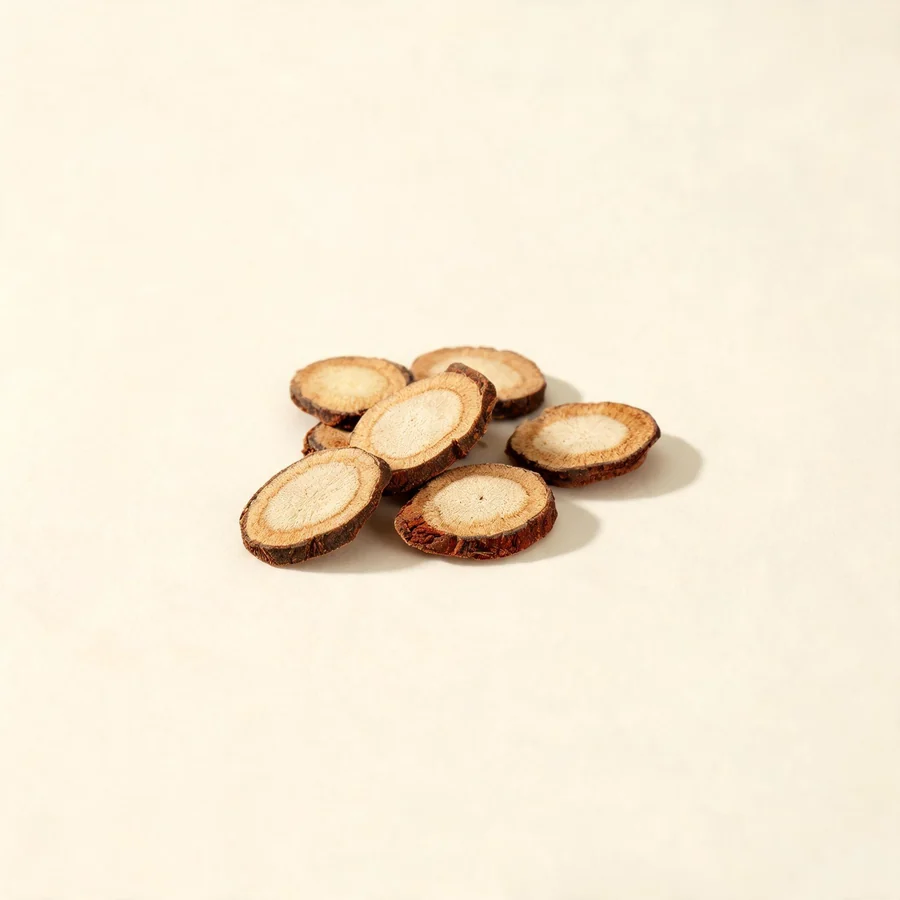
Skin profile
Where this herb sits in skin practice: the pattern it corrects, the skin signs it suits, and what it should not be used for.
Chi Shao is the herb for a lesion that is hot and stuck: dusky, fixed, aching, slow to fade. Where the skin is hot but moving freely, a simpler cooling herb is enough.
Skin signs that suggest it
- Dusky red or purplish patches that feel warm, stay in one place and fade slowly (blood heat with stasis)
- Pinpoint red or purple spots that do not blanch when pressed, or bruising that appears without a knock (heat forcing blood out of the vessels)
- A dark, swollen and tender area after an injury, with heat in the skin over it
- Deep red plaques of psoriasis or eczema that ache rather than itch and resist treatment
- A dark red or purple tongue with a wiry, rapid pulse
When it is not the right herb
Not where blood is deficient and no heat is present: a pale, dry person with a fine weak pulse, dizziness and scanty periods has nothing for a dispersing root to move, and the bitter coldness will thin what is left. Not where periods are heavy but clot-free, since moving Blood can add to the loss, and not for periods that have stopped from cold. Not for cold, weak digestion with chronic loose stools. A sore is a candidate only while it is red, hot, hard and still unbroken; after it opens and starts to discharge, dispersing is held to slow healing. Avoid in pregnancy outside a practitioner's clear indication.
What it does for skin
Skin-relevant actions only. Each one describes a mechanism in TCM terms and what it looks like on the skin.
Cools Blood that has become hot and thick
When heat enters the Blood level the lesions change character: they become deeper in colour, warmer, and less responsive to surface treatment. Chi Shao cools that level, and it is the reason the root appears in formulas for dusky, spreading eruptions and for the rash of a febrile illness. It is used with other Blood-cooling herbs rather than alone, because one root cannot cool a whole level by itself.
Breaks stasis so a fixed lesion can clear
A lesion that sits in one place, aches and darkens is read as Blood that has stopped moving. The root's dispersing quality is what distinguishes it from a simple cooling herb, and it is the reason thickened plaques and old bruises respond to it. The action is on unbroken stagnation: once a lesion drains, the same movement is no longer wanted.
Settles heat that drives blood out of the vessels
Pinpoint spots that do not fade on pressure, purpura, and bleeding into the skin during a fever are read as heat forcing blood out of its channels. Chi Shao cools the Blood without letting it stagnate, and it is partnered with Mu Dan Pi and Sheng Di Huang in the classical formula for cooling the Blood. Bleeding that is unexplained, extensive or recurrent needs a diagnosis before any herb is considered.
Eases pain and swelling in a hot, unbroken lesion
Pain is read as obstruction here, so the relief comes from removing the obstruction rather than from dulling the sensation. The root is used in an abscess at its first red, hot stage and on a bruised, swollen area, to settle the tissue before it suppurates. It is not an analgesic for pain of other kinds, and it is not used once pus has formed and is draining freely.
Skin conditions it is used for
Mapped to the condition pages on this site. The pattern column shows what the skin is doing when this herb is the right choice.
| Condition | Pattern | Why it suits | Typical setting |
|---|---|---|---|
| Psoriasis | Blood heat with stasis in thick plaques | Psoriasis that is deep red or purplish, thickened and slow to clear is read as heat that has entered the Blood, with stasis beneath it. The root cools the heat and moves the stagnation at the same time, which is why it appears in the classical blood-cooling and blood-moving combinations used for the condition. It is not a single-herb treatment, and it is less useful once plaques have become pale and dry. | Wen Qing Yin style formulas with Chi Shao, Mu Dan Pi and Sheng Di Huang |
| Eczema | Dusky, thickened eczema with heat and stasis | Chronic eczema that has become dark, thickened and tender rather than red and weeping has moved from damp-heat towards heat in the Blood with stasis. Chi Shao is added at that stage to cool and move, and it is combined with herbs that nourish the Blood so the skin is not left dry. It is not a herb for the acute weeping flare, where drying and draining are wanted instead. | Chi Shao with Mu Dan Pi, Dang Gui and Bai Xian Pi in a blood-cooling formula |
| Rosacea | Heat in the Blood with fixed redness and burning | Persistent redness with a burning quality and a dusky rather than bright colour is read as heat held in the Blood, and the root's cooling and moving pair suits that better than a purely dispersing herb. It is used with herbs that clear the face and the Stomach, and it is not expected to remove established capillaries. The dry, photosensitive type with no heat signs is the wrong picture for it. | Chi Shao with Mu Dan Pi, Zhi Mu and Lian Qiao |
| Petechiae | Heat in the Blood forcing blood out of the vessels | Pinpoint spots that do not blanch are the smallest visible version of blood leaving its channels, and the root is used to cool the Blood that is driving them out. It is combined with Mu Dan Pi and Sheng Di Huang, and the cause is investigated at the same time. New, spreading or unexplained petechiae need medical assessment before herbal treatment is considered. | Xi Jiao Di Huang Tang style formula with Chi Shao, Mu Dan Pi and Sheng Di Huang |
| Purpura | Blood heat with stasis in purpuric patches | Larger purpuric patches that are raised, dusky and tender carry both heat and stasis, which is precisely the combination this root addresses. It is a supporting herb in the formulas for heat-type purpura, used with Blood-cooling and stasis-moving partners. Purpura from a platelet disorder or a drug reaction needs medical management, and a herb is not a substitute for it. | Chi Shao with Sheng Di Huang, Mu Dan Pi and Zi Cao |
| Bruising | Recent stasis with local heat after a knock | A bruise that is dark, swollen and tender, with heat over it, is recent Blood stasis with local heat, and the root's dispersing coolness suits it. It is used internally in trauma formulas and, in practice, in a cooling wash for an unbroken bruise. It is not applied to broken skin, and a swelling that is rapidly expanding or extremely painful needs assessment. | Chi Shao with Chuan Xiong and Hong Hua in a stasis-moving formula |
Combinations for skin
Herbs it is paired with when the skin, not an internal organ, is the target.
| Partner | Ratio | Why the pair is used |
|---|---|---|
| Mu Dan Pi | 6 to 10 g each | Both work at the Blood level, though mudan pi is the gentler of the two and also clears the low heat of deficiency, while the peony moves more strongly and relieves pain better. With one cooling and the other moving, hot thickened Blood is cooled without being allowed to settle; that is why the pair appears in dusky rashes and in long-standing inflammatory skin disease. |
| Bai Shao | 6 to 10 g each | Two roots from one plant pulling in opposite directions: one holds and nourishes, the other releases and drains. Used together they move without depleting, which suits a depleted person with a fixed, tender area that still needs dispersing, or periods that are both scanty and clotted. The balance is chosen by which side of the picture dominates. |
| Sheng Di Huang | 10 to 15 g Sheng Di Huang with 6 to 10 g Chi Shao | Raw rehmannia supplies the cooling and the nourishment that the peony lacks, while the peony supplies the movement that rehmannia does not have. The pair is the core of a blood-cooling approach to a hot rash with dryness, and it is the answer when cooling alone would leave the skin dry and tight. |
| Chuan Xiong | 6 g Chuan Xiong with 6 to 10 g Chi Shao | Chuan Xiong is warm, pungent and ascending and supplies the motive force; the peony is cool and descending and supplies the cooling. Together they cover both the push and the thickened Blood, and the warm herb is kept at a modest weight when the pattern is hot. The pair is used for fixed pain rather than for surface inflammation. |
Safety for skin use
What to check before recommending or using it, including the cautions that matter most for skin patients.
Do not use, or use with caution
- Blood deficiency without heat or stasis: pallor, dryness, a fine weak pulse and scanty periods. A cooling, dispersing root has nothing to move in that picture and can thin what is already low.
- Heavy periods without clots, and periods that have stopped from cold: moving the Blood can increase a loss that is already too great, and the coolness deepens a cold congealing.
- Cold, weak digestion with chronic loose stools: bitter cold injures Spleen yang, and a tendency becomes established diarrhoea.
- An abscess that has opened and is draining: dispersing is held to delay healing once discharge has begun, so it is used only while the lesion is red, hot, hard and unbroken.
- Pregnancy and anticoagulant treatment: the Blood-moving effect is the concern in both, and the root is avoided in significant doses outside a practitioner's care.
- Li Lu (Veratrum) incompatibility: the Shao Yao entry of the Eighteen Incompatibilities covers both peonies, so the pair is never combined in one prescription.
Pregnancy and breastfeeding
Avoided in significant doses. The root is not treated as an absolute prohibition and it appears in classical gynaecological formulas for stasis during pregnancy, but those are prescriptions for a specific problem rather than general use. The first trimester and any history of threatened miscarriage are the clearest reasons to leave it out, and the Blood-moving effect is the reason for the caution. A topical preparation is not a way around this, because the concern is systemic rather than local.
Interactions
- Warfarin, heparin, aspirin and clopidogrel: paeoniflorin and the root's tannins have inhibited platelet clumping in laboratory work, so a Blood-moving formula that contains it may strengthen their effect. When such a formula starts or stops, the INR needs checking more often.
- Tetracyclines and rifampicin: gut binding by the root's tannins can cut the absorption of either, so an interval of at least two hours is left between the herb and the antibiotic.
- Medicines handled by the liver: the root is also used in hepatobiliary protocols, so anyone on a liver-metabolised medicine with a narrow margin should have the combination reviewed rather than assembled alone.
Allergy and patch testing
Contact sensitivity to peony root is uncommon but recognised in people who handle dried herbs, and a wash or a plaster containing it can produce a rash at the site. Any preparation applied to the skin is patch tested first, and it is stopped if itching or redness develops where it was applied rather than at the lesion.
General safety references
General references for herbal hepatotoxicity and herb-drug interactions; they are not specific to this herb.
- Review article: Herbal hepatotoxicity - an update on traditional Chinese medicine preparations. Alimentary Pharmacology & Therapeutics, 2014. PMID: 24844799.
- Interactions between herbal medicines and prescribed drugs: an updated systematic review. Drugs, 2009. PMID: 19719333.
- Warfarin and food, herbal or dietary supplement interactions: a systematic review. British Journal of Clinical Pharmacology, 2021. PMID: 32478963.
Evidence
The classical record is quoted with its source. The modern note states the level of evidence plainly.
Classical record
It governs blood stasis, swelling and pain, and it clears heat.
Shen Nong Ben Cao Jing (Divine Husbandman's Classic of Materia Medica) - The two halves of the root, moving stasis and clearing heat, are already together in the oldest record.
The red peony is mildly loosening; popular recipes use it for pain, where it is regarded as the equal of Dang Gui.
Ben Cao Jing Ji Zhu, Tao Hongjing - This is the first text to treat the red and white peonies as different drugs, and it already links the red one to pain and to Dang Gui.
The white root can hold yin in place and nourish the nutritive level; the red one does nothing but scatter pathogens and set Blood in motion. White drains Wood from inside Earth, while red breaks up stagnation within the Blood.
Ben Cao Qiu Zhen, Huang Gongxiu - The plainest classical account of why the two peonies cannot be swapped for one another, and of the place the red one takes in the Blood.
Modern evidence
Evidence status
- Laboratory work on paeoniflorin and the whole-root extract reports anti-inflammatory, antioxidant and platelet-inhibiting activity in cell and animal models. These findings are pharmacological and do not establish a clinical effect in psoriasis, eczema or purpura.
- Clinical trial evidence for Chi Shao in skin disease is very limited, and the root is usually studied inside multi-herb formulas rather than as a single herb. No controlled trial of the root alone in a skin condition was identified for this page.
- Regulatory status: the dried root is an accepted herbal substance in the Chinese Pharmacopoeia with a minimum paeoniflorin content, and the wild, unpeeled root is the form specified. The information here describes traditional practice, not proven benefit.
PubMed records
Selected real PubMed records for this herb's species or its constituents, chosen by species name and title relevance. They are references for the non-TCM discussion above, not proof that the herb treats any skin condition.
- Total glucosides of paeony: A review of its phytochemistry, role in autoimmune diseases, and mechanisms of action.. Journal of ethnopharmacology, 2020. PMID: 32371143 (pharmacology or review record).
- Paeoniflorin improves cardiac function and decreases adverse postinfarction left ventricular remodeling in a rat model of acute myocardial infarction.. Drug design, development and therapy, 2018. PMID: 29695894 (safety record).
Dose and forms
Skin-practice dosing and the preparations that suit skin complaints.
| Form | Dose and notes |
|---|---|
| Decoction | 6 to 12 g of dried root daily in a formula. The lower end suits a cooling role; the upper end is for pronounced stasis or pain. |
| Higher range | 15 to 30 g is recorded where moving Blood out of fixed masses is the main task, or after an injury, under supervision, because the Blood-moving and antiplatelet effects grow with the dose. |
| Processed forms | Wine-fried root is less cold and more strongly moving, which suits painful stasis with little heat; dry-frying tempers the cold and softens the dispersing force where digestion is delicate. |
| Course length | Used for weeks rather than months, and reviewed. It is stopped when the lesion has lost its dusky colour, or when the bruising has faded. |
The form matters as much as the number here. The raw root is the cooling, moving medicine described above; the wine-fried and dry-fried versions shift it warmer and either more or less dispersing, so a dose is only meaningful alongside the preparation. Because the Blood-moving and antiplatelet effects rise with the dose, the high figures belong to a practitioner's plan with monitoring rather than to self-treatment.
Citations and further reading
Only real sources are listed: the classical materia medica passages quoted above, and the source works behind the botanical and safety statements.
- Shen Nong Ben Cao Jing (Divine Husbandman's Classic of Materia Medica), attributed compilation of the Han period - classical entry quoted above.
- Ben Cao Jing Ji Zhu, by Tao Hongjing: Records of the Classic Materia Medica, Southern and Northern Dynasties - classical entry quoted above.
- Ben Cao Qiu Zhen, by Huang Gongxiu: Seeking the Truth in Materia Medica, Qing dynasty - classical entry quoted above.
- Pharmacopoeia of the People's Republic of China, Radix Paeoniae Rubra monograph - source for the accepted botanical source, part used and paeoniflorin requirement.
- Botanical identification: taxonomic literature on Paeonia lactiflora and Paeonia veitchii, Paeoniaceae, including the difference between the unpeeled red root and the peeled white one.
- Modern evidence statement: summarised from laboratory literature on paeoniflorin and the whole root, presented as a comment on the level of evidence rather than as a cited finding.
Educational reference for qualified practitioners. This page is not medical advice, and skin conditions should be diagnosed by a clinician before treatment.