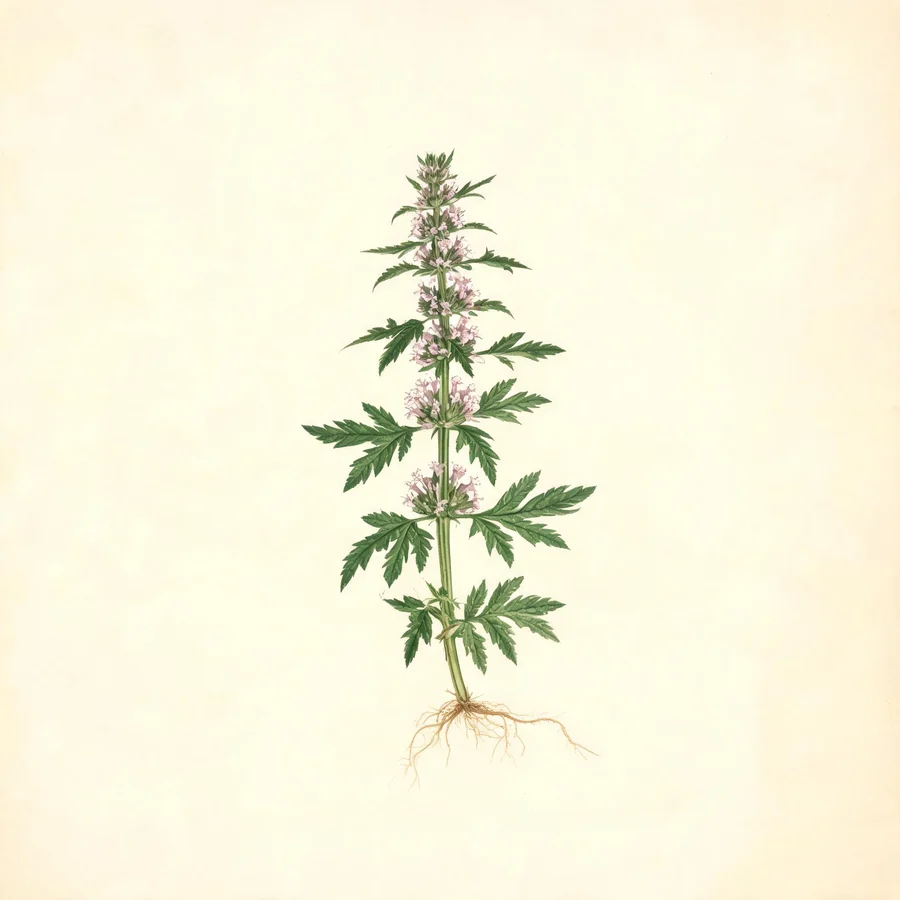
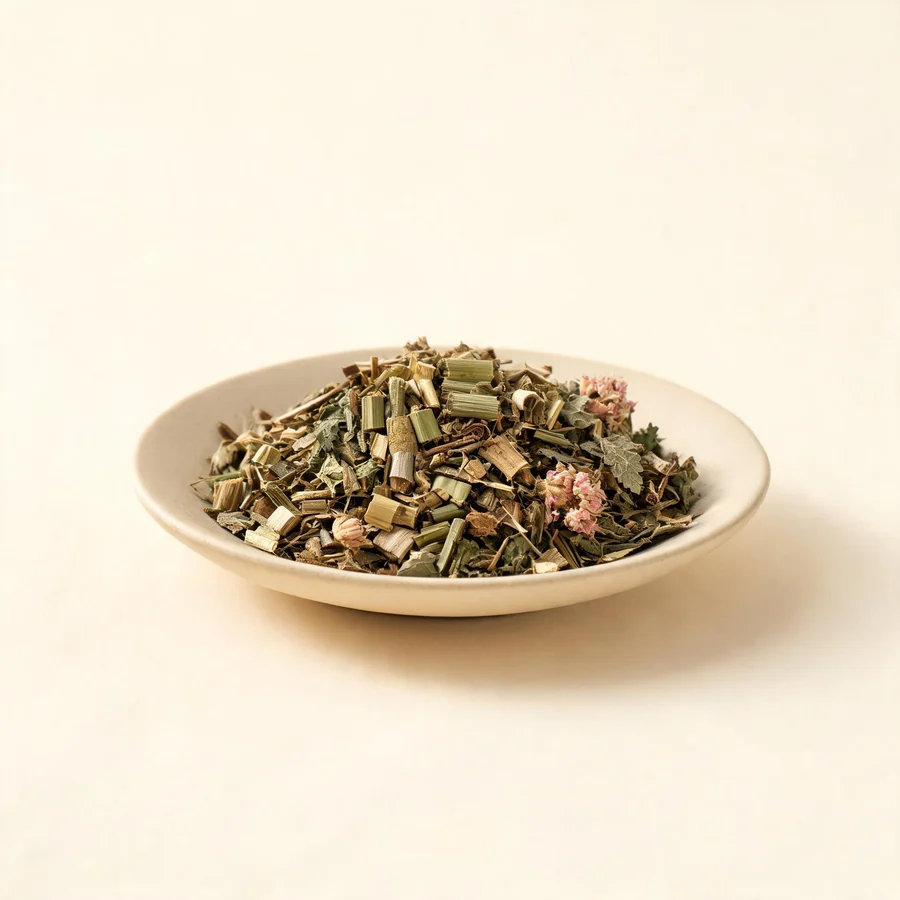
Skin profile
Where this herb sits in skin practice: the pattern it corrects, the skin signs it suits, and what it should not be used for.
Yi Mu Cao reaches the skin from two directions: as a cooling wash for hot, itchy eruptions, and internally as a gentle mover of stagnant blood where a bruise or a long flare has left the skin dusky. It is a short-course herb with a real dose ceiling.
Skin signs that suggest it
- A hot, itchy, slightly moist eruption that has not settled with cooling washes, worse in summer heat
- Dusky, slow-to-fade discolouration after an injury, with swelling that pits on pressure
- Bruising that stays purple and tender in a person whose tongue is dusky
- Puffiness of the skin with scanty dark urine and a heavy feeling in the limbs (stasis with water not moving)
- A purple or dusky tongue with a choppy pulse, and fixed rather than moving discomfort
When it is not the right herb
Not in pregnancy, where the herb is barred rather than cautioned, and not during heavy or prolonged bleeding, after recent surgery or in anyone with a bleeding disorder. It is not for skin that is pale, dry and thin from blood deficiency, because moving blood that is already sparse leaves the person more tired. It is not for a cold, pale, weeping eruption, and it is not a herb for long unsupervised courses, given the kidney findings at high intake.
What it does for skin
Skin-relevant actions only. Each one describes a mechanism in TCM terms and what it looks like on the skin.
Clears heat and resolves toxin at the surface
The classical notice records the stem for itching rashes and as a wash, and the action behind it is heat-clearing with a mild toxin-resolving quality. That makes it a wash herb for eruptions that are red, itchy and a little moist rather than deep, hard or purulent. It is applied as a cooled decoction to the affected area, and it is gentle enough for a heat rash once a practitioner has checked that the skin is not infected.
Moves stagnant blood so that discolouration fades
Bruises, old injury sites and dusky patches that persist after a flare all reflect blood that has stopped. The herb is described as shifting stale blood without damaging healthy blood, which is why it is chosen for a person who is not robust enough for the stronger movers. The change on the skin is in colour and in the softness of the tissue rather than in redness, and it appears over weeks rather than days.
Drains water and reduces puffiness
The tradition pairs blood and water, holding that when the vessels are congested the waterways follow, and the reverse. The herb promotes urination, so it is used where puffy, heavy skin sits alongside scanty urine and a dusky tongue. On the skin this shows as swelling that pits, most often in the legs, and it is read as a sign of fluid rather than of inflammation, which is why a cooling wash alone does not settle it.
Settles a flare that follows the cycle or childbirth
An eruption that reliably appears before or during a period, or that will not settle after childbirth, is read as blood stasis with heat rather than as a purely surface problem. The double action of the herb on blood and on heat addresses that pattern, which is the reasoning behind its traditional place in postpartum formulas for skin that will not calm. It is given in short courses and only after pregnancy has been excluded, since the herb is barred at that time.
Skin conditions it is used for
Mapped to the condition pages on this site. The pattern column shows what the skin is doing when this herb is the right choice.
| Condition | Pattern | Why it suits | Typical setting |
|---|---|---|---|
| Skin rashes | Heat in the skin with stagnant blood underneath | A rash that is red, itchy and a little moist, with a dusky tinge where it has persisted, is read as heat sitting on congested blood. The herb cools the surface and moves the congestion, which is the classical double action recorded for the stem as a wash. It is used as a cooled wash on limited areas, with internal herbs chosen according to the whole pattern. | Cooling wash of Yi Mu Cao, with Mu Dan Pi and Chi Shao internally |
| Heat rash | Heat and damp congested at the surface in hot weather | Small itchy papules in skin folds and on the trunk in hot humid weather are read as heat and damp that cannot escape the surface. A cooled wash of the herb is a traditional way to clear that superficial heat, and its gentleness suits skin that is already irritated. It is a comfort measure rather than a cure, and spreading redness, fever or pus needs medical assessment. | Dilute decoction wash, with Yi Yi Ren and Huang Qin internally |
| Itchy skin | Hot, moist itch with a dusky background | Itch with warmth, slight moisture and a duskiness to the skin is read as heat with stagnant blood, the pattern in which a cooling, moving wash works better than a drying one. The herb cools and shifts without the astringency of the stronger wash herbs, so it is used where the skin is easily irritated. Itch that is dry, pale and worse at night belongs to a dryness pattern and needs the opposite approach. | Wash with Yi Mu Cao and Ku Shen, on limited areas |
| Bruising | Injury stasis with swelling and fixed discolouration | A bruise that remains purple and tender, with swelling that pits, is read as congealed blood with fluid held in the same place. The herb moves the blood and drains the fluid together, which is why it suits a bruise that is both discoloured and puffy rather than a hard dry one. It is used in short courses and not while the injury is still actively bleeding. | Tao Hong Si Wu Tang, or a trauma formula with Hong Hua |
| Skin swelling | Water not moving because the blood is congested | Swelling of the skin that pits, comes with scanty dark urine and a dusky tongue is read as water and blood blocking one another, since the vessels and the waterways share the same space. A herb that moves both is more useful here than a plain diuretic, and its pull on the Bladder channel is why the change shows in the urine. Swelling of one leg, breathlessness or a sudden onset needs urgent medical assessment rather than a herbal wash. | Yi Yi Ren and Fu Ling with Yi Mu Cao |
Combinations for skin
Herbs it is paired with when the skin, not an internal organ, is the target.
| Partner | Ratio | Why the pair is used |
|---|---|---|
| Hong Hua | 10 to 15 g Yi Mu Cao with 6 to 10 g Hong Hua | Both move blood, but their temperaments differ: safflower is warm and works through the whole body, while the leonurus herb is cooler, more pelvic and adds a draining action. The pair is used for bruising and fixed pain with dusky discolouration, and the warmer partner keeps the cooler one from over-chilling a cold pattern. Neither is used in pregnancy. |
| Dang Gui | 10 g each | Dang Gui builds blood as it moves it, and the pair shifts a stagnant picture without leaving the person paler or wearier. It suits dusky, thin skin with scanty clotted periods and a pale complexion, where a strong mover alone would be too much. Moving and nourishing together is the classical preference for a depleted person with stasis. |
| Mu Dan Pi | 6 to 10 g each | Mu Dan Pi cools the blood and moves stasis, so the pair brings together the two halves of a dusky, hot eruption: the cool head and the moving current. It is used for old red patches that have gone purplish and for a flare that persists with low-grade heat. The cooling partner prevents the moving one from stirring up more heat. |
| Yi Yi Ren | 15 to 30 g Yi Yi Ren with 9 to 15 g Yi Mu Cao | Coix drains dampness through the urine while the leonurus herb moves blood and fluid together, so puffy skin with scanty urine is addressed from both sides. The pair suits swelling that pits and a heavy feeling in the limbs, with a dusky tongue. The coix is the gentler of the two and is given in the larger amount. |
Safety for skin use
What to check before recommending or using it, including the cautions that matter most for skin patients.
Do not use, or use with caution
- Pregnancy: an absolute bar. The herb acts on uterine muscle the way ergot does, and the pharmacopoeia bars it in pregnancy for that reason, since the effect raises the danger of losing the pregnancy or of going into labour early. A missed period while taking it means stopping and testing before anything else.
- Heavy or prolonged bleeding: menorrhagia, recent surgery, dental extraction or a bleeding disorder. A blood-moving herb can prolong bleeding and add to the loss, so these situations are left out entirely.
- Known kidney disease or reduced kidney function: modern work describes dose-dependent change in the renal medulla with interstitial fibrosis at high intake, and older people are likelier to have reduced function. Where impairment is known, the herb is avoided rather than dosed carefully.
- Blood deficiency without stasis: pale scanty periods, fatigue and pale dry skin. To move blood that is already thin is to leave the person weaker, and a tonic is needed instead.
Pregnancy and breastfeeding
Avoid entirely: this is a bar and not a caution. The uterine effect is documented, is not a question of dose, and is the reason the pharmacopoeia prohibits the herb in pregnancy. It is left out in anyone trying to conceive and in the weeks leading up to planned surgery. A cooling wash for an itchy patch is not an exception that should be taken lightly at that time, and a skin flare in pregnancy is better managed with gentle surface measures and medical advice.
Interactions
- Anticoagulants and antiplatelet drugs: in laboratory work the herb reduces platelet clumping and blood viscosity, so warfarin, heparin, aspirin and clopidogrel each carry an added bleeding risk. It is stopped around surgery and dental extraction, and anyone taking one of them should tell both prescribers before adding the herb.
- Blood pressure medicines: its alkaloid relaxes blood vessels, so an antihypertensive may act more strongly than expected and produce lightheadedness on standing. Pressure is checked when the herb is added to an existing regimen.
- Uterotonic drugs and diuretics: oxytocin and methylergometrine act on the uterus in the same way as the herb and are not combined with it, while a pharmaceutical diuretic increases the fluid loss, so electrolytes are worth checking.
- Nephrotoxic medicines: given the renal findings at high intake, the herb is best left out alongside medicines that are hard on the kidneys, including some antibiotics, lithium and high-dose anti-inflammatory drugs.
Allergy and patch testing
Contact reactions to the wash are usually irritant rather than allergic, since the liquid is applied to skin that is already inflamed. Patch test on a small area of normal skin before the first wash, keep it off the eyelids, the genitals and broken skin, and stop if burning or spreading redness develops. The plant is a mint-family herb, so anyone who reacts to other members of that family should be cautious with it.
General safety references
General references for herbal hepatotoxicity and herb-drug interactions; they are not specific to this herb.
- Review article: Herbal hepatotoxicity - an update on traditional Chinese medicine preparations. Alimentary Pharmacology & Therapeutics, 2014. PMID: 24844799.
- Interactions between herbal medicines and prescribed drugs: an updated systematic review. Drugs, 2009. PMID: 19719333.
- Warfarin and food, herbal or dietary supplement interactions: a systematic review. British Journal of Clinical Pharmacology, 2021. PMID: 32478963.
Evidence
The classical record is quoted with its source. The modern note states the level of evidence plainly.
Classical record
Of the seed the record says acrid and a little warm: it clears the eyes, benefits essence and moves water Qi, and long use is said to lighten the body. For the stem it gives itching rashes, applied as a wash, and it notes the alternative name Yi Mu.
Shen Nong Ben Cao Jing (Divine Husbandman's Classic of Materia Medica) - The oldest entry, and the one from which the herb’s present name comes. It separates seed from stem from the beginning, and it is the stem, used as a wash, that is the classical basis for the skin use described here.
It moves the blood while feeding it, clears what is stale without harming what is fresh, and feeds without leaving stale blood where it lies. Of the blood medicines it is held to be the first.
Ben Cao Hui Yan (Collected Sayings on Materia Medica) - The passage most often cited for the herb, and the origin of its standing as a gentle mover. It explains why a person who is not robust can be given it where the stronger stasis herbs would be too much.
Its character is slippery and free running, and it is at home in childbirth and in women’s complaints, which is how it got its name. That name does not make it necessary for every woman: its gliding movement is what can be used, and no supplementing power should be expected of it.
Ben Cao Zheng (The Correct Materia Medica), Zhang Jiebin - A corrective from the Ming period, and the reason it is not a general tonic for women. It moves and drains rather than builds, which is exactly the distinction that matters when it is used for the skin.
Modern evidence
Evidence status
- The herb contains the alkaloids leonurine and stachydrine, which account for both its activity and its toxicity at high doses. Reported harm above roughly sixty to ninety grams in a single day includes dizziness, numbness in the limbs, sweating and a fall in blood pressure, with limb paralysis and respiratory depression in severe cases.
- The most important modern finding is dose-dependent kidney change, affecting the renal medulla with interstitial fibrosis and capillary dilatation. That is why the upper end of the ordinary range is treated as a ceiling rather than a target, and why known kidney disease excludes the herb.
- For skin disease, no controlled trial of Yi Mu Cao was identified. The wash for itchy eruptions and the moving of stagnant blood are classical and clinical traditions, and the herb has no established role as a systemic treatment for any dermatosis.
PubMed records
Selected real PubMed records for this herb's species or its constituents, chosen by species name and title relevance. They are references for the non-TCM discussion above, not proof that the herb treats any skin condition.
- Leonurus japonicus Houtt.: ethnopharmacology, phytochemistry and pharmacology of an important traditional Chinese medicine.. Journal of ethnopharmacology, 2014. PMID: 24412548 (pharmacology or review record).
- Enhancement of skin defense against UVB damage by fermentation of Leonurus japonicus with Saccharomyces cerevisiae.. Phytomedicine : international journal of phytotherapy and phytopharmacology, 2025. PMID: 40884938 (skin-related record).
Dose and forms
Skin-practice dosing and the preparations that suit skin complaints.
| Form | Dose and notes |
|---|---|
| Decoction | Nine to thirty grams of dried herb daily, usually inside a formula. Nine to fifteen grams is the working range for a skin or stasis indication, and thirty grams is a supervised ceiling for acute work rather than a starting point. |
| External wash | Fifteen to thirty grams simmered for twenty minutes, strained and cooled, used as a wash or compress on a hot, itchy area for ten to fifteen minutes once or twice daily, on limited areas and for a short period. |
| Fresh and processed forms | Fresh material is used at a slightly larger weight than dried, since alkaloid content drops in storage. Wine-frying suits stasis with pain; charring is the traditional form for bleeding, though it destroys much of the alkaloid. |
| Course length | Short courses, spaced apart, because the concern is cumulative. Anyone with kidney disease, or on a medicine that burdens the kidneys, should not use the herb at all, and repeated courses are separated by a review. |
Within nine to thirty grams the herb is generally well tolerated, and the reported harm sits above that range and is dose dependent. The kidney finding is why the ceiling is real, so the upper figure is a limit rather than a dose to build towards. Because the herb is cool and moving, courses are kept short and the wash is used on limited areas rather than as a whole-body bath.
Citations and further reading
Only real sources are listed: the classical materia medica passages quoted above, and the source works behind the botanical and safety statements.
- Shen Nong Ben Cao Jing (Divine Husbandman's Classic of Materia Medica), attributed compilation of the Han period - classical entry summarised above from the translation consulted.
- Ben Cao Hui Yan (Collected Sayings on Materia Medica), Ming period - classical entry summarised above from the translation consulted.
- Ben Cao Zheng (The Correct Materia Medica), Zhang Jiebin, Ming period - classical entry summarised above from the translation consulted.
- Yi Mu Cao (Herba Leonuri) monograph: Pharmacopoeia of the People's Republic of China - source for the accepted botanical source, part used and the pregnancy prohibition.
- Modern evidence statement: based on toxicological literature on leonurine and stachydrine, summarised as a statement about the renal finding and the level of evidence rather than as a cited trial.
- Botanical description and identification: botanical literature on Leonurus japonicus, Lamiaceae.
Educational reference for qualified practitioners. This page is not medical advice, and skin conditions should be diagnosed by a clinician before treatment.