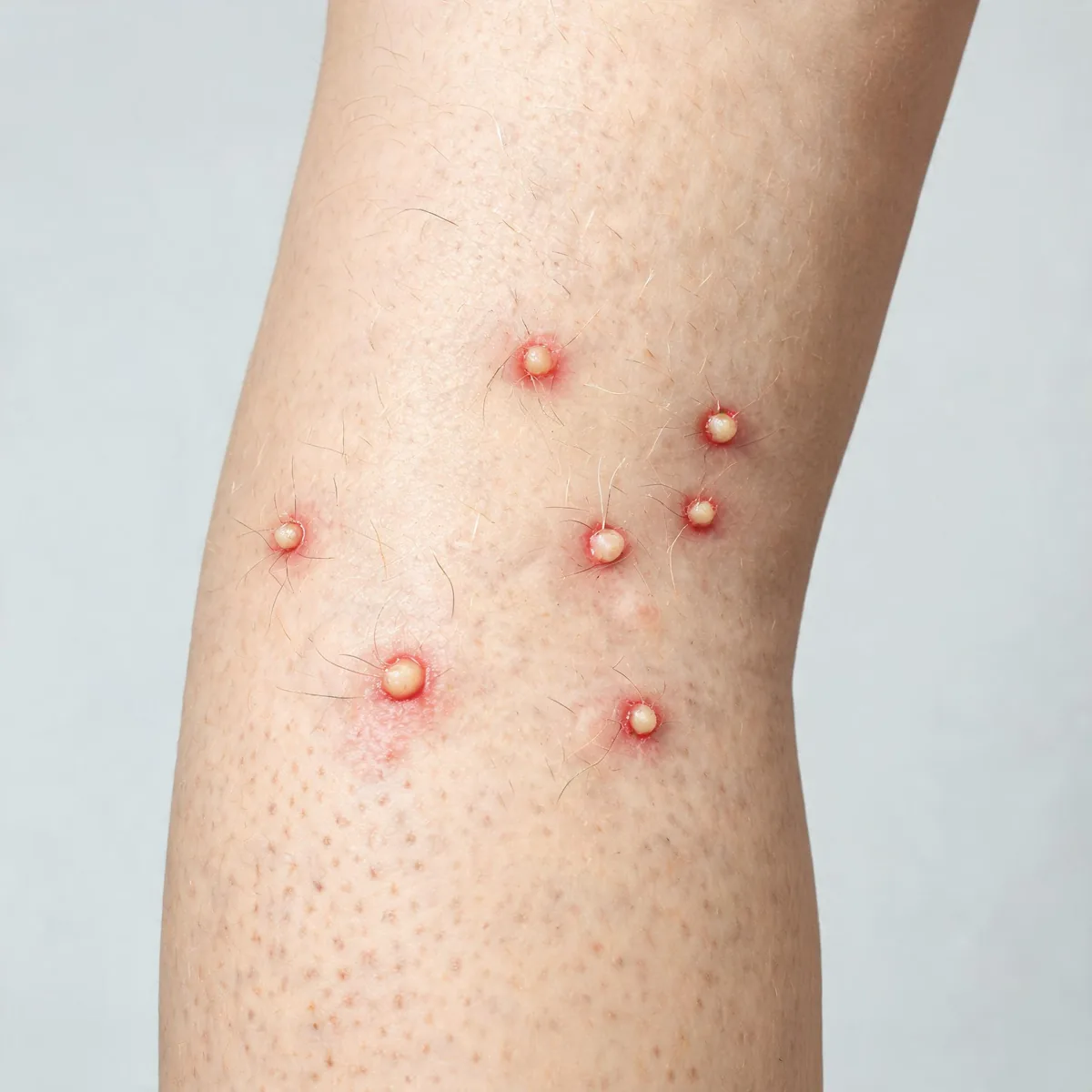
Understanding Folliculitis
The skin is described as the territory of the Lung and its defensive Qi, but folliculitis is said to point deeper, most often to the Spleen and Stomach.
When the Spleen is weakened by diet or stress, it fails to transform fluids and dampness accumulates. Combined with heat from greasy or spicy food, that damp heat is said to emerge through the follicles as greasy, yellow, oozing pustules.
When the picture is more severe the pattern is Toxic-Heat: large, deep, painful boils with pus, surrounding redness, fever and thirst. Chronic, hard, dark-red nodules that heal slowly are read as Blood stagnation with heat still present.
A separate group of patterns explains slow healing: Empty-Heat from Yin deficiency gives burning itchy bumps that worsen at night, while Qi and Blood deficiency gives pale bumps that heal very slowly with thin clear oozing.
The classical literature places the hair follicle where two systems meet: the defensive Qi that the Lung spreads over the surface, and the fluids that the Spleen and Stomach transform within. A follicle that keeps erupting is therefore read as a sign that the inner fluid side has failed, not as a purely local problem. Dampness collects, Heat joins it, and the mixture takes the shortest route out through the pores, which is why one pattern can produce crops of spots in several places at once.
Depth and duration change the reading. Heat held near the surface gives small pustules that dry and return, while Heat that gathers into toxin gives the deep throbbing boil with pus and fever. The classical literature also describes the reverse movement: once lesions have persisted for months, the obstruction they create begins to hold Heat in place, so nodules harden, darken and stop responding to simple clearing. At the far end of the same spectrum sit the depleted pictures, where the skin has neither the material to rebuild itself nor the force to push a lesion out.
Conventional view
Folliculitis means inflamed hair follicles. The usual cause is bacterial, most often Staphylococcus aureus, though fungi, viruses and non-infectious irritation can produce the same appearance. It shows as clusters of red bumps or white-headed spots at the follicle, with itching, burning or tenderness, and mild cases often settle on their own while deeper infection turns into painful boils or carbuncles. The diagnosis is usually made at examination, with swabs or cultures reserved for stubborn cases.
Conventional care follows severity. Warm compresses and antibacterial washes are enough for mild episodes; topical antibiotics such as mupirocin, or an antifungal cream when yeast is responsible, cover the persistent ones; widespread or deep infection needs oral antibiotics, and a large painful boil may be drained. Recurrent episodes prompt a search for an underlying cause such as diabetes or an immune problem.
The limitation the classical literature points to is that antibiotics clear the infection but not the internal conditions that let it take hold. Recurrence is common when diet, stress or a weakened immune response is left unaddressed, and repeated courses disturb the microbiome and encourage resistance. TCM's contribution, in this account, is to correct the underlying pattern, whether that means draining Damp-Heat, cooling Toxic-Heat or rebuilding Qi and Blood, so that the follicles offer less welcome to infection.
Selected PubMed records
Real PubMed records for the conventional discussion above, selected by condition name and title relevance. They are references, not a claim that any treatment is proven for this condition.
- Folliculitis: recognition and management.. American journal of clinical dermatology, 2004. PMID: 15554731.
How it connects
Folliculitis often appears alongside acne because both arise from similar internal imbalances. Damp-Heat and Toxic-Heat are common roots: when the Spleen fails to transform fluids, Dampness accumulates, and with Heat from diet or emotion it rises to the skin, where the same Damp-Heat that clogs hair follicles can also block sebaceous glands and produce acne. Recurrent folliculitis can also co-occur with abscesses as the heat toxicity deepens, a single hair follicle infection spreading into a larger deeper abscess when Toxic-Heat overwhelms the body's defences; addressing the internal Toxic-Heat not only resolves the folliculitis but helps prevent new abscesses. The practical consequence of that shared root is that treatment aimed at one condition is expected to help the other, and the classical literature says so directly: clear the Damp-Heat and the acne improves with the folliculitis, or resolve the Toxic-Heat and the tendency to form abscesses falls as well. That is also why a practitioner asks about spots elsewhere and about previous boils, since a recurrence in one place warns of a recurrence in the other and both are read from the same tongue and pulse.
How it is assessed
The practitioner looks at depth, colour and healing behaviour, then at digestion and energy.
What a practitioner looks for
- Lesion type: superficial greasy pustules suggest Damp-Heat; deep painful boils with fever suggest Toxic-Heat; hard dark nodules suggest stagnation.
- Healing behaviour: slow healing with pale bumps and fatigue points to deficiency.
- Digestive signs: bloating, sticky taste and loose stools support the damp pattern.
- Distribution and triggers: shaving, occlusion, sweat and hot weather are asked about.
The consultation starts with the lesion itself. The classical literature has the practitioner note colour, size, depth and discharge, and ask whether a spot burns or aches, because those two sensations pull in different directions: itch belongs with Wind and surface irritation, while a deep fixed ache belongs with Blood that has stopped moving. The tongue coating then decides between the excess readings, and the pulse confirms it. A yellow greasy coat with a soggy, rapid pulse fits Damp-Heat; a thick yellow coat with a rapid, forceful pulse fits Toxic-Heat, which the classical literature treats as the more urgent of the two.
At the chronic end the signs shift again. A dusky tongue with purplish spots and a choppy pulse points to stagnation, where Heat is trapped inside nodules rather than moving freely. A red, thin, dry tongue with little coat and a fine rapid pulse indicates Empty-Heat from depleted Yin, and a pale tongue with a weak, thready pulse indicates that Qi and Blood can no longer drive healing. Poor appetite, bloating and loose stools alongside the lesions move the emphasis to the Spleen and Stomach, whose failure to transform fluids is then treated as the root rather than as a side issue.
TCM patterns in Folliculitis
Differentiating folliculitis comes down to what the lesion is doing and what the body does with it. Greasy, yellow, oozing pustules on a body that feels heavy, with a sticky taste and loose stools, belong to Damp-Heat invading the Spleen, where digestion fails to transform fluids. Deep throbbing boils with pus, fever and thirst for cold drinks point to Toxic-Heat, the same process driven harder. Hard, dark nodules that ache at night and refuse to settle are read as Blood Stagnation with Heat, a picture that appears over months. Three deficient pictures explain the slow cases: Empty-Heat from Yin deficiency, with burning bumps worse in the evening and night sweats, Qi and Blood Deficiency, with pale lesions and deep fatigue, and Spleen and Stomach Qi Deficiency, with small recurrent pustules and a poor appetite. Tongue, pulse and healing speed decide which thread comes first.
| Pattern | Key signs | The itch | Tongue | Main formula |
|---|---|---|---|---|
| Damp-Heat invading the Spleen | Greasy sticky yellow-oozy pustules | Not specified | Body: Red, often swollen with teeth marksCoat: Thick, yellow and greasy at the centre and root | Not specified |
| Toxic-Heat | Large deep painful boils or carbuncles; Pus with surrounding redness and swelling | Not specified | Body: Red, often with raised red pointsCoat: Yellow, dry, sometimes thick | Not specified |
| Blood Stagnation with Heat | Hard dark-red or purplish nodules; Fixed stabbing pain worse at night | Not specified | Body: Reddish-purple, with stasis spots and dark sublingual veinsCoat: Thin, dry and yellow | Not specified |
| Empty-Heat caused by Yin Deficiency | Dry mouth and throat at night | Burning itchy bumps | Body: Red, thin and dry, often crackedCoat: Little or none; the tongue may look peeled | Not specified |
| Qi and Blood Deficiency | Very slow healing with thin clear oozing | Not specified | Body: Pale, possibly thin or with teeth marksCoat: Thin white | Not specified |
| Spleen and Stomach Qi Deficiency | Small recurrent pustules that heal slowly | Not specified | Body: Pale, puffy and teeth-markedCoat: Thin white | Not specified |
Damp-Heat invading the Spleen
Greasy yellow oozing pustules with a bloated digestive picture.
The mechanism starts in the middle burner. When the Spleen is weakened, fluids are not transported, so Dampness gathers, and greasy or spicy food or a naturally hot constitution then adds Heat to that moisture. The combined pathogen rises outward and lodges in the follicles, where it produces greasy pustules that weep a yellow discharge. Because the same Dampness sits in the digestive tract, the person feels bloated after eating, notices a sticky taste and passes loose stools that feel incomplete, while the limbs feel heavy. The classical literature reads the tongue as red with a yellow greasy coat, thickest at the centre and root, and the pulse as soggy and rapid, or slippery and rapid.
Fried, greasy and sugary food, alcohol, humid weather and long sedentary days all feed the pattern, while light bland meals, gentle movement and keeping the skin clean and dry relieve it. The formulas named for this presentation are Gan Lu Xiao Du Dan, for widespread oozing pustules, and Er Miao San, which clears Heat and dries Dampness. Among the herbs are Huang Qin, which clears Heat and dries Dampness from the upper body and skin, Yi Yi Ren, which strengthens the Spleen while leaching Dampness out, and Ku Shen, chosen for itching. The points are SP-9 Yinlingquan to drain through the Spleen channel, ST-40 Fenglong for Dampness and Phlegm, and LI-11 Quchi to cool the skin.
Signs
- Greasy sticky yellow-oozy pustules
- Bloated feeling after eating
- Greasy taste in the mouth
- Heavy sensation in body and limbs
- Loose sticky stools
Diet and lifestyle for this pattern: Avoid greasy, fried, sugary and spicy food that feed Dampness and Heat. Eat simply, with steamed greens, congee, barley and mung beans to drain Damp-Heat, exercise gently to a light sweat to clear the skin, and keep affected areas clean and dry afterwards.
Toxic-Heat
Deep painful boils with pus and systemic heat.
Toxic-Heat is what the same process becomes when the Heat is intense enough to gather into toxin. It surges outward and lodges in the follicles, and the tradition describes the result as a local battle between defensive Qi and the pathogen: redness, swelling, local heat, tenderness and pus, with boils or carbuncles that are large and deep. The systemic signs follow the depth of the Heat, giving fever with chills, a thirst for cold drinks, urine that is dark and scanty, or constipation. The tongue is red with a prickly surface and a dry yellow coat, and the pulse is rapid, forceful and often slippery.
This is the picture that most needs prompt clearing, and the classical literature warns that spreading redness, fever or a boil on the central face needs medical care rather than herbs alone. Spicy, fried and greasy food, alcohol, humid weather, stress and sweating all make the lesions angrier, while cold compresses, tea made from chrysanthemum or dandelion, plain food and rest in a cool room ease them. Wu Wei Xiao Du Yin is the formula given, clearing Heat and resolving toxin while dispersing swelling. Its herbs include Jin Yin Hua for acute infected lesions with redness and swelling, and Lian Qiao, which helps the toxic clump to discharge. The points are LI-4 Hegu, LI-11 Quchi and DU-14 Dazhui, the last to draw Heat from the whole body and settle fever.
Signs
- Large deep painful boils or carbuncles
- Pus with surrounding redness and swelling
- Local heat and tenderness
- Fever and chills
- Intense thirst for cold drinks
Diet and lifestyle for this pattern: Avoid spicy, greasy and fried food, alcohol and excess sweets, which feed the fire. Drink plenty of water, chrysanthemum or dandelion tea to cool the body, keep the area clean and dry, resist squeezing, and use gentle cool compresses to ease the Heat.
Blood Stagnation with Heat
Hard, dark nodules that are slow to heal.
Months of low-grade inflammation change the terrain. The classical literature explains it as lingering Heat toxins obstructing the local movement of Qi and Blood; the obstruction becomes stasis, and the stasis holds the Heat in place, so each problem sustains the other. What forms is a hard, dark-red or purplish nodule that is fixed, stabbing when pressed and slow to resolve, with dry rough skin around it, and the trapped Heat produces warmth and restlessness at night. The tongue is reddish-purple with stasis spots and distended sublingual veins under a thin dry yellow coat, and the pulse is choppy and rapid, often wiry as well.
Spicy and greasy food, alcohol, stress and humid weather worsen the picture, and a sedentary routine lets stasis deepen, while cool compresses, a cool environment, gentle daily movement and cooling food such as cucumber, mung beans and pear help it. The formula named is Xue Fu Zhu Yu Tang, which moves Blood, breaks stasis and clears Heat at the same time. Dan Shen, Chi Shao and Zi Cao are the herbs singled out, invigorating Blood while cooling it and helping dark lesions to heal. The points are SP-10 Xuehai, BL-17 Geshu, the influential point of Blood, and LI-11 Quchi.
Signs
- Hard dark-red or purplish nodules
- Fixed stabbing pain worse at night
- Restlessness with heat at night
- Dry rough skin around the lesions
Diet and lifestyle for this pattern: Avoid spicy, greasy and fried food, alcohol and smoking, which generate internal Heat and worsen stasis. Eat cooling, blood-nourishing food such as mung beans, cucumber, celery and mulberries, keep moving daily so Blood flows smoothly, cleanse the skin without harsh scrubbing, and manage stress to prevent Qi stagnation.
Empty-Heat caused by Yin Deficiency
Burning itchy bumps that worsen in the evening, with Yin deficiency signs.
Here the problem is a deficit rather than an excess. When the Yin that cools and moistens the body runs low, a relative Heat appears, and the tradition describes it as a smouldering fire that rises to the skin and dries the follicles. The lesions are small and recurrent, burning and itching more than they throb, and drier and less inflamed than the weeping pustules of Damp-Heat. They flare at night and towards evening, when Yin is naturally at its weakest, and come with a dry mouth and throat, night sweats, heat in the palms, soles and chest, flushed cheekbones and broken sleep. The tongue is red, thin and dry with cracks and little or no coat, and the pulse is fine and rapid.
Late nights, overwork, alcohol, spicy and fried food and prolonged stress consume more Yin and make the fire flare, while rest, cooling and moistening food, hydration and gentle exercise such as tai chi calm it. The formula is Zhi Bai Di Huang Wan, which nourishes Kidney Yin and drains the empty fire without injuring fluids. Zhi Mu and Huang Bo clear deficiency Heat and moisten dryness, the raw Rehmannia at the centre of the formula nourishes Yin and cools Blood, and Mai Dong generates fluids for the dry mouth. KI-3 Taixi and KI-6 Zhaohai treat the root, SP-6 Sanyinjiao harmonises Yin and Blood, and LI-11 Quchi cools the skin itself.
Signs
- Burning itchy bumps
- Worse in the evening or at night
- Dry mouth and throat at night
- Night sweats
- Heat in palms, soles and chest
Diet and lifestyle for this pattern: Eat moistening, cooling food such as pear, cucumber, tofu and spinach, and avoid spicy, fried and overly heating food as well as alcohol and coffee, which consume Yin. Rest and avoid overwork, keep exercise gentle such as tai chi or yoga, and use mild non-drying cleansers so the skin keeps its moisture.
Qi and Blood Deficiency
Pale bumps that heal very slowly with deep fatigue.
When Qi and Blood are both low, the skin is left without nourishment or guard. The tradition describes slack pores and a weak defensive response, so bacteria that would normally be shrugged off settle into a follicle; because there is not enough material or force for a strong inflammatory reaction, the lesion stays pale, comes to a head slowly and heals very slowly, sometimes oozing a thin clear fluid. Each infection draws down a little more of the reserve, which is why the pattern recurs in people who are run down. Fatigue, breathlessness on exertion, dizziness, pale lips and nail beds, a sallow complexion, a poor appetite and sweating without cause accompany it. The tongue is pale, perhaps thin or tooth-marked, with a thin white coat, and the pulse is fine and weak.
Overwork, skipped meals, poor nutrition, sweating and stress deepen the depletion, while rest, sleep, warm cooked meals and gentle walking rebuild it. The formula named is Tuo Li Xiao Du San, which builds Qi and Blood and clears the toxins left in chronic non-healing lesions gently. Dang Gui nourishes and invigorates Blood to support repair, Huang Qi strengthens the exterior and helps expel pus, and Dang Shen builds Qi from the Spleen and Lungs. ST-36 Zusanli, SP-6 Sanyinjiao and REN-6 Qihai are used, the last two with moxibustion, to build the core Qi that the skin needs in order to close.
Signs
- Pale or pinkish bumps, not hot
- Very slow healing with thin clear oozing
- Deep fatigue and breathlessness
- Dizziness or light-headedness
- Pale lips and nail beds
Diet and lifestyle for this pattern: Focus on gently cooked, warm, nutrient-dense meals such as bone broth, congees and stews, with a little good quality protein each day. Avoid raw, cold and greasy food that weakens the Spleen, protect sleep and avoid overwork, and prefer short gentle walks to intense exercise that drains Qi.
Spleen and Stomach Qi Deficiency
Recurrent small pustules with a digestive deficiency picture.
This pattern sits one step further back from Damp-Heat. The Spleen and Stomach Qi are too weak to transform food and fluids at all, so Dampness accumulates as a by-product, rises to the skin and clogs the follicles. The deficiency also means the body cannot finish the job of resolving inflammation, so the pustules are pale and small, arrive in recurrent crops and heal slowly. The classical literature ties the picture to the digestion: poor appetite, bloating when eating, stools that are loose or poorly formed, physical weakness and a sallow complexion. The tongue is pale and puffy, marked by teeth, under a thin white coat, and the pulse is weak and soft, above all at the right middle.
Overeating, irregular meals, raw and cold food and drink, overwork and stress further weaken the middle, while rest, warm cooked food taken in small frequent meals and gentle movement support it. The formula is Shen Ling Bai Zhu San, which tonifies Spleen Qi while draining the Dampness that surfaces as folliculitis. Bai Zhu strengthens the Spleen and dries Dampness, Fu Ling leaches Dampness out without harming the Spleen, and Yi Yi Ren drains Dampness and mildly clears Heat. The points are ST-36 Zusanli, SP-6 Sanyinjiao and REN-12 Zhongwan, the last to regulate the middle burner directly.
Signs
- Poor appetite with bloating
- Loose or poorly formed stools
- Fatigue and weakness
- Small recurrent pustules that heal slowly
- Sallow complexion
Diet and lifestyle for this pattern: Focus on warm, cooked, easy food such as soups and congees, and avoid raw, cold and greasy food that burdens the Spleen. Eat small frequent meals, and keep up gentle daily movement to support Qi circulation.
Treatment approach
How the tradition treats folliculitis, with the herbs, formulas and points used for it.
Principles
- Clear damp heat while the pustules are active, and support the Spleen so they stop recurring.
- Resolve toxicity promptly where boils are deep and painful, and involve medical care if infection spreads.
- Move Blood and resolve stasis where nodules are hard and dark.
- Nourish Qi and Blood where lesions heal slowly and the person is depleted.
- Underneath the pattern-by-pattern detail the strategy is consistent: clear the pathogen while the lesions are active, then strengthen the body's capacity to heal itself so that the follicles stop being hospitable. That is why a course often opens with a draining or detoxifying formula and later shifts towards tonification, with external washes and acupuncture running alongside both phases.
Herbs used
Formulas
- Gan Lu Xiao Du Dan
- Er Miao San
- Wu Wei Xiao Du Yin
- Xue Fu Zhu Yu Tang
- Zhi Bai Di Huang Wan
- Tuo Li Xiao Du San
- Shen Ling Bai Zhu San
Acupoints
- SP-9 (Yinlingquan)
- ST-40 (Fenglong)
- LI-11 (Quchi)
- LI-4 (Hegu)
- DU-14 (Dazhui)
- SP-10 (Xuehai)
- BL-17 (Geshu)
- KI-3 (Taixi)
- KI-6 (Zhaohai)
- SP-6 (Sanyinjiao)
- ST-36 (Zusanli)
- qihai-ren-6
- zhongwan-ren-12
What to expect
- Superficial pustules are described as settling within one to two weeks.
- Deep boils and dark nodules take longer and can scar.
- Recurrence is expected if shaving habits, occlusion or the damp pattern are not addressed.
- The classical literature gives both an early signal and a long tail: less heat and less itch within the first week, pustules flattening quickly when the presentation is acute, and a far more gradual course when the condition is chronic and recurrent. The formula is expected to change as the lesions change, so regular review matters more than a fixed course length.
Safety and when to get help
Seek medical help urgently for
- Rapidly spreading redness or streaks from the area, which may indicate cellulitis.
- Fever, chills or body aches with the skin lesions.
- A boil on the central face with swelling and fever, which needs urgent assessment.
For anything severe, sudden or spreading quickly, read when a skin problem needs urgent care.
Cautions
- Do not squeeze boils, particularly on the face.
- Recurrent folliculitis should be medically reviewed and swabbed where indicated.
- Diabetes and immune suppression make infection more serious and need medical input.
Using this alongside conventional care
- TCM is described as complementary to conventional care: antibiotics and prescribed topical treatment can continue alongside herbs and acupuncture.
- Combining is straightforward here as long as each prescriber knows what the other is doing. Antibiotics, antibiotic creams and antifungal shampoos can continue, and herbs are used to support healing rather than to replace them; the classical literature asks that both the dermatologist and the TCM practitioner be told about the combination so that rare interactions are watched for. Where immunosuppressive medication is in use, herbal treatment should be discussed with the prescribing doctor first, because some herbs modulate immune function. No prescribed drug should be stopped abruptly.
Diet and lifestyle
- Avoid deep-fried food, excess red meat, alcohol, sugary snacks and very spicy dishes, and favour cooling light food.
- Two rules sit under all the pattern-specific advice: do not add Heat, and do not add Dampness. In practice that means limiting deep-fried food, alcohol, sugary snacks, red meat and the hottest spices, and building meals from cooling, light ingredients such as cucumber, celery, mung beans, watermelon and leafy greens, with chrysanthemum or dandelion tea through the day. Where the pattern is deficient the same diet gains a second half: congee, bone broth and vegetables that are well cooked to rebuild strength without burdening digestion. Regular meal times and stopping short of full belong to the treatment of the Spleen patterns, because overeating is one of the ways Dampness is made.
If you're pregnant
Pregnancy concentrates Qi and Blood on the fetus, and the classical literature reads that as making the skin more prone to Damp-Heat, with Damp-Heat and Toxic-Heat patterns often more pronounced as body heat rises. Many herbs that drain Dampness and clear Heat are avoided because they can disturb the fetus: Yi Yi Ren is set aside for its downward, slippery nature, while a milder Heat-clearing herb such as Huang Qin is preferred. Points such as LI-4 Hegu and SP-6 Sanyinjiao are avoided for their effect on the uterus. Diet, gentle topical care and a practitioner experienced in pregnancy care carry the treatment at this time.
If you're breastfeeding
The concern here is the transfer of herbs into milk. Bitter-cold herbs such as Huang Lian and Da Huang are avoided because they can cause diarrhoea in the infant, while Jin Yin Hua and Lian Qiao clear Heat without that harsh quality and are the safer choices. Topical applications and acupuncture carry little risk, and keeping the skin clean, cool and hydrated supports healing without affecting the baby.
If treating a child
In children the classical literature links folliculitis to diet: sweets, dairy and fried food generate the Damp-Heat that clogs the skin, and the Spleen pattern is the commonest, sometimes with food stagnation added on top of it. Children's Spleen function is immature, which is why Dampness forms so easily. Formulas such as Gan Lu Xiao Du Dan are used at roughly a third to a half of the adult dose by age and weight, and cooling topical washes with Ku Shen suit small patients. Because children describe symptoms poorly, the diagnosis leans on what can be seen.
If treating an elderly patient
In older patients the tradition describes a chronic, recurrent course rooted in deficiency rather than excess, most often Qi and Blood Deficiency, or a deficiency of Spleen and Stomach Qi, with pale lesions that resolve slowly, fatigue and a poor appetite. Treatment stays gentle: Shen Ling Bai Zhu San or Tuo Li Xiao Du San at reduced doses, so that a weak digestion is not burdened, and acupuncture with moxibustion at ST-36 Zusanli to build Qi. Because several medicines are often in use, herb-drug interactions need checking.
Urgent-sign guidance is based on standard sources: NHS anaphylaxis, NHS cellulitis, NHS Stevens-Johnson syndrome, NHS melanoma.
Evidence
Evidence status
Compiled for this page from the classical and modern literature; not a systematic review, so treat it as a pointer to sources rather than clinical guidance.
Evidence is limited but promising. Chinese studies report that Wu Wei Xiao Du Yin and Gan Lu Xiao Du Dan clear lesions and reduce recurrence compared with conventional antibiotics, with improvement rates often quoted at 80 to 90 percent, though many lack blinding and placebo controls. Acupuncture has been studied for recurrent skin infection with some suggestion of immune modulation. English-language randomised trials are scarce and overall quality is moderate at best.
The figures deserve a cautious reading. Improvement rates of 80 to 90 per cent come from Chinese-language studies that were largely unblinded and uncontrolled, so they describe what clinicians see rather than what a trial has proved, and the shortage of English-language randomised work means the case rests on long clinical use and on the pattern-level reasoning set out above. Integrative care, with hygiene and conventional treatment in place, is the setting in which the classical literature places TCM.
Studies often cited
Chinese studies report clearance of lesions and reduced recurrence versus conventional antibiotics, with quoted improvement rates of 80 to 90 percent. Chinese clinical studies (as recorded in the source)
Some trials suggest modulation of immune function and reduced inflammation. Clinical trials (as recorded in the source)
PubMed records for the TCM evidence
Real PubMed records for the TCM clinical evidence discussed above, selected by condition name and title relevance. They are references, not proof of benefit.
- Eosinophilic pustular folliculitis: A published work-based comprehensive analysis of therapeutic responsiveness.. The Journal of dermatology, 2016. PMID: 26875627.
- Disseminate and Recurrent Infundibular Folliculitis: Case Report and Literature Review.. Indian journal of dermatology, 2024. PMID: 38572033.
Classical record
Furuncles are a condition of fire toxin.
- Wai Ke Zheng Zong (Orthodox Manual of External Medicine), chapter on furuncles. The Chinese original is not reproduced here: it could not be recovered reliably from the source record, and is not guessed.
夫痈疽者,皆由寒热不调,饮食不节,以致阴阳痞隔,气血壅滞,结聚而成。
Every abscess and boil comes from disharmony between cold and heat and from eating without regularity, which obstructs yin and yang and leaves qi and blood stagnant, gathering into lesions.
Zhu Bing Yuan Hou Lun, Volume 31, Sores and Boils - Classical citation: which features it in its account of how TCM understands folliculitis. It is the older and more general statement of the same argument: the boil is read as the end point of disharmony and poor diet rather than as a local accident.
Common questions
Can herbs clear folliculitis?
The classical literature treats the damp heat behind recurrent pustules and records improvement over weeks. Deep or spreading infection needs medical treatment first.
Why does it come back after shaving?
Shaving and occlusion are described as local triggers of the damp heat pattern, so changing the habit is part of the treatment.
Are boils dangerous?
They can be. A boil with spreading redness, fever or on the central face needs urgent medical assessment rather than herbal treatment alone.
Should I stop washing the area?
No. Gentle cleansing is compatible with treatment; scrubbing and picking are what the classical literature advises against.
Can TCM clear folliculitis without antibiotics?
For mild to moderate cases the classical literature answers yes: herbs that clear Heat and resolve Dampness reduce inflammation and fight infection, and oral antibiotics are often unnecessary. Deep or widespread infection is a different matter, and there TCM is used together with conventional care to speed healing and reduce the chance of a repeat.
How soon will I see results?
Redness and pain usually begin to fade within three to five days, and hot acute lesions respond fastest. Bumps that have been present for weeks or months take two to four weeks to soften and start closing, and the response depends heavily on whether the herbs and the dietary advice are kept up together.
Can I use TCM herbs with topical antibiotic creams?
In the reference's account, yes. Creams act on the surface and internal herbs act from within, so the two are complementary, and no serious interaction is recorded between the common topical antibiotics and Chinese herbs. Both practitioners should still be told what is being used so that care is coordinated.