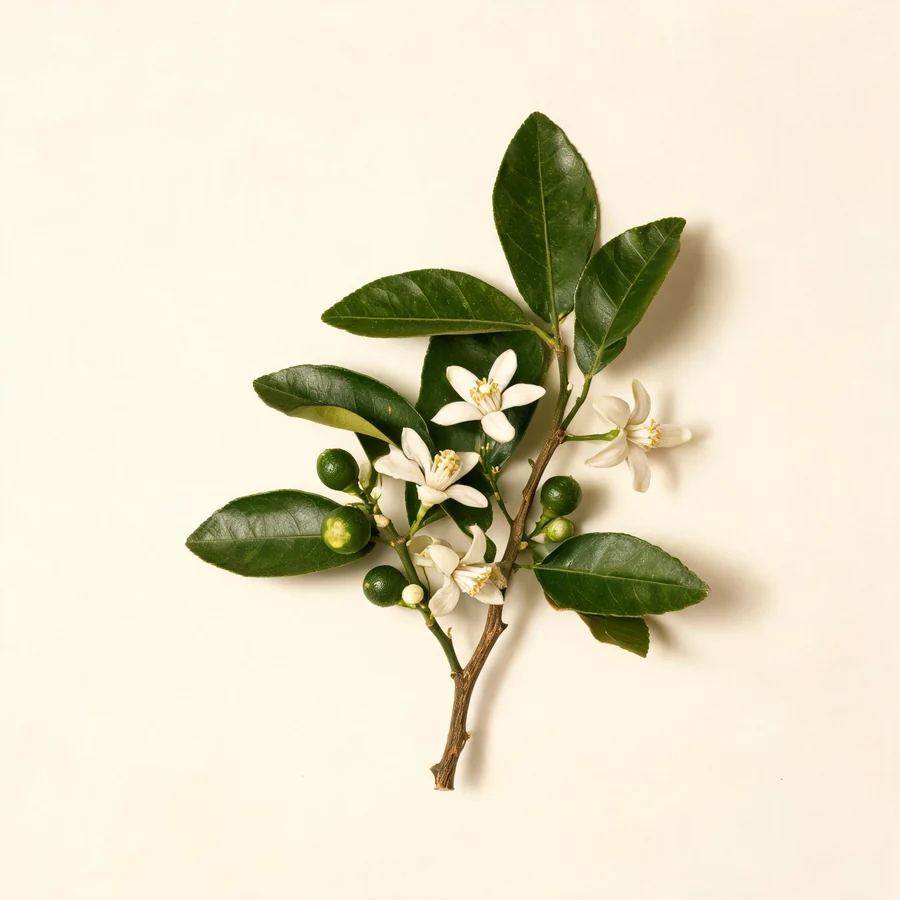
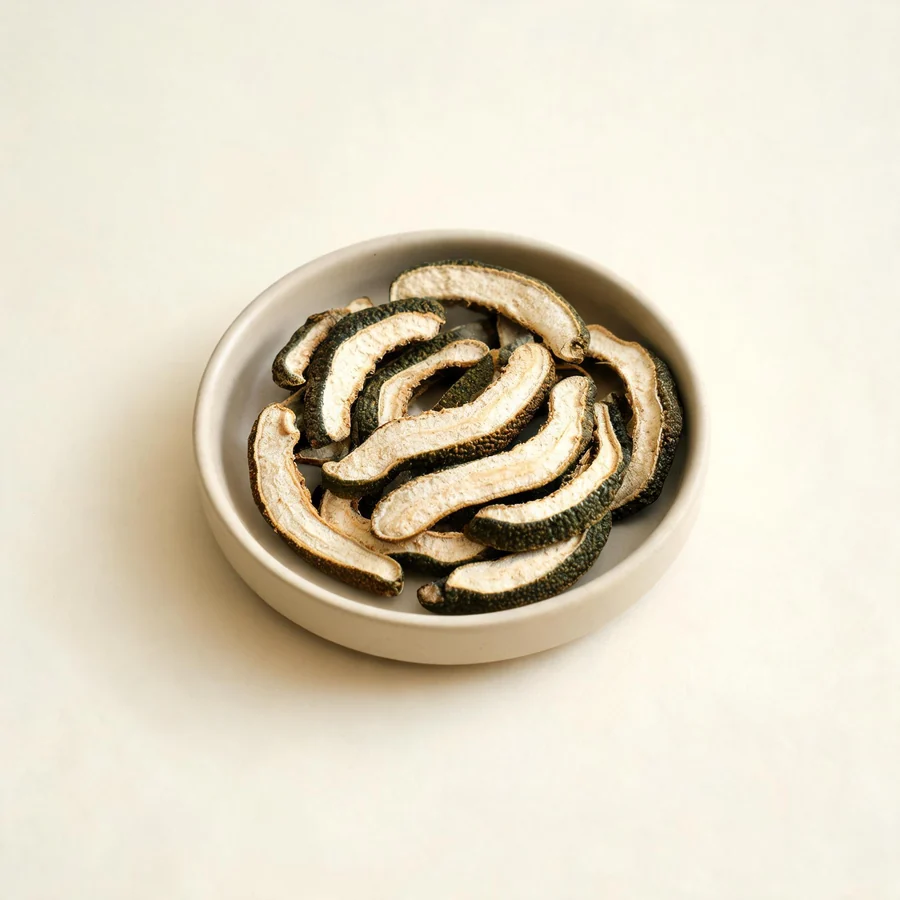
Skin profile
Where this herb sits in skin practice: the pattern it corrects, the skin signs it suits, and what it should not be used for.
Zhi Ke has a small, specific place in skin practice: it is for eruptions that keep pace with stress, distension and a coated tongue, and for formulas that need the middle kept open. The signs that make it plausible are a wiry pulse, rib-side tightness, sighing and a rash that moves. The signs that forbid it are pallor, exhaustion, dryness and heat. It moves Qi; it does not make it, and it does not clear heat, so it is never the whole treatment.
Skin signs that suggest it
- Wheals that come up after stress or emotional tension and settle when the person relaxes
- A thickened, leathery, itchy plaque that the person cannot stop scratching, worse at night and in tense periods
- A rash that appears with a bloated abdomen, belching and a feeling of tightness in the chest or ribs
- Itch that moves around the body and changes with mood, with a wiry pulse
- Premenstrual flares of an existing skin condition, with breast and rib-side distension
When it is not the right herb
Not for a hot, red, weeping or infected lesion, and not for a rash with fever. Not for exhaustion with no stagnation: the fruit moves Qi and does not manufacture it, so in a tired, pale person a long course brings more fatigue, looser stools and a poorer appetite. Not in pregnancy unless a practitioner has decided the case warrants it, and not as a daily habit for the complexion, because the classical warning is that it damages the Qi of the chest when taken beyond a few doses.
What it does for skin
Skin-relevant actions only. Each one describes a mechanism in TCM terms and what it looks like on the skin.
Moves Qi and lifts the stagnation that keeps a rash going
Stagnation on the skin looks like a lesion that will not finish: a plaque that stays after the trigger has gone, wheals that return with tension, itch that moves. The fruit moves Qi in the middle and the chest, and the skin is expected to settle as the congestion clears. It is a supporting action, and it needs a formula that also addresses why the Qi stalled.
Broadens the middle so that a skin formula does not sit heavily
This is the least visible and most common use. Skin formulas for chronic disease are full of tonics, moisteners and rich herbs, and a sluggish digestion turns them into dampness, which then shows on the skin. The fruit keeps the middle open so that the rest of the prescription is absorbed, and it is included in small amounts for that reason alone.
Eases the chest and rib-side tightness that comes with a flare
A rash that flares with a sense of constriction in the chest or ribs, sighing and a wiry pulse is read as Qi that has stalled in the chest rather than in the digestion. The fruit's downward and outward movement reaches that area, and it is paired with Liver-moving herbs. Chest tightness with pain or breathlessness is a medical matter and not a pattern to treat with a fruit.
Supports the movement of Blood in a static, thickened lesion
A lichenified plaque is the end point of years of scratching, and the tradition treats it as Blood that has stagnated after Qi stalled. The fruit does not move Blood itself, but it removes the Qi obstruction that keeps the Blood still, and it is used with Blood-moving herbs in that kind of formula. It is not a treatment for the plaque on its own.
Skin conditions it is used for
Mapped to the condition pages on this site. The pattern column shows what the skin is doing when this herb is the right choice.
| Condition | Pattern | Why it suits | Typical setting |
|---|---|---|---|
| Urticaria | Qi stagnation with wind, flaring under stress | Wheals that arrive with tension, move about and fade when the person relaxes are read as wind stirred by stalled Qi rather than by heat. The fruit moves the Qi while the formula harmonises the Liver and Spleen and the wind-releasing herbs address the surface. Cold-provoked or heat-provoked hives belong to different patterns, and hives with swelling of the lips or tongue are an emergency. | Xiao Yao San with Zhi Ke and Fang Feng |
| Neurodermatitis | Liver Qi stagnation with Blood stasis in a lichenified plaque | A leathery, thickened, intensely itchy plaque in a tense person is read as Qi stalling first and Blood stagnating after it. The fruit contributes the Qi-moving half and the blood-moving formula the other, and the aim is to interrupt the itch and scratch cycle rather than to sedate the itch. A new or changing plaque, or one that ulcerates, needs assessment. | Xue Fu Zhu Yu Tang with Zhi Ke and Chai Hu |
| Skin rashes | Food and Qi stagnation with a rash and a coated tongue | A rash that appears with a bloated abdomen, a coated tongue and a feeling of food sitting in the stomach is read as stagnation in the middle expressing itself at the surface. The fruit moves the middle while the formula releases the surface, and the rash usually settles as the digestion does. A rash with fever, a rash that does not blanch or a rapidly spreading rash needs urgent medical assessment. | Jing Fang Bai Du San with Zhi Ke and Chen Pi |
| Itchy skin | Qi and Blood stalling in a tense, sedentary person | Generalised itch without a rash, in someone who is tense, sedentary and sighing, is read as Qi that moves poorly and Blood that follows it badly. The fruit is a small part of a formula that harmonises the Liver, nourishes the Blood and moves the Qi, and it is judged over weeks. Itch with weight loss, jaundice, a new medicine or a widespread rash needs investigation rather than a Qi-moving fruit. | Modified Xiao Yao San with Zhi Ke |
Combinations for skin
Herbs it is paired with when the skin, not an internal organ, is the target.
| Partner | Ratio | Why the pair is used |
|---|---|---|
| Chai Hu | 6 to 10 g Chai Hu with 6 to 10 g Zhi Ke | Bupleurum lifts and spreads the Qi of the Liver and the fruit brings it down and outward, so the two together restore movement in both directions. The pair is the backbone of formulas for stress-linked skin disease, and the proportions follow the direction that is blocked: more bupleurum for a constrained, sighing picture, more fruit for distension and a coated tongue. |
| Bai Shao | 10 to 15 g Bai Shao with 6 to 10 g Zhi Ke | White peony nourishes the Blood and softens the Liver, while the fruit moves the Qi that has become stuck. The combination suits a tense person with dry, thin, itchy skin, because the peony supplies what the moving fruit would otherwise spend. It is the pairing at the heart of the classical harmonising formula. |
| Chen Pi | 6 to 10 g Chen Pi with 3 to 6 g Zhi Ke | Both are citrus and both move Qi, but the peel is gentle and rises while the fruit is stronger and descends. Together they cover the stomach and the chest, which suits a rash with both nausea and tightness. The pair is a formula ingredient rather than a household remedy, and it is stopped when the coating clears. |
| Dang Gui | 10 g Dang Gui with 6 to 10 g Zhi Ke | Angelica nourishes and moves the Blood and the fruit moves the Qi that has held it still, which is the division of labour for a thickened, dusky plaque. The pair is used in formulas for chronic lichenified skin and for pigmentation that follows long-standing stagnation. Neither is a cosmetic treatment, and a plaque that is changing needs a diagnosis first. |
Formulas where it leads
- Xiao Yao San (逍遥散) - The classical formula for Liver Qi stagnation with Spleen deficiency, with bupleurum, peony, angelica, atractylodes, poria and liquorice. Skin conditions that flare with stress and settle with rest are treated with it, and the fruit is a common addition when distension is marked.
- Xue Fu Zhu Yu Tang (血府逐瘀汤) - The formula for Blood stasis in the chest, with peach kernel, safflower, angelica, bupleurum and the fruit, which gives it its Qi-moving component. Its skin relevance is the dusky, thickened, static lesion and the pigmentation that follows long stagnation.
- Jing Fang Bai Du San (荆防败毒散) - A formula for the early stage of an exterior condition with wind-cold and dampness, used for rashes that come with a coated tongue and heaviness. The fruit is added when food stagnation is part of the picture.
Safety for skin use
What to check before recommending or using it, including the cautions that matter most for skin patients.
Do not use, or use with caution
- Exhaustion with no stagnation: a pale, tired person with a soft voice and loose stools. The fruit spends Qi that is not there to spend, so a long course deepens the fatigue.
- Pregnancy, unless a practitioner has decided the case warrants it. Animal work reports greater uterine tone and stronger contractions, which gives the old caution a footing without proving harm in people.
- A hot, red, weeping or infected skin lesion, or a rash with fever. The fruit has no cooling or toxin-resolving action, and using it alone delays proper treatment.
- A dry, thin constitution with a red tongue and little coating, where moving and drying herbs make the dryness worse.
Pregnancy and breastfeeding
Caution, rather than outright prohibition, is the classical position: Li Shizhen allowed the mature fruit late in pregnancy when the stagnation was clear, and withheld it where Qi was already weak. Rabbit uterus, studied both in whole animals and in isolated strips, responded with higher tone and stronger contractions, enough to keep the fruit out of casual use. It is not given for the nausea of early pregnancy, nor for the bloating that comes with pregnancy, and any use is a practitioner's decision about a defined pattern. Nothing is recorded for breastfeeding; a bitter aromatic fruit could flavour the milk or loosen a baby's stool, so short courses for clear indications are the sensible limit.
Interactions
- Monoamine oxidase inhibitors. Synephrine, a sympathomimetic amine in the fruit, could in theory push blood pressure up sharply in combination, and conventional advice is to keep them apart entirely.
- Stimulant medicines such as ephedrine and pseudoephedrine, and a heavy coffee habit. The combined effect on pulse and pressure can add up.
- Digoxin and other cardiac glycosides. Work on the same species raises the possibility of a stronger effect and greater toxicity, so the herb is mentioned to anyone taking one.
- Juice from Seville oranges, the same tree, lifts blood felodipine levels as grapefruit juice does, so the fruit is kept away from that medicine. A short study of the dried extract did not reproduce the enzyme effect, which suggests the form matters.
Allergy and patch testing
Citrus sensitivity is worth asking about, and a fixed rash after handling the fresh fruit is usually contact irritation rather than a true allergy. People who react to birch pollen can have oral allergy symptoms with citrus. The dried fruit in a decoction is unlikely to cause a reaction, but a new rash after starting it should be reviewed rather than continued through.
General safety references
General references for herbal hepatotoxicity and herb-drug interactions; they are not specific to this herb.
- Review article: Herbal hepatotoxicity - an update on traditional Chinese medicine preparations. Alimentary Pharmacology & Therapeutics, 2014. PMID: 24844799.
- Interactions between herbal medicines and prescribed drugs: an updated systematic review. Drugs, 2009. PMID: 19719333.
- Warfarin and food, herbal or dietary supplement interactions: a systematic review. British Journal of Clinical Pharmacology, 2021. PMID: 32478963.
Evidence
The classical record is quoted with its source. The modern note states the level of evidence plainly.
Classical record
无毒。
The entry states only that the fruit is without poison, and that single line is the whole of the classical safety record for the article.
Kai Bao Ben Cao (开宝本草) - Short classical citation. The source is a Song dynasty catalogue that gives the mature fruit its own entry, separate from the unripe one.
枳实、枳壳,大抵其功皆能利气,气下则痰喘止,气行则痞胀消,气通则痛刺止,气利则后重除。
Zhi Shi and Zhi Ke share one gift, which is to free Qi. Let Qi descend and phlegm and wheezing settle; let it move and knotted fullness eases; let it pass and stabbing pain ends; let it run smoothly and the bearing-down of tenesmus goes.
Ben Cao Gang Mu (本草纲目), Li Shizhen - Li Shizhen's summary of the whole citrus family, and the clearest account of why a single Qi herb serves cough, bloating and dysentery alike: each is read as downward movement that has failed.
枳实、枳壳,一物也。小则其性酷而速,大则其性和而缓。
Zhi Shi and Zhi Ke are the same thing. The small fruit is harsh and quick, the large one mild and slow.
Ben Cao Yan Yi (本草衍义), Kou Zongshi - Kou Zongshi, writing in the Song, draws a line that every later text repeats. The point is ripeness, not species, and it accounts for the unripe fruit being kept for emergencies and the mature one for everyday courses.
Modern evidence
Evidence status
- The constituent behind most of the interest is synephrine, a sympathomimetic amine, together with the flavonoids of the peel. Laboratory and animal work describes anti-inflammatory and prokinetic effects, while the synephrine literature is mostly about weight-loss extracts rather than about decoctions.
- No controlled trial of Zhi Ke in urticaria, neurodermatitis, pruritus or any other skin condition was identified. The skin use rests on the Qi-stagnation pattern and on the classical formulas in which the fruit appears.
- Regulatory status: the dried nearly mature fruit is an accepted article in the Chinese Pharmacopoeia. The safety questions that attract attention belong to concentrated synephrine extracts sold for weight loss, which deliver far more of the compound than a decoction does.
PubMed records
Selected real PubMed records for this herb's species or its constituents, chosen by species name and title relevance. They are references for the non-TCM discussion above, not proof that the herb treats any skin condition.
- An approach of pectin from Citrus aurantium L. for superabsorbent resin with superior quality for hygiene products: Salt resistance, antibacterial, nonirritant and biodegradability.. International journal of biological macromolecules, 2023. PMID: 36539172 (pharmacology or review record).
Dose and forms
Skin-practice dosing and the preparations that suit skin complaints.
| Form | Dose and notes |
|---|---|
| Decoction | A daily decoction of 3 to 10 g. Three to six grams is enough for mild fullness in the chest or rib-side; six to ten for food stagnation with marked distension. |
| Bran-fried fruit | Bran-frying is the usual dispensary preparation: slices are stir-fried with wheat bran until they darken, and the bran is then sieved out. Frying takes the edge off the Qi-moving force and is kinder to the stomach. |
| Course length | Two to three weeks, then a break. The classical warning is that the fruit damages the Qi of the chest beyond a few doses, and it is not a daily habit. |
The moving action, not any poison, sets the ceiling. Three to ten grams for a defined stagnation is unremarkable. The mistakes are a course stretched over months in a person whose Qi was thin to begin with, and the far higher prolapse range, which is supervised practice rather than skin care. Untreated fruit moves Qi more forcefully and upsets a delicate digestion, so the bran-fried form is preferred for skin patients, many of whom are already on rich formulas. A pregnant or nursing woman, or anyone on a stimulant, should raise it with a practitioner instead of self-prescribing.
Citations and further reading
Only real sources are listed: the classical materia medica passages quoted above, and the source works behind the botanical and safety statements.
- Kai Bao Ben Cao (开宝本草), Song dynasty catalogue - classical entry quoted above.
- Ben Cao Gang Mu (本草纲目), Li Shizhen, 1578 - classical entry quoted above.
- Ben Cao Yan Yi (本草衍义), Kou Zongshi, Song dynasty - classical entry quoted above.
- Aurantii Fructus monograph: Pharmacopoeia of the People's Republic of China - accepted botanical source, part used and quality requirements.
- Modern evidence statement: based on published laboratory and pharmacological literature on synephrine and Citrus aurantium, summarised as a statement about the level of evidence rather than as a cited finding.
- Botanical description and identification: botanical literature on Citrus aurantium, Rutaceae.
Educational reference for qualified practitioners. This page is not medical advice, and skin conditions should be diagnosed by a clinician before treatment.