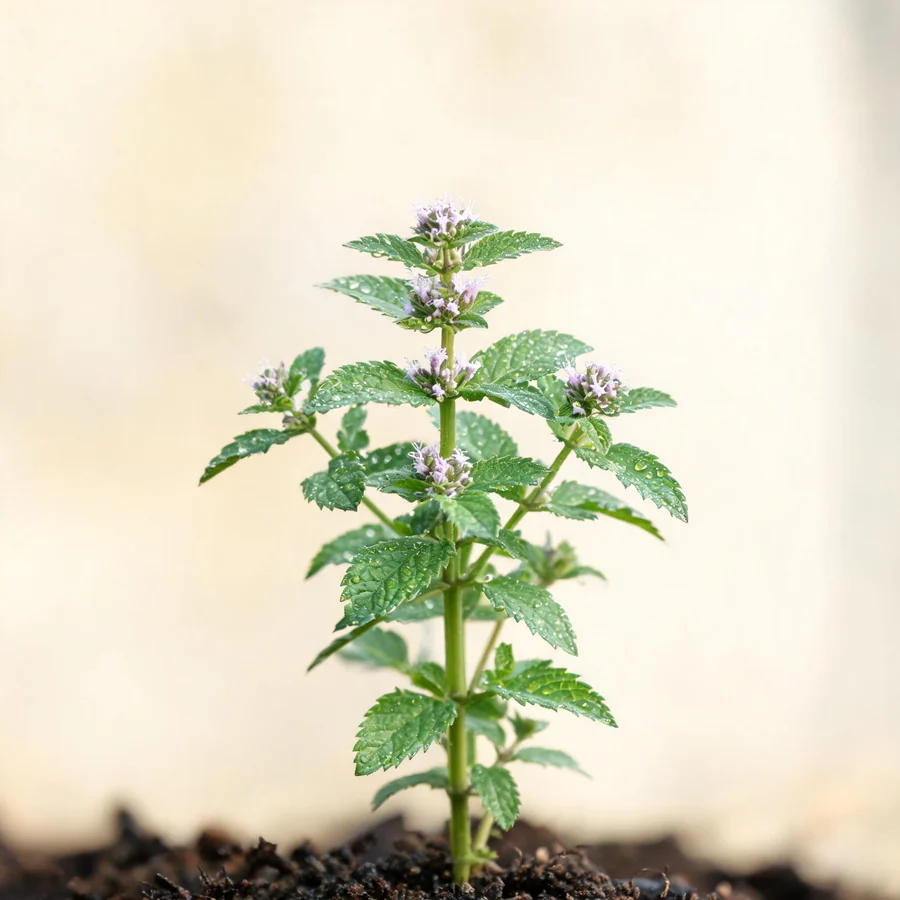
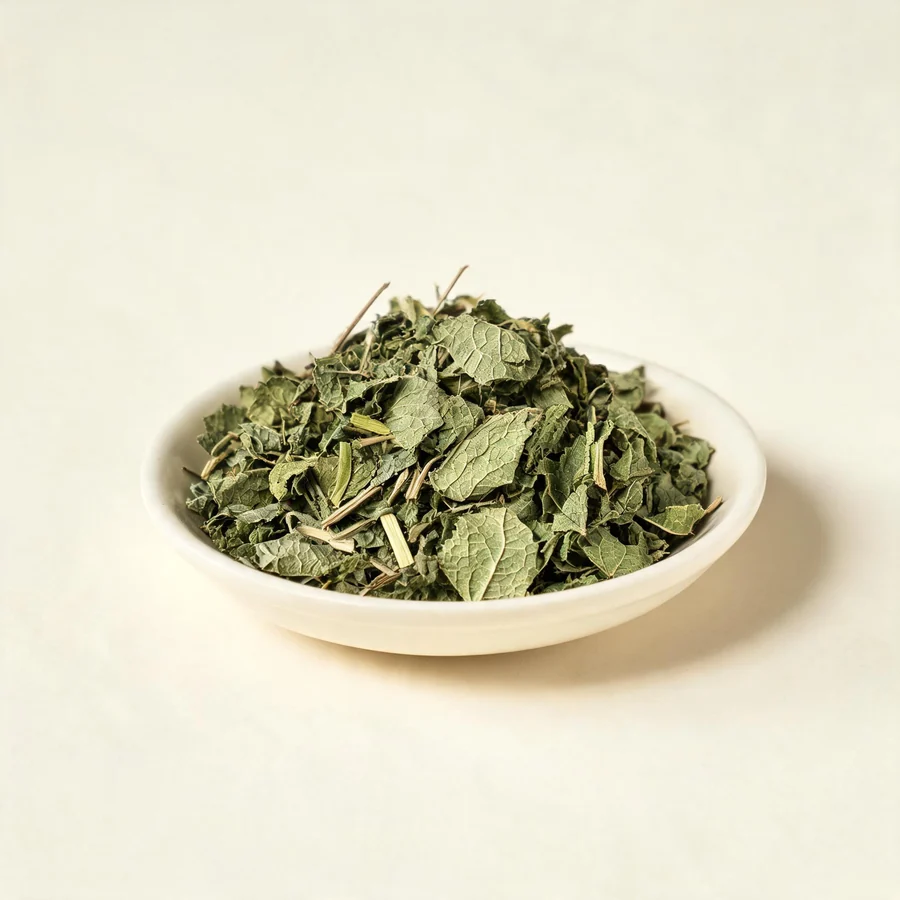
Skin profile
Where this herb sits in skin practice: the pattern it corrects, the skin signs it suits, and what it should not be used for.
Bo He is the opening herb for a hot, itchy, newly erupted skin, and its strength is movement rather than substance. It is used in small amounts, late in the decoction, and mainly to let something out: a rash, a wheal, or the constraint that keeps a flare going.
Skin signs that suggest it
- Raised red or pink wheals that come and go within hours and itch intensely (Wind-Heat in the surface)
- Itch that is worse in warmth, after exercise and in bed, and that moves from one place to another
- A sparse red rash that appears slowly, or fades almost as soon as it is seen (a rash failing to vent)
- Tiny red papules in the folds of the neck and chest in hot, humid weather (heat rash)
- An itchy scalp with a hot, crawling quality, often with red eyes or a sore throat alongside
When it is not the right herb
Not for dry, thin, pale skin with no redness and no itch, and not for an eruption that has already come out and is settling. It is left out where the person sweats freely without effort, where there is Yin deficiency with night sweats and a dry mouth, or where the skin is cold and the circulation poor. Because it disperses and rises, large or repeated doses can leave a depleted person flatter and can reduce milk in a mother who is establishing supply. A cold, pale, slow rash needs warming and support rather than release, and mint given there makes the pattern worse.
What it does for skin
Skin-relevant actions only. Each one describes a mechanism in TCM terms and what it looks like on the skin.
Releases Wind-Heat from the surface
The primary action. Acrid, cool and aromatic, mint is said to open the pores, letting a light sweat carry an early pathogen off the surface. On skin that means the hot, itchy, newly erupted problem: wheals that redden with warmth or exertion, an itch that begins with a feverish cold, and a rash being pressed down by surface Heat. It is a first move, not a treatment for an eruption that has already settled.
Vents a rash that is stuck
A rash that is sparse, slow, or gone as quickly as it appeared is read as Heat confined to the exterior, the pathogen having no way out. Mint is cool enough to clear that Heat and mobile enough to lift the eruption outwards, and it is used this way for the early rash of a febrile illness and for a child whose spots will not emerge. Fever with a rash in a child still needs a diagnosis; the historical use long predates modern assessment.
Stops itch by moving Wind rather than by numbing
Mint does not sedate the skin. It reduces itch by dispersing the Wind that the tradition holds responsible for a moving, come-and-go itch, which is why it works best on an itch with no fixed lesion that is worse when warm. It is volatile, so its effect is brief, and it is used as a wash or as a small ingredient in a formula rather than as a stand-alone antipruritic.
Cools the head and scalp
The herb's ascending, aromatic quality carries it to the head, and that is where a good deal of skin practice uses it: an itchy, hot scalp, dandruff with redness and irritation, and the burning of the face in a hot flush. It is combined with chrysanthemum and the wind herbs for the scalp, and it shows that a herb can act on the skin of the head through the same channels that make it useful for headache and red eyes.
Loosens the constraint that drives a flare
Mint enters the Liver channel, and a small amount is said to loosen constraint, the stuck quality that shows as chest tightness, irritability and a flare of itch under stress. That is the reasoning that puts it in formulas for stress-provoked urticaria, and it explains why a few grams can matter out of proportion to the dose. It assists the leading herbs rather than replacing them.
Skin conditions it is used for
Mapped to the condition pages on this site. The pattern column shows what the skin is doing when this herb is the right choice.
| Condition | Pattern | Why it suits | Typical setting |
|---|---|---|---|
| Urticaria | Wind-Heat in the surface with red, moving wheals | Hives are the clearest skin expression of Wind: they arrive suddenly, move and disappear, and the tradition treats the pattern rather than the individual wheal. Where the wheals are red, the skin feels hot and the attack follows warmth, exercise or a feverish cold, mint is the herb that opens the surface and lets the Wind out. It is used in small amounts inside a formula, and it is much less useful in the cold, pale, oedematous type of hive. | Xiao Feng San, or Yin Qiao San for the early hot stage |
| Itchy skin | Wind-Heat with a moving itch and little to see | An itch that moves, worsens at night and leaves little beyond scratch marks is read as Wind. Mint is chosen when there is also heat: the skin is warm and slightly red, the person feels hot, and cold applications help. Its volatile oil makes it a plausible wash, and it is one of the few herbs that can be used as a light, cooling application without drying the surface. | A wash, or a modified Xiao Feng San with Chan Tui and Jing Jie |
| Skin rashes | Rash held below the surface, slow to vent | The venting action is the classical use, and it survives in modern practice for the rash that is sparse and slow. The reasoning is that the eruption is the pathogen looking for an exit, so the treatment helps it out rather than suppressing it. A febrile rash in a child needs a diagnosis first, particularly where there is drowsiness, neck stiffness or a rash that does not fade under pressure. | Yin Qiao San with Bo He added late in the decoction |
| Heat rash | Summer Heat and Dampness blocked at the pores | Prickly heat is read as sweat that cannot escape because Heat and Dampness have blocked the pores, and mint suits it on both counts: it is cooling and it opens the surface. A weak cooled wash or a small internal dose in a formula is the usual form, and loose clothing and a cooler room matter as much as the herb. It is not a treatment for a widespread pustular eruption in a baby, which needs assessment. | A cooled mint wash, or a light formula with Lian Qiao and Jin Yin Hua |
| Chickenpox | Epidemic toxin with vesicles and itch, rash not fully out | The classical paediatric use was for the eruptive fevers, and chickenpox fits the reasoning: heat and dampness producing vesicles that itch, with the rash appearing in crops. Mint is used here for the itch and for the surface Heat, not to shorten the illness, and it is given only inside a formula. Chickenpox in an adult, in pregnancy, or with a widespread weeping rash needs medical advice, and the herb is not a substitute for that. | A light wind-heat formula with Bo He, Lian Qiao and Chan Tui |
| Itchy scalp | Wind-Heat rising to the scalp | The scalp is the highest part of the body, and the tradition treats itch there as Wind rising, often with Heat or Dampness feeding it. Mint is a natural fit for a scalp wash because it is aromatic, cooling and volatile, and it leaves the sensation of heat reduced. It is a comfort measure for an itch with a hot quality; a scaly, greasy scalp with yellow crusting points more to Dampness, and a persistent patch needs examination. | A dilute mint and chrysanthemum wash, or a formula with Ju Hua and Fang Feng |
Combinations for skin
Herbs it is paired with when the skin, not an internal organ, is the target.
| Partner | Ratio | Why the pair is used |
|---|---|---|
| Chan Tui | 3 to 6 g of each, in decoction | Two light, cool surface herbs. Mint disperses more strongly and works better on the head and throat, while the shell contributes the venting action, relief of itch and a mildness that is useful in children. An early itchy eruption with a sore throat, or a rash that is emerging too slowly, is where the two are used together. |
| Jing Jie | 6 g each | A pairing of opposite temperatures: Jing Jie is warm and opens the surface, while mint is cool and clears the Heat beneath it. Together they release a surface that is stuck without over-cooling it, which is why the pair is used for an itchy rash with a mixture of heat and chilliness, and for the early stage of an eruption when the pattern is not yet clearly hot or cold. Mint goes in late, because its volatile oil is the action. |
| Jin Yin Hua | 6 g of mint with 10 to 15 g of honeysuckle | One clears Heat and neutralises toxin at the surface, the other disperses and lifts; together they form the core of the classic formula for the opening stage of a warm-febrile illness. Skin practice borrows that pairing for an early hot eruption that comes with a sore throat, and for a red, spreading rash while fever persists. Honeysuckle is given in the greater amount, the toxin being the more serious element. |
| Niu Bang Zi | 6 to 10 g each | Both release Wind-Heat and help a rash emerge, but the burdock fruit is the stronger against Heat-toxin and swollen tissue, while mint opens the surface and clears the head more effectively. The two are aimed at throat and skin simultaneously, and suit an itchy eruption with a swollen sore throat or a rash that will not complete. Mint goes in at the end so the oil is not boiled off. |
Formulas where it leads
- Xiao Feng San (消风散) - The standard formula for wind-damp-heat itch, and the context in which mint is most often used on the skin. Mint and the other surface herbs move the Wind, while Shi Gao, Zhi Mu and the drying herbs deal with the Heat and the Dampness underneath, which is the combination that makes the formula work for urticaria and for itchy, weeping eruptions.
- Yin Qiao San (银翘散) - The classic formula for the opening stage of a warm-febrile illness, where mint and the surface herbs lift the pathogen out. Its skin use is the early hot eruption with a sore throat: the mint is added in the last minutes of decoction, and the formula is given for days rather than weeks.
Topical use
Mint is applied to the skin as a cooled wash or compress for hot, itchy and newly erupted areas. The dried leaf is steeped briefly rather than boiled hard, because the volatile oil that does the work is driven off by long heat, and the liquid is used weak. It is also the source of the menthol in medicated creams and cooling gels, which are a very different exposure from a cup of leaf in water.
| Preparation | How and when it is used |
|---|---|
| Cooled leaf wash | Steep 5 to 10 g of dried leaf in 300 ml of just-boiled water for 10 minutes, strain and cool to skin temperature. Bathe or compress the itchy area for 5 to 10 minutes, then pat dry, and make a fresh infusion each time. |
| Dilute scalp rinse | Use a weaker infusion on a cloth held against the scalp for a few minutes, or add it to a final rinse. Keep it out of the eyes, and do not use it on broken or weeping skin where a stronger preparation would sting. |
| Menthol and essential oil products | Concentrated products are a different medicine from a leaf infusion. They must be kept off the face of a baby or small child, and an adult should patch test before spreading one over a large area. |
Patch test and cautions
Patch test on normal skin for 24 hours. Keep mint preparations away from the eyes, do not apply a strong infusion to broken skin, and stop at once if burning or spreading redness develops. Menthol and peppermint oil must never be put on a baby's or toddler's face: they can trigger apnoea or laryngospasm. Anyone using a cooling gel on a large area should read the label rather than assume it is equivalent to a leaf wash.
Safety for skin use
What to check before recommending or using it, including the cautions that matter most for skin patients.
Do not use, or use with caution
- Yin deficiency with Heat: night sweats, a dry mouth, a dry throat and a thin rapid pulse. Mint disperses and cools, and in this pattern it can deplete fluids further and leave the person drier and more restless.
- Free sweating, or an exterior pattern without Wind-Heat. Where the pores are already open and the person sweats without effort, an opening herb thins a defence that is already leaking and makes the sweating worse.
- Cold-deficient skin: pale, cold, dry skin with a slow rash and no heat signs. Mint is the wrong temperature for that picture, and it can deepen the chill.
- Infants and young children. Menthol is irritant to the immature airway and must not be applied near the face; internal use in this age group needs a practitioner, and the dose is scaled down sharply.
Pregnancy and breastfeeding
Small quantities within a formula are used, and one weak cup of tea is unlikely to matter, but medicinal doses and the essential oil are avoided. The concern is partly traditional and partly experimental: mint moves Qi, animal studies have reported uterine stimulation from mint preparations, and the oil is a far more concentrated question than the leaf. Mothers who are breastfeeding are usually told to keep the dose low, since heavy or repeated use of mint is the remedy most often blamed when milk supply drops.
Interactions
- Medicines handled by CYP3A4. Peppermint oil inhibits this enzyme in laboratory work and in a small human study, and one controlled study reported higher felodipine levels. A decoction dose should have little effect, but a narrow therapeutic index makes it worth knowing.
- Warfarin. Case reports describe INR changes in people on warfarin who also took large amounts of menthol, though controlled work has not resolved the question; new bruising should prompt a stop and advice.
- Iron tablets and reflux treatment. Mint can reduce iron absorption, so leave at least two hours between them. It also relaxes the lower oesophageal sphincter, which can worsen heartburn in someone already treated for it.
Allergy and patch testing
Contact dermatitis to mint oils and to herb-containing cooling gels is recognised, and menthol can produce a burning sensation that is not an allergy but is often reported as one. Patch test a new preparation, keep washes away from the eyes and broken skin, and stop if the skin becomes redder rather than calmer. People who react to one member of the mint family may react to another, so a previous reaction to a mint-flavoured product is worth asking about.
General safety references
General references for herbal hepatotoxicity and herb-drug interactions; they are not specific to this herb.
- Review article: Herbal hepatotoxicity - an update on traditional Chinese medicine preparations. Alimentary Pharmacology & Therapeutics, 2014. PMID: 24844799.
- Interactions between herbal medicines and prescribed drugs: an updated systematic review. Drugs, 2009. PMID: 19719333.
- Warfarin and food, herbal or dietary supplement interactions: a systematic review. British Journal of Clinical Pharmacology, 2021. PMID: 32478963.
Evidence
The classical record is quoted with its source. The modern note states the level of evidence plainly.
Classical record
薄荷,辛能发散,凉能清利,专于消风散热,故头痛、头风、眼目、咽喉、口齿诸病,小儿惊热及瘰疬、疮疥为要药。
Bo He is acrid and can disperse, cool and able to clear and benefit. It specialises in dispelling Wind and dissipating Heat, so it is an important herb for headache, head Wind, eye, throat and mouth-tooth disorders, febrile convulsion in children, scrofula and sores.
Ben Cao Gang Mu (Compendium of Materia Medica), Li Shizhen - Li Shizhen's summary includes sores and scrofula in the list, which is the classical warrant for the skin use.
利咽喉,口齿诸病。治瘰疬,疮疥,风瘙瘾疹。
It benefits the throat and the various disorders of the mouth and teeth, and it is used for scrofula, for sores and itch, and for the itchy rashes that Wind provokes.
Ben Cao Gang Mu (Compendium of Materia Medica), on the itch of Wind - The term used here for the itchy rash is the one later used for urticaria, which makes this the clearest classical statement of the skin use.
薄荷,不特善解风邪,尤善解忧郁,用香附以解郁,不若用薄荷解郁之更神。薄荷入肝胆之经,善解半表半里之邪,较柴胡更为轻清。
Mint is not only good at resolving Wind; it is better still at loosening melancholy, and for that purpose it is held to work more subtly than Xiang Fu. It enters the Liver and Gallbladder channels and is skilled with pathogens caught between the exterior and the interior, being lighter and clearer than Chai Hu.
Ben Cao Xin Bian (New Compilation of Materia Medica), Qing dynasty - The basis for the small dose that loosens constraint in a stress-provoked flare.
Modern evidence
Evidence status
- Laboratory work on menthol and on mint extracts describes cooling, antipruritic and mild anti-inflammatory effects, much of it through the cold-sensing receptor TRPM8 and through effects on sensory nerve endings. That is a plausible explanation for the sensation of relief; it is not evidence that an eruption resolves.
- Clinical evidence for the dried herb in skin disease is thin. Small studies of menthol-containing topical products for itch exist, but they test the product rather than the leaf, and no adequate trial of Bo He in urticaria or eczema was identified for this edition.
- The safety literature is better developed than the efficacy literature: the oil inhibits CYP3A4, concentrated menthol irritates mucous membranes and can trigger apnoea in an infant, and the decoction dose is a very different exposure from an essential oil.
PubMed records
Selected real PubMed records for this herb's species or its constituents, chosen by species name and title relevance. They are references for the non-TCM discussion above, not proof that the herb treats any skin condition.
- Effects of topical application of a tri-herb formula on inflammatory dry-skin condition in mice with oxazolone-induced atopic dermatitis.. Phytomedicine : international journal of phytotherapy and phytopharmacology, 2021. PMID: 34425472 (skin-related record).
- Traditional Chinese medicine for atopic eczema: PentaHerbs formula suppresses inflammatory mediators release from mast cells.. Journal of ethnopharmacology, 2008. PMID: 18725279 (skin-related record).
Dose and forms
Skin-practice dosing and the preparations that suit skin complaints.
| Form | Dose and notes |
|---|---|
| Decoction for skin | 3 to 6 g a day, stirred in for the final five minutes of cooking. This is the range for an itchy, hot eruption inside a formula, where mint assists rather than leads. |
| Higher short-term dose | 6 to 10 g is used when the aim is to vent a rash or release the exterior strongly. That is a short-term figure; bigger amounts promote sweating and drain fluids. |
| Powder | 1 to 3 g a dose as powder, which keeps the aromatic oil intact and suits a headache or throat formula. Powder is a practical way to give a small supervised dose to a child. |
| External wash | 5 to 10 g steeped, not boiled, for a cooled wash or compress on a hot itchy area. Fresh leaf can be used at roughly double the dried weight. |
Because the active part is a volatile oil, mint is added at the end and given in small amounts. Venting a rash or releasing the exterior pushes the range to 6 to 10 g, while 3 to 6 g is sufficient to loosen constraint, since excessive aromatic dispersal wastes protective Qi and fluids. Fresh leaf is commonly used at twice the dried weight, and herb that no longer smells of mint has lost most of its power.
Citations and further reading
Only real sources are listed: the classical materia medica passages quoted above, and the source works behind the botanical and safety statements.
- Ben Cao Gang Mu (Compendium of Materia Medica), Li Shizhen, 1578 - both passages quoted above.
- Ben Cao Xin Bian (New Compilation of Materia Medica), Qing dynasty - passage on constraint quoted above.
- Xin Xiu Ben Cao (Newly Revised Materia Medica), Tang dynasty, 659 - the earliest record, describing the herb as warm and listing digestive rather than skin uses.
- Pharmacopoeia of the People's Republic of China - Bo He monograph: accepted species, part used and quality requirements.
- Modern evidence statement: based on pharmacological literature on menthol and on CYP3A4 inhibition by peppermint oil, summarised as a statement about the level of evidence rather than as a cited finding.
- Botanical description and identification: botanical literature on Mentha haplocalyx, Lamiaceae, including the distinction from spearmint and peppermint.
Educational reference for qualified practitioners. This page is not medical advice, and skin conditions should be diagnosed by a clinician before treatment.