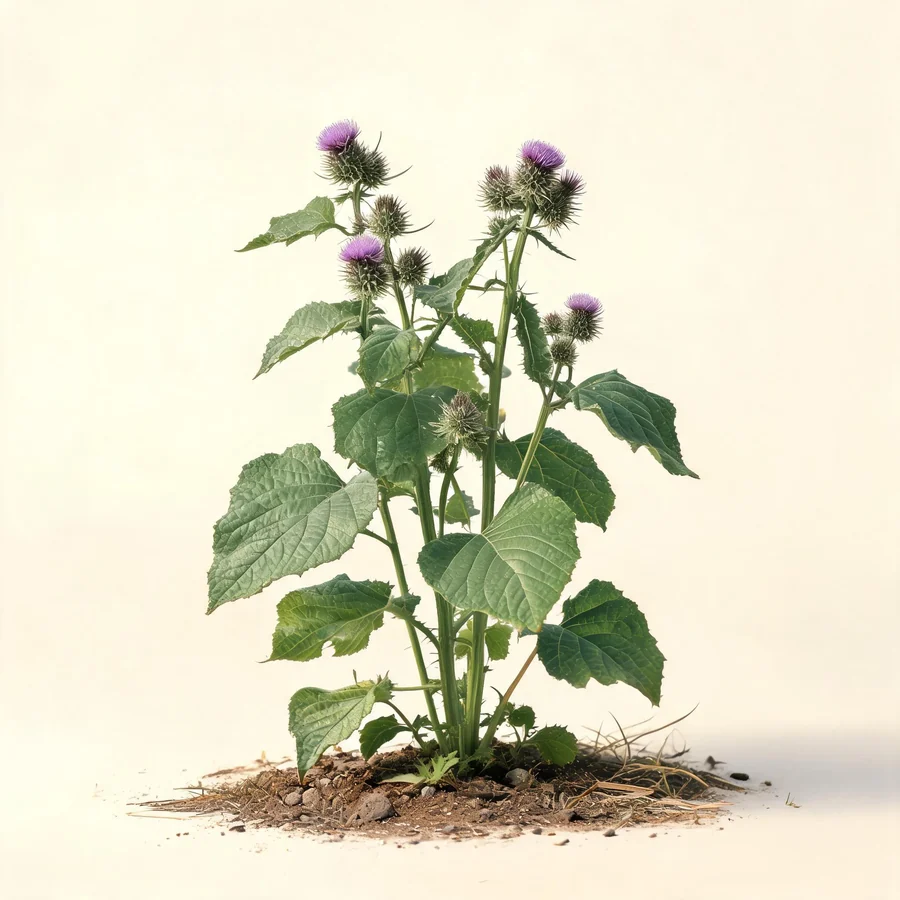
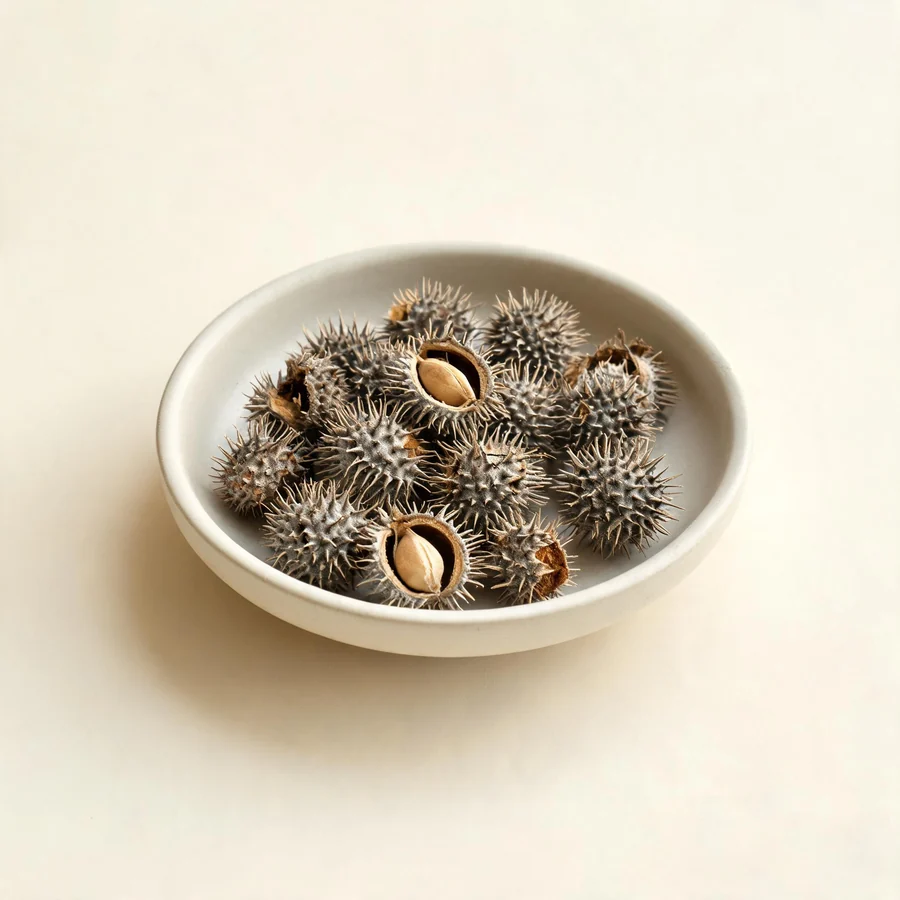
Skin profile
Where this herb sits in skin practice: the pattern it corrects, the skin signs it suits, and what it should not be used for.
The seed's skin value is directional: it lifts an eruption outward and cools the heat behind it. Most of its other work is in the throat, so skin practice uses only part of its range.
Skin signs that suggest it
- An eruption that surfaced in a few spots and stopped, or that receded after appearing (an eruption that has not vented)
- Red, itchy wheals arriving with a feverish cold, a sore throat or sore eyes (wind-heat in the skin)
- A hot red plaque or a boil with swelling, alongside a red tongue tip and a sore throat
- Dry stool together with a hot eruption, a red tongue and a yellow coat
- Itchy bumps on face or trunk that worsen in wind and warmth and settle with cooling
When it is not the right herb
Not for wind-cold: shivering, a streaming nose, a white tongue coat and a throat that tickles rather than burns. Not for an eruption that has already come out fully, nor for the closing stage of a febrile rash with cold and deficiency signs. Not where the stool is loose or digestion cold and weak, and not for an abscess that has opened and is draining thin fluid, since dispersal is then unwanted.
What it does for skin
Skin-relevant actions only. Each one describes a mechanism in TCM terms and what it looks like on the skin.
Disperses wind-heat from the surface
The seed opens the surface and carries heat outward, and most of its skin work rests on that. It produces sweat less readily than peppermint but works more strongly on the throat and on the eruption itself, so it fits a rash arriving with a sore throat and feverish cold. The acrid flavour provides movement and the cold nature provides cooling, which is how it vents without adding heat.
Vents an eruption that has stalled
An eruption that has not completed is treated as heat shut under a closed surface, which this tradition regards as more dangerous than one that has come out fully. The seed helps the eruption finish, and it needs other venting herbs because no single one lifts a rash alone. It is used while the eruption is undecided and stopped once it has spread.
Clears heat toxin and reduces swelling
Past the surface, the seed serves where heat toxin has collected: boils, abscesses, carbuncles, and the vivid spreading plaque of erysipelas, which one classical text names outright. Its dispersing quality stops the lesion hardening, and its mild downward action offers the toxin an exit through the bowel. It assists in these pictures; it does not replace antibiotics.
Quiets itch by clearing the heat that drives it
The seed is a fixture of the wind formula for itchy eruptions, where what it contributes is cooling rather than direct itch relief. It fits itch with redness, a raised surface and a recent start, and fits poorly the dry, chronic, blood-deficient kind. Its place in that formula explains why it appears in so many itchy-rash prescriptions even when the throat is quiet.
Skin conditions it is used for
Mapped to the condition pages on this site. The pattern column shows what the skin is doing when this herb is the right choice.
| Condition | Pattern | Why it suits | Typical setting |
|---|---|---|---|
| Macular rash | Wind-heat with an eruption held at the surface | A flat red eruption appearing in patches and going no further, in a feverish person with cough and sore eyes, is read as heat that has not fully left by way of the skin. The seed is one of the standard venting herbs for that moment, given with other surface medicines rather than alone. A febrile rash in a child should be assessed medically; the historical use long predates modern diagnosis. | Xuan Du Fa Biao Tang, or Niu Bang Zi with Jing Jie, Bo He and Chan Tui |
| Urticaria | Wind-heat with red, itchy wheals | Wheals that are red, raised and itchy, arriving with heat or a feverish cold, read as wind-heat in the skin. The seed supplies cooling and surface movement in one move, which suits a recent attack in a hot person. It is paired with wind-releasing and itch-quieting herbs, and it does less for chronic wheals provoked by cold. | Xiao Feng San, or Niu Bang Zi with Jing Jie, Chan Tui and Bo He |
| Eczema | Wind-heat with itch in an acute flare | During an acute itchy flare with redness and a raised surface, the seed adds cooling and dispersal without adding heat. It is a supporting herb, chosen where the itch is recent and the skin is not heavily weeping. In the dry, thickened stage it contributes little. | Modified Xiao Feng San with Niu Bang Zi and Chan Tui |
| Itchy skin | Wind-heat provoking itch of recent onset | Itch that arrives with redness, a raised surface and a recent beginning is wind-heat rather than dryness. The seed cools the heat while the surface is opened, which makes it a good partner for itch-quieting herbs rather than a treatment on its own. Long-standing itch in a depleted person needs another approach. | Niu Bang Zi with Jing Jie, Fang Feng and Bai Xian Pi |
| Erysipelas | Dan toxin with a bright red spreading plaque | One classical text credits the seed with removing dan, the vivid spreading plaque this tradition calls fire toxin. It supports treatment there and never substitutes for the antibiotics erysipelas needs without delay. The reasoning is the pairing of toxin-clearing with outward dispersal, which suits a lesion spreading at the surface. | Niu Bang Zi with Jin Yin Hua, Lian Qiao and Chi Shao in a toxin-clearing formula |
| Boils and hot swellings | Heat toxin with swelling that has not hardened | The seed is given for boils and carbuncles while they are still spreading and unlocalised, because dispersal keeps the lesion from consolidating. It is combined with stronger toxin-clearing herbs and withdrawn once the sore opens. A boil on the face, or one with fever, needs medical care. | Niu Bang Zi with Lian Qiao, Jin Yin Hua and Pu Gong Ying |
Combinations for skin
Herbs it is paired with when the skin, not an internal organ, is the target.
| Partner | Ratio | Why the pair is used |
|---|---|---|
| Jing Jie | 6 to 10 g each | This pair sits at the heart of the powder for wind-type eruptions. Jing Jie is slightly warm and acts at the Blood and skin level; the seed is cold and deals with the heat travelling with that wind, and Jing Jie's warmth is too slight to fight it. Together they address both halves of an itchy rash, and they are used for hives, eczema and an eruption slow to complete. |
| Lian Qiao | 10 to 12 g each | Both are cold heat-toxin clearers, but forsythia scatters clumped heat and reduces a nodular swelling more strongly, while the seed opens the Lung and reaches the throat. The pair gives wide cover for upper-body toxic heat. The principle is simple: one herb opens a way out, the other breaks up what has gathered. |
| Bo He | 6 to 10 g each | Peppermint is the stronger surface releaser and produces more sweat; the seed is the stronger on throat and toxin. An early wind-heat illness has two halves, an exterior to open and a throat to cool, and this pair takes one each. That is why both appear in prescriptions for the opening days of a febrile cold with an eruption. |
| Chan Tui | 6 to 10 g seed with 3 to 6 g Chan Tui | Cicada moult is light and rising, and its strengths are quieting itch and helping an eruption vent; the seed supplies the heat-clearing and toxin-resolving power the moult lacks. They are paired rather than exchanged, because itch and heat are two different problems in one skin. Both belong to the powder for wind-heat rashes with fierce itching and red wheals. |
| Xuan Shen | 10 to 15 g Xuan Shen with 6 to 9 g Niu Bang Zi | Salty and cold, Xuan Shen softens what has hardened, nourishes yin and clears heat at once, which makes it the answer to a swelling that is turning firm. The seed adds the outward push that carries that cooling to the surface. The combination is for a long-standing problem in a person whose fluids are already low, where dispersing alone would leave the tissue drier still. |
Formulas where it leads
- Xiao Feng San (消风散) - The standard wind formula for itchy eruptions, where the seed adds cooling and dispersal to the itch-quieting and drying herbs. It is the usual setting for Niu Bang Zi in eczema and urticaria, and it explains why the seed turns up in prescriptions where the throat is not involved.
- Yin Qiao San (银翘散) - The archetypal wind-heat formula for the opening days of a febrile illness with sore throat, in which the seed opens the throat and helps an eruption vent. In skin practice it is used when an itchy red rash arrives with a feverish cold, the same wind-heat picture showing on the skin.
- Xuan Du Fa Biao Tang (宣毒发表汤) - A venting formula for a slow eruption, with fever, cough and sore eyes. Niu Bang Zi works with Jing Jie, Bo He and Chan Tui to bring the rash out. Its indication is a febrile eruption in childhood, and such a rash needs medical assessment before a herbal approach.
Safety for skin use
What to check before recommending or using it, including the cautions that matter most for skin patients.
Do not use, or use with caution
- Cold, weak digestion with unformed stool, no appetite, a pale tongue, and a pulse that is slow. The seed is cold and oily, can worsen diarrhoea, and the raw seed is best avoided in that state.
- A wind-cold pattern: shivering, a runny clear nose, a white tongue coat and a throat that tickles rather than burns. A cold dispersing herb given in a cold pattern drives the pathogen inward.
- An eruption that has already completed, an abscess that has opened and is draining thin fluid, and the closing stage of a febrile rash with deficiency signs. Dispersal at those points opposes healing.
Pregnancy and breastfeeding
Only with caution, and only under practitioner supervision. The European medicines assessment concluded that burdock is not recommended in pregnancy for want of adequate safety data, and a uterine stimulant effect has been reported for burdock preparations in vivo, although the evidence for the fruit itself is thin. Its cold, slippery character and its tendency to move the bowel add a second reason for restraint. Where it is judged necessary, use the smallest effective amount for the shortest period.
Interactions
- Medicines that lower blood glucose. Burdock extracts have reduced blood glucose in animal studies, so the effect may add to insulin or an oral diabetes drug. Glucose should be checked more often while the herb is taken, particularly at the outset and whenever either dose changes.
- Blood-thinning medicines. Laboratory work shows arctigenin has anti-inflammatory and vascular effects, and no direct interaction with warfarin has been demonstrated, but caution is still sensible where clotting is already being managed.
- Diuretics. The seed is mildly diuretic by itself, which could add to a prescribed diuretic and disturb electrolytes; in an older person taking a loop diuretic that can surface as dizziness or cramp.
Allergy and patch testing
Allergic reactions are uncommon but documented: chest tightness, a sense of throat narrowing, headache, nausea and an itchy rash. They call for prompt attention, since a throat symptom is especially alarming in someone who is already taking the seed for a sore throat. Cross-reaction is possible in people with Asteraceae allergy. Stop at once if a rash spreads or breathing tightens, and get urgent help for any throat or breathing symptom.
General safety references
General references for herbal hepatotoxicity and herb-drug interactions; they are not specific to this herb.
- Review article: Herbal hepatotoxicity - an update on traditional Chinese medicine preparations. Alimentary Pharmacology & Therapeutics, 2014. PMID: 24844799.
- Interactions between herbal medicines and prescribed drugs: an updated systematic review. Drugs, 2009. PMID: 19719333.
- Warfarin and food, herbal or dietary supplement interactions: a systematic review. British Journal of Clinical Pharmacology, 2021. PMID: 32478963.
Evidence
The classical record is quoted with its source. The modern note states the level of evidence plainly.
Classical record
味辛,平,无毒。主明目,补中,除风伤。
Its flavour is acrid, its nature balanced and it carries no toxin. It brightens the eyes, supplements the middle, and removes injury caused by wind.
Ming Yi Bie Lu - The earliest entry gives the seed a balanced nature rather than a cold one, and is silent on throat and eruption, the uses it is known for today.
除诸风,去丹毒,主明目,利腰脚,又散诸结节、筋骨烦热毒。
It clears the various wind disorders, takes away erysipelas, brightens the eyes, frees the lower back and the legs, and scatters the nodules and the irritable heat toxin that settles in the sinews and bones.
Yao Xing Lun - The mention of erysipelas grounds the later use of the seed on a spreading red plaque, and the nodule-scattering action recorded here dropped out of the standard lists.
牛蒡味辛且苦,既能降气下行,复能散风除热。但性冷滑利,多服则中气有损,且更令表益虚矣。至于脾虚泄泻为尤忌焉。
Burdock is acrid and bitter: it can send qi downward and it can also disperse wind and clear heat. But its nature is cold and slippery, so taking too much damages the middle qi and leaves the exterior weaker still. In spleen deficiency with diarrhoea it is especially to be avoided.
Ben Cao Qiu Zhen - The warning comes from a text that admires the herb, and it is precisely the reasoning behind current advice on loose stool and the stir-fried form.
Modern evidence
Evidence status
- Laboratory work on the seed's lignans, arctiin and arctigenin, describes anti-inflammatory and antiproliferative activity in cell and animal models, and arctigenin has been studied for its vascular effects. These are laboratory findings and say nothing about clinical effect in skin disease.
- Trial evidence is very thin: small Chinese-language studies of compound formulas for childhood eruptions mention the seed, and this page found no adequately controlled trial of the single herb in a skin condition.
- Regulatory position: the dried ripe fruit holds a monograph in the Chinese Pharmacopoeia, and the European assessment of burdock notes insufficient safety data for pregnancy and lactation. What is written here describes traditional practice and the evidence as it stands, not proven benefit.
PubMed records
Selected real PubMed records for this herb's species or its constituents, chosen by species name and title relevance. They are references for the non-TCM discussion above, not proof that the herb treats any skin condition.
- A systematic review on botany, ethnopharmacology, quality control, phytochemistry, pharmacology and toxicity of Arctium lappa L. fruit.. Journal of ethnopharmacology, 2023. PMID: 36781057 (safety record).
Dose and forms
Skin-practice dosing and the preparations that suit skin complaints.
| Form | Dose and notes |
|---|---|
| Decoction | 6 to 12 g of dried fruit a day. Crush the seed first, since the hard husk otherwise holds the oily constituents in and the prescription is wasted. |
| Range by aim | 6 to 9 g for a rash or a throat picture, 9 to 12 g when the aim is to bring an eruption out, and 15 g at most for acute heat toxin under supervision rather than self-prescribed. |
| Raw or stir-fried | Raw seed is the colder, more laxative choice and suits heat with constipation; dry-frying makes it gentler on the Stomach, which is preferred when digestion is delicate or the stool already loose. |
| Powder | 1 to 2 g per dose as a powder, used in children and graded by age. It is taken with warm water and not continued beyond the acute stage. |
Three things count for more than the exact weight. Whether the seed was crushed comes first, since an uncrushed seed releases very little. Raw or fried comes second, and that decides whether the stool loosens. Length of course comes third: this belongs to the acute stage, is stopped when the eruption has completed or the heat has settled, and is not a winter tonic.
Citations and further reading
Only real sources are listed: the classical materia medica passages quoted above, and the source works behind the botanical and safety statements.
- Ming Yi Bie Lu, a Han-era supplement to the classic - classical passage quoted above.
- Yao Xing Lun, Tang dynasty - classical passage quoted above.
- Ben Cao Qiu Zhen, Qing dynasty - classical passage quoted above.
- Pharmacopoeia of the People's Republic of China, Arctii Fructus monograph - basis for source species, plant part and quality standards.
- Botanical identification: taxonomic literature on Arctium lappa in the Asteraceae, including how the fruit differs from the morning glory seed sold under a similar name.
- Modern evidence: a summary of pharmacological work on arctiin and arctigenin together with the European assessment of burdock, offered as an assessment of the level of evidence rather than as a cited result.
Educational reference for qualified practitioners. This page is not medical advice, and skin conditions should be diagnosed by a clinician before treatment.