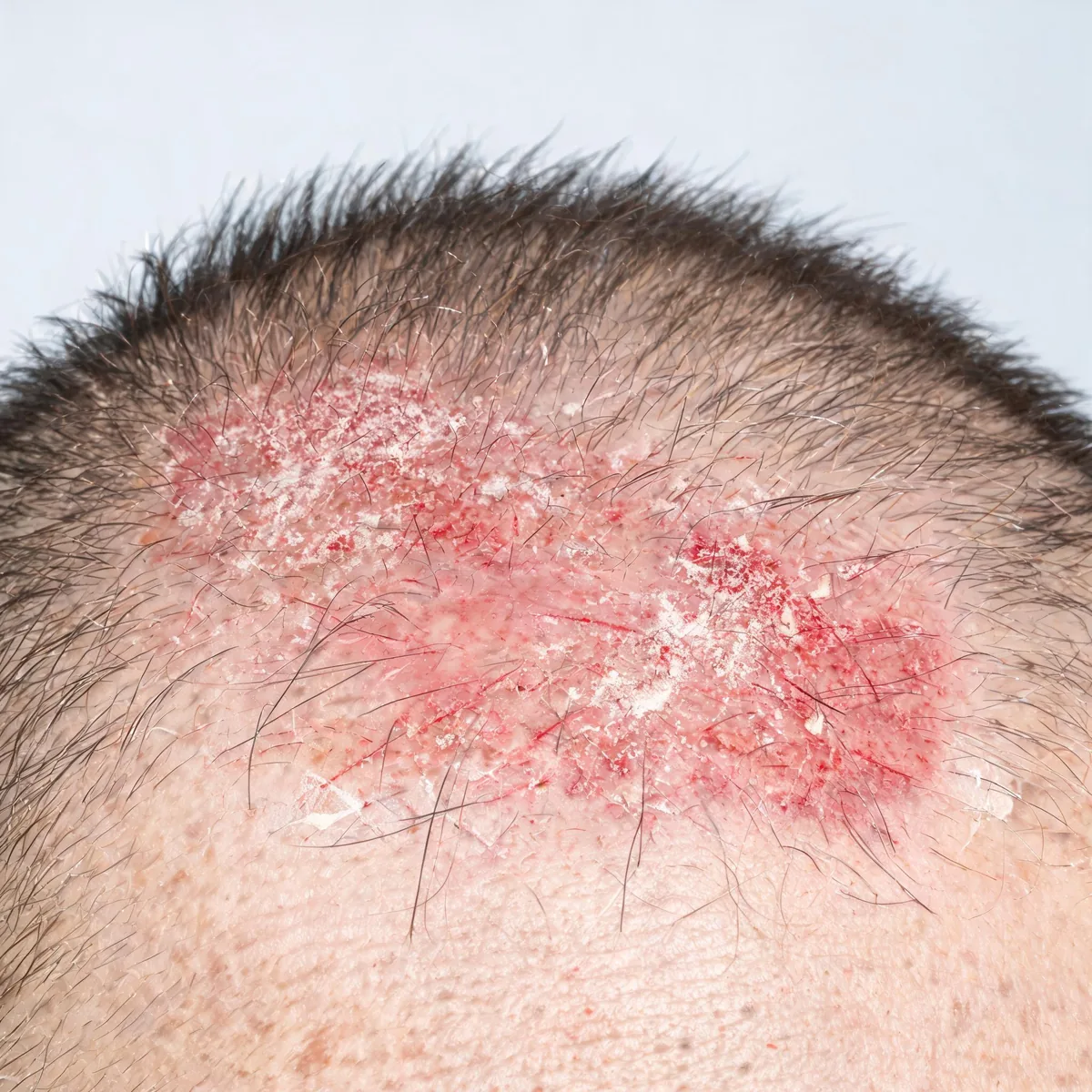
Understanding Itchy scalp
The tradition describes the scalp as the highest part of the body, where imbalance rises like steam from a pot, and links the sensation of itch almost always to Wind.
That Wind need not come from outside. It can be stirred internally by Heat in the Blood, by damp heat along the Liver channel, by Liver Blood deficiency leaving the skin undernourished, or by Liver Qi stagnation turning into heat.
Heat in the Blood gives scalp redness with intense itch, dry scaling or small red papules, worse with heat, alcohol or spice. Damp-Heat in the Liver channel gives an oily sticky scalp with itch and possible yellowish crusts, a bitter taste and dark urine.
Liver Wind from Blood deficiency gives a dry shifting itch with no redness or oiliness, plus dizziness, pale complexion, brittle ridged nails and poor sleep. Stress-triggered itch with irritability and rib-side distension is Liver Qi stagnation transforming into heat.
In Chinese medicine the scalp sits at the highest point of the body, the place where disturbance tends to gather and rise. Almost every scalp itch is filed under Wind, yet that Wind is rarely weather. It is stirred from within by heat held in the Blood, by dampness and heat carried up from the Liver, or by Blood that has grown too thin to feed the skin. Each route produces a different itch, so each asks for a different strategy.
The Liver shapes most of these pictures because its channel climbs to the crown. When rich food, alcohol and long strain leave the Liver loaded with dampness and heat, the itch turns greasy and persistent and the scalp coats itself with oil. When Liver Blood runs low the surface dries, flakes, and a faint crawling Wind wanders across it. Heat in the Blood has a third signature, coming from hot spices, fried food or held frustration, which redden and inflame the scalp so that a hot shower or a glass of wine sets it burning.
Because the origins differ, treatment differs. One person needs the Blood cooled, another needs dampness drained and Liver fire cleared, and a third needs Blood rebuilt until Wind has something to hold. Tongue and pulse separate the three, and classical writers described the scaling type long ago as white scaling wind, a pattern in which wind lodges in the pores, turns to heat and leaves the Blood too dry to settle. Reading the whole picture rather than the itch alone is what decides the formula.
Conventional view
Western medicine treats an itchy scalp as a skin problem to be identified. Seborrhoeic dermatitis, ordinary dandruff, psoriasis, a fungal infection or a reaction to a hair product are the usual explanations, and the scalp is examined for scaling, grease and inflammation. A scraping may be taken when fungus or bacteria is suspected, and the diagnosis rests on what the skin looks like rather than on the itch itself.
Standard care begins with a medicated shampoo containing ketoconazole, coal tar, selenium sulfide or salicylic acid to cut scaling and calm inflammation. A topical corticosteroid lotion or solution is added for a flare, antihistamines help when the itch is severe, and oral antifungals or systemic drugs are reserved for cases that do not respond. Most people get relief while they keep using the product.
The limit is that relief usually lasts only as long as the treatment. Itch commonly returns when the shampoo or cream is stopped, and years of topical steroids leave the skin thinner. The method also never separates heat from dampness or from deficiency, so the tendency behind the itch is left untouched. This is the gap the pattern approach is meant to fill.
Selected PubMed records
Real PubMed records for the conventional discussion above, selected by condition name and title relevance. They are references, not a claim that any treatment is proven for this condition.
- The itchy scalp--scratching for an explanation.. Experimental dermatology, 2011. PMID: 22092575.
- Itching for an answer: A review of potential mechanisms of scalp itch in psoriasis.. Experimental dermatology, 2019. PMID: 31022307.
How it connects
Scalp itch seldom travels alone. When damp heat sits in the Liver and Gallbladder, the same turbid heat often shows as acne, a bitter or sticky taste and an oily scalp, and all of them ease once the Liver has been cooled and drained. Blood Deficiency that leaves the scalp dry also starves the hair follicles, so patchy loss or alopecia areata can appear alongside it, with pale brittle nails and dizziness. Where constraint is the root, anxiety, chest tightness and irritability arrive with the itch, and freeing the Qi settles mood and scalp together.
How it is assessed
The practitioner looks at the scalp condition under the itch and asks what triggers it.
What a practitioner looks for
- Redness and papules: redness suggests Heat in the Blood; no redness with dryness suggests deficiency.
- Oiliness: an oily sticky scalp with crusts suggests Damp-Heat in the Liver channel.
- Timing and triggers: stress-triggered itch suggests Liver Qi stagnation; night itch suggests Blood deficiency.
- Constitutional signs: dizziness and brittle nails support Blood deficiency.
A consultation starts with the state of the skin itself. Flakes, redness and a flush that arrives after wine or a hot curry point first to Heat in the Blood, the most acute of the four pictures. The tongue is red under a thin yellow coating, while the pulse runs fast, sometimes floating, which tells the practitioner that excess heat is driving Wind upward. Where the scalp instead feels oily and sticky, with yellow crusts or a little weeping, the reading shifts to Damp-Heat in the Liver Channel. A thick greasy yellow coating, a slippery rapid pulse, a bitter taste and fullness in the chest all fit turbid heat travelling the Liver pathway.
Long-standing dryness with fine white flakes and hardly any redness suggests the opposite problem. Liver Wind raised by Blood Deficiency tends to arrive slowly, often in older people or after years of strain, and it brings dizziness, dry eyes and broken sleep. Here the tongue looks pale, or red with scanty coating, and the pulse runs thin and fast. Itch that keeps time with frustration, sighing and rib-side distension completes the set, marking Liver Qi Stagnation that has turned to Heat, with a wiry rapid pulse. Mixed pictures are common, and the practitioner weighs which element leads before choosing a formula.
TCM patterns in Itchy scalp
Four patterns account for most scalp itch, and the quickest way to tell them apart is the skin itself. Redness with heat, and a flush after alcohol, spice or a hot shower, belongs to Heat in the Blood. Oiliness, sticky crusts and a bitter taste belong to Damp-Heat in the Liver Channel. Dryness with flakes, no oil and a shifting, crawling itch belongs to Wind raised by Liver Blood Deficiency. Itch that follows anger and eases with calm belongs to Liver Qi Stagnation that has turned into Heat. The tongue coating refines each picture: a red body under a thin yellow coat for Blood Heat, a thick greasy coat for Damp-Heat, scanty coating on a pale thin body for Blood Deficiency, and a thin yellow coat with a wiry pulse for stagnation. Excess patterns flare and settle quickly, while the deficiency pattern builds slowly. Menstruation, blood loss and diet often decide which element dominates.
| Pattern | Key signs | The itch | Tongue | Main formula |
|---|---|---|---|---|
| Heat in the Blood | Dry scaling or small red papules | Scalp redness and intense itching | Body: Deep red, often with red points or pricklesCoat: Thin, yellow and dry | Not specified |
| Damp-Heat in the Liver Channel | Possible yellowish crusts | Oily sticky scalp with itch | Body: Red, with redder sides and edgesCoat: Yellow and greasy, thicker at the centre and root | Not specified |
| Liver Wind agitating Internally due to Liver Blood Deficiency | Worse with tiredness | Dry shifting scalp itch without redness or oiliness | Body: Pale and thin, sometimes tremblingCoat: Thin white | Not specified |
| Liver Qi Stagnation that transforms into Heat | Distending pain in the ribcage | Itching worsens with emotional stress or anger | Body: Red, with the sides redder than the centreCoat: Yellow | Not specified |
Heat in the Blood
Red scalp with intense itch and heat sensitivity.
Heat that settles in the Blood does not stay quiet. It stirs the Blood into faster movement, and that movement throws up internal Wind, which climbs to the scalp. The same heat dries the fluids that should keep the surface soft, so scales form and small red papules appear where the skin has been strained. Scratching brings relief for a moment and often a little blood, because the vessels beneath are already hot and full.
The tongue is red, sometimes with raised red points, under a thin yellow dry coat, and the pulse is rapid, often wiry or slippery. Alcohol, chilli, fried food, saunas and hot showers all add fuel, and so does held anger, which heats the Liver. Cooling food such as cucumber and pear, lukewarm washing and quiet rest calm it. Xiao Feng San is the formula usually chosen, clearing heat and dispelling Wind, and the points named for this pattern are GB-20 Fengchi, LI-4 Hegu, LI-11 Quchi and SP-10 Xuehai.
Signs
- Scalp redness and intense itching
- Dry scaling or small red papules
- Worse with heat, alcohol or spicy food
- Body heat worse at night
- Thirst for cool drinks
Diet and lifestyle for this pattern: Avoid spicy, greasy and fried food as well as alcohol and coffee, which add Heat. Eat more cooling food such as cucumber, pear and mung beans, keep the scalp clean with a mild non-irritating shampoo and avoid very hot water, and gentle scalp massage helps while aggressive scratching does not.
Damp-Heat in the Liver Channel
Oily sticky scalp with crusts and a bitter taste.
Dampness is heavy and heat rises, and together they behave like steam in a closed room. Rich food, alcohol and sustained pressure on the Liver load it with both, and the channel carries the mixture to the crown. The scalp answers by turning oily and sticky, crusting yellow near the hairline and itching in a way that lingers rather than flares. Humid weather and a heavy meal make it worse, because both add to the dampness already lodged in the channels.
A red tongue with redder sides and a yellow greasy coat, thickest at the centre and root, is the expected finding, with a pulse that is wiry, slippery and rapid at once. Coffee, fried meals, stuffy weather and unexpressed anger aggravate it, while cool dry air, bitter greens, lighter meals and steady gentle exercise ease it. Long Dan Xie Gan Tang drains Liver fire and clears the channel, and the points used are LR-3 Taichong, GB-20 Fengchi, SP-9 Yinlingquan and ST-36 Zusanli.
Signs
- Oily sticky scalp with itch
- Possible yellowish crusts
- Bitter taste in the mouth
- Dark scanty urine
- Heaviness in the body
Diet and lifestyle for this pattern: Cut back on fried, greasy and sugary food as well as alcohol and coffee, which feed Damp-Heat. Eat more cooling, bitter greens such as dandelion leaves, celery and cucumber, favour lightly cooked meals, keep the scalp clean and dry, and avoid heavy occlusive hair products that trap Heat and moisture.
Liver Wind agitating Internally due to Liver Blood Deficiency
Dry shifting itch without redness, with a deficient picture.
Blood is what keeps Wind still. When Liver Blood has been low for a long time, through overwork, poor food, heavy periods or years of strain, the scalp loses its moisture and the unanchored Wind begins to move. The itch that follows is dry and shifting, hard to place and sometimes described as crawling, and it is far less fiery than the excess patterns. Fatigue and blood loss make it worse, which is why it often arrives after a period or a run of late nights.
Expect a pale, thin tongue, sometimes trembling, with a thin white coat, and a pulse that is fine and wiry. Overwork, stress, drying spices and hot dry weather all consume what little Blood remains, while sleep, calm, black sesame, dark greens and a weekly warm oil scalp massage help rebuild it. Dang Gui Yin Zi nourishes Blood, moistens dryness and settles Wind, and the points chosen are LR-3 Taichong, SP-6 Sanyinjiao, BL-18 Ganshu, ST-36 Zusanli and DU-20 Baihui.
Signs
- Dry shifting scalp itch without redness or oiliness
- Dizziness or light-headedness
- Pale complexion with brittle ridged nails
- Poor sleep with frequent waking
- Worse with tiredness
Diet and lifestyle for this pattern: Build Blood with dark leafy greens, red dates, black sesame, eggs and small amounts of liver if you eat meat, and avoid spicy, fried and drying food that consumes Yin. Protect sleep, since Blood regenerates at night, keep movement gentle such as tai chi or walking, and a weekly warm-oil scalp massage soothes local dryness.
Liver Qi Stagnation that transforms into Heat
Itch that flares with stress and anger.
Anger that is held in rather than expressed knots the flow of Liver Qi. A knot that lasts long enough generates heat, and heat looks for a way out, so it climbs the Liver channel and reaches the head. The scalp registers the pressure as itch, and the itch keeps the same timetable as the mood, arriving with frustration and easing when the person relaxes. Distension in the ribcage and a bitter taste are the other signs that Qi is stuck rather than simply low.
The tongue body is red, its sides redder, the coat thin and yellow; the pulse is wiry and rapid. Spice, alcohol and hot weather add heat to a system that is already heated, while stress relief, a cool room, gentle exercise and bitter foods such as dandelion greens relieve it. Jia Wei Xiao Yao San courses the Liver, clears the heat and supports the Blood at the same time, and the points named are LR-3 Taichong, LR-2 Xingjian and GB-20 Fengchi.
Signs
- Itching worsens with emotional stress or anger
- Irritability and explosive anger
- Distending pain in the ribcage
- Bitter taste in the mouth
Diet and lifestyle for this pattern: Manage stress with meditation, yoga or regular gentle exercise, and avoid spicy, greasy and fried food that adds Heat. Eat more cooling vegetables such as cucumber and celery, and keep the scalp clean with mild shampoo.
Treatment approach
How the tradition treats itchy scalp, with the herbs, formulas and points used for it.
Principles
- Settle Wind, which the framework identifies as the mechanism of itch.
- Cool the Blood where the scalp is red and hot.
- Drain damp heat where the scalp is oily and crusted.
- Nourish Liver Blood where the itch is dry and shifting, and address stress where it flares with emotion.
- The branch is Wind and the root is whatever raised it, so every plan settles the scalp while treating the source. Blood Heat is cooled, Damp-Heat is drained, Blood Deficiency is rebuilt, and constrained Liver Qi is coursed before heat is cleared, with formulas adjusted when two patterns run together.
Herbs used
Formulas
Acupoints
- GB-20 (Fengchi)
- LI-4 (Hegu)
- LI-11 (Quchi)
- SP-10 (Xuehai)
- LR-3 (Taichong)
- SP-9 (Yinlingquan)
- ST-36 (Zusanli)
- SP-6 (Sanyinjiao)
- BL-18 (Ganshu)
- DU-20 (Baihui)
- LR-2 (Xingjian)
What to expect
- Acute heat or damp patterns are described as settling within weeks.
- Blood deficiency itch takes longer, with gradual improvement as the Blood is nourished.
- Recurrence follows stress and diet unless the pattern is addressed.
- Excess pictures such as Blood Heat and Damp-Heat usually ease within two to four weeks of herbs and weekly acupuncture, while a deficiency picture needs six to twelve weeks or longer. The itch commonly lifts before the redness and scaling go, and a flare with stress, alcohol or a dry season is expected along the way rather than a sign of failure. Once the scalp has settled, occasional treatment at a change of season helps hold the gain.
Safety and when to get help
Seek medical help urgently for
- Sudden severe swelling of the scalp or face.
- Oozing pus, yellowish crusts or a foul smell from the scalp.
- Rapid hair loss with scalp inflammation.
For anything severe, sudden or spreading quickly, read when a skin problem needs urgent care.
Cautions
- Do not scratch persistently; broken skin invites infection.
- Persistent itch needs review for fungal infection or other causes.
- Strong medicated shampoos can irritate; use as directed.
Using this alongside conventional care
- TCM is described as complementary to conventional care: medicated shampoo or prescribed topical treatment can continue alongside herbs.
- Medicated shampoo, steroid solutions and antihistamines can continue while herbs are taken, and most people do not need to choose between the two approaches. The practitioner should know about every product and oral drug in use, because herbs that move Blood, including Dang Gui and Chuan Xiong, may add a mild effect to blood thinners or immunosuppressants. Topical treatment that is working is tapered with medical advice rather than stopped abruptly.
Diet and lifestyle
- Reduce spicy food, alcohol, deep-fried food and excess sugar, and favour cooling light food.
- The general rule is to remove what feeds heat and dampness and add what cools and nourishes. Spicy dishes, alcohol, deep-fried food and too much sugar go first, replaced by cucumber, pear, celery and leafy greens, with black sesame, goji berries and dark greens added when the scalp is dry and flaky. Regular, unhurried meals matter as much as the ingredients, because a settled Spleen makes clean Blood instead of dampness. For the oily pattern, bitter greens and lighter cooking help; for the dry pattern, a warm oil massage and blood-building food do more.
If you're pregnant
Hormonal change in pregnancy often pushes Heat in the Blood or Damp-Heat further, so the itch can be stronger than usual. Many cooling and damp-draining herbs are avoided because they may stimulate the uterus or affect the foetus, and Long Dan Xie Gan Tang, which holds Mu Tong and Chai Hu, is not used at all. Xiao Feng San, containing Ku Shen and Jing Jie, needs modification by a practitioner. Acupuncture and external rinses come first, using points such as GB-20 Fengchi, while LI-4 Hegu is traditionally avoided in pregnancy. A rinse made from Bai Xian Pi, Ku Shen and She Chuang Zi cools the scalp without much absorption. When Blood Deficiency dominates, a version of Dang Gui Yin Zi with less Dang Gui may be considered under close supervision.
If you're breastfeeding
Herbs of a bitter cold nature, which clear heat and dry dampness, can pass into milk and may loosen an infant's stools or upset the digestion, which is why Long Dan Xie Gan Tang is avoided while feeding. Xiao Feng San, if used at all, is prescribed cautiously and the baby watched for diarrhoea or rash. Milder blood-nourishing formulas such as Dang Gui Yin Zi are generally preferred because they support Blood and calm Wind without harsh cold. Acupuncture and external rinses remain safe, and the mother may need to drop greasy, spicy and heating food that feeds Damp-Heat.
If treating a child
In children the itch is more often Damp-Heat or a simple invasion of Wind-Heat, sometimes with food stagnation adding internal dampness. A child's Spleen is immature and collects dampness easily, which can steam upward and leave the scalp oily and itchy. Damp-Heat in the Liver Channel is less frequent at this age and Blood Deficiency is rare unless there is chronic illness. Observation of scalp, tongue and behaviour carries more weight than description, doses run from a quarter to a half of the adult amount, and external washes with Ku Shen or Ju Hua are preferred. Acupressure or paediatric tui na replaces needles.
If treating an elderly patient
A long-standing itch in later life usually comes from Liver Blood Deficiency raising internal Wind. The scalp turns dry, thin and flaky, and the itch is low grade, worse with tiredness and better after rest. Reserves are smaller, so treatment is gentle and nourishing rather than strongly clearing, and Dang Gui Yin Zi suits many people at about two-thirds of the usual adult dose over a longer course. Polypharmacy needs checking, and acupuncture is a useful adjunct with no drug interaction. Zusanli ST-36 and Sanyinjiao SP-6 both support Blood, while Fengchi GB-20 calms local itch.
Urgent-sign guidance is based on standard sources: NHS anaphylaxis, NHS cellulitis, NHS Stevens-Johnson syndrome, NHS melanoma.
Evidence
Evidence status
Compiled for this page from the classical and modern literature; not a systematic review, so treat it as a pointer to sources rather than clinical guidance.
Evidence is developing and small: most studies concern seborrhoeic dermatitis or scalp pruritus in single-centre Chinese trials. Xiao Feng San and Long Dan Xie Gan Tang show promise for itch, scaling and oiliness, but large double-blind placebo-controlled trials are lacking. Acupuncture for scalp itch appears in case series and pilot studies reporting reduced intensity and frequency, with mechanisms proposed rather than proven.
A fuller reading of the source record shows a thin evidence base. Most trials look at seborrhoeic dermatitis or scalp pruritus, are small and single-centre, and appear in Chinese-language journals. Xiao Feng San has shown promise for itch and scaling, and Long Dan Xie Gan Tang for oiliness and crusting, but no large double-blind placebo-controlled trial supports either. Acupuncture appears in pilot studies and case series, which report falls in itch intensity and frequency, and the mechanism offered is altered blood flow in the skin and the neural pathways of itch rather than a proven one. Larger and better controlled research is still needed.
Studies often cited
Promise for reducing itching, scaling and oiliness in small Chinese trials. Chinese clinical trials (as recorded in the source)
Case series and pilot studies report reduced itch intensity and frequency. Case series and pilot studies (as recorded in the source)
Classical record
Oil wind is due to damp-heat in the Liver channel steaming upward; the scalp becomes oily and itchy, scratching produces white scales, and in severe cases the hair falls out.
- Wai Ke Zheng Zong (Orthodox Manual of External Medicine), Volume 4, On Oil Wind. The Chinese original is not reproduced here: it could not be recovered reliably from the source record, and is not guessed.
白屑风者,由风邪侵入毛孔,郁久化热,血燥生风,风热相搏,故头皮瘙痒,白屑纷飞。
White scaling wind arises when wind evil enters the pores, stagnates until it turns to heat, dries the blood and engenders wind; wind and heat clash, so the scalp itches and white scales fly.
Zhu Bing Yuan Hou Lun, Volume 27, On White Scaling Wind - Classical citation: which quotes it in the understanding section of the source page.
Common questions
Why does my scalp itch more when I am stressed?
Stress-triggered itch is described as Liver Qi stagnation transforming into heat, which is why the emotion and the itch arrive together.
Can dandruff cause the itch?
They often coexist. Greasy yellowish flakes with itch suggest Damp-Heat; dry white flakes with night itch suggest Blood deficiency.
Is itchy scalp a sign of hair loss?
Persistent itch with inflammation can accompany hair shedding. That combination needs medical review.
When should I seek care?
For spreading swelling, pus, foul smell, fever, or rapid hair loss with scalp inflammation.
How long does acupuncture take to calm the itch?
Many people feel the scalp quieter after the first session, but lasting change needs a course. Heat-driven itch often responds to three to five weekly sessions, while chronic or deficiency-based itch may need eight to twelve before the cycle breaks. The practitioner adjusts frequency as the scalp settles.
Can I keep using my medicated shampoo?
Yes, in most cases the shampoo can continue alongside herbs. No direct interaction is recorded between antifungal or anti-dandruff shampoos and the formulas used for scalp itch. Mention what you use, and avoid applying a strong steroid cream just before acupuncture on the scalp.
Can I make a herbal rinse at home?
A wash prepared at home can soothe the scalp between treatments. Cooling, itch-relieving herbs such as Ku Shen and Bai Xian Pi are boiled, left to cool and used as a final rinse after shampooing. The right combination depends on the pattern, so ask a practitioner rather than following a single recipe.