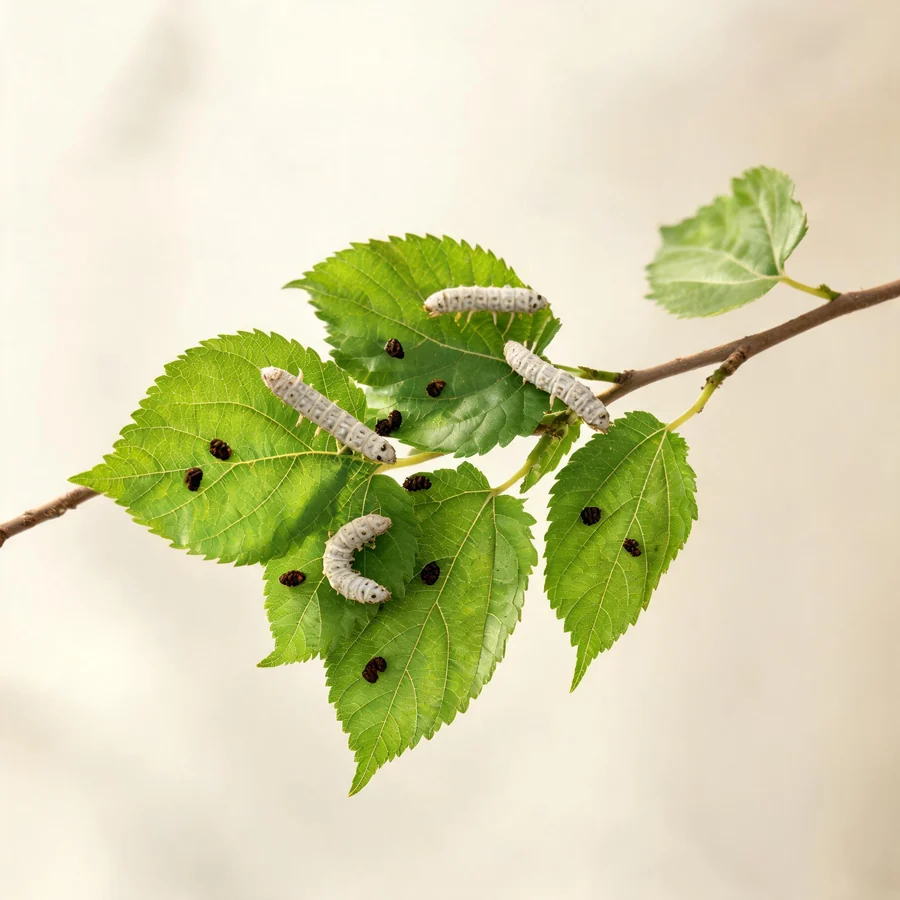
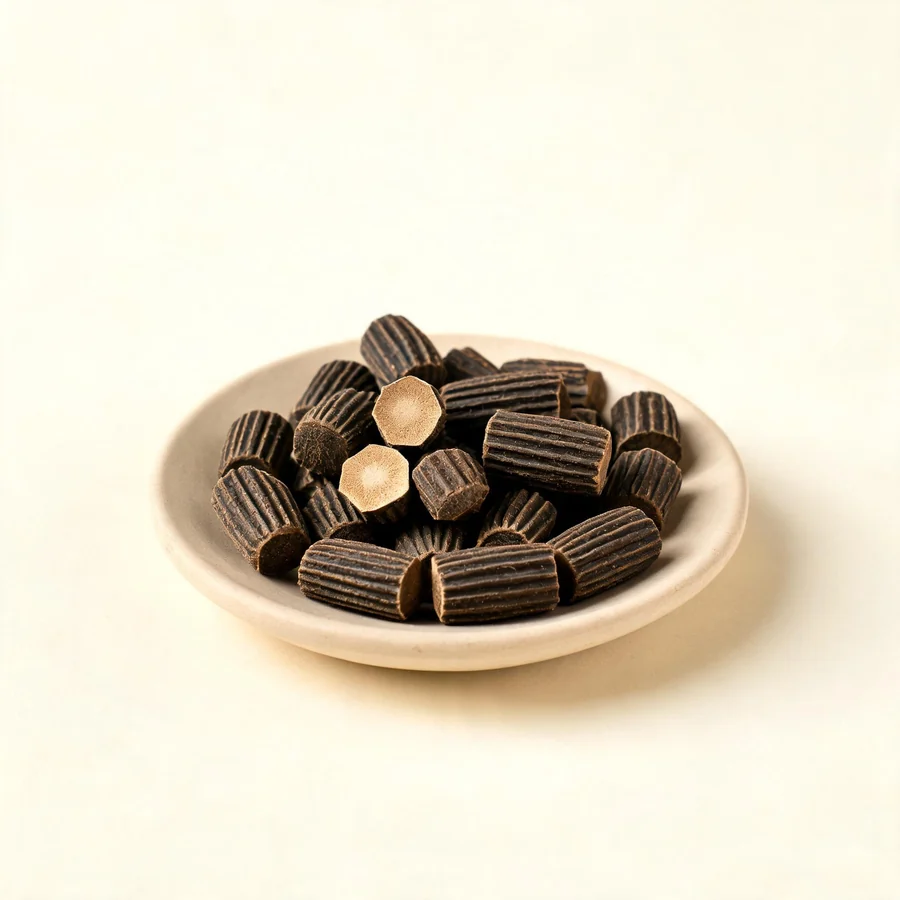
Skin profile
Where this herb sits in skin practice: the pattern it corrects, the skin signs it suits, and what it should not be used for.
Can Sha suits the weather-sensitive, itchy, swollen skin that comes with a heavy body and a coated tongue. It is warm and mild, so it is chosen for the subacute, damp phase rather than a hot acute eruption, and it is as often used as a wash as a decoction.
Skin signs that suggest it
- Itchy wheals or a raised red rash that moves around and flares in damp, humid weather
- Swelling of the skin with a heavy, tight feeling, worst on the limbs and in the folds
- Weeping or macerated patches with a sticky discharge and a greasy tongue coating
- Aching, heavy limbs alongside the skin flare, worse before rain and better in dry warmth
- A swollen tongue with a greasy white or yellow coat and a slippery pulse
When it is not the right herb
Not for skin that is dry, thin and hot without dampness: the warm, drying action adds to the dryness and can make itch worse. Not for blood-deficiency numbness or wasting, where the limbs are undernourished rather than obstructed, and not for a rash that is bright red, febrile and spreading quickly, which needs cooling rather than warming. Anyone with a known allergy to silk or silkworm material should avoid it completely, in a wash as much as in a decoction, and mouldy or badly stored material should never be used.
What it does for skin
Skin-relevant actions only. Each one describes a mechanism in TCM terms and what it looks like on the skin.
Disperses Wind-Dampness from the surface
The core action on the skin. Wind-Dampness shows as itch that moves, swelling that pits a little, and a rash that is worse in humid weather. The warm, acrid quality opens the surface and moves the dampness out, so the itch quietens and the swelling softens together. It is a gentle medicine, chosen for the subacute, weather-sensitive phase rather than for an acute hot eruption.
Dries the dampness that keeps a lesion weeping
Where a fold is macerated or a patch oozes a sticky discharge, Can Sha reduces the moisture that keeps the skin sodden. It is not a bitter cold drainer like Huang Qin, so it suits dampness with a cold or neutral picture better than damp-heat with strong redness. The drying is mild, which is why it can be used in a wash for a large area without stripping the skin.
Settles the middle so dampness is not remade
Dampness on the skin usually has a source in the Spleen and Stomach. The medicine harmonises the middle and transforms turbid dampness, so the heavy body, the greasy coating and the loose stool that accompany a flare begin to settle. In skin practice this is the difference between suppressing an itch and changing the ground it grows in, and it is the reason the medicine is paired with Spleen herbs rather than used alone.
Relieves swelling and itch in a wash or warm pack
The material has a long external tradition: boiled, strained and used as a wash, or stir-fried warm and sealed in cloth to lay over a swollen, itchy patch. The warmth carries the dispersing action into the surface and the drying action takes the moisture away. Cleanliness and a patch test matter more with dung than with a leaf or a root.
Skin conditions it is used for
Mapped to the condition pages on this site. The pattern column shows what the skin is doing when this herb is the right choice.
| Condition | Pattern | Why it suits | Typical setting |
|---|---|---|---|
| Urticaria | Wind-Dampness with itchy, migrating wheals | Wheals that move from place to place and flare in humid weather are the classic wind-damp picture. Can Sha is the warm, mild choice for the subacute phase, when the skin is swollen and itchy but not hot and angry, and it is combined with wind-releasing herbs that carry the action to the surface. A wheal that is bright red, burning and provoked by heat needs a cooling approach instead. | With Fang Feng and Jing Jie in a wind-damp formula, or as a cooled wash |
| Chronic urticaria | Dampness and Wind lodged in the surface with a heavy body | When wheals recur for months, the pattern is rarely a simple surface wind. Can Sha is used where the attacks come with heaviness, a greasy coating and a flare in damp weather, which points to dampness holding the wind in place. It is a supporting medicine that dries the dampness and moves the wind, and it is given with Spleen-supporting herbs so the dampness has less chance to re-form between attacks. | With Bai Zhu and Fang Feng, or in a modified dampness formula |
| Damp itch | Itch with swelling and moisture, worse in humidity | Itch that comes with a puffy, slightly moist skin and a heavy feeling is damp itch rather than dry itch. The medicine addresses the dampness behind it, and its warmth is mild enough not to provoke a flare. It is used in a formula with itch-quieting herbs and, for limited areas, as a wash. Itch in dry, thin, cold skin is a different pattern, and warming and drying would make that worse. | With Ku Shen and Bai Xian Pi for a damp itch, or as a dilute wash |
| Swelling of the skin | Dampness and Wind in the flesh | The classical record names swelling of the skin among its indications, and the reasoning is the same as for the joints: dampness and wind lodged in the flesh produce a heavy, tight, poorly defined swelling. It is a mild medicine for a mild, subacute picture, and it is combined with herbs that move the surface and drain downward. A hot, red, rapidly spreading swelling is infection and needs assessment, not a warm wash. | With Yi Yi Ren and Fang Feng, or as a warm compress |
| Weather-sensitive rashes | Wind-Dampness with a migrating, itchy rash | A rash that shifts position, itches more in damp weather and leaves the skin slightly swollen is read as wind-damp on the surface. Can Sha disperses that, and its digestive action is an advantage when the rash arrives with a heavy body and a coated tongue. It is a supporting medicine rather than the lead, and it suits the lingering phase after the acute redness has gone. | With Jing Jie, Fang Feng and Bai Xian Pi |
Combinations for skin
Herbs it is paired with when the skin, not an internal organ, is the target.
| Partner | Ratio | Why the pair is used |
|---|---|---|
| Fang Feng | 10 g each in decoction | Fang Feng releases Wind from the surface and Can Sha dries the Dampness that holds it there. Together they suit an itchy, migrating rash with swelling, especially when it flares in humid weather. The pair is warm and mildly dispersing, so it is chosen for skin that is not hot and angry; a bright red, burning eruption needs cooling herbs instead. |
| Yi Yi Ren | 15 g Can Sha with 20 g Yi Yi Ren | A dampness pair. The grain drains fluid downward through the urine and the droppings dry and disperse it at the surface, so a weeping, puffy rash on the legs is worked from both directions. It is also the pair used when the skin flare comes with loose stools and a heavy body. Both are mild, so both are given at the upper end of their range. |
| Bai Zhu | 10 g each | Bai Zhu strengthens the Spleen that keeps producing dampness, while Can Sha clears what has already gathered. The pair is chosen when a damp skin flare sits on poor digestion, a pale tongue and a tendency to loose stools. The warming quality of both suits a cold-damp picture, and the combination treats the skin without cooling the digestion. |
| Ku Shen | 10 g Can Sha with 6 to 10 g Ku Shen | An unusual pairing of temperatures: Ku Shen is bitter and cold and dries damp-heat strongly, while Can Sha is warm and mild. It is used where a rash is both itchy and weeping but the person cannot tolerate much cold, with the cold herb kept at the lower end of its range. The result drains the moisture without chilling the digestion. |
Topical use
Can Sha is used externally as a wash and as a warm cloth pack. The material is boiled, strained and either cooled for a wash or stir-fried and sealed in cloth while still warm. Both preparations come from the same traditional practice of driving Wind-Dampness out of the surface, and both are limited to intact skin.
| Preparation | How and when it is used |
|---|---|
| Decoction wash | 15 to 30 g of the dried material, tied in gauze, simmered in 1 litre of water for 20 minutes. Strain, cool to a comfortable temperature and pour over or bathe the affected area for 10 minutes once or twice daily. Discard the wash after use and do not share the bowl. |
| Warm cloth pack | The dried material is stir-fried until warm, sealed in a clean cloth bag and laid over a swollen, itchy limb or a macerated fold. Test the temperature on the inner wrist first, lift the pack every few minutes and stop if the skin becomes more red or more itchy. |
| In a formula bath | A gauze bundle of Can Sha is added to a warm bath with other wind-damp herbs for widespread itch. The bath is kept short, the skin is patted dry rather than rubbed, and the material is never reused. This is a comfort measure for intact skin, not a treatment for an infected lesion. |
Patch test and cautions
Patch test on a small area of normal skin for 24 hours before first use. Do not apply to broken, ulcerated or infected skin, to the face or near the eyes, and do not cover a warm pack with plastic or a dressing. Stop at once if burning, spreading redness or a new rash appears. Because the material is animal dung, use only clean, dry, properly stored stock and discard anything musty or contaminated.
Safety for skin use
What to check before recommending or using it, including the cautions that matter most for skin patients.
Do not use, or use with caution
- Dry, thin or hot skin without dampness. The medicine is warm and drying, and in a dry eczema or an ichthyotic skin it removes moisture that is already short and can increase itch and cracking.
- Blood-deficiency numbness or weakness of the limbs. The classical caution is explicit: when numbness comes from undernourished channels rather than from obstruction, a wind-damp medicine treats the wrong cause.
- Known allergy to silk, silkworm or insect material. Some silkworm protein persists in the droppings, and a reaction can follow a wash as well as a decoction.
- Mouldy, damp or contaminated material. The droppings are an animal by-product and support mould; no amount of boiling makes a bad lot safe.
Pregnancy and breastfeeding
Use only with practitioner supervision and preferably not at all. The medicine has a recorded blood-moving use for absent periods, and that action is the reason for caution in pregnancy, although it is not among the strongly forbidden blood-breaking medicines. The external wash is the lower-risk form, but it is still not a routine measure on the abdomen or lower back. During breastfeeding there are no safety data, and the possibility of allergenic silkworm protein passing into milk is theoretical but unstudied.
Interactions
- Anticoagulants and antiplatelet drugs. In the laboratory, water extracts slowed the clotting of human fibrinogen, so warfarin, heparin, aspirin and clopidogrel are a reason for disclosure rather than for panic. Nothing has been measured in patients.
- No other pharmaceutical interaction is well documented. That means the evidence is missing, not that the combination is safe, and anyone taking several medicines or one with a narrow margin should mention the medicine to the prescriber.
Allergy and patch testing
Silkworm allergy is the specific risk. People sensitised to silk, to silkworm larvae or to insect material may react to the droppings, and the reaction can be local or general. Patch test before a wash, keep the first application small and short, and stop if the skin burns or swells. Asthma or hay fever with a known insect sensitivity is a reason for extra care, and a first use in a child should be supervised.
General safety references
General references for herbal hepatotoxicity and herb-drug interactions; they are not specific to this herb.
- Review article: Herbal hepatotoxicity - an update on traditional Chinese medicine preparations. Alimentary Pharmacology & Therapeutics, 2014. PMID: 24844799.
- Interactions between herbal medicines and prescribed drugs: an updated systematic review. Drugs, 2009. PMID: 19719333.
- Warfarin and food, herbal or dietary supplement interactions: a systematic review. British Journal of Clinical Pharmacology, 2021. PMID: 32478963.
Evidence
The classical record is quoted with its source. The modern note states the level of evidence plainly.
Classical record
主肠鸣,热中消渴,风痹,瘾疹。
It treats rumbling in the intestines, heat in the middle with wasting and thirst, wind painful obstruction, and hidden rashes.
Ming Yi Bie Lu (Supplement to the Classic of Materia Medica) - Hidden rashes are named in the oldest surviving entry, so the skin use is not a later addition to a joint medicine.
蚕性燥,燥能胜风去湿,故蚕沙主疗风湿之病。
The silkworm is dry by nature, and dryness overcomes Wind and removes Dampness, which is why the droppings treat Wind-Dampness disease.
Ben Cao Gang Mu (Compendium of Materia Medica), Li Shizhen - Li Shizhen argues from the nature of the source animal, and the sentence became the standard explanation of the drying action.
治风湿遏伏于脾家,筋骨疼痛,皮肤发肿,腰腿疼痛,血瘀血少,痘科浆靥不起。
It treats Wind-Dampness held in the Spleen, pain in the sinews and bones, swelling of the skin, lumbar and leg pain, blood stasis with scanty blood, and pox that fails to come out.
Ben Cao Zai Xin (Materia Medica Renewed) - The list is the widest attached to the material and includes swelling of the skin, the external use that survives in washes.
Modern evidence
Evidence status
- No clinical trial of Can Sha in skin disease was found for this page. The skin uses rest on the traditional record and on clinical observation, not on controlled evidence, and no claim of proven benefit is made here.
- Laboratory work on chlorophyll derivatives from the material has been reported, including an oral tolerated dose in mice above 6,600 mg per kg. That is a toxicology finding in animals and says nothing about itch, swelling or any other skin outcome in people.
- The chemistry of the material is ordinary: partly digested mulberry leaf with chlorophyll, protein, flavonoids and minerals. That composition explains why it is treated as a mild medicine, and it also explains why contamination and mould, rather than potency, are the practical quality problems.
PubMed records
Selected real PubMed records for this herb's species or its constituents, chosen by species name and title relevance. They are references for the non-TCM discussion above, not proof that the herb treats any skin condition.
- Bombyx mori derived scaffolds and their use in cartilage regeneration: a systematic review.. Osteoarthritis and cartilage, 2018. PMID: 30059787 (pharmacology or review record).
- Regulation of Bombyx mori-BmNPV Protein Interactions: Study Strategies and Molecular Mechanisms.. Viruses, 2025. PMID: 40733633 (safety record).
Dose and forms
Skin-practice dosing and the preparations that suit skin complaints.
| Form | Dose and notes |
|---|---|
| Decoction | 5 to 15 g daily. Tie the material in gauze first, since the fine particles make the liquid cloudy and hard to strain. For skin complaints 10 to 15 g is the usual weight, and the decoction is taken in two doses. |
| Wash or compress | 15 to 30 g simmered in 1 litre of water, strained and used cooled as a wash or warm as a pack, once or twice daily on intact skin. The external amount is not counted against the internal one. |
| Course length | Short courses of one to three weeks, reviewed as the skin settles. The medicine is drying and is not a maintenance treatment, and a flare that does not improve needs a diagnosis rather than a longer course. |
The weight matters less than the form. A decoction for a damp, itchy skin is given in the middle of the range, while a wash can be made stronger because it is not swallowed. Buy clean, dry, uniform pellets and discard anything musty. It is wrapped before decocting, both to keep the liquid clear and to stop the fine particles from irritating the throat.
Citations and further reading
Only real sources are listed: the classical materia medica passages quoted above, and the source works behind the botanical and safety statements.
- Ming Yi Bie Lu (Supplement to the Classic of Materia Medica), Tao Hongjing, Southern and Northern Dynasties - classical entry quoted above.
- Ben Cao Gang Mu (Compendium of Materia Medica), Li Shizhen, 1578 - classical entry quoted above.
- Ben Cao Zai Xin (Materia Medica Renewed), late Qing - classical entry quoted above.
- Pharmacopoeia of the People's Republic of China, Bombyx mori faeces monograph - source for the accepted material, part and quality requirements.
- Modern evidence statement: based on toxicology and laboratory literature on the chlorophyll derivatives of the material, presented as a statement about the level of evidence rather than as a cited skin finding.
- Zoological description: sericulture literature on Bombyx mori, including the hexagonal cross-section used to identify the material.
Educational reference for qualified practitioners. This page is not medical advice, and skin conditions should be diagnosed by a clinician before treatment.