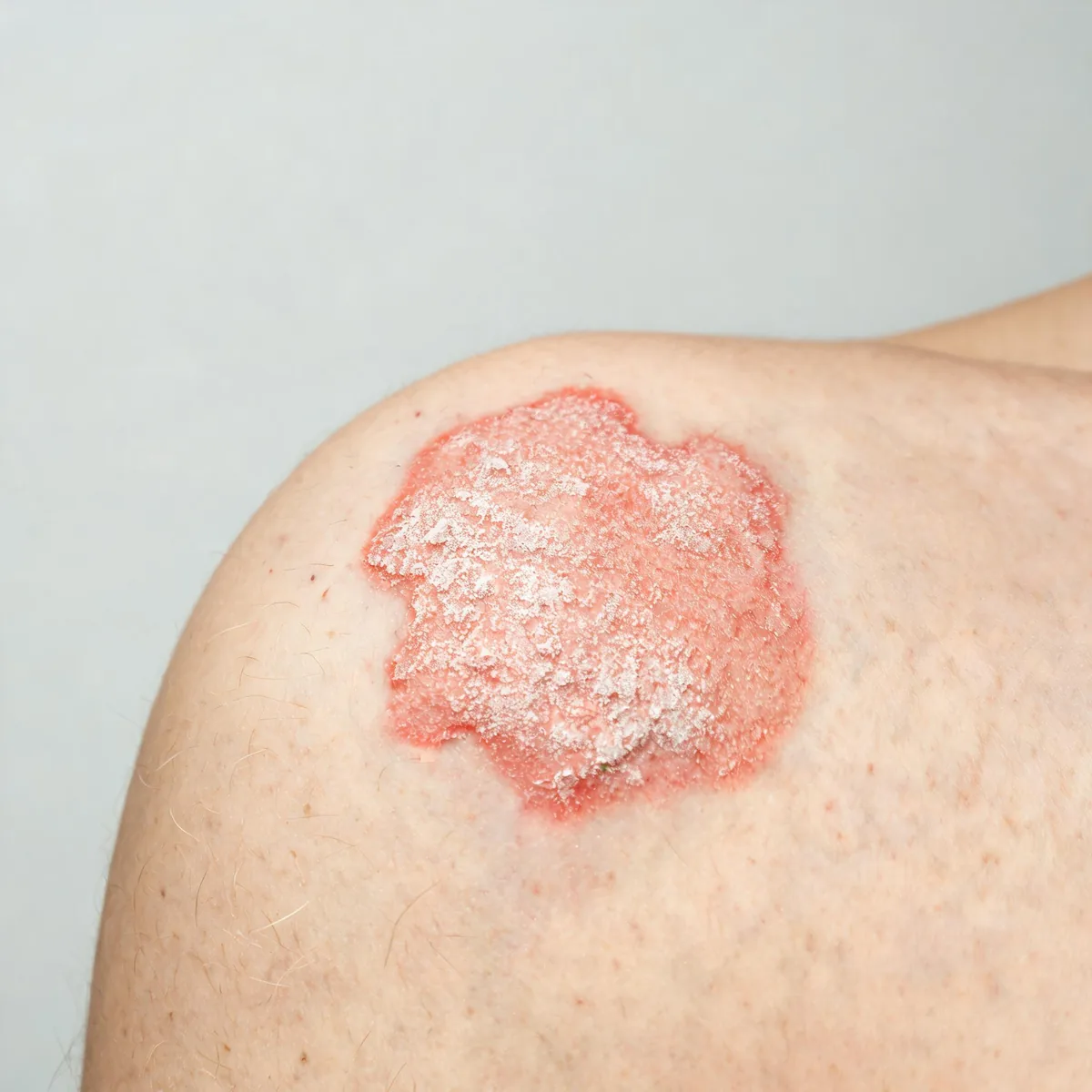
Understanding Psoriasis
The tradition describes psoriasis at the level of the Blood: what shows on the skin is said to reflect heat, dryness or stagnation inside it. That is why two plaques that look similar in size can be treated in opposite ways.
Bright red patches that spread quickly and feel hot are read as Heat agitating the Blood. The heat is understood to push outward to the surface, which is why the lesions are red, why they itch intensely, and why spicy food, alcohol and hot showers are described as making them worse.
Pale, dry, finely scaling plaques are read differently: as Blood failing to nourish the skin. Here the surface is underfed rather than overheated, so the scales flake easily, the itch worsens at night, and the person may also report dizziness, brittle nails or a pale complexion. A third picture, dark or purplish thick plaques with fixed stabbing pain, is read as Blood stasis with heat still present.
The practical consequence is that the same diagnosis can call for completely different treatment. Clearing heat suits the first picture and can worsen the second; nourishing Blood suits the second and is too slow for an acute hot flare. The classical literature is explicit that the pattern, not the label, decides the formula.
Two further points follow from the blood-level view. The first is that the direction of change matters more than the appearance at a single visit. A flare that starts bright red and settles into dry pale scaling has moved from heat into deficiency, and the formula has to move with it; a plaque that began flat and has become thick and dark has moved from heat into stasis. The second is that one person can show more than one picture at once, with active red patches at the elbows and pale dry ones on the shins, which is why treatment often combines a cooling herb with a nourishing one instead of choosing between them.
The classical literature also says where the heat comes from. Emotional stress, especially frustration and resentment, is described as the commonest source, because constrained Liver Qi turns into fire over time. A diet heavy in spicy, greasy or fried food and alcohol adds to it, and an invasion of external Wind-Heat can start the sequence in someone who has never had a plaque before. Recognising the source matters for prevention as much as for prescription, since removing it is what allows the skin to stay clear between courses of treatment.
Conventional view
Psoriasis is a chronic inflammatory condition in which the skin's cell turnover is accelerated, so cells pile up on the surface before they have matured. Plaque psoriasis, the commonest form, produces raised red patches covered with silvery scale, most often on elbows, knees, the scalp and the lower back. The diagnosis is usually clinical, based on how the skin looks and sometimes confirmed by biopsy. It is not contagious, and it can be triggered by stress, infection, injury to the skin or certain medicines.
Severity decides treatment. Mild disease responds to topical corticosteroids, vitamin D analogues and moisturisers. Moderate to severe disease may need phototherapy, systemic drugs such as methotrexate or ciclosporin, or biologics that block specific parts of the immune response. All of these slow the turnover of skin cells and reduce inflammation, and none of them cures the condition.
The trade-offs are real. Prolonged use thins the skin, systemic drugs put strain on the liver and kidneys, and biologics raise the risk of infection. Stopping treatment often brings the plaques back quickly, because the triggers that provoked them, stress, diet and constitutional imbalance among them, have not changed. The conventional model also treats psoriasis as one inflammatory process, without separating the internal patterns that make one person's psoriasis dry and another's hot and spreading.
Selected PubMed records
Real PubMed records for the conventional discussion above, selected by condition name and title relevance. They are references, not a claim that any treatment is proven for this condition.
- Treatment guidelines in psoriatic arthritis.. Rheumatology (Oxford, England), 2020. PMID: 32159790.
- French guidelines on systemic treatments for moderate-to-severe psoriasis in adults: Update 2025.. Journal of the European Academy of Dermatology and Venereology : JEADV, 2026. PMID: 41469898.
How it connects
Psoriasis and arthritis often appear together because the same blood-level Heat and stasis that inflame the skin can lodge in the joints. In TCM this is not two separate diseases but one systemic pattern, usually Heat in the Blood combined with Blood Stagnation, that shows in both skin and sinews; when the plaques are thick, dark and stubborn the joints are often stiff and painful too, reflecting stasis and Heat blocking the channels. Anxiety and insomnia are also frequent companions, because the Heat that drives psoriasis upward and outward easily disturbs the Heart Shen, leaving the mind restless and sleep fragmented, and itching at night disrupts rest further. That poor sleep weakens the Blood, which then fails to anchor the Shen, deepening both the emotional distress and the skin's inflammation. The pattern that links the two is usually Blood stasis with residual heat, which explains why stubborn plaques and stiff painful joints so often arrive together and why moving Blood addresses both. The emotional cluster has its own mechanism: heat disturbing the Heart and Shen is what leaves the mind restless, and because itching peaks at night the sleep that would restore Blood is lost, so the deficiency deepens and the next flare comes more easily. Treating the skin without attending to sleep and mood tends to leave the cycle running.
How it is assessed
Diagnosis starts with the plaque itself, then looks for the internal signs that explain it.
What a practitioner looks for
- Colour and heat: bright red and warm points to Heat; pale and dry points to deficiency; dark and thick points to stasis.
- Scale and thickness: fine flaking scales suggest dryness and Blood deficiency; thick adherent scales suggest heat and stasis.
- Bleeding on scale removal: pinpoint bleeding is recorded as a sign of heat in the Blood.
- Associated signs: thirst, irritability, sleep, complexion, nails, menstrual pattern, and how the skin responds to warmth and cold.
The examination begins with the lesion itself. Colour is recorded first, because bright red and hot means heat while pale and dry means deficiency and dark purple means stasis. Thickness and infiltration come next, since a plaque that feels raised and hard has been there long enough for stasis to settle in. Then the scale: fine silvery flakes that shed easily belong to dryness, while thick adherent scale that bleeds in pinpoints when lifted belongs to heat in the Blood. The practitioner also asks how quickly new lesions appear, where they favour, and whether old ones ever fade completely.
The tongue and pulse then separate the three patterns. Heat in the Blood gives a red tongue, sometimes with red spots or prickles, a thin yellow dry coat, and a rapid, wiry, forceful pulse. Blood deficiency with external wind gives a pale, thin tongue with a thin white coat that is slightly dry, and a pulse that is thin, wiry and floating. Blood stagnation with heat gives a reddish-purple tongue with stasis spots and distended sublingual veins, a thin dry yellow coat, and a choppy, rapid, often wiry pulse. The practitioner also asks about itching at night, response to warmth, sleep, mood, menstrual pattern and bowel habit, because each fills in a different part of the picture.
TCM patterns in Psoriasis
Three patterns are described, and they are usually read in sequence. Heat in the Blood is the active, early picture: plaques are bright red, warm to the touch, spreading, and itchy enough to disturb sleep, and the person is often restless and thirsty. Blood deficiency with external wind is the later, drier picture: the colour fades to pale red, the scale becomes fine and flakes easily, the itch worsens at night, and the person looks tired, with a pale complexion, brittle nails and sometimes dizziness. Blood stagnation with heat is the chronic picture, stubborn and slow to shift: lesions look purplish or dark red, thick, and they stay in one place, with stabbing pain and a purple tongue. Colour, thickness and the behaviour of the scale decide it, with the tongue and pulse. The patterns move into one another, so a person may begin in the first and end in the third over several years.
Heat in the Blood
The active, spreading hot picture: bright red, warm plaques that itch intensely.
Heat in the Blood is the pattern in which the skin is being driven from inside. Emotional stress, spicy and greasy food, alcohol or an invasion of Wind-Heat generates heat that sinks into the Blood level, where it agitates the Blood and pushes it outward to the surface. The result is a plaque that is bright red, warm and spreading, with silvery scale over it and pinpoint bleeding when the scale is lifted, because the vessels underneath are already engorged. The same heat disturbs the Heart and Liver, which is why the person is restless, irritable and thirsty, and why the face may be flushed.
The tongue is red with red spots or prickles and a thin yellow dry coat, and the pulse is rapid, wiry and forceful. Flares follow spicy food, alcohol, coffee, emotional stress, hot showers and hot weather, and are eased by cooling food such as cucumber and watermelon, water, rest and cool compresses. The formula named is the classic blood-cooling one, containing Zi Cao, Mu Dan Pi and Chi Shao, and needling uses DU-14 Dazhui and LI-11 Quchi to clear heat, LI-4 Hegu to dispel wind from the skin, SP-10 Xuehai to cool the Blood, and SP-6 Sanyinjiao to protect fluids from the drying effect of heat.
Signs
- Bright red plaques that feel hot
- Rapid spread of new lesions
- Intense itching
- Pinpoint bleeding when scales are removed
- Irritability and restlessness
- Thirst for cold drinks
Diet and lifestyle for this pattern: Eat plenty of cooling, hydrating food such as cucumber, watermelon, pear and mung beans. Avoid spicy, greasy, fried and barbecued food, and cut out alcohol and coffee. Keep the skin moisturised with gentle fragrance-free products, avoid hot showers or baths, and make time for rest and stress-reducing activity such as gentle walking, tai chi or meditation, since emotional tension directly fuels this pattern.
Blood Deficiency with External Wind
The dry, undernourished picture: pale plaques, fine scales and itch that worsens at night.
This pattern is the dry counterpart. Blood is what moistens the skin, so when it is thin the surface loses its nourishment and becomes pale, dry and finely scaled; the classical literature compares the resulting internal wind to dust lifting from a dry landscape. That wind is what produces the itching and the way patches appear and shift rather than staying put. Because the defensive Qi at the surface is also underfed, external wind finds it easy to invade, so flares come and go with wind, dry indoor heat and the change of seasons, and the skin never quite settles.
The tongue is pale and thin with a thin white, slightly dry coat, and the pulse is fine, wiry and floating. The itch is worse at night, after bathing and in dry heated rooms, and the person often reports a pale complexion, dizziness, brittle nails, scanty menstruation and an aversion to drafts. Moisturising, a warm humid environment, rest, blood-nourishing food and gentle movement all help. Si Wu Xiao Feng Tang, with Dang Gui, Shu Di Huang and Fang Feng, is the formula that nourishes Blood, moistens dryness and dispels wind, and SP-6 Sanyinjiao, ST-36 Zusanli, SP-10 Xuehai, BL-18 Ganshu and BL-23 Shenshu are the points used to build Blood and calm the itch.
Signs
- Pale-red, dry plaques
- Fine dry scales that flake easily
- Itch worse at night
- Pale complexion and lips
- Dizziness or light-headedness
- Brittle dull nails
Diet and lifestyle for this pattern: Eat blood-building food such as gently cooked dark leafy greens, beetroot, black sesame, goji berries and red dates. Avoid spicy, fried or overly heating food that can dry out the Blood, keep the skin well moisturised with gentle fragrance-free emollients, protect yourself from wind and dry air with scarves and light layers, and keep movement gentle such as walking or tai chi so Blood circulates without being depleted.
Blood Stagnation with Heat
The chronic thickened picture: dark, fixed, painful plaques with heat underneath.
When psoriasis has been active for years, heat that began by moving Blood begins to congeal it. The image the classical literature uses is a river slowing and turning muddy: flow decreases, the vessels become obstructed, and the skin is left without fresh nourishment. The plaque that results is thick, dark red or purplish, and fixed to the same spot for months or years, and the obstruction itself produces a stabbing pain that is worse at night, when circulation is naturally slower. A little heat usually remains, which is why the colour keeps a purple-red tinge and the lesions still itch and feel warm.
The tongue is reddish-purple with stasis spots, distended sublingual veins and a thin dry yellow coat, and the pulse is choppy, rapid and often wiry. Stress, alcohol and spicy food congeal Blood further, while cooling compresses, gentle exercise, tai chi and deliberate relaxation loosen it. Xue Fu Zhu Yu Tang, containing Dan Shen and Chi Shao, is the formula named for moving Blood and dispersing stasis while the lingering heat is addressed, and the points are LI-11 Quchi to clear heat, SP-10 Xuehai to invigorate and cool the Blood, and ST-36 Zusanli to support the production and movement of Qi and Blood.
Signs
- Dark red or purplish thick plaques
- Fixed stabbing pain in the lesions
- Worse at night
- Dry rough scaly skin
- Irritability and restlessness
Diet and lifestyle for this pattern: Eat cooling, blood-nourishing food such as cucumber, celery, mung beans and dark leafy greens, and avoid alcohol, spicy food and fried dishes that generate internal Heat. Gentle exercise such as walking or tai chi keeps blood moving without overheating, and manage stress through meditation or breathing, since emotional tension fuels both Heat and stagnation.
Treatment approach
How the tradition treats psoriasis, with the herbs, formulas and points used for it.
Principles
- Treat the pattern, not the plaque: clear heat, nourish Blood or move stasis according to what the skin shows.
- Cool the Blood in active flares, and avoid drying it further - harsh drying treatment can push a hot flare into a dry, deficient one.
- Support the Blood and Yin between flares, since the tradition describes recurrence as a return of the underlying imbalance.
- Address triggers: alcohol, spicy food, stress and hot showers are named for the heat patterns.
- Treating the Blood is the constant, but the verb changes with the pattern: cool it, nourish it, or move it. In practice the three are combined in proportion, since a chronic plaque usually carries some stasis and some dryness at the same time as residual heat. The formula is also adjusted for the season and for the state of the digestion, because nourishing and blood-moving herbs are heavy and a weak Spleen will not process them well. Follow-up at fixed intervals is part of the treatment rather than an afterthought.
Herbs used
Formulas
Acupoints
- DU-14 (Dazhui)
- LI-11 (Quchi)
- LI-4 (Hegu)
- SP-10 (Xuehai)
- SP-6 (Sanyinjiao)
- ST-36 (Zusanli)
- BL-18 (Ganshu)
- BL-23 (Shenshu)
What to expect
- The classical literature suggests itching and new plaque formation usually begin to settle within the first weeks of treatment.
- Clearing scale and thickness takes longer, and is expected to lag behind symptom relief.
- Consistency matters: stopping treatment early is described as the common reason for a rapid return of plaques.
- Itching and new lesions respond first, usually within a few weeks; the plaque itself takes months, and older thickened lesions take longest because the skin has to remodel rather than simply calm down. Flares around infections, stress and the winter months are expected. The classical literature frames the aim as long remission with occasional maintenance rather than a permanent cure, and progress is judged by colour, thickness and scale.
Safety and when to get help
Seek medical help urgently for
- Sudden widespread redness over most of the body, with fluid loss and feeling unwell.
- Pustules appearing on red skin together with fever and fatigue.
- Joint pain with swelling and stiffness that comes on with a flare - this needs medical assessment, not herbs alone.
For anything severe, sudden or spreading quickly, read when a skin problem needs urgent care.
Cautions
- Do not stop prescribed systemic treatment abruptly.
- Long-term internal herbal use should be supervised with liver function checked where indicated.
- Strong topical applications on broken or widespread skin should be avoided without advice.
Using this alongside conventional care
- TCM is described as complementary to conventional care: to conventional care: emollients, topical treatments and phototherapy can continue alongside herbs and acupuncture. Any change to prescribed systemic or biologic therapy should be made with the prescribing doctor.
- Topical steroids, vitamin D analogues and moisturisers are compatible with herbal treatment and are usually continued, and using them while the internal formula takes effect is sensible rather than a compromise. Systemic treatment changes the calculation. Methotrexate, ciclosporin and biologics mean the dermatologist and the practitioner both need the full list, because blood-moving herbs can interact with immunosuppressants and anticoagulants, and long-term medication is a reason to include herbs that support the Liver. Any change to a prescribed drug is made by the prescriber, and never abruptly.
Diet and lifestyle
- For the heat patterns the advice is to limit alcohol, spicy and fried food, and to avoid very hot showers and overheating. For the deficiency patterns the emphasis shifts to regular meals and nourishment rather than restriction.
- Diet is supportive rather than curative, and its main job is to keep new heat and dampness out of the system. Spicy, greasy and fried food, alcohol, sugar and shellfish are the usual offenders, while cucumber, watermelon, dark leafy greens and a moderate amount of lean protein are the usual replacements. If Blood deficiency dominates, bone broth, eggs and black sesame are added; where heat dominates, lamb and coffee are reduced. Nightshades and gluten are worth testing individually, since the response varies widely, and a food diary is the only reliable way to find a personal trigger.
If you're pregnant
Pregnancy sends Blood and Yin to nourish the fetus, which can calm active heat and sometimes brings a temporary improvement in psoriasis. It can also deepen a shortage of Blood, so dry scaly plaques may become more prominent. Treatment avoids any herb with a strong blood-moving or stasis-breaking action, Tao Ren, Hong Hua, together with San Leng and E Zhu, since they risk disturbing the pregnancy, and points such as LI-4 Hegu, SP-6 Sanyinjiao and the lower abdominal points are left alone. Gentler blood-nourishing formulas can be used under professional guidance, and herbal washes with cool compresses are generally considered safe.
If you're breastfeeding
Most external treatment, herbal baths, ointments and acupuncture, is compatible with breastfeeding and can manage localised plaques well. Internal herbs need more caution: bitter-cold herbs such as Huang Lian or Da Huang pass into milk and may cause diarrhoea or digestive upset in the infant, and formulas with a strong blood-invigorating action are avoided because of the baby's developing circulation. Milder blood-nourishing choices, Dang Gui, Bai Shao and Shu Di Huang, are usually well tolerated, and a practitioner should keep an eye on both mother and infant.
If treating a child
Psoriasis in children often shows up as small droplet-like spots after a streptococcal throat infection, and the classical literature reads that as Wind-Heat or Heat-Toxin reaching the Blood level, an acute picture that responds well to cooling and detoxifying herbs. The tongue is usually red and spotted, the pulse rapid and floating. Doses are reduced by age and weight, commonly a third to a half of the adult amount for school-age children. Children's skin absorbs more, so external washes, gentle acupuncture and acupressure are preferred, and the colour and spread of the lesions are read closely when the child cannot describe symptoms.
If treating an elderly patient
In older patients plaques tend to be thicker, darker and long-standing, reflecting Blood stagnation over a background of Yin and Blood depletion. The skin is frequently cracked, the itch can be fierce, above all in winter, the tongue generally looks pale or carries a purple tinge with a thin dry coating, and a thready, choppy pulse is felt. Doses start low, usually about two thirds of the adult standard, and are raised gradually. Blood-moving formulas such as Xue Fu Zhu Yu Tang need care if the patient takes anticoagulant or antiplatelet drugs, and acupuncture, tuina and nourishing topical applications are the low-risk options.
Urgent-sign guidance is based on standard sources: NHS anaphylaxis, NHS cellulitis, NHS Stevens-Johnson syndrome, NHS melanoma.
Evidence
Evidence status
Compiled for this page from the classical and modern literature; not a systematic review, so treat it as a pointer to sources rather than clinical guidance.
Evidence is mixed for acupuncture and stronger, though imperfect, for herbal medicine. A 2013 Cochrane review found acupuncture safe but with insufficient evidence to recommend it as standalone treatment because of small samples and high risk of bias; later larger trials report reductions in PASI scores with moderate quality. Chinese herbal medicine is supported by the 2013 evidence-based clinical practice guideline for psoriasis vulgaris, which synthesised decades of Chinese research.
The two strands differ in strength. Acupuncture is safe but unproven as a standalone: the 2013 Cochrane review of six trials with 522 participants found no serious adverse events and insufficient evidence of benefit, and later trials reporting lower PASI scores have not settled the question. Herbal medicine has the firmer base, with the 2013 guideline for psoriasis vulgaris setting out three blood syndromes, heat, dryness and stasis, and the formulas attached to each, and network pharmacology work describing multi-target anti-inflammatory effects for those formulas. Placebo-controlled trials in English remain scarce.
Studies often cited
Acupuncture was safe, but evidence was insufficient to recommend it as a standalone treatment because of small samples and high risk of bias. The review included six randomised trials with 522 participants; acupuncture was not linked to serious adverse events, but small samples and methodological limitations meant the evidence could not establish effectiveness, and the authors called for larger well-designed trials. Coyle M, Deng J, Zhang AL, et al. Acupuncture for psoriasis. Cochrane Database of Systematic Reviews. 2013;10:CD007536. https://doi.org/10.1002/14651858.CD007536.pub2
Synthesised decades of Chinese research on herbal medicine into a clinical practice guideline, supporting pattern-based herbal treatment. The guideline systematically reviewed Chinese and international literature and set out diagnosis and treatment recommendations for psoriasis vulgaris around the three core blood syndromes, with specific formulas, acupuncture protocols and external therapies. China Academy of Chinese Medical Sciences. Evidence-based clinical practice guideline for psoriasis vulgaris (Bai Bi) in Chinese medicine (2013 version). Published 2013.
The study mapped the compounds and targets of three formulas matched to the heat, stasis and dryness patterns, and found overlapping actions on inflammation, immune regulation and keratinocyte proliferation. That offers a systems-level rationale for treating the patterns differently rather than using one formula for everyone. The network pharmacology analysis mapped active compounds and target pathways for formulas matched to the blood-heat, blood-stasis and blood-dryness patterns, finding involvement of inflammation, immune regulation and keratinocyte proliferation. Li J, Li J, Fu X, et al. Chinese medicine for psoriasis vulgaris based on syndrome pattern: a network pharmacological study. Evidence-Based Complementary and Alternative Medicine. 2020;2020:7204377. https://doi.org/10.1155/2020/7204377
PubMed records for the TCM evidence
Real PubMed records for the TCM clinical evidence discussed above, selected by condition name and title relevance. They are references, not proof of benefit.
- Gut microbiota and psoriasis: pathogenesis, targeted therapy, and future directions.. Frontiers in cellular and infection microbiology, 2024. PMID: 39170985.
- Interleukins and Psoriasis.. Journal of cutaneous medicine and surgery, 2024. PMID: 38314729.
Classical record
Bai Bi (psoriasis) is mostly caused by wind evil lodging in the skin, and blood dryness failing to nourish and moisten.
- Wai Ke Zheng Zong (Orthodox Manual of External Medicine), Volume 4, chapter on psoriasis. The Chinese original is not reproduced here: it could not be recovered reliably from the source record, and is not guessed.
Common questions
Can acupuncture help psoriasis?
The classical records acupuncture as part of a traditional treatment plan, chosen by pattern, and does not claim it clears plaques on its own. Evidence for acupuncture in psoriasis is limited, and this page records the traditional selection rather than a proven result.
How soon will I see results?
The classical literature suggests reduced itching and slower new plaque formation within the first weeks, with scale and thickness improving more slowly. Plaque clearance is a matter of months, not days.
Do I need to change my diet?
The classical literature advises limiting alcohol, spicy and fried food for the heat patterns, since these are the foods it associates with aggravating Blood heat.
Is psoriasis contagious?
No. It is described in both frameworks as an internal condition expressed on the skin, not an infection.
Can I carry on with my steroid creams during TCM treatment?
Yes. Topical treatment can continue while herbs and acupuncture are started, and using the cream as directed keeps symptoms manageable while the internal work takes effect. As the skin improves the amount needed often falls, and any reduction is made with the dermatologist's agreement rather than suddenly. Both the practitioner and the doctor should know everything being used, including moisturisers and over-the-counter preparations.
Does stress play a part in psoriasis?
Closely. Frustration, anger and long-held resentment are described as the commonest triggers, because they stop the Liver from keeping Qi moving, and Qi that stops moving turns into heat that eventually reaches the Blood and shows on the skin. That is why flares so often follow a difficult period. Treatment smooths the Liver and clears the heat that has built up, and many people notice their response to stress changing too.
Does psoriasis return once treatment stops?
The aim is remission rather than temporary suppression. After a course of treatment many people stay clear for long periods and find that any later flare is milder and shorter. Psoriasis is long term, however, and the classical literature suggests seasonal tune-ups or a short course of herbs at times of stress or weather change to keep it in check.