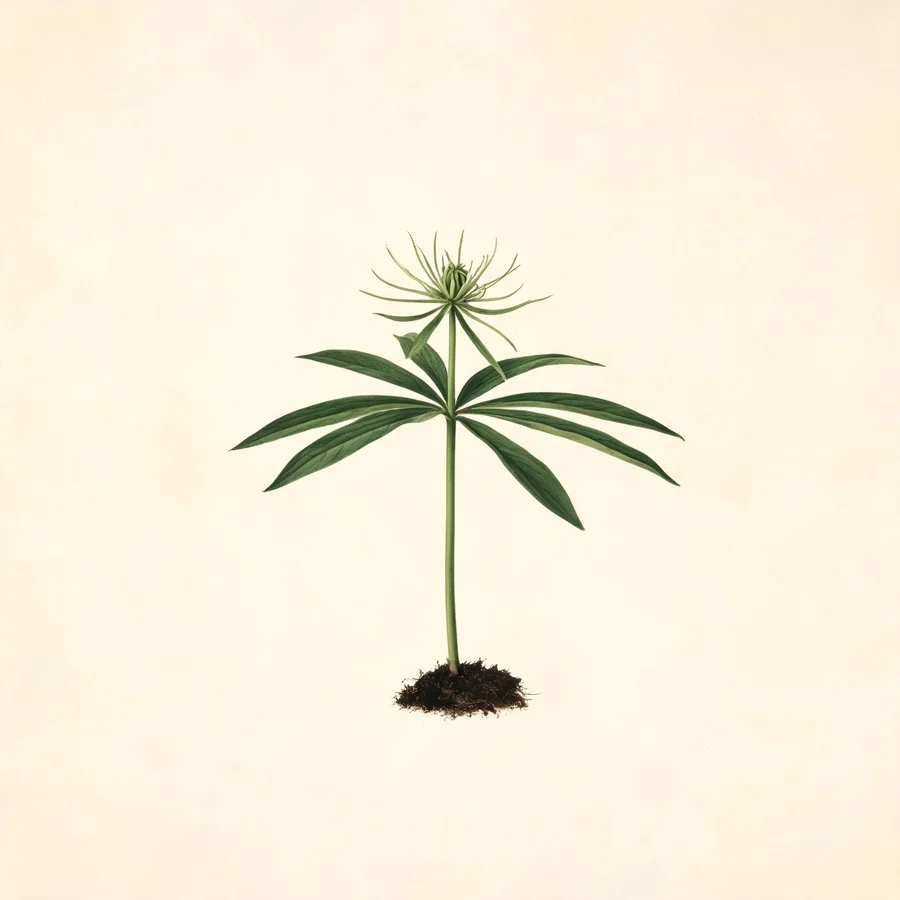
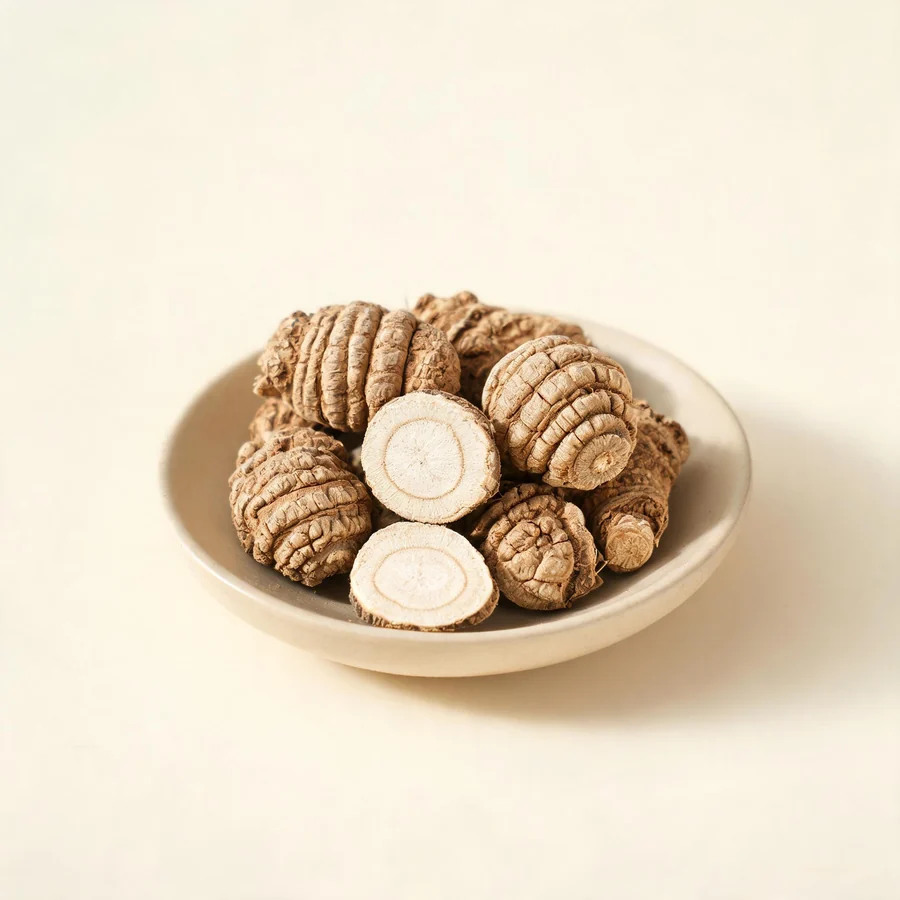
Skin profile
Where this herb sits in skin practice: the pattern it corrects, the skin signs it suits, and what it should not be used for.
Chong Lou is a short-course, capped-dose herb for hard, hot, painful swellings: boils, carbuncles, abscesses and spreading red plaques. The saponins are the medicine and the toxicity, and pregnancy is an absolute contraindication.
Skin signs that suggest it
- A hot, red, hard, raised swelling that is painful to touch (heat toxin gathering)
- A boil or carbuncle with a dusky centre and spreading redness around it (toxic heat with pus forming)
- A bright red, sharply bordered, hot plaque that spreads quickly (erysipelas-type toxic heat)
- Fever, a red tongue with a yellow coat and a rapid pulse alongside the lesion (systemic heat toxin)
- A hard, swollen, bruised area that has become hot and slow to settle after an injury
When it is not the right herb
Not for cold, pale, flat sores that are slow to heal, since a cold flat sore is the reverse of the hot raised swellings this herb is chosen for. Not for deficiency without heat: a tired, cold patient with a weak pulse offers nothing for a bitter, cold, toxic herb to work on. Not for chronic dry eczema or scaly psoriasis where there is no heat toxin, and not as a self-treatment herb, since the dose ceiling exists for a reason.
What it does for skin
Skin-relevant actions only. Each one describes a mechanism in TCM terms and what it looks like on the skin.
Clears heat and resolves toxin
This is the herb's primary action and its narrow strength. It is chosen where heat has concentrated into a destructive focus rather than spreading thinly: a boil with a dusky centre, a carbuncle, an abscess, or a red plaque that is spreading across the surface. The bitterness and slight coldness are described as neutralising that localised heat, and the herb is applied as well as prescribed internally because the target is on the surface.
Reduces swelling and relieves pain
Swelling and pain that come with heat are treated by breaking up what has gathered. The herb is used where an injury or a toxic lesion has become hard, raised and tender, and where the swelling refuses to go down. It is a standard ingredient in trauma formulas for that reason: it addresses inflammation and pain together rather than one after the other.
Dries and closes a hot, discharging lesion from outside
The vinegar paste is the classical external preparation, recorded in the Tang pharmacopoeia. Vinegar is mildly astringent and the rhizome is drying and toxin-clearing, so the paste is applied thinly over a hot swelling to draw the surface heat down. It is used on intact skin around the lesion, never packed into an open cavity, and it is washed off after a short application.
Cools the Liver, which is why it is also used when fever accompanies the lesion
The herb enters the Liver channel, and in this framework extreme heat in that channel can stir wind, which in a child shows as twitching or a convulsion after a fever. That use belongs to paediatric practice inside a prescription, not to skin care. It matters here only because it explains why a hot skin lesion with fever and restlessness is read as a deeper heat picture than a local spot.
Skin conditions it is used for
Mapped to the condition pages on this site. The pattern column shows what the skin is doing when this herb is the right choice.
| Condition | Pattern | Why it suits | Typical setting |
|---|---|---|---|
| Boils | Heat toxin gathering into a hard, painful swelling | A boil that is hard, red and painful, with the redness spreading beyond the head, is heat toxin concentrated in one place. Chong Lou is one of the strongest herbs for that, and it is used both internally in a formula and externally as a vinegar paste. Its strength is also its limit: it is a short-course herb for an acute lesion, not something to take while a boil slowly resolves, and a large or spreading boil needs drainage and medical care. | Chong Lou with Jin Yin Hua and Lian Qiao, plus a vinegar paste on the lesion |
| Skin abscess | Toxic heat with pus collecting and hardening | An abscess is heat toxin that has gathered into a collection, and the herb's swelling-reducing action is aimed at the hardening around it. It is used while the lesion is still hard and inflamed, which is the phase the tradition calls before the pus forms, and it is stopped once the collection is established. An abscess that fluctuates, drains or comes with fever needs drainage rather than a paste. | Chong Lou with Xuan Shen and Chi Shao, alongside drainage where a collection has formed |
| Cellulitis | Toxic heat spreading through the deeper tissue | Spreading redness with heat, swelling and tenderness is the picture the tradition calls toxic swelling, and Chong Lou is one of the herbs used for it because it clears the toxin and reduces the swelling at the same time. This is exactly the situation where herbs are adjuncts: cellulitis needs antibiotics and assessment, and the herb is used only with that treatment, never as a delay to it. | Chong Lou with Jin Yin Hua and Lian Qiao, alongside antibiotic treatment |
| Erysipelas | Bright red, sharply bordered heat toxin on the surface | Erysipelas gives a sharply defined, bright red, hot plaque that spreads at the edge, which the tradition reads as toxic heat moving across the surface. The vinegar paste and the internal formula are both directed at that heat. Because the infection is bacterial and can progress quickly, the herb is a supporting measure and the case needs prompt medical treatment, especially on the face or in a frail person. | Chong Lou with Lian Qiao and Chi Shao, alongside medical treatment |
| Skin swelling | Hot, hard swelling from toxic heat or injury | A swelling that is hot, hard and tender is the herb's core target, whether it followed an injury or gathered on its own. The action is to break up what has congested and to cool the heat that made it hard, which is why the herb appears in trauma formulas as well as in sore-clearing ones. Swelling that is cold, pale and pitting is a different problem and does not belong here. | Chong Lou with Chi Shao and Xuan Shen, or a vinegar paste for a localised swelling |
Combinations for skin
Herbs it is paired with when the skin, not an internal organ, is the target.
| Partner | Ratio | Why the pair is used |
|---|---|---|
| Xuan Shen | 10 g each in a decoction | Xuan Shen cools the blood and softens hardness, and the two are used together for nodular, hard skin lesions where the swelling has not yet softened. Chong Lou supplies the stronger toxin-clearing and Xuan Shen the moistening, cooling quality that keeps the pair from being purely drying. Both are cold, so the pair is used in short courses and with attention to the digestion. |
| Jin Yin Hua | 10 to 15 g Jin Yin Hua with 6 to 9 g Chong Lou | A carbuncle that is spreading has two fronts at once: the margin, where heat is being pushed outward, and the centre, where it has settled and is doing damage. Jin Yin Hua handles the first by venting surface heat, Chong Lou the second by breaking up what has collected. The honeysuckle is the gentler of the pair and can be continued after the rhizome has been stopped. |
| Lian Qiao | 10 to 15 g Lian Qiao with 6 to 9 g Chong Lou | Forsythia separates heat that has clumped and sends it out to the surface, while the rhizome deals with the part that has gone deep and hard. Used together they suit an early carbuncle with no pus yet, and a throat that is swollen with tender glands when the skin lesion is one part of a wider toxic picture. Both cool, so the pair runs only while the acute phase does. |
| Chi Shao | 10 g each | Red peony both cools the blood and keeps it moving, which is what a bruise turned hot and tender needs, while the rhizome deals with the toxin that produced the heat. The pair suits an injury that has gone hard and inflamed instead of settling, especially where the swelling lingers. The peony also prevents the stagnation that cooling alone can leave behind. |
Topical use
The external use of this rhizome is old and specific: a paste made with vinegar for abscess and swelling, and plain application for snakebite. On a skin page only the first of those belongs, and even that is limited. The powdered rhizome is applied thinly to the intact skin over a hot, hard swelling, left for a short time and washed off, because the saponins are irritant and are absorbed through broken skin.
| Preparation | How and when it is used |
|---|---|
| Vinegar paste | Finely ground rhizome is mixed with rice vinegar to a thin paste and spread over the intact skin covering a hot, hard swelling, leaving a margin of clean skin around it. Cover with gauze, leave for 20 to 30 minutes, then wash off with warm water. Once daily at most, and not on the face, neck or genitals. |
| Cooled decoction compress | 3 to 6 g of sliced rhizome is simmered in 300 ml of water for 20 minutes, strained and cooled. A cloth is soaked and held over the swelling for 10 minutes, once or twice daily. Make it fresh, and keep it off broken skin. |
Patch test and cautions
Patch test first, and keep the first application to a small area away from the face. Do not apply it to broken, ulcerated, blistered or draining skin, do not use it on mucous membranes or near the eyes, and do not cover a treated area with an airtight dressing, because occlusion increases absorption of the saponins. Stop at once if there is burning, stinging or spreading redness, and wash the area with plain water. The paste stays in the category of a traditional external measure, not a treatment for infection that needs antibiotics.
Safety for skin use
What to check before recommending or using it, including the cautions that matter most for skin patients.
Do not use, or use with caution
- Deficiency without heat: the patient is pale and tired, the limbs are cold and the pulse is weak. A cold, bitter, toxic herb has no work to do in such a body, and the classics refuse it wherever the original qi is deficient.
- Cold, pale, flat sores that are slow to heal: they are the reverse of the hot raised swellings this herb is chosen for, and a cold drying paste applied there only delays healing.
- Weak digestion, and any history of nausea or loose stools from herbs. The saponins upset stomach and bowel at any dose, so for a delicate gut the only safe version is a smaller amount inside a formula that protects the middle.
- Liver impairment or heavy alcohol use, because mild hepatotoxicity has been noted in modern toxicology, and the powder is more irritant than the decoction.
Pregnancy and breastfeeding
Contraindicated in pregnancy, in every form. The rhizome is bitter, cold and slightly toxic; the old texts forbid it without qualification, and that ban extends to putting it on the skin, because its saponins kill cells in the laboratory and can pass through the skin. Breastfeeding is avoided too: the saponins break red cells in the laboratory and no one knows whether they pass into milk, so there is no safe basis for using it while nursing when the alternative is to wait. Children belong to specialist care: the herb is given inside a prescription, at an amount the practitioner chooses rather than one a parent works out from the adult figure.
Interactions
- Other medicines that burden the liver. A rhizome that is slightly toxic and a little hard on the liver is not stacked casually with hepatotoxic drugs, nor with a lengthy course of any other medicine that loads that organ, and the powder is avoided where the liver is already under strain.
- Central nervous system depressants. At high doses the herb has been described as additive with sedatives and similar drugs, which is one more reason the dose ceiling is not a suggestion.
- Chemotherapy and immunosuppressant treatment. Anyone having either should only take the herb as part of a plan their specialist team knows about, never added on their own initiative, because the saponins are cytotoxic and the interaction is unknown.
- Other topical irritants. A vinegar paste used at the same time as a retinoid, a keratolytic or another strong herbal plaster increases the chance of a chemical burn, so the two are separated in time and never applied to the same area.
Allergy and patch testing
Contact dermatitis from the paste is the most likely skin reaction, and vinegar itself stings on any area that is already inflamed. Patch test on the forearm for 24 hours, apply thinly, and stop at once if the skin burns, blisters or spreads redness beyond the treated area. A person who has reacted to another herbal plaster or to a strong aromatic topical should not use this one without advice.
General safety references
General references for herbal hepatotoxicity and herb-drug interactions; they are not specific to this herb.
- Review article: Herbal hepatotoxicity - an update on traditional Chinese medicine preparations. Alimentary Pharmacology & Therapeutics, 2014. PMID: 24844799.
- Interactions between herbal medicines and prescribed drugs: an updated systematic review. Drugs, 2009. PMID: 19719333.
- Warfarin and food, herbal or dietary supplement interactions: a systematic review. British Journal of Clinical Pharmacology, 2021. PMID: 32478963.
Evidence
The classical record is quoted with its source. The modern note states the level of evidence plainly.
Classical record
主惊痫,摇头弄舌,热气在腹中,癫疾,痈疮,阴蚀,下三虫,去蛇毒。
Under its old name it is listed for convulsions of fright with a shaking head and a restless tongue, for heat lodged in the belly, for the falling sickness, for abscess and sore, for genital erosion, for driving out worms and for snake venom.
Shen Nong Ben Cao Jing (Classic of Materia Medica), as Zao Xiu - Sore, abscess and snakebite are listed together at the very start, so its later standing as a herb for hot, swollen lesions was there from the beginning.
今谓重楼者是也。……根如肥大菖蒲,细肌脆白,醋摩疗痈肿,敷蛇毒,有效。
This plant is what is now called Chong Lou. Its root looks like a thick sweet flag rhizome, brittle, white and of fine grain; ground with vinegar it is used on abscess and swelling, and laid on a snakebite it proves effective.
Xin Xiu Ben Cao (Newly Revised Materia Medica) - The Tang pharmacopoeia is where the present name arrives, and it records both of the external methods still quoted today, the paste made with vinegar and the plain application.
热伤营阴吐衄血证忌用之。
It is forbidden once heat has injured the nutritive level and the patient is coughing or vomiting blood, or bleeding from the nose.
Ben Cao Hui Yan (Collected Sayings on Materia Medica) - A warning rather than an indication, kept because the caution belongs to the herb's own classical record and was not invented by later editors.
Modern evidence
Evidence status
- Laboratory work on the polyphyllin saponins reports anti-inflammatory, antimicrobial and cytotoxic activity, mostly in cell and animal models. Cytotoxicity is the same property that makes the herb toxic, so these findings support the dose ceiling rather than demonstrating benefit.
- No adequately powered dermatological trial of Chong Lou was identified. Its place in spreading skin infection sits alongside antibiotics and drainage rather than instead of them, and the toxicology is better documented than the efficacy.
- Regulatory position: the rhizome is an accepted herbal substance in the Chinese Pharmacopoeia with a stated dose limit, and since the rhizome is costly and often substituted, which species was collected, and how good the grade is, count for as much as the number of grams.
PubMed records
Selected real PubMed records for this herb's species or its constituents, chosen by species name and title relevance. They are references for the non-TCM discussion above, not proof that the herb treats any skin condition.
- Paris polyphylla: chemical and biological prospectives.. Anti-cancer agents in medicinal chemistry, 2014. PMID: 24917072 (pharmacology or review record).
- Paris polyphylla ethanol extract and polyphyllin I ameliorate adenomyosis by inhibiting epithelial-mesenchymal transition.. Phytomedicine : international journal of phytotherapy and phytopharmacology, 2024. PMID: 38452697 (pharmacology or review record).
Dose and forms
Skin-practice dosing and the preparations that suit skin complaints.
| Form | Dose and notes |
|---|---|
| Decoction (internal) | 3 to 9 g of dried rhizome daily, generally not exceeding 9 g, inside a formula and for a short course. The lower end suits a mild lesion and the upper end a severe abscess, and the position inside that range is a clinical decision. |
| Powder | 1 to 3 g per dose, swallowed with warm water rather than boiled, and only at an amount a practitioner has fixed, since the gut tolerates the raw powder less well than the decoction. |
| Vinegar paste (external) | Enough powdered rhizome to make a thin paste with rice vinegar for one area, applied for 20 to 30 minutes once daily and washed off. External use has no fixed weight and is limited to a small intact area. |
| Course length | Three to seven days for an acute hot swelling, with review. Any nausea, vomiting or dizziness means the dose was too high: stop rather than reduce and continue. |
The ceiling is the heart of this entry. Nine grams in a decoction is the limit; anything above that belongs to supervised hospital use, and an overdose announces itself through the gut almost at once. Boiling partially breaks the saponins down, which is why the decoction is gentler than the powder. The rhizome is also among the most frequently substituted, so which species was collected, and its grade, count for as much as the weight.
Citations and further reading
Only real sources are listed: the classical materia medica passages quoted above, and the source works behind the botanical and safety statements.
- Shen Nong Ben Cao Jing (Classic of Materia Medica), attributed compilation of the Han period, in which the herb appears under the older name Zao Xiu - classical entry quoted above.
- Xin Xiu Ben Cao (Newly Revised Materia Medica), Tang dynasty - classical entry quoted above.
- Ben Cao Hui Yan (Collected Sayings on Materia Medica) - classical warning quoted above.
- Chong Lou monograph: Pharmacopoeia of the People's Republic of China - source for the accepted botanical varieties, part used and the stated dose limit.
- Modern evidence statement: based on laboratory and toxicological literature on Paris polyphylla and its polyphyllin saponins, described as a statement about the level of evidence rather than as a cited finding.
- Botanical description and identification: botanical literature on Paris polyphylla, Melanthiaceae.
Educational reference for qualified practitioners. This page is not medical advice, and skin conditions should be diagnosed by a clinician before treatment.