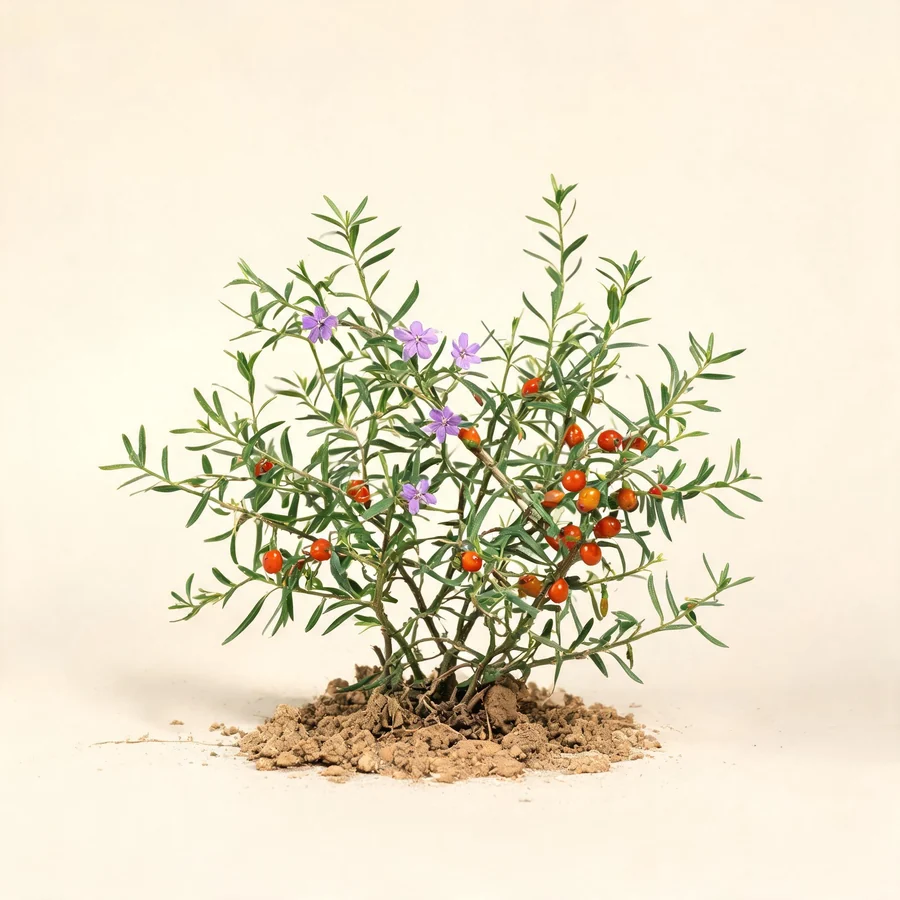
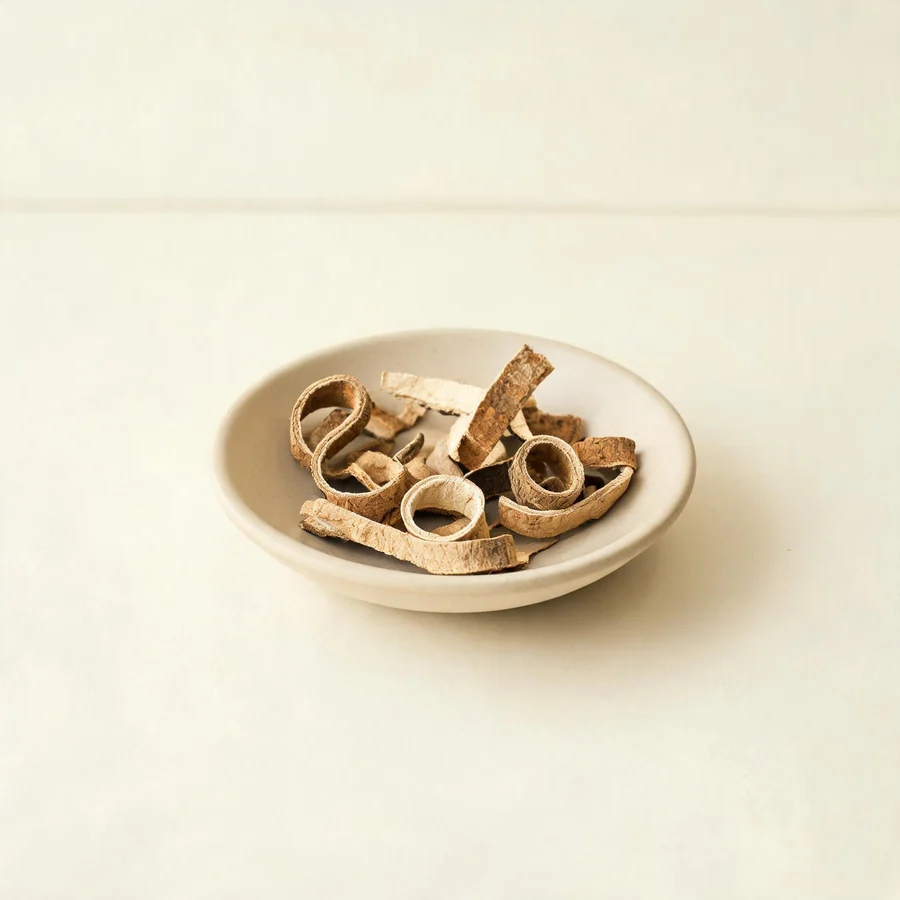
Skin profile
Where this herb sits in skin practice: the pattern it corrects, the skin signs it suits, and what it should not be used for.
Di Gu Pi is for the hot, dry, depleted skin: the afternoon flush, the burning surface, the itch of old age, the small bleeds that come with a long illness. It clears gently and protects the fluids, which is why it is preferred to a bitter cold herb in a thin patient. Acute, wet, angry skin is a different problem.
Skin signs that suggest it
- Skin that feels hot and dry, worst in the afternoon and evening, with a low-grade fever
- Flushing of the cheeks and a warm face in a thin person, with night sweats
- Dry, itchy skin with fine scaling and a red tongue without much coat
- Small purple or red spots under the skin with heat signs and a chronic illness
- A red tongue with a peeled or scanty coat and a fine, rapid pulse
When it is not the right herb
Not for a fever or rash that has just arrived from outside, with chills and an exterior pattern: the medicine clears heat that arises from deficiency, and using it at the surface is said to trap the pathogen. Not for Spleen or Stomach deficiency-cold with loose stools and a cold abdomen, where a sweet cold bark worsens the looseness. Not for the early, red, weeping phase of an acute eczema, which needs a stronger clearing herb. A lingering fever with wasting or drenching night sweats needs investigation before it is treated.
What it does for skin
Skin-relevant actions only. Each one describes a mechanism in TCM terms and what it looks like on the skin.
Clears deficiency heat so the skin stops flushing
The core action. Heat that comes from depleted Yin shows as an afternoon flush, warmth in the palms and soles, night sweats and a low fever. The bark clears that heat from the Yin layer, and the skin becomes less hot and less reactive. It is chosen when the person is thin and dry rather than robust and overheated, and when the heat is chronic rather than acute.
Cools the Blood and contains small bleeds
When hot Blood escapes its vessels, the result is petechiae, purpura and nosebleeds. The bark cools the Blood and is used as a supporting herb in a cooling formula, particularly in a person whose underlying deficiency makes the stronger herbs hard to tolerate. A new crop of spots or unexplained bruising needs a blood count before it is treated as a pattern.
Clears heat without drying the fluids
This is the quality that makes the bark useful on the skin. Bitter cold herbs clear heat but can leave the skin drier than before, and in a thin, dry patient that is a real cost. The sweet, bland taste is held to protect the fluids while the heat clears, so a hot dry rash or an elderly itch can be treated without stripping the surface further.
Quiets the itch that comes with dry heat
Itch in the elderly, or after a long illness, often comes with warmth, dryness and a red tongue rather than with ooze. Clearing the deficiency heat reduces the underlying drive, and the fluid-protecting quality keeps the skin from cracking. It is combined with itch-quieting and moistening herbs, and it is not a treatment for wet, weeping eczema.
Skin conditions it is used for
Mapped to the condition pages on this site. The pattern column shows what the skin is doing when this herb is the right choice.
| Condition | Pattern | Why it suits | Typical setting |
|---|---|---|---|
| Hot, dry skin | Yin deficiency with empty heat in the skin | Skin that is hot to the touch, dry and worse in the afternoon is the surface expression of deficiency heat. The bark clears that heat gently and protects the fluids, so the skin becomes less hot without becoming more dry. It is used in a formula with moistening and blood-cooling herbs, and it is not the choice for an acute hot, weeping rash, which needs stronger clearing. | With Sheng Di Huang, Mu Dan Pi and Zhi Mu in a deficiency-heat formula |
| Burning skin on touch | Deficiency heat with heat in the Yin layer | A skin that feels burning but looks only mildly red, in a thin person who sweats at night and has a dry mouth, fits empty heat rather than excess fire. The bark reaches heat that sits deep and clears it without a harsh purge. A burning skin with fever, a spreading rash or pain out of proportion to the appearance needs medical assessment, because several serious conditions present this way. | With Bie Jia, Qing Hao and Zhi Mu for steaming-bone heat |
| Itch of the elderly | Yin and Blood deficiency with dry heat | Itch in an older person with dry, thin skin, warmth in the evening and a red tongue with little coat is read as dry heat from depletion. The bark clears the heat and the sweet taste protects what moisture remains, and it is combined with moistening and blood-nourishing herbs. It is not enough on its own, and a new generalised itch in an older person should be checked for systemic causes. | With Dang Gui, Bai Shao and Sheng Di Huang in a moistening formula |
| Petechiae | Blood heat leaking into the skin on a deficient background | Pinpoint spots with a red tongue and a chronic, low-grade heat picture suit the bark's cooling and containing action. It is a supporting herb, used where the person is depleted enough that stronger cold medicines would be badly tolerated. Petechiae are a sign rather than a diagnosis, and a new crop with bruising or bleeding elsewhere needs a blood count. | With Sheng Di Huang, Mu Dan Pi and Ce Bai Ye |
| Dry skin with heat | Fluids depleted with residual heat | Dryness that comes with warmth, a dry mouth and a red tongue is not simple dryness but fluid depletion with heat still present. The bark clears the residual heat without adding to the dryness, which is the reason it is preferred to a bitter cold herb in a thin patient. It is used with moistening herbs, and plain dry skin without heat needs nourishment rather than clearing. | With Mai Men Dong, Sheng Di Huang and Bai Shao |
Combinations for skin
Herbs it is paired with when the skin, not an internal organ, is the target.
| Partner | Ratio | Why the pair is used |
|---|---|---|
| Mu Dan Pi | 10 g each | Both clear heat from the deeper levels, but Mu Dan Pi moves the Blood and clears heat from the Blood level while the bark clears heat from the Qi level. The classical rule is that the bark suits steaming bone with sweating and Mu Dan Pi the same picture without it. On the skin the pair suits a hot, dry, flushed face with small bleeds. |
| Sheng Di Huang | 10 to 15 g Sheng Di Huang with 9 to 12 g Di Gu Pi | Sheng Di Huang cools the Blood more powerfully and also generates fluids; the bark, by contrast, seeks the deeper layer of deficiency heat and is kinder to the stomach. The pair suits a hot, dry rash or purpura with a chronic low fever, and the ratio depends on whether bleeding or depletion dominates. |
| Zhi Mu | 6 to 10 g each | Anemarrhena is bitter and cold, clearing heat while moistening dryness, so it strengthens the fluid-protecting side of the bark. The pair is used for night sweats and a dry throat after a febrile illness, and for a hot dry skin that is worse at night. Anemarrhena is the stronger, so it is kept smaller when the digestion is weak. |
| Qing Hao | 6 to 10 g Qing Hao with 9 to 15 g Di Gu Pi | Qing Hao reaches deficiency heat with a light, outward drift, while the bark works from deep within the Yin layer. One reaches the surface and the other the interior, so together they suit a lingering afternoon fever with a flushed, dry skin. Li Shizhen recorded using the pair repeatedly, and it is still chosen for heat that resists a single herb. |
Safety for skin use
What to check before recommending or using it, including the cautions that matter most for skin patients.
Do not use, or use with caution
- Cold deficiency of the Spleen and Stomach, with loose stools. A sweet, cold bark further weakens cold digestion and worsens diarrhoea and abdominal discomfort.
- Exterior Wind-Cold with fever and chills. The bark clears heat that arises inside from depletion, and using it for an exterior pattern may drive the pathogen inward.
- Very weak digestion with a poor appetite. Even the mild coldness can be too much, so reduce the amount or leave the herb out.
- Known allergy to Lycium species. The fruit and the bark come from the same shrub, so a reaction to goji is a reason for care with the bark.
Pregnancy and breastfeeding
Use only under practitioner supervision. An injected preparation stimulated the isolated uterus in animal work, so a uterotonic effect cannot be ruled out, though it is unclear whether an oral decoction behaves the same way. The conservative course is to avoid it while pregnant unless a practitioner has prescribed it, and not at a high dose. No breastfeeding safety data exist, and the bark contains small amounts of alkaloids, among them atropine and scopolamine in trace quantities, which argues for caution: use only on advice, keep the dose modest and do not continue for long.
Interactions
- Warfarin and other anticoagulants. Two case reports record a raised INR with Lycium products; they concern the fruit rather than the bark, but the shared plant means the risk is worth taking seriously. Anyone on warfarin should have INR checks if they start the bark.
- Blood pressure medicines. Decoctions have lowered blood pressure in animal studies, so an additive effect with antihypertensives is plausible. Home readings are the practical response, especially in an older person who feels dizzy on standing.
- Diabetes medicines. Animal work shows lowered blood glucose, so insulin and the sulphonylureas may in theory add to the effect. More frequent glucose checks are sensible when the medicine is started.
Allergy and patch testing
Allergy to Lycium species is uncommon but reported, and the fruit and bark are from the same shrub, so a reaction to goji berries is a reason to be careful with the bark. Stop at once if a rash, swelling, wheeze or gastrointestinal upset appears. Because the bark is a concentrated decoction rather than a food, a small first dose is sensible, and a reaction should be assessed rather than treated by reducing the dose.
General safety references
General references for herbal hepatotoxicity and herb-drug interactions; they are not specific to this herb.
- Review article: Herbal hepatotoxicity - an update on traditional Chinese medicine preparations. Alimentary Pharmacology & Therapeutics, 2014. PMID: 24844799.
- Interactions between herbal medicines and prescribed drugs: an updated systematic review. Drugs, 2009. PMID: 19719333.
- Warfarin and food, herbal or dietary supplement interactions: a systematic review. British Journal of Clinical Pharmacology, 2021. PMID: 32478963.
Evidence
The classical record is quoted with its source. The modern note states the level of evidence plainly.
Classical record
The root is bitter and cold, and it addresses pathogenic Qi in the five viscera, heat in the centre, wasting with thirst and generalised painful obstruction. Long use is said to firm the sinews and bones and to slow the decline of age.
Shen Nong Ben Cao Jing (Divine Husbandman's Classic of Materia Medica), on the root - The oldest entry already contains the wasting and thirst use, and the name Earth Bone comes from the idea that the root reaches bone-deep heat.
The root is the Earth Bone: sweet, bland and cold, suited to deficiency heat of the Liver and Kidney in the lower burner. Gou Qi and Di Gu Pi are both sweet and cold and both supplement gently, so that false Fire withdraws by itself. Li Shizhen adds that he often combined it with Qing Hao to bring down fever, with striking results.
Ben Cao Gang Mu (Compendium of Materia Medica), Li Shizhen, on the Earth Bone - Li Shizhen's own clinical note, and the source of the Qing Hao pairing that is still used for lingering afternoon fever.
At the surface it disperses the unsettled pathogenic Qi of deficiency; deeper in, it clears steaming bone with sweating. Mu Dan Pi takes heat from the Blood level, whereas Di Gu Pi takes it from the Qi level, which is why the two are chosen differently.
Yao Pin Hua Yi (Materia Medica Explained), on Qi and Blood levels - The sweating distinction is the practical rule still quoted for choosing between the two herbs.
Modern evidence
Evidence status
- No clinical trial of Di Gu Pi in skin disease was found for this page. The hot-dry-skin and senile-itch uses rest on the traditional record and on clinical observation, not on controlled evidence.
- Animal toxicology suggests a wide margin: given intraperitoneally to mice, a decoction had a lethal dose of about 12.8 g/kg, and a week of repeated doses produced no accumulation. That is a safety finding, not evidence of benefit in any skin condition.
- Laboratory work reports blood-pressure and blood-glucose lowering from decoctions in animals, and the bark carries small amounts of alkaloids, among them traces of atropine and scopolamine. Those findings explain the interaction cautions rather than any skin action.
PubMed records
Selected real PubMed records for this herb's species or its constituents, chosen by species name and title relevance. They are references for the non-TCM discussion above, not proof that the herb treats any skin condition.
- Lycium barbarum glycopeptide alleviates neuroinflammation in spinal cord injury via modulating docosahexaenoic acid to inhibiting MAPKs/NF-kB and pyroptosis pathways.. Journal of translational medicine, 2023. PMID: 37907930 (skin-related record).
- Lycium ruthenicum studies: Molecular biology, Phytochemistry and pharmacology.. Food chemistry, 2018. PMID: 28946340 (pharmacology or review record).
Dose and forms
Skin-practice dosing and the preparations that suit skin complaints.
| Form | Dose and notes |
|---|---|
| Decoction | 9 to 15 g daily for deficiency heat, a hot dry skin or a chronic low fever. The bark is decocted with the rest of the formula, and any woody core is removed first. |
| Higher range | 15 to 30 g where the heat is deep and stubborn, under practitioner supervision. The higher figure is recorded in the classical literature and is a ceiling rather than a routine dose. |
| Course length | One to three weeks with review. The bark is not a maintenance medicine, and a chronic fever that has not been diagnosed should not be treated with a longer course. |
How deep the heat lies determines the amount. For ordinary deficiency heat, with night sweating and a dry mouth, 9 to 15 g is usual, while the bone-level fever the classical authors describe is treated at 15 to 30 g under supervision. Material from the south, which is less bitter and a little sweeter, is preferred by tradition for skin use. A long-running fever with wasting, a persistent cough or drenching sweats should be investigated first, because tuberculosis and lymphoma can present in the same way.
Citations and further reading
Only real sources are listed: the classical materia medica passages quoted above, and the source works behind the botanical and safety statements.
- Shen Nong Ben Cao Jing (Divine Husbandman's Classic of Materia Medica), attributed compilation of the Han period - classical entry summarised above.
- Ben Cao Gang Mu (Compendium of Materia Medica), Li Shizhen, 1578 - classical entry summarised above.
- Yao Pin Hua Yi (Materia Medica Explained), Qing dynasty - classical entry summarised above.
- Ming Yi Bie Lu (Supplement to the Classic of Materia Medica), Tao Hongjing, Southern and Northern Dynasties - wider action list referred to above.
- Pharmacopoeia of the People's Republic of China, Cortex Lycii monograph - accepted species and part, and the removal of the woody core.
- Modern evidence statement: based on toxicological and pharmacological literature on Lycium chinense root bark, presented as a statement about the level of evidence rather than as a cited skin finding.
- Botanical description and adulterant note: botanical literature on Lycium chinense and Lycium barbarum, Solanaceae.
Educational reference for qualified practitioners. This page is not medical advice, and skin conditions should be diagnosed by a clinician before treatment.