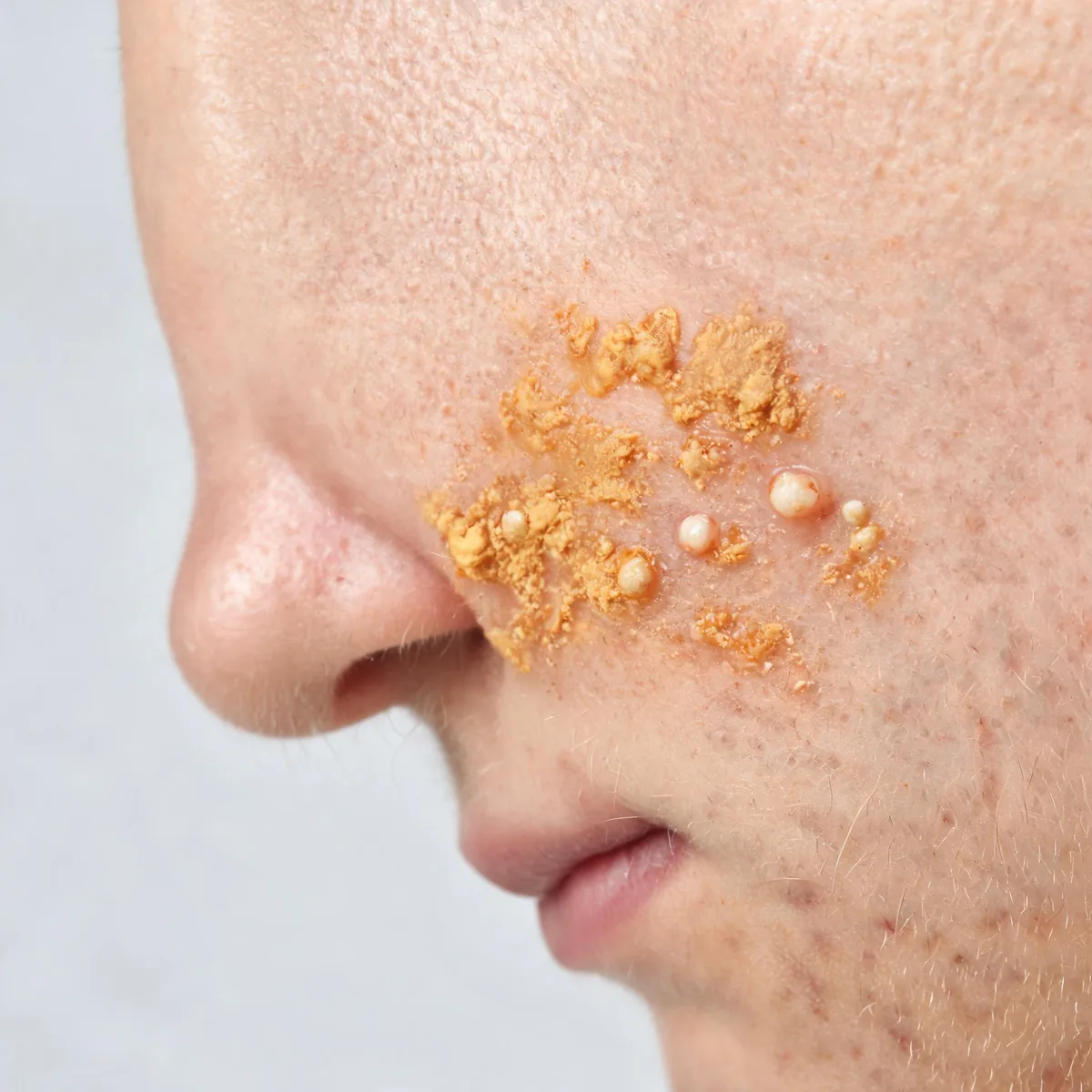
Understanding Impetigo
The classical literature links impetigo to the interplay of Dampness and Heat, which may come from hot humid weather outside or from an internal imbalance.
The skin is described as the exterior of the body, with the Lungs governing the opening and closing of the pores. When hot humid weather, or internal damp heat from diet, overwhelms that surface, the result is dense clusters of yellow oozing pustules with red halos.
A more severe Toxic-Heat picture is described when pus-filled blisters develop thick honey-coloured crusts with marked redness, heat, swelling and fever.
Where lesions ooze clear fluid and heal slowly, recurring after fatigue or dietary excess, the pattern is Spleen deficiency with dampness. Two stagnation patterns are also described for painful hard nodules and for stabbing pain in long-standing lesions.
The skin is treated as the body's exterior, with the Lungs controlling the opening and closing of the pores. Impetigo is read less as a problem of the pores than as a meeting of dampness and heat, and those can arrive from outside with hot humid weather or from inside when the Spleen cannot transform fluids. Recurrent cases are most often rooted in the Spleen: when it fails to separate the clear from the turbid, dampness accumulates and overflows to the skin, which is why some people develop the same sores repeatedly despite good hygiene.
Emotion and time add the other two pictures. When stress and frustration stagnate Liver Qi, the resulting heat can flare upward and outward, producing painful inflamed lesions that heal slowly. When the illness drags on, unresolved dampness and heat congeal into stasis, and the sores become hard, dark and stabbing rather than weepy and red. One diagnosis therefore covers five patterns, and which one is active is read from how the lesions look, what season they appear in and what the rest of the body is doing.
Conventional view
Impetigo is a bacterial skin infection that spreads very easily, most often from Staphylococcus aureus or Streptococcus pyogenes. It starts as red sores or blisters, most often around the nose and mouth, which rupture, ooze and form the honey-coloured crust that gives the condition its name. It is most common in children and in warm humid weather, and spreads through close contact and shared towels or clothing. Diagnosis is usually clinical, with a swab taken when the bacteria need confirming.
Conventional treatment depends on extent. Mild, localised infection is treated with topical antibiotics such as mupirocin or fusidic acid; more widespread or severe infection needs oral antibiotics such as cephalexin or dicloxacillin. Hygiene is part of the treatment, not an optional extra: gentle washing of the sores, short nails and no scratching limit spread to other areas and other people.
Antibiotics kill the bacteria effectively, but they do not explain why one child develops impetigo repeatedly while another does not. Overuse contributes to resistance, and oral courses can upset the stomach or trigger allergic reactions. In recurrent cases the underlying susceptibility, whether constitutional weakness or accumulated internal dampness lies behind it, stays untouched. This is the gap TCM addresses: by changing the internal environment, the skin becomes a less hospitable place for infection to take hold. Fever over 38.3 C with a spreading rash, red streaks, or sores near the eyes need urgent medical care rather than herbal treatment alone.
Selected PubMed records
Real PubMed records for the conventional discussion above, selected by condition name and title relevance. They are references, not a claim that any treatment is proven for this condition.
- Impetigo: diagnosis and treatment.. American family physician, 2014. PMID: 25250996.
How it connects
Impetigo and atopic dermatitis often appear together, especially in children. Atopic dermatitis frequently stems from a Spleen deficiency that lets internal Dampness build up; that Dampness surfaces through the skin, causing itching and a weakened barrier, and when the skin is scratched and broken, external Damp-Heat or Summer-Heat pathogens invade and transform into the yellow crusted pustules of impetigo. The two conditions feed each other, because the oozing and crusting of impetigo damage the skin further and leave it more vulnerable to future eczema flares. Treating the underlying Spleen deficiency and clearing Damp-Heat is what breaks the cycle: strengthening the Spleen and drying Dampness addresses the root while topical herbal washes clear the acute infection.
How it is assessed
Diagnosis looks at the crusts, the season, and whether the infection is spreading.
What a practitioner looks for
- Crust type: honey-coloured thick crusts and pus suggest Toxic-Heat; oozing thin fluid with slow healing suggests Spleen deficiency.
- Season: outbreaks in hot humid weather support the summer heat pattern.
- Systemic signs: fever, thirst and restlessness indicate toxic heat and need medical review.
- Spread: new lesions appearing rapidly, or lesions around the nose and mouth in children, need prompt medical attention.
The practitioner asks when the rash began and what the lesions have done since. Crops of yellow, honey-crusted pustules with red halos that erupt in hot, sticky weather point to Summer Heat with Dampness, the classic early picture, supported by a red tongue carrying a thick, greasy yellow coat, with a slippery rapid pulse.
Greater intensity moves the reading toward Toxic-Heat: deeper redness, blisters thick with pus, fever, thirst and restlessness, with a pulse that is faster and more forceful than in the seasonal picture. Where lesions ooze and heal slowly in a tired person with a poor appetite, a pale puffy tongue and a soft weak pulse, the pattern is Spleen Deficiency with Dampness. Hard painful sores that resist healing in an irritable person, with a tongue redder at the sides and a wiry rapid pulse, suggest Liver Qi Stagnation transforming into Heat, and old lesions that turn dark, hard and stabbing with a dusky tongue and a wiry rough pulse suggest Qi and Blood Stagnation once the acute infection has passed.
TCM patterns in Impetigo
Five patterns are described, and they are separated by what the lesions are doing rather than by where they sit. Summer Heat with Dampness is the seasonal picture: crops of oozing yellow pustules ringed with red in hot humid weather, with heaviness, a stuffed chest and thirst without much wish to drink. Toxic-Heat is the same process intensified, with thick honey-coloured crusts, marked redness, fever and a raging thirst. Spleen Deficiency with Dampness is the slow recurrent picture, where lesions ooze a clear or slightly yellow fluid, healing stalls, and fatigue, bloating and loose stools point to internal weakness. Liver Qi Stagnation transforming into Heat gives painful hard nodules with irritability and rib-side distension, while Qi and Blood Stagnation is what remains when the sores have turned dark and stabbing. Appearance, season, systemic signs and pulse separate them.
| Pattern | Key signs | The itch | Tongue | Main formula |
|---|---|---|---|---|
| Summer Heat with Dampness | Dense clusters of yellow oozing pustules with red halos | Not specified | Body: RedCoat: White greasy, turning yellow greasy if Heat predominates | Not specified |
| Toxic-Heat | Pus-filled blisters with thick honey-coloured crusts; Intense redness, heat and swelling | Not specified | Body: Red, often with raised red pointsCoat: Yellow, dry, sometimes thick | Not specified |
| Spleen Deficiency with Dampness | Lesions ooze clear or slightly yellow fluid | Not specified | Body: Pale and swollen, often with teeth marks along the edgesCoat: White, greasy and moist, thick in the middle | Not specified |
| Liver Qi Stagnation that transforms into Heat | Painful hard inflamed nodules; Distending pain in the ribcage | Not specified | Body: Red, with the sides redder than the centreCoat: Yellow | Not specified |
| Qi And Blood Stagnation | Stabbing pain in the lesions | Not specified | Body: Purple or dark, with stasis spots; sublingual veins dark and distendedCoat: Thin white | Not specified |
Summer Heat with Dampness
The seasonal picture: yellow oozing pustules in hot humid weather.
Summer heat and dampness arrive together in hot, humid weather and settle on the skin, where they clog the pores and create a warm, sticky environment in which pus forms. The result is crops of yellow pustules that ooze and sit inside red halos. The same dampness and heat disturb the Spleen and Stomach internally, which is why the skin signs come with heaviness, a poor appetite, a stuffed feeling in the chest and upper abdomen, and thirst with little desire to drink.
The tongue is red with a white greasy coat that may turn yellow as the heat intensifies, and the pulse is soggy and rapid. Heat, humidity, sweating, greasy or sweet food and stress all worsen it, while cool dry weather, light cooling food such as mung bean soup, gentle washing and rest help. The herbs named for this presentation are Huang Qin, Huo Xiang, Ma Chi Xian and Jin Yin Hua, and the points are Fenglong (ST-40), Zusanli (ST-36), Xuehai (SP-10) and Xingjian (LR-2).
Signs
- Dense clusters of yellow oozing pustules with red halos
- Worse in hot humid months
- Body heaviness and fatigue
- Stuffiness in chest and upper abdomen
- Thirst with little desire to drink
Diet and lifestyle for this pattern: Eat light, cooling food that drains Dampness, such as mung bean soup, bitter melon and cucumber, and avoid greasy, fried, spicy and very sweet food that creates more internal Dampness and Heat. Stay in a cool dry environment and wear loose breathable cotton to reduce sweating and friction on the sores.
Toxic-Heat
The severe picture: honey-coloured crusts with heat and fever.
When dampness and heat are not cleared, they can concentrate into a fiery toxin that rises to the surface. The skin then erupts in furious red blisters filled with pus that crust over quickly with thick honey-coloured scabs, and the whole body reacts: fever, a sensation of heat, a raging thirst that wants cold drinks, urine that is dark and scanty, or constipation, and a flushed look as the toxin is pushed outward.
The tongue is red with prickly thorns and a dry yellow coat, and the pulse is rapid, forceful and slippery. Spicy, greasy or fried food, hot humid weather and scratching all feed the fire, while cool compresses, cooling food and rest in a cool airy room ease it. Wu Wei Xiao Du Yin is the primary formula, with Huang Lian Jie Du Tang where fever and systemic signs dominate and Bing Peng San applied topically to crusted lesions; the herbs named are Jin Yin Hua, Lian Qiao, Huang Lian and Ban Lan Gen, and the points are Dazhui (DU-14), Quchi (LI-11), Hegu (LI-4) and Xuehai (SP-10).
Signs
- Pus-filled blisters with thick honey-coloured crusts
- Intense redness, heat and swelling
- Fever and body heat
- Intense thirst for cold drinks
- Dark scanty urine
Diet and lifestyle for this pattern: Eat plenty of cooling, water-rich food such as cucumber, watermelon and mung bean soup, and strictly avoid spicy, greasy and fried food as well as alcohol and coffee, which add fuel to the internal fire. Keep the skin clean and dry, wash gently with a mild cooling herbal wash such as diluted honeysuckle tea, and resist scratching or picking the crusts.
Spleen Deficiency with Dampness
The slow, recurrent picture with a digestive deficiency.
A weak Spleen fails to transform food and fluids, and dampness accumulates internally and overflows to the skin, producing lesions that ooze clear or slightly yellow fluid and heal slowly. Because the Spleen also underpins defensive Qi, such lesions return after fatigue or a dietary lapse rather than clearing once and staying away. The internal picture matches: fatigue, drowsiness after meals, a poor appetite, abdominal bloating, loose stools and a heavy feeling in the body and limbs.
The tongue is pale and swollen with teeth marks, a white greasy coat and a moist surface, and the pulse is soggy and slow, weak and slightly slippery. Cold and raw food, dairy, overwork and damp weather all aggravate it, while warm easily digested food, rest and a dry warm environment help. Shen Ling Bai Zhu San is the formula, with Bai Zhu, Fu Ling and Yi Yi Ren, and the points are Zusanli (ST-36), Sanyinjiao (SP-6), Yinlingquan (SP-9) and Pishu (BL-20).
Signs
- Lesions ooze clear or slightly yellow fluid
- Slow healing with recurrence
- Fatigue and drowsiness after meals
- Poor appetite with abdominal bloating
Diet and lifestyle for this pattern: Eat warm cooked food such as congee, stews and soups, and avoid cold, raw and greasy food that weakens the Spleen. Gentle daily walking circulates Qi without overexertion, and keep the skin clean and dry.
Liver Qi Stagnation that transforms into Heat
Painful hard nodules with irritability and rib-side distension.
When stress and frustration persist, the Liver loses its ability to keep Qi moving, and the stagnation generates heat and fire that rise and flare at the skin. Because the Qi is stuck rather than the skin simply infected, the lesions are hard, painful, inflamed nodules that heal slowly, often on the trunk or the rib-side, and the person feels irritable and explosively angry with distending pain in the ribcage and a bitter taste in the mouth.
The tongue is red with redder sides and a thin yellow coat; the pulse is wiry, rapid, and most marked at the left Guan position. Anger, spicy food, alcohol and hot weather provoke it, while stress reduction, cooling food, gentle exercise and cold compresses ease it. Dan Zhi Xiao Yao San is the formula, with Chai Hu, Zhi Zi and Mu Dan Pi, and the points are Taichong (LR-3), Xingjian (LR-2), Xiaxi (GB-43) and Ganshu (BL-18).
Signs
- Painful hard inflamed nodules
- Irritability and explosive anger
- Distending pain in the ribcage
- Bitter taste in the mouth
Diet and lifestyle for this pattern: Prioritise stress management through gentle exercise such as walking or yoga, and avoid spicy, greasy and fried food as well as alcohol, which add Heat. Eat cooling food such as cucumber, chrysanthemum tea and mung beans, and keep the affected area clean without scratching to prevent secondary infection.
Qi And Blood Stagnation
Hard dark nodules with stabbing pain in long-standing lesions.
When impetigo persists, the dampness and heat that have not resolved can congeal into stasis, and the lesions stop behaving like an active infection. They become hard, dark or purplish nodules with stabbing pain, and the circulation through the surrounding skin is poor. Emotional stress, itself a cause of Liver Qi stagnation, makes the stagnation worse and is one reason the nodules resist healing.
The tongue is dark purple with stasis spots, the veins beneath it distended, and the coat thin and white; the pulse is wiry and choppy. Cold and inactivity congeal blood further, while warmth, gentle exercise and stress reduction promote flow and soften the nodules. Xue Fu Zhu Yu Tang is the formula, with Dan Shen, Tao Ren and Chuan Xiong, and the points are Taichong (LR-3), Xuehai (SP-10), Geshu (BL-17) and Quchi (LI-11).
Signs
- Stabbing pain in the lesions
- Hard dark or purplish nodules
- Dark purple tongue with stasis spots
- Irritability or chest distension
Diet and lifestyle for this pattern: Avoid cold raw food and heavy greasy meals that can congeal Blood, and include small amounts of turmeric, hawthorn and black fungus to move Blood gently. Light exercise such as walking or stretching helps Qi flow.
Treatment approach
How the tradition treats impetigo, with the herbs, formulas and points used for it.
Principles
- Clear heat and drain dampness while lesions are oozing and spreading.
- Resolve toxicity where crusts are thick and the skin is hot and swollen.
- Support the Spleen where the pattern is recurrent and slow-healing.
- Prevent spread: covering lesions and hand hygiene are part of care in both frameworks.
- What gets cleared depends on which pathogen is dominant. In an acute attack the work is to clear heat and drain dampness, using cooling, drying herbs internally and washes on the skin; in recurrent or chronic cases the emphasis moves to strengthening the Spleen so it can transform fluids, or to soothing the Liver so that heat stops flaring. The formula follows the pattern rather than the diagnosis, so a child whose pustules are dense and yellow, with a red tongue, may be given Wu Wei Xiao Du Yin, which clears toxin, while Shen Ling Bai Zhu San suits a pale tired child whose sores heal slowly. Across all patterns, decoctions of Ku Shen, Huang Lian or Jin Yin Hua are applied to the skin to dry, cool and speed healing, and contagion precautions apply throughout.
Herbs used
Formulas
- Wu Wei Xiao Du Yin
- Huang Lian Jie Du Tang
- Bing Peng San
- Shen Ling Bai Zhu San
- Dan Zhi Xiao Yao San
- Xue Fu Zhu Yu Tang
Acupoints
- ST-40 (Fenglong)
- ST-36 (Zusanli)
- SP-10 (Xuehai)
- LR-2 (Xingjian)
- DU-14 (Dazhui)
- LI-11 (Quchi)
- LI-4 (Hegu)
- SP-6 (Sanyinjiao)
- SP-9 (Yinlingquan)
- BL-20 (Pishu)
- LR-3 (Taichong)
- GB-43 (Xiaxi)
- BL-18 (Ganshu)
- BL-17 (Geshu)
What to expect
- Treated impetigo is described as improving within one to two weeks.
- Recurrence is common in children and where household spread is not addressed.
- Deep or spreading infection with fever requires antibiotics, not herbs alone.
- Acute cases move quickly. With a wash applied several times a day and an internal formula, crusts begin to dry within two or three days and new blisters stop forming, with the skin usually settling over one to two weeks. Chronic or recurrent lesions respond more slowly: less oozing and faster healing may be seen after a week or two, but the work of preventing the next episode takes far longer. Acupuncture, where it is used, is weekly and aimed at draining dampness and calming inflammation, and itching often eases within the first few treatments.
Safety and when to get help
Seek medical help urgently for
- Fever over 38.3 C with a spreading rash.
- A rapidly enlarging painful red area, or lesions with spreading redness and swelling.
- Widespread crusting with fever, or infection in a newborn or immune-suppressed person.
For anything severe, sudden or spreading quickly, read when a skin problem needs urgent care.
Cautions
- Impetigo is contagious: cover lesions, wash hands and avoid sharing towels and bedding.
- Do not stop prescribed antibiotics early.
- Children with recurrent impetigo need medical review.
Using this alongside conventional care
- TCM is described as complementary to conventional care: prescribed antibiotics and topical treatment continue alongside herbs and acupuncture, with contagion precautions in place throughout.
- TCM is described as combinable with antibiotic creams and oral antibiotics rather than an alternative to them. A herbal wash can be applied between antibiotic applications, provided the area is cleaned first and a fresh cloth or cotton ball is used each time. Anyone taking oral antibiotics should tell their practitioner so that herbs with a theoretical interaction can be avoided, though such interactions are described as rare. Prescribed antibiotics are not stopped early, and the contribution claimed for herbs is a lower chance of repeated courses because the underlying imbalance is being addressed.
Diet and lifestyle
- Avoid sugar, dairy, greasy fried food, alcohol and excess spicy food, and favour cooling dampness-draining foods.
- Diet is aimed at reducing what feeds dampness and heat. Sugar, dairy, fried greasy food, alcohol and excess spicy food are the ones to limit, while cooling dampness-draining food such as mung beans, adzuki beans, cucumber and celery is favoured, with lightly cooked easily digested meals supporting the Spleen. Children need the same advice more simply: sweets and sugary drinks feed dampness, so cutting them back comes first. Room-temperature water is preferred to iced drinks, which weaken the Spleen. When Summer Heat with Dampness dominates, light cooling food such as mung bean soup and bitter melon helps; where Toxic-Heat dominates, water-rich cooling food and no alcohol or coffee matters more; where the Spleen is deficient, warm congee, stews and soups replace cold and raw food; and where stagnation dominates, a little turmeric, hawthorn and black fungus moves blood gently.
If you're pregnant
Pregnancy draws Qi and Blood towards the fetus, which can make Spleen deficiency patterns more pronounced, and the lesions tend to ooze more and heal more slowly. Strong toxin-clearing herbs such as Huang Lian and Da Huang are contraindicated, because they are too cold and may harm the pregnancy. Milder herbs such as Jin Yin Hua and Lian Qiao are safer, given in low doses alongside herbs that tonify the Spleen.
External treatment is preferred, with washes made from Ma Chi Xian or Pu Gong Ying. Acupuncture is an option, though points over the lower abdomen or sacrum are avoided. Any treatment in pregnancy belongs with a practitioner experienced in its care.
If you're breastfeeding
Bitter-cold herbs such as Huang Lian can enter breast milk and give an infant diarrhoea, so they are avoided while nursing. A herbal wash applied to the skin is the first choice, because systemic absorption is minimal. Where internal herbs are needed, gentle damp-heat clearing with herbs such as Yi Yi Ren and Jin Yin Hua is preferred.
Acupuncture is safe while nursing and can ease inflammation and itching. Where the Spleen is deficient, dietary adjustments may also help, supporting milk production while dampness is cleared.
If treating a child
Children are the group most often affected, especially through hot humid summers, and Toxic-Heat and Summer Heat with Dampness are the patterns seen most often. In a child the Spleen is often immature, so dampness gathers easily. Decoction doses should be cut to about a quarter to a half of the adult amount according to age and weight, and external treatment is often sufficient and well tolerated, whether a wash made from Ma Chi Xian or an application of San Huang Xi Ji.
Since a child cannot always describe what is happening, the tongue coating and behaviour are observed instead: a thick greasy coat, irritability and scratching all count. Acupressure or paediatric tuina on points such as Quchi (LI-11) and Zusanli (ST-36) often takes the place of needling, supporting the Spleen and clearing heat.
If treating an elderly patient
Impetigo is uncommon in older people but can appear where chronic Spleen deficiency and dampness accumulation sit alongside conditions such as diabetes. Of the five patterns, Spleen Deficiency with Dampness is the most likely, and healing is slower because Qi and Blood are weaker. Strong heat-clearing herbs are used cautiously so that the Spleen and Stomach are not damaged further, and a gentle formula such as Shen Ling Bai Zhu San suits this picture.
Topical treatment is safe, and acupuncture may be used with gentle stimulation. Where several medications are in use, interactions need checking. The aim is to support the body in clearing the infection gradually rather than attacking it aggressively.
Urgent-sign guidance is based on standard sources: NHS anaphylaxis, NHS cellulitis, NHS Stevens-Johnson syndrome, NHS melanoma.
Evidence
Evidence status
Compiled for this page from the classical and modern literature; not a systematic review, so treat it as a pointer to sources rather than clinical guidance.
Evidence rests mainly on clinical experience and observational studies from China, and a 2020 expert consensus sets out standardised diagnostic and treatment protocols. Several small randomised trials found topical herbal washes containing Ma Chi Xian or Huang Bai as effective as topical antibiotics such as mupirocin, with fewer side effects, though larger blinded multicentre trials are still needed. Impetigo is contagious bacterial infection, so medical care comes first.
Three strands make up the evidence. A 2020 expert consensus sets out standardised diagnostic and treatment protocols, which shows how widely the approach is used clinically rather than how well it has been tested. Several small randomised trials found topical washes containing Ma Chi Xian or Huang Bai as effective as mupirocin, with fewer side effects. Beyond that, the claim is that combining internal herbs with external washes reduces recurrence by addressing Spleen deficiency and damp-heat, which is plausible and clinically reported but not yet established in large blinded multicentre trials.
Studies often cited
Standardised TCM diagnostic and treatment protocols, reflecting widespread clinical use rather than trial evidence. 2020 expert consensus (as recorded in the source)
Small randomised trials report similar effectiveness to topical antibiotics with fewer side effects. Small randomised controlled trials (as recorded in the source)
Classical record
Impetigo is a superficial damp-heat condition. When summer-heat and dampness invade the skin, they cause itching, redness and yellow crusts. Treatment should clear heat and resolve dampness, using topical powders and washes.
- Wai Ke Zheng Zong (Orthodox Manual of External Medicine), chapter on sores. The Chinese original is not reproduced here: it could not be recovered reliably from the source record, and is not guessed.
黄水疮者,由湿热搏于皮肤,毒气熏蒸,变生疱疮,破流黄水,浸淫成痂。小儿夏日多有之。
The yellow-water sore comes from dampness and heat striking the skin, where the toxic Qi steams upward and produces vesicles; these break, discharge yellow fluid and spread into crusts. Children commonly have it in summer.
Zhu Bing Yuan Hou Lun, volume 35 - Classical citation: Zhu Bing Yuan Hou Lun (Treatise on the Origins and Symptoms of Diseases), volume 35.
Common questions
Is impetigo contagious?
Yes. It is a bacterial skin infection and spreads by contact, so covering lesions and hand hygiene are part of management in both frameworks.
Can TCM treat impetigo without antibiotics?
The tradition describes herbs for the damp heat picture, but a spreading infection with fever needs antibiotics. This page does not present herbs as a substitute for that.
How long does it take to clear?
Treated cases are described as improving within one to two weeks, with recurrence common in children if household spread continues.
Should children stay off school?
Contagion guidance is a medical and public health matter. The classical literature emphasis is on covering lesions and hygiene. Follow your doctor or school health advice.
Is impetigo contagious while using herbal treatment?
Yes. The infection stays contagious until the sores have dried over and formed crusts, usually a day or two after effective treatment begins. Lesions should be covered with clean dressings, towels and clothing should not be shared, and hands should be washed often. A herbal wash reduces the bacterial load on the skin but does not replace those precautions.
Can I use herbal washes alongside antibiotic cream?
The tradition describes this as straightforward: wash or compress the area first to clean and cool it, let the skin dry, then apply the antibiotic cream, using a fresh cloth or cotton ball every time. Both the practitioner and the doctor should know what is being used so that the two can be coordinated.
Does my child need to change their diet to prevent impetigo?
Diet is described as playing a large part in recurrence. Sugar, dairy and greasy food create internal dampness and heat that leave the skin more vulnerable, so reducing sugary drinks, sweets and fried snacks while adding cooling food such as mung beans, cucumber and lightly cooked vegetables is the practical change. Children who develop impetigo every summer often respond to it.
Will acupuncture help with the pain and itching?
The tradition describes acupuncture as reducing itching, pain and inflammation, frequently within the first session, using points that clear heat and dampness from the channels involved and calm the mind so that the urge to scratch drops. Where a child fears needles, gentle massage or acupressure on the same points is used instead. It sits alongside topical and internal treatment rather than replacing them.