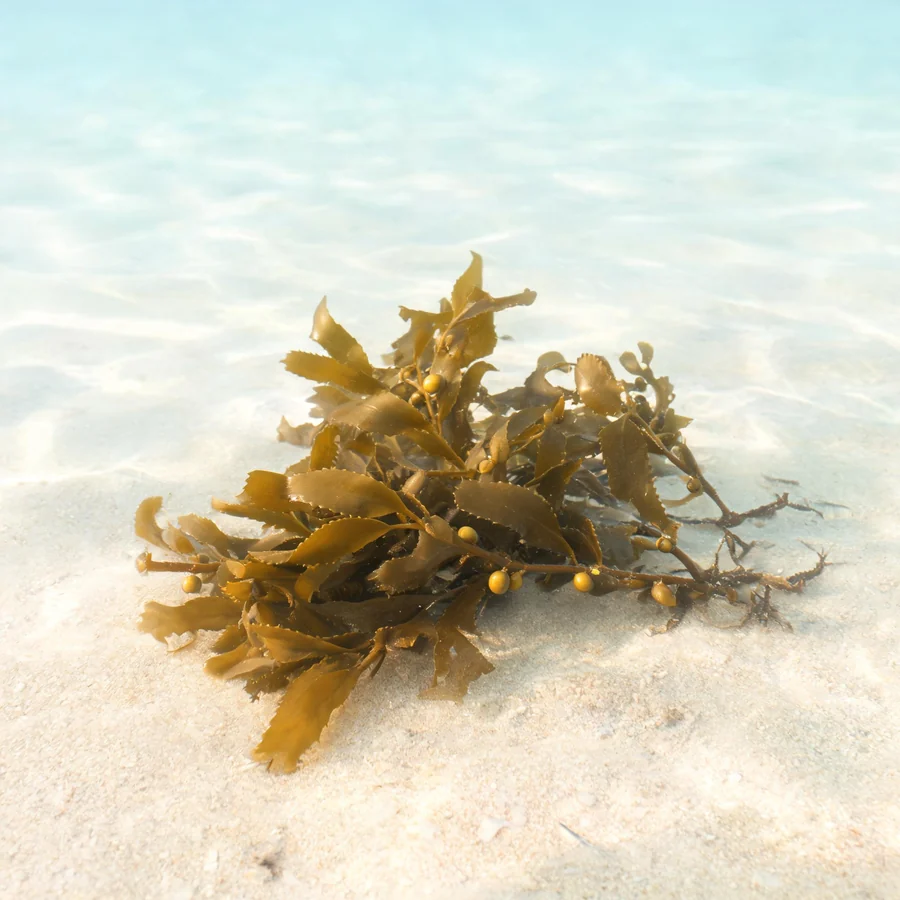
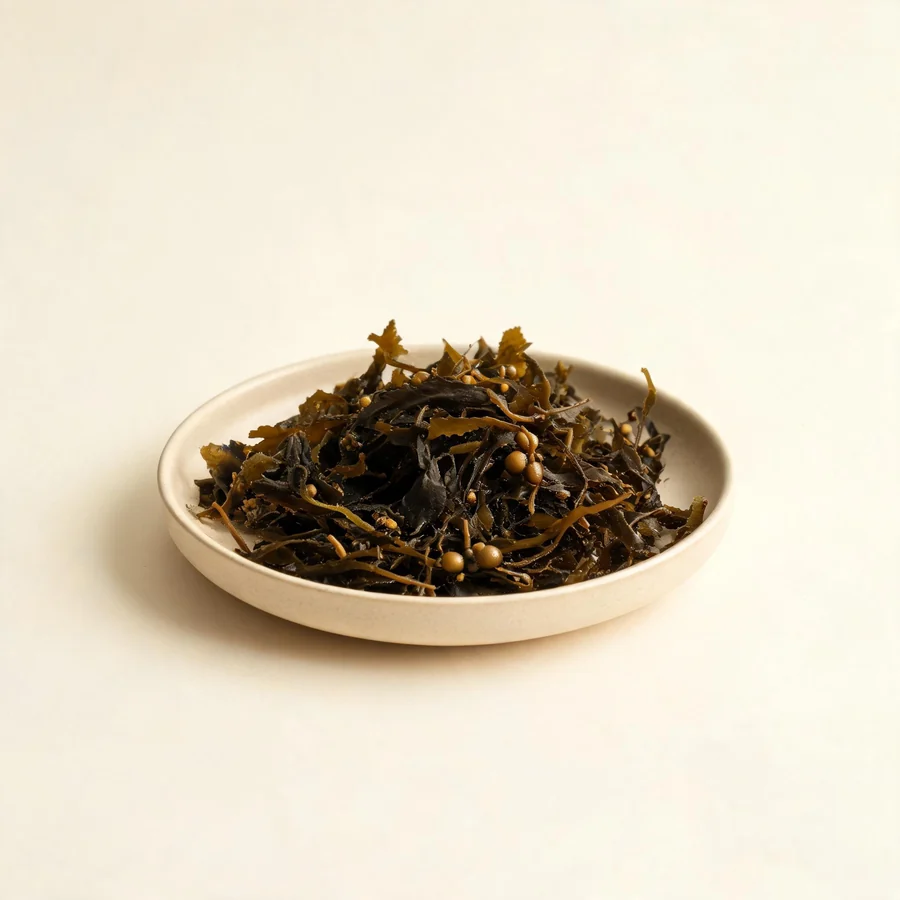
Skin profile
Where this herb sits in skin practice: the pattern it corrects, the skin signs it suits, and what it should not be used for.
Hai Zao is a softening herb for what has set under the skin: a soft nodule, a cyst, a thickened plaque, a doughy swelling. Its iodine load, its incompatibility with licorice and the need to diagnose a lump before treating it are the three facts that govern its use.
Skin signs that suggest it
- A firm, painless nodule under the skin that has been present for months and has not changed
- A cyst or lipoma that is soft to firm, movable and not inflamed
- Thickened, hardened or leathery skin over a plaque or an old scar
- A doughy, puffy swelling of a limb or an eyelid that pits slightly
- A goitre or a swollen lymph node in the neck, with a normal or known thyroid status
- A greasy tongue coating and a pulse that feels slippery
When it is not the right herb
Not for anything that is new, growing, painful, hot or fixed to deeper tissue: a lump like that needs imaging or a biopsy before it needs a herb. Not for a weeping, infected or ulcerated lesion, which needs drainage and antibiotics rather than a softening agent. Not for anyone with an overactive thyroid, or with a thyroid nodule that has not been assessed, and not alongside licorice. A cold, weak digestion is the last caution, because a salty cold seaweed taken for months is hard on a Spleen that is already cold.
What it does for skin
Skin-relevant actions only. Each one describes a mechanism in TCM terms and what it looks like on the skin.
Softens hard tissue
The salty taste is read as loosening what has become fixed, in the same way that salt breaks down a brine-cured food. Applied to the skin's domain, that means a nodule, a cyst wall, a keloid or a plaque that has thickened and lost its elasticity, and the herb is chosen where the change is slow and firm rather than red and active. Its coldness answers the mild heat that anything stagnant for a long time tends to generate, so the same material loosens the mass and cools the process building it.
Dissolves the Phlegm that gives a lump its substance
In this framework Phlegm is not only what is coughed up; it is thickened fluid that has stopped moving and set. Under the skin it appears as a soft or rubbery lump, a cyst, a lipoma or a patch of thickened dermis, and a bitter taste is said to dry it while a salty one breaks it apart. This is why the action is normally named in the same breath as softening hardness: Phlegm supplies the substance, hardness the shape it has set into.
Moves fluid out of a puffy, swollen surface
The salty downward quality is read as guiding water towards the bladder, and the herb is used as a supporting one where swelling sits alongside nodular disease, so that one agent addresses both the lump and the fluid around it. It is not a strong diuretic and it is never the leading herb for oedema, but in a puffy face or a heavy limb with a nodule it adds something the standard water-moving herbs do not. Pitting oedema of a whole limb needs a medical cause found.
Cools and disperses a hot, tender nodule
When a nodule is sore, the overlying skin hot and the tongue red with a yellow coating, Fire has formed out of the stagnation, with Phlegm as its vehicle. The coldness is directed at that Fire and the saltiness at the hardened material, so the herb fits precisely where mass and heat are present together. It is a poor choice where the picture is pale and cold, and a hot tender red leg is a reason to exclude infection and clot first.
Skin conditions it is used for
Mapped to the condition pages on this site. The pattern column shows what the skin is doing when this herb is the right choice.
| Condition | Pattern | Why it suits | Typical setting |
|---|---|---|---|
| Subcutaneous lipomas and nodules | Phlegm congealed under the skin | A soft, movable, painless lump is the clearest picture of Phlegm that has set, and the salty softening action is aimed directly at it. The herb is used in a formula with other softening agents over months, and it is judged by whether the lump stops growing and softens rather than by whether it disappears. A lipoma is harmless and usually needs nothing at all; anything that is growing, painful or hard needs assessment before it is treated. | Hai Zao Yu Hu Tang style formulas, with Kun Bu and Zhe Bei Mu |
| Sebaceous cysts | Dampness thickened into a nodule | A cyst with a visible punctum and cheesy contents is read as dampness thickened into a sac, and the salty cold action is used to soften the wall and disperse the surrounding congestion. It is a modest adjunct, not a cure, and the practical rule is clinical: a painless cyst can be left alone, while one that is red, tender, growing or discharging needs a doctor, because infection and, rarely, a tumour can look similar. The herb does not replace drainage when drainage is needed. | A Phlegm-dissolving formula with Zhe Bei Mu and Mu Li |
| Skin swelling | Dampness collecting with Phlegm | Puffy, heavy, slightly doughy swelling, worse in the morning and in humid weather, is read as fluid that has stopped moving. The seaweed is a supporting herb in the water-moving part of the formula, and its value is that it addresses the sticky component that keeps the swelling from resolving. It is not the herb for a swollen leg that is hot, red or one-sided, which needs urgent assessment for infection or clot. | A damp-draining formula with Fu Ling, Ze Xie and Kun Bu |
| Thickened or insensitive skin | Phlegm and stasis hardening the surface | Thickened, leathery or numb skin over a plaque or an old scar is read as Phlegm and Blood stasis fixed in the skin channels, and the softening action is used to loosen what has set. The seaweed is an adjunct to blood-moving and Phlegm-transforming herbs, and it is not expected to reverse established thickening on its own. Rapidly spreading hardness, or skin that has become tight over a whole limb, needs a diagnosis rather than a course of seaweed. | A formula with Zhe Bei Mu, Dan Shen and Mu Li |
| Erythema nodosum | Phlegm-heat nodules with heat in the deeper tissue | Tender red nodules on the shins are a heat pattern with a nodular component, and a salty cold herb that softens nodules while cooling the heat is a logical supporting choice. It is used where the nodules are firm and recurring rather than newly hot and spreading, and alongside the herbs that clear the damp-heat properly. Fever, joint pain and breathlessness with a crop of nodules need a cause identified, since the same picture appears in infection and in sarcoidosis. | A damp-heat formula with Zhe Bei Mu, Lian Qiao and Kun Bu |
Combinations for skin
Herbs it is paired with when the skin, not an internal organ, is the target.
| Partner | Ratio | Why the pair is used |
|---|---|---|
| Kun Bu | 10 to 15 g of each | Two salty, cold seaweeds, both of them softeners of hardness, and they are almost always used together for nodules, which is why they are treated as a unit rather than as alternatives. Kelp is the more commonly supplied and clears heat and swelling a little better, while this seaweed is stronger at dissolving Phlegm and moving water. Together they are the backbone of the traditional nodule formulas, and both carry an iodine load that has to be counted once. |
| Zhe Bei Mu | 10 g of each | Fritillary clears heat and transforms Phlegm from within, while the seaweed softens and breaks the shell of a mass from without, so one works on the material that keeps forming and the other on the structure already formed. The pair is used for a firm nodule with heat signs, and it is one of the few combinations in this group aimed at a specific lump rather than at a whole pattern. |
| Mu Li | 10 to 15 g of the seaweed with 15 to 30 g of the shell | Oyster shell is a dense mineral that both softens hardness and settles Yang as it rises, so it suits a nodule in someone with flushing, palpitations or a bounding pulse, where the same constitution is driving both. The seaweed supplies the Phlegm and water side and the shell the settling side. Both are cold, so the digestion is the limiting factor for a long course. |
| Xuan Shen | 10 g of this seaweed with 15 g of figwort | Figwort has its own tradition for scrofula, so it covers the heat and the Yin damage that a node present for months creates, while the seaweed does the softening. Where the tongue is red and dry the pair also protects fluid that cold drying herbs would otherwise consume. It belongs to the chronic case rather than the acute one. |
| Xia Ku Cao | 10 g of this seaweed to 15 or 20 g of prunella | Prunella addresses the Liver Fire behind so many nodules, while the seaweed addresses the Phlegm that same Fire has hardened, so each covers a different half of one process. The pair suits a lump with irritability, redness of the eyes, headache or a bitter taste, each a sign that Fire is still feeding the lump. It is the standard combination for neck nodes with heat signs. |
Formulas where it leads
- Hai Zao Yu Hu Tang (海藻玉壶汤) - The classical formula for a goitre or a neck nodule, from the Ming surgical compendium Wai Ke Zheng Zong, built on this seaweed with kelp, fritillary and licorice. That last ingredient is the interesting part, because the herb is nominally incompatible with licorice and this formula breaks the rule deliberately. It is included as the classical setting for the softening action, not as a skin prescription.
Topical use
External use is minor, and it belongs to tradition rather than to routine practice: a decoction of the washed seaweed has been used as a wash for a swollen area, and it is secondary to internal treatment. It suits a cool, doughy swelling rather than a broken surface, and far less iodine is taken up through intact skin than is swallowed in a decoction. A hot, red or broken area should not be washed with it.
| Preparation | How and when it is used |
|---|---|
| Wash for a doughy swelling | Simmer 15 to 20 g of washed, dried thallus in 600 ml of water for 20 minutes, strain and cool to skin temperature. Bathe the area for 10 minutes once daily, then discard the liquid. Keep it off broken skin and out of the eyes, and stop after a week if the swelling has not changed. |
Patch test and cautions
Use only on intact skin, and patch test on a small area first. Do not use on a hot, red, tender or broken area, which needs assessment rather than a wash. Seaweed from a polluted coast can carry heavy metals, so use only material from a reputable supplier, and do not continue a wash for a swelling that is growing.
Safety for skin use
What to check before recommending or using it, including the cautions that matter most for skin patients.
Do not use, or use with caution
- Thyroid disease that has not been assessed, and any overactive thyroid. The iodine load is large and variable, and extra iodine can worsen thyrotoxicosis; a thyroid nodule or goitre should be evaluated before a seaweed is taken for it.
- Licorice in any form. The classical mnemonic sets this seaweed against Gan Cao, and the pair is avoided in ordinary practice, including licorice in sweets, teas and prepared herbal products.
- A cold, weak digestion with loose stools. Being bitter, salty and cold, and taken over many months, it burdens a Spleen that is already cold.
- Pregnancy, and any unassessed lump. Iodine intake in pregnancy affects the fetal thyroid, and a lump that has not been diagnosed should not be treated with a softening herb.
Pregnancy and breastfeeding
Avoid, or use only under specialist advice. The classical literature lists seaweeds among pregnancy cautions, and the modern reason is more concrete: a large iodine load can disturb fetal thyroid development, especially after the first trimester when the fetal thyroid begins to concentrate iodine. The cold, dispersing, water-moving quality is the traditional objection. Normal dietary amounts of seaweed are a different matter from a medicinal decoction. In breastfeeding, iodine passes readily into milk, so a high intake is avoided; a short course at a modest dose belongs to a practitioner.
Interactions
- Thyroid medicines and iodine. The herb can work against levothyroxine replacement or add to antithyroid drugs such as carbimazole and propylthiouracil, and no one can predict the scale of that from the weight of seaweed used. Iodine-containing contrast media, amiodarone and kelp supplements compound the load.
- Diuretics and blood pressure medicines. The herb moves fluid, so it may add to the losses caused by loop or thiazide diuretics and to the effect of antihypertensives, which matters for anyone with a delicate fluid balance.
- Anticoagulants. Brown-algal polysaccharides have shown weak anticoagulant behaviour in early laboratory work, so caution is sensible with warfarin, heparin or antiplatelet drugs, although how much this matters at herbal doses has never been measured in people.
Allergy and patch testing
Contact reactions to a seaweed wash are uncommon, and the main risk is iodine sensitivity rather than a true allergy. Patch test any wash first and stop if the skin becomes more irritated. Anyone who reacts to iodine, to iodised salt or to shellfish should avoid the herb altogether, because the reaction is to the iodine rather than to the plant.
General safety references
General references for herbal hepatotoxicity and herb-drug interactions; they are not specific to this herb.
- Review article: Herbal hepatotoxicity - an update on traditional Chinese medicine preparations. Alimentary Pharmacology & Therapeutics, 2014. PMID: 24844799.
- Interactions between herbal medicines and prescribed drugs: an updated systematic review. Drugs, 2009. PMID: 19719333.
- Warfarin and food, herbal or dietary supplement interactions: a systematic review. British Journal of Clinical Pharmacology, 2021. PMID: 32478963.
Evidence
The classical record is quoted with its source. The modern note states the level of evidence plainly.
Classical record
疗皮间积聚,暴癀,留气,热结,利小便。
It treats accumulations between the skin, sudden swellings, retained Qi and masses bound by heat, and it frees the passing of urine.
Ming Yi Bie Lu (Supplement to the Classic of Materia Medica) - The earliest record places the herb at the skin and pairs the nodule work with the movement of water, a combination later herbals retain.
主瘿瘤气,颈下核,破散结气,痈肿癥瘕坚气,腹中上下鸣,下十二水肿。
It governs goitre and tumour Qi, hard nodes below the neck, and breaks up and disperses bound Qi, abscesses and swelling, and abdominal masses of hard Qi; it drains the twelve kinds of oedema.
Shen Nong Ben Cao Jing (Divine Husbandman's Classic of Materia Medica) - Abscess and swelling are named alongside the neck nodes, which is the basis for a skin use of the herb beyond the thyroid.
海藻,咸能润下,寒能泄热引水,故能消瘿瘤、结核、阴㿉之坚聚,而除浮肿、脚气、留饮、痰气之湿热。
Hai Zao is salty and able to moisten and descend, and cold and able to drain heat and lead out water; that is why it dissolves the hard accumulations of goitre, scrofula and genital swelling, and clears the damp-heat of oedema, beriberi, retained fluids and Phlegm Qi.
Ben Cao Gang Mu (Compendium of Materia Medica), Li Shizhen - Li Shizhen traces the actions back to the salty and cold character of the material, and this is the sentence the whole softening rationale rests on.
Modern evidence
Evidence status
- The iodine content is the established modern fact, and it is a two-edged one: a seaweed taken for a thyroid swelling can itself disturb thyroid function, with reports of a swing from underactive to overactive after months of high intake. How much iodine is present differs greatly between species and between coasts.
- No controlled trial of this seaweed in lipoma, cyst, keloid or any skin condition was identified. Laboratory work on algal polysaccharides reports anticoagulant and anti-inflammatory activity in vitro, which does not establish a benefit in a skin nodule.
- Regulatory status: the dried thallus is an accepted herbal substance in the Chinese Pharmacopoeia under the name Sargassum. Contamination with arsenic, mercury and lead is the documented quality concern, because seaweeds concentrate metals from the water they grow in.
PubMed records
Selected real PubMed records for this herb's species or its constituents, chosen by species name and title relevance. They are references for the non-TCM discussion above, not proof that the herb treats any skin condition.
- Sargassum pallidum reduces inflammation to exert antidepressant effect by regulating intestinal microbiome and ERK1/2/P38 signaling pathway.. Frontiers in pharmacology, 2024. PMID: 39092228 (skin-related record).
Dose and forms
Skin-practice dosing and the preparations that suit skin complaints.
| Form | Dose and notes |
|---|---|
| Decoction | 6 to 15 g of washed, dried thallus daily in a formula. The seaweed is rinsed before decocting to remove sand and surface salt, and it is added at the beginning with everything else. |
| Upper range | Up to 30 g for a stubborn nodule, under supervision and only when thyroid status is known. The higher figures belong to short courses, not to routine use. |
| Wash | 15 to 20 g simmered in 600 ml of water as a wash for a cool doughy swelling, once daily for about a week before it is judged. |
| Course length and monitoring | Two to three months with review for a slow nodule. Thyroid function is checked on a long course, and the course is stopped if the neck swells, the heart races or the weight changes. |
Iodine, not weight, is the variable that matters here. A decoction of a high-iodine species can deliver several times the iodine of a low-iodine one from a different coast, so a prescriber needs to know what else the person is taking for the thyroid before deciding a dose. The seaweed is washed to remove surface salt and grit, which does not remove the iodine. Long courses are avoided in anyone with thyroid disease, and the lower end of the range is used in the elderly.
Citations and further reading
Only real sources are listed: the classical materia medica passages quoted above, and the source works behind the botanical and safety statements.
- Ming Yi Bie Lu (Supplement to the Classic of Materia Medica), Han to Jin period - the entry on accumulations between the skin is quoted above.
- Shen Nong Ben Cao Jing (Divine Husbandman's Classic of Materia Medica) - the entry on goitre, neck nodes and abscess is quoted above.
- Ben Cao Gang Mu (Compendium of Materia Medica), Li Shizhen, 1578 - the passage on saltiness and coldness is quoted above.
- Sargassum monograph, Pharmacopoeia of the People's Republic of China - accepted species and part used.
- Safety literature on iodine intake and thyroid function, and on heavy metal contamination of edible seaweeds, summarised as a statement about risk rather than as a cited trial.
- Botanical literature on Sargassum pallidum and Sargassum fusiforme, Sargassaceae, for identification of the dried thallus.
Educational reference for qualified practitioners. This page is not medical advice, and skin conditions should be diagnosed by a clinician before treatment.