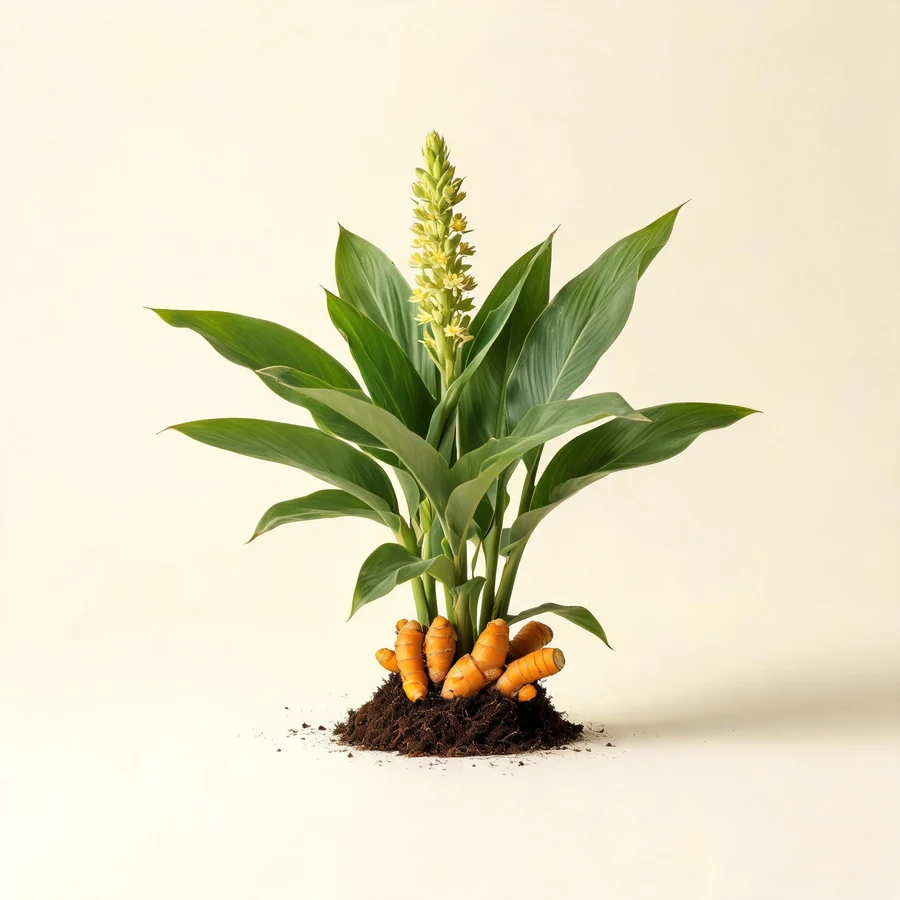
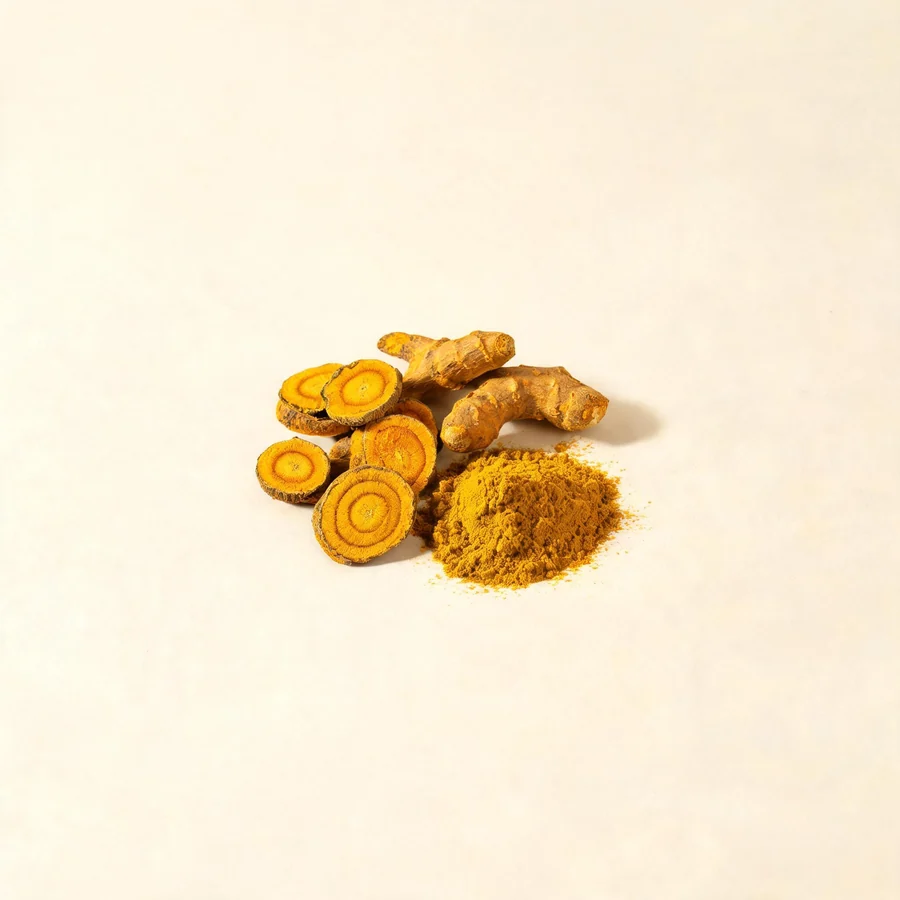
Skin profile
Where this herb sits in skin practice: the pattern it corrects, the skin signs it suits, and what it should not be used for.
Jiang Huang is on this page for blood that has congealed and stayed: the bruise that will not fade, the haematoma that stays hard, the plaque that is dark and fixed. Its warmth and its blood-breaking strength are the same quality, and both set its limits in pregnancy, in active bleeding and alongside anticoagulants.
Skin signs that suggest it
- Dusky, purple or blue-black discolouration that is slow to fade and tender when pressed
- Fixed, stabbing pain in a bruise, plaque or nodule that is worse at night and in cold
- Thick, dark red, firmly fixed plaques rather than bright, spreading ones
- Cold, stiff, aching shoulders or knees with dusky skin over the joint
- A purple or dusky tongue, or dark clotted menstrual blood in a person whose skin flares with the cycle
When it is not the right herb
Not for hot, red, spreading or weeping skin, where the warmth and movement add to the inflammation. Not for pale, dry, thin skin with no fixed pain and no dark discolouration, because there is nothing for a blood-breaking herb to break, and it may thin tissue that is already thin. Not in pregnancy, not in active bleeding, and not alongside anticoagulants without the prescriber knowing. Not for a child outside supervision, and not for someone with gallstones, because the rhizome stimulates bile flow.
What it does for skin
Skin-relevant actions only. Each one describes a mechanism in TCM terms and what it looks like on the skin.
Breaks stasis and disperses fixed swelling
The rhizome does not merely hurry blood that has slowed; it breaks blood already congealed into a lump or a fixed obstruction, and the signs are pain in one place, a purple tongue and dark clotted loss. On the skin that is the bruise that stays hard, the haematoma that will not resolve and the plaque that is fixed rather than spreading. The warm pungent quality is the mechanism in the tradition's logic, because cold congeals and warmth disperses what cold has gathered.
Moves Qi and relieves the pain of stagnation
Because it enters the Spleen as well as the Liver, it moves Qi alongside the Blood, which is why it fits the mixed picture of distension with a stabbing quality. Skin lesions rarely stagnate on one level only, and the same logic explains its use where a plaque is both tight and painful, or a bruise is both swollen and hard. Six grams of the rhizome with six of Zhi Ke is the pairing that separates the two levels cleanly.
Warms the channels and drives cold out of the skin
Cold is said to slow blood until it thickens and stalls, and the result is tissue that is dusky, cold to the touch and painful in winter. The rhizome is warm and is chosen when a plaque or a joint stiffens in cold weather and eases with warmth, which is the pattern behind its use in chilblains and in cold-type joint pain. It is a herb for cold stasis, not for a hot, red joint, where it would add fire.
Brightens a dusky, stagnant complexion
Blood stasis on the face is read as a dull, dark or uneven complexion with fixed dull-red or brownish patches, and the rhizome is a supporting herb in formulas that move Blood and lift the colour. It is never used alone for this, and it is not a whitening agent: the aim is to restore movement, not to bleach the skin. Pigmentation that is new, unilateral or changing needs dermatological assessment first.
Disperses swelling and pain when applied
The rhizome is one of the herbs in the classical external powder for hot, swollen, painful areas, where the cooling and drying ingredients dominate and the turmeric moves Blood and settles pain. Applied as a paste it is a short, local treatment for a bruise or a hard swelling, not a wash for a broad surface. The powder stains skin and cloth bright yellow, and it is kept away from broken skin.
Skin conditions it is used for
Mapped to the condition pages on this site. The pattern column shows what the skin is doing when this herb is the right choice.
| Condition | Pattern | Why it suits | Typical setting |
|---|---|---|---|
| Bruising | Blood stasis after injury, with hardness and fixed pain | A bruise that stays dark, hard and tender is congealed blood, and the rhizome's job is to break it up and restore movement. It is used internally in a stasis-moving formula and externally in a paste over intact skin, and the two routes are often combined for a haematoma that has stopped resolving. A bruise that appears without injury, or one that keeps enlarging, is a bleeding problem rather than a stasis pattern and needs assessment. | Modified Tao Hong Si Wu Tang with Jiang Huang |
| Skin swelling | Stasis swelling that is hard rather than hot | Swelling after a blow is blood and fluid trapped in the tissue, and the rhizome is chosen when the area is hard, dusky and tender rather than bright red and spreading. Its warming movement is paired with cooling and drying herbs in the external powder, which is why the same rhizome can appear in a preparation for a hot, swollen area without heating it further. A swelling that is hot, spreading or out of proportion to the injury needs assessment. | Ru Yi Jin Huang San, applied as a paste |
| Psoriasis | Blood stasis with thick, dark, fixed plaques | Psoriasis is read as a disorder of the Blood, and the stasis type shows thick, dark red, firmly fixed plaques that do not change much from week to week, with a purple tongue. The rhizome is a supporting herb in formulas that move Blood and soften the plaque, used when the colour is dusky rather than bright and the scaling is thick rather than thin. It is not a first-line herb for a hot, spreading flare, and it does not replace topical treatment of the plaques. | Modified Tao Hong Si Wu Tang or Xue Fu Zhu Yu Tang with Jiang Huang |
| Chilblains | Cold congealing the vessels, with stasis and pain | A chilblain is cold that has congealed blood in the small vessels, and the rhizome is used for the dusky, hard, painful stage rather than for a broken or ulcerated one. Its warmth disperses the cold and its movement breaks the stasis, and it is given with channel-warming herbs such as Gui Zhi. Chilblains that do not settle after the cold weather, or that come with colour change in the fingers, need a vascular assessment. | Modified Dang Gui Si Ni Tang with Jiang Huang and Gui Zhi |
| Psoriatic arthritis | Blood stasis with cold-damp obstruction of the joints | Psoriatic arthritis is read as a Blood-level skin problem meeting a painful obstruction in the joints, and the rhizome addresses both halves of that description, since it moves Blood and disperses cold-damp from the channels. It is used when the joints are stiff, cold and fixed rather than hot and swollen, and it is paired with wind-damp herbs such as Qiang Huo. Joint damage, deformity or a hot swollen joint needs rheumatological care, and the herb is an adjunct rather than a substitute. | Modified Juan Bi Tang with Jiang Huang and Qiang Huo |
Combinations for skin
Herbs it is paired with when the skin, not an internal organ, is the target.
| Partner | Ratio | Why the pair is used |
|---|---|---|
| Qiang Huo | 9 g each | Qiang Huo drives wind-cold-damp off the exterior while the rhizome moves Qi and Blood inside, so the pair attacks a painful obstruction from both sides. It is used for a stiff, cold, aching shoulder or knee with dusky overlying skin, where the surface and the deeper channels are both stuck. Both are warm and drying, so the pair is short and is avoided in a dry, hot picture. |
| Gui Zhi | 9 g rhizome with 6 to 9 g Gui Zhi | Cassia twig warms and opens the vessels while the rhizome breaks the stasis inside them, and the two warm the channels from different directions. The pair is used for cold-type obstruction with cold extremities and pain that is worse for cold, and for painful periods with dark clots in a person whose skin flares with the cycle. The twig's dispersing quality keeps the heavier rhizome moving. |
| Zhi Ke | 6 g each | Zhi Ke opens the chest and moves Qi while the rhizome moves Blood, which is the pairing that separates the two levels cleanly. It is used where a plaque or a bruise is both distended and stabbing, and where treating one level alone has failed because the two stagnations reinforce each other. Six grams of each is the traditional figure, and both are moving herbs that are avoided in pregnancy. |
| Rou Gui | 9 g rhizome with 3 g Rou Gui | Rou Gui is hotter and reaches deeper than the twig, and it suits cold that has gone into the interior. The proportions matter, the bark at a third of the rhizome, because equal parts would make a heating formula rather than a warming one. It belongs to cold stasis of the trunk rather than of a limb, and it is not used where there is heat. |
Formulas where it leads
- Ru Yi Jin Huang San (如意金黄散) - The classical external powder from the Wai Ke Zheng Zong, built on Jiang Huang with Da Huang, Huang Bo, Bai Zhi, Tian Nan Xing, Cang Zhu, Hou Po, Chen Pi, Gan Cao and Tian Hua Fen. It is applied with tea, honey or vinegar to a hot, swollen, painful area, and the cooling ingredients dominate while the turmeric moves Blood and settles pain. It is for intact skin, it stains, and it contains Tian Nan Xing, so it is used sparingly and not on broken or ulcerated surfaces.
Topical use
The rhizome's best-documented surface use is inside a compound powder for hot, swollen, painful areas, where it is one moving ingredient among cooling and drying ones. On its own it is also made into a paste for a bruise or a hard swelling, and the stain it leaves is a reminder that the material is potent dye as well as medicine. External use is short, local and kept to intact skin.
| Preparation | How and when it is used |
|---|---|
| Paste for a bruise | Two to three grams of finely ground rhizome is mixed with warm water or a little rice vinegar to a thick paste and spread over the discoloured area, leaving a margin of normal skin. It stays for twenty minutes and is then washed off, once a day for a few days, and it is stopped if the skin becomes red or sore. |
| Compound powder for a hot swelling | In the classical powder the rhizome is one part in a mixture dominated by cooling herbs, applied with tea or honey to a hot, hard, painful swelling. It is a practitioner's preparation rather than a kitchen one, because the mixture contains toxic Tian Nan Xing and the proportions matter. It is used on intact skin only, for a limited area, and not for a deep or spreading infection. |
| Oil for stiff, cold joints | A warmed oil or ointment containing the rhizome is rubbed into cold, stiff shoulders and knees with dusky skin, in the tradition's external treatment of cold painful obstruction. The area is not covered with a heating pad afterwards, and the skin is checked for irritation, since warmth plus occlusion plus a dye-rich herb is a common setting for contact dermatitis. |
Patch test and cautions
Patch test on normal skin for twenty-four hours, and keep the paste away from the eyes, the mouth and broken skin. The yellow colour stains skin, nails and fabric and takes days to fade, so gloves are sensible. Stop at once if burning, stinging or spreading redness appears, and do not use an occlusive dressing over a paste. A hot, swollen area with fever or rapid spread needs medical assessment rather than another application.
Safety for skin use
What to check before recommending or using it, including the cautions that matter most for skin patients.
Do not use, or use with caution
- Pregnancy. The rhizome is classed as blood-breaking, and extracts have increased contractions in laboratory work on uterine tissue, so anyone who is pregnant or trying to conceive avoids medicinal doses.
- Active bleeding of any kind, including heavy periods, a bleeding ulcer or recent surgery, and any bleeding disorder. A blood-breaking herb adds to the risk.
- Anticoagulant or antiplatelet treatment without the prescriber's knowledge. Case reports describe the INR climbing in people whose warfarin had been stable until they began turmeric products, so the combination is supervised rather than assumed safe.
- Blood deficiency without stasis, and Yin deficiency with heat. In the first there is nothing to break and the herb may thin tissue that is already thin; in the second the warm dry nature adds to night sweats, dryness of the mouth and a flushed face.
- Gallstones. The rhizome increases bile flow and makes the gallbladder contract, which is helpful for a sluggish digestion and dangerous where a stone is lodged in the duct.
Pregnancy and breastfeeding
Contraindicated. The rhizome is classed among the blood-breaking herbs, and experiments on uterine tissue taken from animals show turmeric extracts increasing contractions, a mechanism by which miscarriage or heavy bleeding could occur. The classical warnings and the laboratory signals point the same way here, which is not always so. Anyone pregnant, or hoping to conceive, keeps to culinary amounts and avoids the medicinal dose entirely, and a woman who becomes pregnant during a course stops it and tells her practitioner. While breastfeeding there is little data: amounts used in cooking are thought harmless, medicinal doses belong under supervision, and a short course aimed at a clear stasis picture is easier to justify than one that simply continues.
Interactions
- Anticoagulants and antiplatelets such as aspirin, clopidogrel, warfarin, heparin, enoxaparin and dipyridamole. Laboratory work shows curcumin lengthening clotting time through interference with thrombin and factor Xa, and published cases describe a rising INR where warfarin had been stable until turmeric was added, so the prescriber is told and clotting is checked.
- Glucose-lowering medicines. Studies in animals and in small human groups suggest that curcumin may reduce glucose, so taking the rhizome alongside insulin, metformin or a sulphonylurea means a second glucose-lowering influence and a greater risk of a hypo, which is why monitoring is the practical answer.
- CYP3A4 substrates such as tacrolimus, ciclosporin, fentanyl, midazolam and certain statins. Curcumin may inhibit the enzyme and raise drug levels, and how large that effect is in people has not been well measured, which is precisely why it needs watching.
- Stomach acid medicines and chemotherapy. Turmeric may increase stomach acid, working against antacids and proton pump inhibitors, and curcumin touches several cell signalling pathways, so anyone having chemotherapy speaks to their oncologist before medicinal doses.
Allergy and patch testing
Turmeric is a recognised contact allergen, and a dye-rich paste or oil can produce an itchy, red, sharply bordered rash where it was applied. A first use is patch tested for a day on normal skin, and a preparation that causes stinging or redness is washed off and not reapplied. The yellow stain can persist for days and is not itself a reaction. People with a known allergy to other Zingiberaceae, including ginger, should be cautious, though cross-reactivity is not established.
General safety references
General references for herbal hepatotoxicity and herb-drug interactions; they are not specific to this herb.
- Review article: Herbal hepatotoxicity - an update on traditional Chinese medicine preparations. Alimentary Pharmacology & Therapeutics, 2014. PMID: 24844799.
- Interactions between herbal medicines and prescribed drugs: an updated systematic review. Drugs, 2009. PMID: 19719333.
- Warfarin and food, herbal or dietary supplement interactions: a systematic review. British Journal of Clinical Pharmacology, 2021. PMID: 32478963.
Evidence
The classical record is quoted with its source. The modern note states the level of evidence plainly.
Classical record
姜黄,味辛、苦,大寒,无毒。主心腹结积疰忤,下气破血,除风热,消痈肿,功力烈于郁金。
Acrid and bitter, greatly cold and free of toxicity, it breaks gatherings and masses in the chest and belly, drives Qi downward, invigorates blood, removes wind-heat and disperses abscess and swelling; its strength is reckoned greater than that of Yu Jin.
Xin Xiu Ben Cao (Newly Revised Materia Medica) - The Tang text gives the first entry, and its rating of the herb as greatly cold was corrected to warm by later authors, a correction worth knowing because the whole skin use depends on the warmth.
姜黄、郁金、蒁药三物,形状功用皆相近……郁金入心治血;而姜黄兼入脾,兼治气;蒁药则入肝,兼治气中之血,为不同尔。
Yu Jin goes to the Heart and works on blood; Jiang Huang also enters the Spleen and treats Qi; E Zhu goes to the Liver and works on the blood within Qi. That is how the three, which look alike and act alike, differ.
Ben Cao Gang Mu (Compendium of Materia Medica), Li Shizhen - No other classical passage states so clearly how the rhizome differs from its two relatives, and the comparisons on this page rest on it.
辛能散,温能通,故可破结辟恶,消瘀下气,是物功用,即在此数者之中。
Acridity disperses, warmth unblocks, and everything else follows from those two qualities: sending Qi down, breaking masses, expelling harmful influences and dissolving stasis.
Ben Cao Zheng Yi (Correct Meaning of Materia Medica), Zhang Shanlei - Zhang Shanlei argues from taste and temperature rather than listing uses, which is why the actions on this page are written as mechanisms.
Modern evidence
Evidence status
- No controlled trial of Jiang Huang for psoriasis, bruising or any skin condition was identified for this page. Research on curcumin is active, but it is mostly laboratory work and small studies, often with formulations designed to improve absorption, and it does not establish a skin benefit for the crude rhizome.
- Curcumin has poor oral bioavailability, which is the recurring problem in the clinical literature: it is poorly absorbed, rapidly metabolised and cleared, and the concentrations used in cell studies are far above what a decoction produces. That gap is the reason a promising laboratory signal has not become a treatment.
- The most relevant clinical reports are about risk rather than benefit: published cases describe INR rises where warfarin had been stable until turmeric was added, and the herb is a recognised contact allergen. Regulatory status: the rhizome is an accepted pharmacopoeial substance and, since 2019, a listed food-and-medicine substance in China, which is why culinary and medicinal doses are kept apart.
PubMed records
Selected real PubMed records for this herb's species or its constituents, chosen by species name and title relevance. They are references for the non-TCM discussion above, not proof that the herb treats any skin condition.
- Potential of Curcumin in the Management of Skin Diseases.. International journal of molecular sciences, 2024. PMID: 38612433 (skin-related record).
Dose and forms
Skin-practice dosing and the preparations that suit skin complaints.
| Form | Dose and notes |
|---|---|
| Decoction | 3 to 10 g a day in a formula, and up to 15 g for severe stasis pain under supervision, since the danger of bleeding grows with the dose. Three to six grams is used for a bruise that is slow to clear, six to ten for a thick dark plaque or a hard haematoma, and the top of the range for a stubborn fixed stasis alongside other moving herbs. |
| Vinegar-processed form | Cu Jiang Huang is made by frying the slices with rice vinegar until the vinegar is taken up, a Ming method which the tradition says steers the action toward the Liver and sharpens the relief of pain. It is the form used when the stasis is in the Liver channel or the pain is the main problem. |
| External powder and paste | Two to three grams of ground rhizome for a single paste, or a measured part in a compound powder such as Ru Yi Jin Huang San, applied to intact skin for twenty minutes to half an hour. It stains, and it is not used on broken skin. |
| Course length | A course is aimed at one defined stasis picture over a set period. When the fixed pain eases, or the period returns to normal, the herb stops, since prolonged use of a blood-breaking medicine can injure the very Qi and Blood it moves. |
Here the top of the range matters more than the bottom: fifteen grams is the ceiling, and more of the herb means a greater risk of bleeding, not greater relief. Length of course matters too, since a blood-breaking herb is no tonic and is not taken for months. Anyone on an anticoagulant needs the prescriber's agreement before starting, and the kitchen spice is not a scaled-down version of the medicinal dose.
Citations and further reading
Only real sources are listed: the classical materia medica passages quoted above, and the source works behind the botanical and safety statements.
- Xin Xiu Ben Cao (Newly Revised Materia Medica), Su Jing and colleagues, 659 - classical entry quoted above.
- Ben Cao Gang Mu (Compendium of Materia Medica), Li Shizhen, 1578 - classical entry on the three Curcuma relatives.
- Ben Cao Zheng Yi (Correct Meaning of Materia Medica), Zhang Shanlei, early twentieth century - classical entry on taste and temperature.
- Pharmacopoeia of the People's Republic of China - Rhizoma Curcumae Longae monograph, source species and quality standards.
- Wai Ke Zheng Zong (Orthodox Manual of External Medicine), Chen Shigong, 1617 - the source of Ru Yi Jin Huang San.
- Modern evidence statement: laboratory and clinical literature on curcumin, summarised as a statement about the level of evidence rather than as a cited finding.
- Botanical description and identification: botanical literature on Curcuma longa, Zingiberaceae.
Educational reference for qualified practitioners. This page is not medical advice, and skin conditions should be diagnosed by a clinician before treatment.