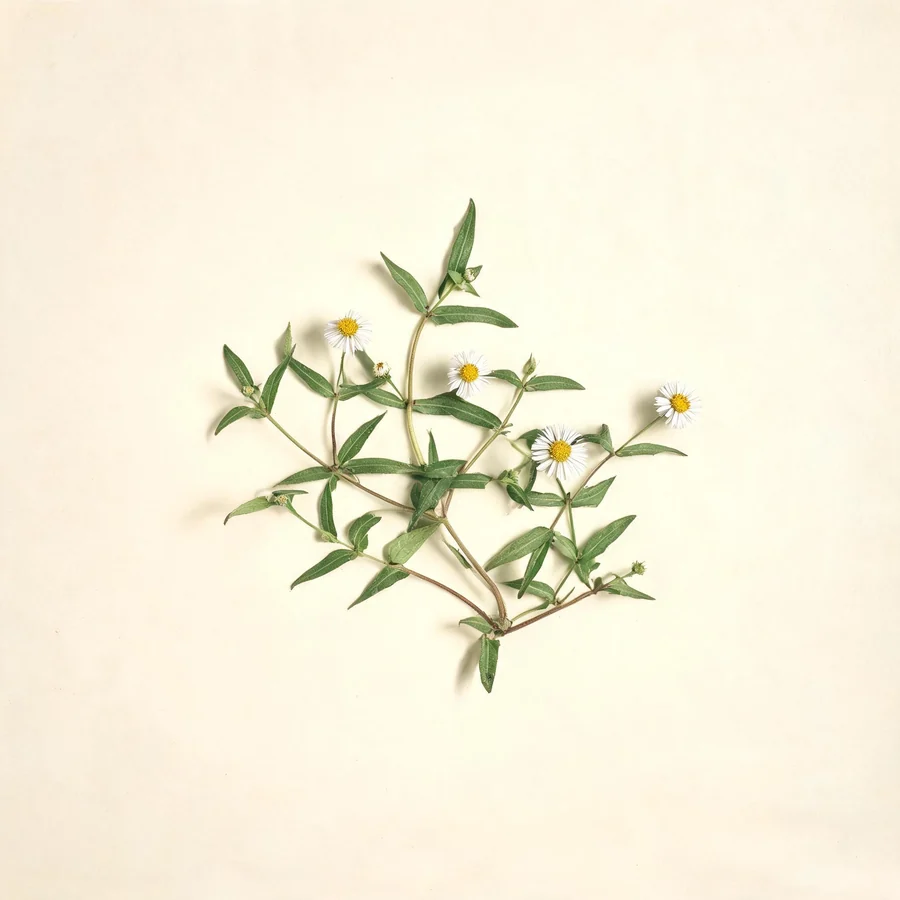
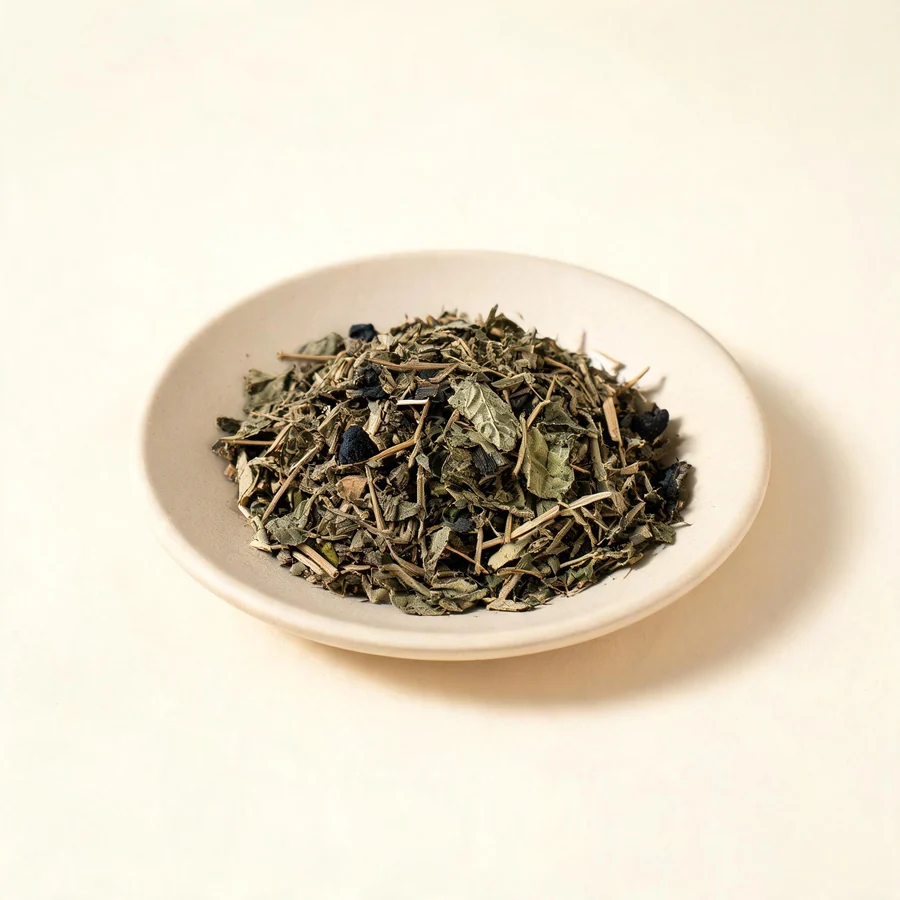
Skin profile
Where this herb sits in skin practice: the pattern it corrects, the skin signs it suits, and what it should not be used for.
Mo Han Lian works on the Blood rather than on the surface: it cools blood that is leaking, moistens a dry warm skin, and slowly supplies the Yin behind a thinning scalp. Its topical use, fresh juice on a small bleeding break or worked into the scalp, is older than its tonic reputation.
Skin signs that suggest it
- Pinpoint bleeds or small bruises beneath unbroken skin, arriving with heat signs (Blood that will not stay in its vessels)
- A dry, thin scalp with early greying and hair that sheds more than it used to
- Skin that is dry yet warm to the touch, with night sweats and a dry mouth at night
- Fine scaling over the shins and forearms in a person who is dizzy and easily tired
- Small grazes that ooze slowly and reopen, on skin that is otherwise unbroken
- A red tongue with very little coating, and a pulse that is fine and rapid
When it is not the right herb
Not for cold, pale, moist skin, and not for the red, weeping flare of damp-heat eczema, where a drying cooling herb is the wrong instrument. The plant is cold and sweet, so a Spleen that is already cold will usually register the objection first: loose stools, a poor appetite and heaviness after eating are reasons to reduce or stop. Bleeding that comes from a Spleen too weak to hold Blood needs warming and tonifying treatment rather than a cooling herb, and any unexplained bruising or bleeding deserves a diagnosis before it is treated with anything.
What it does for skin
Skin-relevant actions only. Each one describes a mechanism in TCM terms and what it looks like on the skin.
Cools Blood that has left its vessels
Purpura, petechiae and the small spontaneous bruises of a hot Blood picture are the clearest skin indication. The herb is cold, it enters the Liver, which stores the Blood, and the sour taste is read as a holding quality, so the combination cools the layer that is overheating and helps keep what remains inside the channels. It is used as an adjunct inside a formula, never as the only measure, and a low platelet count or a clotting disorder belongs to a haematologist.
Rebuilds the Yin that keeps skin supple
Dry skin that is also warm, a dry mouth at night and sweat that escapes during sleep point to Yin that has thinned rather than to Wind or Dampness. The plant supplies moisture without the cloying weight of prepared rehmannia, so it suits a person who needs nourishment over months and whose digestion would object to the richer tonics. The change is measured in texture and comfort, not in the disappearance of a lesion.
Settles a dry, hot scalp
Hair that greys early or thins in a person who is simultaneously dry and warm is read as a shortage at the top of the body: the Liver and Kidney stores send too little upward, and empty Heat parches whatever arrives. The classical tradition credits the plant with darkening hair, and the fresh juice was rubbed into the scalp and brows for that purpose. Honest practice expects a slower shed and a better texture at best; no preparation has been shown to restore colour to hair that has already lost it.
Stops small surface bleeding when applied fresh
The oldest record already describes the crushed plant laid on a bleeding moxibustion sore, and the same logic covers a graze that keeps oozing. The fresh material is pressed to the spot or its juice is applied on clean gauze, and the astringency plus the coldness is what settles it. This is first aid for small, clean breaks in the skin: a wound that is deep, dirty, spreading or slow to heal needs medical care rather than a herb.
Skin conditions it is used for
Mapped to the condition pages on this site. The pattern column shows what the skin is doing when this herb is the right choice.
| Condition | Pattern | Why it suits | Typical setting |
|---|---|---|---|
| Purpura | Blood heat with blood escaping the vessels | Purpura without a break in the skin is read as Heat making the Blood reckless, and the herb is chosen when the spots are bright, the person is warm and thirsty, and the tongue is red with little coating. It cools the Blood level and its sourness is read as containing what has leaked, which is why it appears with Ce Bai Ye and Sheng Di Huang in formulas for recurrent spots. A bleeding disorder, a drug reaction or a low platelet count has to be excluded first, and the herb sits beside that assessment rather than instead of it. | Er Zhi Wan with Sheng Di Huang and Ce Bai Ye |
| Petechiae | Fine pinpoint bleeding with heat in the Blood | Pinpoint bleeds that appear in crops, especially on the legs, with warmth and a dry mouth are the smallest visible form of the same process. The plant belongs to the cooling and containing part of the formula, where it is gentle enough for a longer course than the harsher cold herbs. Its limits matter: petechiae with fever, with a new medicine, or with bruising elsewhere are a reason to seek urgent assessment, and a child with a pinpoint rash and fever needs to be seen the same day. | A blood-cooling formula with Sheng Di Huang, Mu Dan Pi and Ce Bai Ye |
| Idiopathic thrombocytopenic purpura | Blood heat with Yin deficiency, on a background of immune platelet loss | In this condition the vessels are not held and the Blood leaks, and the traditional reading is either Heat agitating the Blood or a Spleen too weak to contain it. The herb belongs to the first reading, where the person is warm, dry and restless rather than pale and cold, and it is used to cool and settle while the underlying deficiency is nourished. It is never a replacement for haematological treatment, and any decision to use it alongside steroid or immunoglobulin therapy belongs to both practitioners together. | Er Zhi Wan with Sheng Di Huang, used alongside haematological care |
| Dry scalp | Liver and Kidney Yin not reaching the scalp | A scalp that is dry, tight and finely scaled, with hair that greys or thins early in a person who is dizzy and wakes with a dry mouth, is read as Yin and Blood failing to reach the top of the body. The plant is one of the two herbs in the classical hair formula, and its role there is the cooling and moistening half rather than the building half. It is a slow, low-risk component, and a scalp that is red, greasy or actively inflamed belongs to a different pattern altogether. | Er Zhi Wan, or a hair formula with He Shou Wu and Nu Zhen Zi |
| Dry skin | Yin deficiency with warm, dry skin | Dry skin has many causes, and this herb suits the version that comes with warmth: a dry mouth at night, sweating in sleep, a fine rapid pulse and a tongue with almost no coating. The plant moistens while it cools, so it does not leave the skin colder than it found it, which is the usual objection to treating dryness with cold herbs. An emollient still does the daily work at the surface, and the herb is judged over a season rather than a fortnight. | A Yin-nourishing formula with Sheng Di Huang, Nu Zhen Zi and Mai Dong |
| Senile pruritus | Dry, thin, itchy skin with empty heat in later life | Itch in older skin that is dry and papery, worse at night and after washing, is read as Blood and Yin no longer moistening the surface. When the person is also warm and restless rather than cold and pale, the cooling moistening action of this plant suits better than a warming tonic. It is given in a nourishing formula with an emollient used daily, and itch that has appeared recently, or comes with weight loss, needs a cause looked for before it is treated. | A nourishing formula with Dang Gui, Bai Shao and Sheng Di Huang |
Combinations for skin
Herbs it is paired with when the skin, not an internal organ, is the target.
| Partner | Ratio | Why the pair is used |
|---|---|---|
| Nu Zhen Zi | 10 to 15 g of each, equal parts in decoction | The two herbs make Er Zhi Wan, the smallest and most quoted formula for depleted Liver and Kidney Yin with early greying. Privet fruit supplies the cooler, plainer nourishment while this plant adds the Blood-cooling and the slight holding quality that suits a person who also bleeds or flushes. On the skin the pair is used for dry warm skin and a thinning scalp, and it is mild enough to continue for a season without unsettling the digestion. |
| Ce Bai Ye | 10 g of each, with the Ce Bai Ye usually charred | Each of these two cools the Blood and halts bleeding, yet the timing differs. The charred cypress is astringent and drying and acts on the bleeding itself, while this plant supplies the cooling and the moisture that the loss has been drawing on. The pair is chosen when small bleeds keep returning in someone who is already dry, because stopping the loss with an astringent alone would leave the person thinner and colder. |
| Sheng Di Huang | 10 g Mo Han Lian with 10 to 20 g Sheng Di Huang | Raw rehmannia is the heavier and colder partner: stronger on heat, more cloying, and harder on a weak Spleen. This plant is light and moistening and can be continued far longer. The pair is used when the heat is too much for eclipta alone and the person cannot tolerate rehmannia by itself, either because the depletion is deep or because the stomach objects, which is the usual situation in a long-standing dry hot picture. |
| He Shou Wu | 10 g of each, using the prepared root | Both are named in the tradition for dark hair and they are often mentioned together, but they work on different substances. The prepared fleeceflower warms as it builds the Liver's Blood and the Kidney's Essence, while this plant cools and moistens. The pair suits early greying or thinning in someone who is depleted and also a little hot, and the raw fleeceflower is a purgative that must not be substituted. |
Formulas where it leads
- Er Zhi Wan (二至丸) - A two-herb formula of equal parts, and the definitive setting for the Yin-nourishing and hair-darkening action. It is taken over months, which is the right timescale for scalp and skin changes, and it is also the base to which blood-cooling herbs are added when the same person has purpura or recurring small bleeds.
Topical use
Topical use is older than the tonic reputation and much simpler. The fresh plant was crushed and laid on a bleeding sore, and its juice was worked into the scalp and eyebrows; in modern practice a cooled decoction can be used as a compress on small clean grazes and on a dry scalp. The plant is not a treatment for infected or deep wounds, and a compress is a first-aid measure that sits beside the internal formula rather than replacing it.
| Preparation | How and when it is used |
|---|---|
| Fresh juice | Take a handful of fresh aerial parts, crush them and squeeze the juice through clean gauze. Apply it directly to a small clean graze or a bleeding moxibustion sore, using fresh material each time and discarding what is left. The juice stains dark, so keep it off clothing and away from the eyes. |
| Cooled decoction compress | Simmer 15 to 20 g of dried herb in 400 ml of water for 15 minutes, strain and cool to skin temperature. Soak clean gauze and lay it on the area for 10 minutes once or twice daily, then discard the liquid rather than storing it. |
| Scalp application | A weak decoction of the dried herb is patted into a dry scalp before washing, or the fresh juice is worked into the hairline, following the classical use for hair and brows. It is kept out of the eyes, it does not colour hair that has already greyed, and a scalp that is red or greasy is not the right candidate. |
Patch test and cautions
Patch test on a small area of normal skin for 24 hours, and keep the preparation out of the eyes and off broken, ulcerated or infected skin. Stop if burning, stinging or spreading redness appears. The fresh juice stains, so protect clothing and bedding, and do not apply a compress under an occlusive dressing.
Safety for skin use
What to check before recommending or using it, including the cautions that matter most for skin patients.
Do not use, or use with caution
- A cold, weak digestion: loose stools, a poor appetite, a pale tongue and a heavy feeling after eating. The plant is cold and moistening, and a long course in this constitution commonly produces looser stools and more digestive discomfort.
- Bleeding from a Spleen too weak to hold Blood: pale, cold skin, fatigue, a soft pulse and bruising that appears without heat signs. A cooling herb does nothing for that picture and can make the weakness worse.
- No heat signs at all. This is a draining, cooling plant, and continued use in a cold dry person without empty heat gradually works against the Yang that keeps the surface warm.
- Unexplained bleeding or bruising under investigation. The herb can mask nothing, but it can delay a diagnosis, so assessment comes first.
Pregnancy and breastfeeding
Use only with practitioner advice. No toxicity is recorded and the plant has no reputation for moving the uterus, but it is cold and moistening, and the classical caution about cold Yin substances in pregnancy is the relevant one. Small topical applications to a graze are a different matter from a daily internal course. In breastfeeding the same reasoning applies, and a cooling plant taken in quantity can loosen a nursing infant's stools, so a short course at a normal dose is the reasonable limit.
Interactions
- Anticoagulant and antiplatelet medicines. The plant is used to stop bleeding and contains coumestans such as wedelolactone, so an additive or opposing effect is plausible; anyone on warfarin, apixaban or clopidogrel should tell the prescriber before a regular course.
- Medicines handled by the liver. Laboratory work shows the coumestans interacting with liver enzyme pathways, so levels of drugs cleared that way could in theory shift; this matters mainly for concentrated extracts rather than a standard decoction.
- Laxatives and other cooling herbs. Because it can loosen the stool, it may add to the effect of laxatives and to the gut effects of some antibiotics, and stacking it with other cold draining herbs makes loose stools more likely.
Allergy and patch testing
Contact reactions to plant juices are uncommon but recognised, and the fresh juice is more likely to irritate than a cooled decoction. Patch test first, apply to limited areas, and stop if the skin becomes more irritated rather than calmer. Anyone who has reacted to other Asteraceae plants, including chamomile and ragweed, should be more cautious.
General safety references
General references for herbal hepatotoxicity and herb-drug interactions; they are not specific to this herb.
- Review article: Herbal hepatotoxicity - an update on traditional Chinese medicine preparations. Alimentary Pharmacology & Therapeutics, 2014. PMID: 24844799.
- Interactions between herbal medicines and prescribed drugs: an updated systematic review. Drugs, 2009. PMID: 19719333.
- Warfarin and food, herbal or dietary supplement interactions: a systematic review. British Journal of Clinical Pharmacology, 2021. PMID: 32478963.
Evidence
The classical record is quoted with its source. The modern note states the level of evidence plainly.
Classical record
主血痢。针灸疮发,洪血不可止者敷之;汁涂发眉,生速而繁。
It is used for bloody dysentery. Where a sore from acupuncture or moxibustion has broken out and the bleeding will not stop, the plant is applied to it; the juice rubbed into the hair and eyebrows is said to make them grow quickly and thickly.
Tang Ben Cao (Materia Medica of the Tang Dynasty) - The earliest clear statement of both surface uses, the bleeding sore and the hair, which are the two applications this page keeps.
鳢肠善凉血。须发白者,血热也,齿不固者,肾虚有热也。
Eclipta is good at cooling the Blood. White hair and beard point to heat in the Blood, while teeth that are not firm point to Kidney deficiency with heat.
Ben Cao Jing Shu (Commentary on the Classic of Materia Medica) - The same text supplies the standard caution, that a cold Yin substance of this kind does not help a weak Spleen and Stomach.
鳢肠,入肾补阴而生长毛发,又能入血,为凉血止血之品。
Eclipta enters the Kidney to nourish Yin and to grow hair, and it also enters the Blood, where it cools and stops bleeding.
Ben Cao Zheng Yi (Rectified Meaning of Materia Medica) - A compact summary of the double identity, a hair herb and a bleeding herb, together with the warning that a purely cold Yin plant should not be handed out freely.
Modern evidence
Evidence status
- Laboratory work on eclipta extracts reports anti-inflammatory and antioxidant activity, and a small number of rodent studies describe faster hair regrowth after a topical extract. These are animal and cell findings, and they do not establish a benefit in human skin or in hair loss.
- No controlled clinical trial of this herb in purpura, petechiae or any skin condition was identified. Published human material is limited to traditional-use reviews and small observational reports, usually of multi-herb formulas in which the plant is one ingredient.
- Regulatory status: the dried aerial parts are an accepted herbal substance in the Chinese Pharmacopoeia under the name Herba Ecliptae. This page describes traditional practice and the state of the evidence, and it makes no claim of proven effect.
PubMed records
Selected real PubMed records for this herb's species or its constituents, chosen by species name and title relevance. They are references for the non-TCM discussion above, not proof that the herb treats any skin condition.
- The role and mechanism of Asian medicinal plants in treating skin pigmentary disorders.. Journal of ethnopharmacology, 2019. PMID: 31445129 (skin-related record).
Dose and forms
Skin-practice dosing and the preparations that suit skin complaints.
| Form | Dose and notes |
|---|---|
| Decoction | 6 to 12 g of dried aerial parts daily in a formula. The lower end suits a long nourishing course for skin and scalp, and the upper end is used for a short period when small bleeds are active. |
| Fresh plant | The fresh herb is used in much larger amounts because most of its weight is water, and old herbals describe squeezing the juice from a hundred grams or more of the fresh plant for a bleeding sore. |
| Topical decoction | 15 to 20 g simmered in 400 ml of water, strained and cooled, for compresses on small grazes or as a scalp rinse once or twice daily. |
| Course length | Scalp and skin changes are judged over two to three months, with a review at six weeks. Stop or reduce if the stools loosen, the appetite falls away or the abdomen feels cold. |
The two preparations are not interchangeable. The raw dried herb is the tonic and the blood-cooling agent, used for months; material charred until black outside keeps the haemostatic action and loses some of the coldness, which is the version chosen for an active bleed and the wrong one for slow nourishment. Since the unprocessed plant cools the digestion, a warming companion is the usual practice, and the amount is cut back as soon as the stools begin to soften.
Citations and further reading
Only real sources are listed: the classical materia medica passages quoted above, and the source works behind the botanical and safety statements.
- Tang Ben Cao (Materia Medica of the Tang Dynasty) - the passage on the bleeding sore and the hair juice is quoted above.
- Ben Cao Jing Shu (Commentary on the Classic of Materia Medica) - the passage on cooling the Blood is quoted above.
- Ben Cao Zheng Yi (Rectified Meaning of Materia Medica) - the summary passage on the Kidney, the hair and the Blood is quoted above.
- Herba Ecliptae monograph, Pharmacopoeia of the People's Republic of China - accepted source and part used.
- Laboratory literature on eclipta extracts and wedelolactone, summarised as a statement about the level of evidence rather than as a cited finding.
- Botanical literature on Eclipta prostrata, Asteraceae, for identification of the dried aerial parts.
Educational reference for qualified practitioners. This page is not medical advice, and skin conditions should be diagnosed by a clinician before treatment.