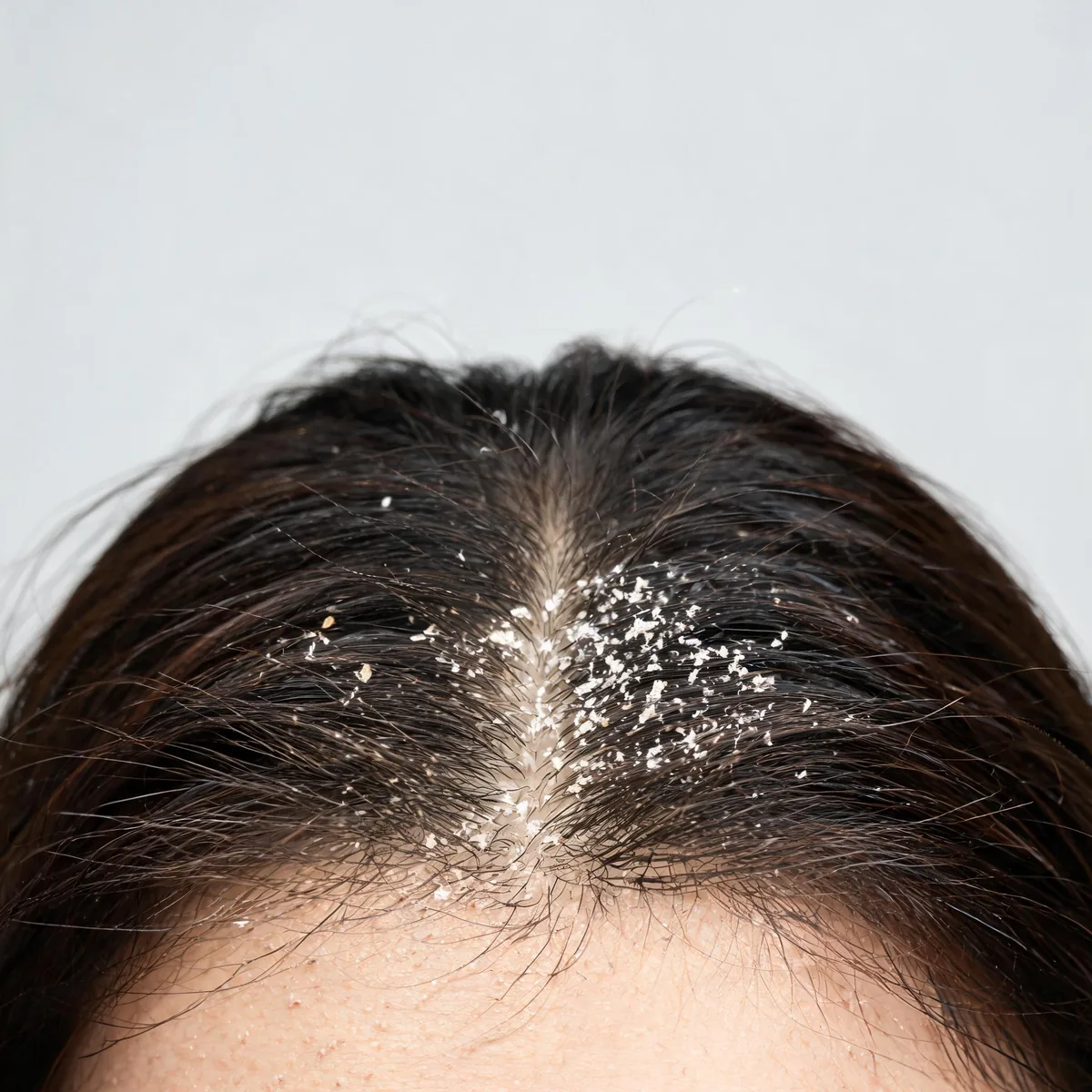
Understanding Dry scalp
Dry scalp is described primarily through the nourishing substances: Blood and Yin, which travel upward to moisten skin and hair.
When those run low, the scalp tightens and flakes first, because it depends on fluid reaching the highest point. The commonest picture is Blood deficiency with external wind: dry flaky scalp, itch that wanders and worsens at night, a pale complexion and an aversion to drafts.
Empty-Heat from Yin deficiency gives tight dry scalp with fine white flakes, worse in the evening, with night sweats and malar flush. Stress-linked dryness with a bitter taste and rib-side discomfort is read as Liver Qi stagnation transforming into heat.
Two further patterns are worth separating carefully. Qi and Yin deficiency gives dryness with fatigue, spontaneous sweating and a pale tongue. Wind-Heat gives redness with yellowish flakes and a sore throat, and Damp-Heat gives a scalp that feels dry while the flakes are oily, with a foggy head and sticky stools. Both are excess patterns where nourishing treatment alone will not work.
Three organ systems decide whether moisture reaches the scalp. The Liver stores the Blood and keeps it moving, the Spleen turns food into the fluids from which Blood and Yin are made, and the Kidneys hold the deeper Yin reserve that all of it draws on. When any one of the three loses its balance, the scalp, sitting at the very top of the body, is among the first places to show the shortfall.
The same complaint can therefore carry opposite logic. One person has fine powdery flakes, a pale tongue and a sallow face, and needs Blood nourished; another has oily yellow scales, a red tongue and a greasy coat, where Damp-Heat is steaming the scalp and nourishment would only add fuel. Recognising which is which matters more than the label on a bottle of shampoo, because the two need different herbs, different food and a different pace of treatment.
Conventional view
Western medicine treats a dry scalp as a sign of environmental dryness or of eczema, psoriasis or seborrhoeic dermatitis. The scalp feels tight and itchy with white or yellowish scales, and a dermatologist confirms the picture by looking at the scalp, sometimes taking a scraping to exclude a fungal infection.
Standard treatment begins with medicated shampoos bought over the counter, which may contain ketoconazole, zinc pyrithione, coal tar or selenium sulfide. Stubborn cases may need prescription antifungal shampoos, topical corticosteroids or salicylic acid preparations, with conditioners and oils used to ease tightness.
These measures soothe the surface but do not touch the internal imbalance that keeps the dryness returning, and some anti-dandruff shampoos are harsh enough to strip natural oils and cause rebound dryness. Treating every dry scalp the same way also misses the difference between a flare driven by stress, an itch tied to the weather and a dryness that follows fatigue, which is the distinction TCM is built to make.
Selected PubMed records
Real PubMed records for the conventional discussion above, selected by condition name and title relevance. They are references, not a claim that any treatment is proven for this condition.
- Natural Topical Treatment Contributes to a Reduction of Dry Scalp Symptoms in Children.. Clinical, cosmetic and investigational dermatology, 2023. PMID: 37814676.
- Novel Topical Treatment for Dandruff & Dry Scalp Through Sustained Balance in Skin Microbiome.. Clinical, cosmetic and investigational dermatology, 2021. PMID: 34335039.
- Damp scalp application enhances follicular delivery of dutasteride loaded in liposomes compared to dry scalp.. Therapeutic delivery, 2026. PMID: 42318887.
How it connects
Patterns on the scalp tend to arrive in company. Blood deficiency often carries some Yin deficiency with it, since both are built from the same reserves, and stress that has gone on for years can leave Liver Qi stagnant and hot, so dryness and irritability rise together. The flake appearance is the most reliable compass: fine white flakes point to deficiency, yellow oily flakes to Damp-Heat, and a scalp that is dry yet greasy usually means the two are present at once. Sudden severe dryness, pain or patchy hair loss with inflammation is a reason to see a practitioner promptly rather than adjust a formula alone.
How it is assessed
The practitioner distinguishes true dryness from dryness that is a symptom of damp or heat.
What a practitioner looks for
- Flake type: fine white dry flakes suggest deficiency; yellowish oily flakes suggest Damp-Heat.
- Redness: redness with dryness suggests Wind-Heat or Heat in the Blood; no redness suggests deficiency.
- Constitutional signs: fatigue points to Qi and Yin deficiency; night sweats to Yin deficiency.
- Stress link: dryness that worsens with anger suggests Liver Qi stagnation transforming into heat.
The practitioner asks first about texture and flakes, then about energy, stress, sleep and diet, because a dry scalp rarely tells the whole story. Fine powdery flakes on a scalp that feels tight, with a pale complexion and a feeling of fatigue, usually indicate Blood deficiency with external wind, and the tongue is pale with a thin white coating, and the pulse is thready and weak, which fits a surface too poorly nourished to hold moisture.
Where the scalp is papery and tight and the tongue is red with almost no coating, the pattern moves to Empty-Heat from Yin deficiency, with a thready rapid pulse, night sweats, a dry mouth and warm palms. If the dryness clearly tracks stress and anger, Liver Qi stagnation transforming into heat is more likely: the scalp is irritated and itchy, the tongue shows red edges and the pulse is wiry, and flares follow emotional strain.
Fatigue with a pale tongue, a thin coating and a weak pulse points to Qi and Yin deficiency, where there is neither the force to lift fluids nor the substance to moisten with. Sudden redness and itching with yellowish flakes, a red tongue, a yellow coat and a rapid pulse suggest Wind-Heat arriving after exposure to wind and heat. A scalp that looks dry yet carries oily yellowish scales, with a red tongue, a greasy yellow coat and a slippery pulse, is the paradox of Damp-Heat steaming upward.
TCM patterns in Dry scalp
The six patterns behind a dry scalp separate first by what the flakes look like. Fine powdery white flakes belong to deficiency, where Blood or Yin or Qi has fallen short and the scalp is undernourished; yellow oily scales belong to excess, where Damp-Heat is rising and steaming the surface. Within the deficiency group the distinctions turn on heat: a red tongue with no coat and night sweats means Empty-Heat from Yin deficiency, while a pale tongue with fatigue and a weak pulse means Blood deficiency or a combined Qi and Yin deficiency. Emotion is the fourth thread, since dryness that flares with frustration and shows a wiry rapid pulse is Liver Qi stagnation turning into heat. Because these patterns can sit side by side, flake colour, tongue and pulse are read together rather than one at a time, and the treatment follows whichever picture is dominant.
| Pattern | Key signs | The itch | Tongue | Main formula |
|---|---|---|---|---|
| Blood Deficiency with External Wind | Dry flaky scalp | Itch that wanders or comes and goes | Body: Pale and thin, sometimes slightly dryCoat: Thin, white and a little dry | Not specified |
| Empty-Heat caused by Yin Deficiency | Scalp feels tight and dry with fine white flakes; Dry mouth and throat at night | Not specified | Body: Red, thin and dry, often crackedCoat: Little or none; the tongue may look peeled | Not specified |
| Liver Qi Stagnation that transforms into Heat | Scalp dryness worsens with stress or anger; Distending or burning pain along the ribs | Not specified | Body: Red, with the sides redder than the centreCoat: Yellow | Not specified |
| Qi and Yin Deficiency | Dry tight scalp with fine white flakes; Dry mouth with little desire to drink | Not specified | Body: Red or pale-red, thin and dry, possibly crackedCoat: Thin or absent | Not specified |
| Wind-Heat | Scalp redness with yellowish flakes | Itching | Body: Red at the tip and edgesCoat: Thin yellow or white turning yellow | Not specified |
| Damp-Heat | Scalp feels dry but flakes are oily and yellowish | Not specified | Body: Red, often swollen with teeth marksCoat: Yellow, greasy and thick, usually in the middle and at the root | Not specified |
Blood Deficiency with External Wind
Dry flaky scalp with a wandering night itch.
Blood is what moistens the scalp, so when it runs low the surface dries and starts to flake. That dryness stirs an internal wind that sends the itch wandering or makes it arrive in spells, and a surface weakened by lack of Blood lets external wind in as well. Cold dry weather and overwork deepen the shortfall.
The tongue is pale and slender, its coating thin, white and a little dry; the pulse is fine and wiry and may feel floating at the surface. Cold dry weather, draughts, late nights, spicy fried food and harsh shampoos aggravate it, while warmth with some humidity, gentle scalp massage, nourishing soups and sleep ease it. Dang Gui Yin Zi is the formula, with Dang Gui, Bai Shao, He Shou Wu and Fang Feng as its key herbs, and the points are GB-20 Fengchi, SP-6 Sanyinjiao, ST-36 Zusanli and DU-20 Baihui.
Signs
- Dry flaky scalp
- Itch that wanders or comes and goes
- Worse at night
- Pale or sallow complexion
- Aversion to wind and drafts
Diet and lifestyle for this pattern: Eat blood-nourishing food such as dark leafy greens, red meat, eggs, black sesame and goji berries, and avoid spicy, fried or very drying food. Protect the head from cold wind and dry air with a silk scarf or hat, and give the scalp a gentle daily massage with warm oil to improve local circulation.
Empty-Heat caused by Yin Deficiency
Tight dry scalp with fine flakes and night sweats.
Yin is the body's cooling and moistening reserve, and when it falls low a quiet heat begins to stir. That heat behaves like a small flame under a pot, steadily drying the moisture the scalp depends on, and because the scalp is the highest part of the body it feels the shortage early. The result is a tight, parched scalp with fine white flakes.
The tongue is red, thin and dry with cracks and little or no coat, and the pulse is fine and rapid. Warm rooms, evening heat, spicy fried food, late nights and emotional strain worsen it, while a cool humid environment, cucumber and pear, rest and gentle movement ease it. Zhi Bai Di Huang Wan is the formula, with Shu Di Huang, Zhi Mu and Mai Dong as its key herbs, and the points are KI-3 Taixi, SP-6 Sanyinjiao, BL-23 Shenshu and DU-20 Baihui.
Signs
- Scalp feels tight and dry with fine white flakes
- Worse in the evening or warm environments
- Night sweats
- Dry mouth and throat at night
- Flushed cheeks
Diet and lifestyle for this pattern: Eat plenty of moistening food such as pear, black sesame, walnuts and cucumber, and avoid spicy, fried and very roasted food as well as alcohol and coffee, which fan empty Heat. Be in bed before eleven so Yin can regenerate, and keep living spaces cool and humidified.
Liver Qi Stagnation that transforms into Heat
Dryness that worsens with stress and anger.
The Liver keeps Qi moving smoothly, and when frustration, suppressed anger or sustained stress pile up, that flow stalls. Stagnant Liver Qi eventually generates heat, and heat rises to the head, where it burns off the fluids that keep the scalp supple. The more the stress builds, the more the dryness flares.
The tongue body is red with redder sides and a yellow coat, and the pulse is wiry and rapid, most marked at the left Guan position. Emotional stress, spicy and greasy food, alcohol and sugary drinks, overwork and late nights all aggravate it, while rest, cooling foods, mint or chrysanthemum tea and gentle exercise ease it. Dan Zhi Xiao Yao San is the formula, with Chai Hu, Zhi Zi and Dang Gui as its key herbs, and the points are LR-3 Taichong, LI-4 Hegu and GB-20 Fengchi.
Signs
- Scalp dryness worsens with stress or anger
- Irritability and explosive anger
- Bitter taste in the mouth
- Distending or burning pain along the ribs
Diet and lifestyle for this pattern: Avoid spicy, greasy and fried food as well as alcohol and coffee, which add Heat. Favour cooling, moistening food such as cucumber, pear, mint tea and chrysanthemum tea, keep moving gently each day so Liver Qi flows, and deal with emotional tension before it builds up.
Qi and Yin Deficiency
Dry tight scalp with fatigue and sweating.
Qi is the power that distributes fluids and Yin is the fluid itself, so when both are low the body has neither the pump nor the water. The scalp is left undernourished, tight and flaky while the person feels drained. This dryness is quiet and chronic rather than inflamed, and fatigue with a dry mouth and little thirst is its signature.
The tongue is pale-red or red with a thin or absent coat, sometimes dry and cracked, and the pulse is fine and weak and may be rapid. Overwork, late nights, spicy food, stress and hot dry rooms worsen it, while rest, moistening foods such as pear and honey, gentle movement and cool humid air help. Sheng Mai San is the formula, with Dang Shen, Huang Qi, Mai Dong and Wu Wei Zi as its key herbs, and the points are ST-36 Zusanli, SP-6 Sanyinjiao, KI-3 Taixi and DU-20 Baihui.
Signs
- Dry tight scalp with fine white flakes
- Persistent fatigue and weakness
- Dry mouth with little desire to drink
- Spontaneous sweating or night sweats
- Pale tongue
Diet and lifestyle for this pattern: Include moistening food such as pear, honey, black sesame and eggs, and avoid spicy, fried and very dry food. Gentle activity such as walking or yoga suits this pattern better than intense exercise, and rest plus sleep restore Qi and Yin.
Wind-Heat
Red scalp with yellowish flakes and a sore throat.
Wind-Heat enters through the nose and mouth and travels upward to the head, where it damages the fluids that keep the scalp moist. The surface becomes red, dry and irritated, and the pattern usually arrives with the other signs of a mild cold, such as a sore throat and a slight fever.
The tongue tip and edges are red with a thin yellow coat, which may start white, and the pulse is floating and rapid. Windy or draughty weather, spicy fried food, stress and overwork worsen it, while mint or chrysanthemum tea, rest, a cool environment and gentle scalp massage ease it. Yin Qiao San is the formula, with Jing Jie and Lian Qiao as its key herbs, and the points are GB-20 Fengchi, EX-HN-5 Taiyang and LI-4 Hegu.
Signs
- Scalp redness with yellowish flakes
- Itching
- Sore throat
- Mild fever or aversion to wind
- Worse in windy or drafty weather
Diet and lifestyle for this pattern: Avoid spicy, greasy and fried food that generates internal Heat. Drink cooling herbal teas such as chrysanthemum and mint, keep the scalp clean with mild natural shampoo and avoid scratching, and protect the head from wind and draughts.
Damp-Heat
A scalp that feels dry but flakes oily, with a foggy head.
When the Spleen cannot transform fluids, dampness collects and combines with heat. That mixture moves upward and steams the scalp, so the surface feels dry and tight while the flakes come away yellow, oily and sticky. The fluids causing the trouble are turbid rather than nourishing, which is why the scalp can seem both dry and greasy at once.
The tongue body is red with a greasy yellow coat that resists scraping, often swollen with teeth marks, and the pulse is slippery and rapid. Hot humid weather, greasy or spicy food, alcohol and sugary drinks, a sedentary routine and stress aggravate it, while light bland meals, cool dry air and gentle exercise ease it. Long Dan Xie Gan Tang is the main formula and Bi Xie Fen Qing Yin the second, with Long Dan Cao, Tu Fu Ling and Yin Chen as key herbs; the points are SP-9 Yinlingquan, GB-20 Fengchi, ST-8 Touwei and SP-6 Sanyinjiao.
Signs
- Scalp feels dry but flakes are oily and yellowish
- Heavy foggy sensation in the head
- Sticky or bitter taste
- Loose sticky stools
Diet and lifestyle for this pattern: Eat light, plain food that helps drain Dampness, such as barley, mung beans, bitter gourd and lightly cooked leafy greens, and strictly avoid greasy, fried and sugary food as well as alcohol, which all generate more Dampness.
Treatment approach
How the tradition treats dry scalp, with the herbs, formulas and points used for it.
Principles
- Nourish Blood and Yin where supply is the problem, which is the usual cause.
- Settle Wind where the itch wanders and worsens at night.
- Resolve the excess patterns first where flakes are oily or the scalp is red, before nourishing.
- Treat stress where dryness clearly follows emotional strain.
- The root and the branch are treated in a fixed order: clear what is aggravating the scalp, then rebuild what it lacks. Where the flakes are oily or the scalp is red, the excess is resolved first so that nourishment will not feed the heat; where the picture is deficiency, Blood and Yin are nourished from the start. External washes with herbs such as Ku Shen or Huang Bai sit alongside the internal formula to settle itch and flaking at the surface, and the formula is revised as the scalp changes.
Herbs used
Formulas
- Dang Gui Yin Zi
- Zhi Bai Di Huang Wan
- Dan Zhi Xiao Yao San
- Sheng Mai San
- Yin Qiao San
- Long Dan Xie Gan Tang
- Bi Xie Fen Qing Yin
Acupoints
- GB-20 (Fengchi)
- SP-6 (Sanyinjiao)
- ST-36 (Zusanli)
- DU-20 (Baihui)
- KI-3 (Taixi)
- BL-23 (Shenshu)
- LR-3 (Taichong)
- LI-4 (Hegu)
- SP-9 (Yinlingquan)
- ST-8 (Touwei)
What to expect
- Dryness from Blood and Yin deficiency is described as improving over weeks to months.
- Excess patterns settle faster once cleared.
- Scalp care with gentle washing and emollient support continues throughout.
- Itching and flaking usually begin to ease within two to four weeks of a consistent formula and weekly acupuncture. Excess pictures such as Wind-Heat, or Liver Qi stagnation that has turned to heat, often settle within a few weeks, while deficiency pictures need three to six months to rebuild reserves; external washes can give relief in the meantime. Flaking can fluctuate before it settles, and once the scalp is clear the formula is often continued at a lower dose for a while.
Safety and when to get help
Seek medical help urgently for
- Sudden severe scalp pain, swelling or warmth.
- Open sores, oozing or bleeding on the scalp.
- Hair loss with an inflamed scalp.
For anything severe, sudden or spreading quickly, read when a skin problem needs urgent care.
Cautions
- Do not use harsh clarifying shampoos on a dry scalp.
- Persistent dryness with scaling should be medically reviewed.
- Very hot water and frequent heat styling worsen dryness.
Using this alongside conventional care
- TCM is described as complementary to conventional care: gentle scalp care and prescribed topical treatment continue alongside herbs.
- TCM works alongside ordinary scalp care. A gentle moisturising shampoo can continue while herbs are taken or acupuncture is given, and a medicated shampoo or topical corticosteroid should be disclosed so that the formula is not made too drying on top of it. Dang Gui and other Blood-nourishing herbs have mild blood-thinning properties, so anyone on an anticoagulant should tell both the TCM practitioner and the doctor. Bring a full list of medicines and supplements to every consultation.
Diet and lifestyle
- Favour foods that nourish Blood and Yin such as dark leafy greens, black sesame, walnuts, pear, cucumber, honey and bone broth.
- Diet is chosen to feed the Spleen, which turns food into the fluids that end up feeding the scalp. Blood and Yin nourishing foods such as dark leafy greens, black sesame, walnuts, eggs, pears, cucumber, honey and bone broth form the base, with plenty of room-temperature water. Spicy, greasy and deep-fried food generates heat and dampness and should be limited, and alcohol and coffee are drying. Where the pattern is deficient, add red dates, goji berries and liver; where it is Damp-Heat, favour barley, mung beans, lightly cooked greens and bitter gourd, and cut out sugar, dairy and alcohol.
If you're pregnant
Pregnancy makes heavy demands on the mother's Blood and Yin, so the deficiency pictures behind a dry scalp grow more common. Many of the standard herbs, Dang Gui among them, are generally safe with professional supervision, while Huang Bai, a bitter-cold herb in Zhi Bai Di Huang Wan, is best left out. Acupuncture is a safe alternative, though LI-4 and SP-6 are avoided early in pregnancy. Gentle washing and regular moisturising keep the scalp comfortable meanwhile.
If you're breastfeeding
Huang Bai, Zhi Mu and Long Dan Cao are all bitter and cold, and all three can pass into milk, where they may upset a nursing infant's digestion or reduce supply. Dang Gui Yin Zi is the safer choice here, and so is Sheng Mai San, and acupuncture remains well tolerated and effective. A practitioner can tailor the prescription to nursing rather than postponing treatment until weaning.
If treating a child
Children more often show external Wind-Heat or Damp-Heat from their diet than the deficiency pictures familiar in adults, and the scalp may be red, itchy and flecked with yellow. Yin Qiao San, or Long Dan Xie Gan Tang with modifications, can be given at between a third and a half of an adult amount, and paediatric tuina with gentle acupuncture is well accepted. Shampooing should be mild and infrequent.
If treating an elderly patient
The deficiency pictures dominate in old age, most often Yin deficiency or a combined Qi and Yin deficiency. The scalp turns thin and papery. The tongue is usually red with little coating. Sheng Mai San suits this presentation, and so does Zhi Bai Di Huang Wan at about two-thirds of the usual dose, and acupuncture should be gentle. Concurrent medication needs checking for interactions, and emollient scalp care is worth as much as the internal treatment.
Urgent-sign guidance is based on standard sources: NHS anaphylaxis, NHS cellulitis, NHS Stevens-Johnson syndrome, NHS melanoma.
Evidence
Evidence status
Compiled for this page from the classical and modern literature; not a systematic review, so treat it as a pointer to sources rather than clinical guidance.
No trials address dry scalp alone. Support is indirect, from seborrhoeic dermatitis and atopic dermatitis research: a systematic review of Chinese herbal medicine for atopic dermatitis found blood-nourishing and wind-dispelling formulas reduced itching and scaling, and small studies suggest acupuncture modulates skin barrier function and inflammation. Most evidence is moderate-quality Chinese randomised trial data.
Studies often cited
A systematic review in atopic dermatitis found reduced itching and scaling with this approach. Systematic review (as recorded in the source)
Small studies suggest modulation of barrier function and reduced inflammation. Small clinical studies (as recorded in the source)
Classical record
White-flake wind often occurs on the head and face; it is caused by skin heat encountering wind, wind evil invading the pores, prolonged stagnation leading to blood dryness, and the skin losing nourishment.
- Wai Ke Zheng Zong (Orthodox Manual of External Diseases), Volume 4, White-Flake Wind. The Chinese original is not reproduced here: it could not be recovered reliably from the source record, and is not guessed.
头风白屑者,由风邪入脑,与血气相搏,血气不和,则生白屑。
Head white flakes arise when wind evil reaches the brain and contends with the blood and qi; when those two are not in harmony, the flakes appear.
Zhu Bing Yuan Hou Lun, Head Wind and White Flakes - Classical citation: for this page: Zhu Bing Yuan Hou Lun (Treatise on the Origins and Symptoms of Diseases), chapter on head wind and white flakes.
Common questions
Why is my scalp dry when my face is oily?
The tradition describes patterns that can coexist: Damp-Heat in the Stomach and Spleen affects the face, while Blood or Yin deficiency shows first where fluids must travel highest, at the scalp.
Does drinking water help?
Hydration helps, but the framework treats the body ability to transform and carry fluids upward, which is why Blood and Yin nourishment is the focus.
Can herbs fix a dry scalp?
The tradition describes nourishing Blood and Yin with gradual improvement over weeks to months.
When should I worry?
If the scalp is painful, swollen, sores appear, or hair is lost with inflammation.