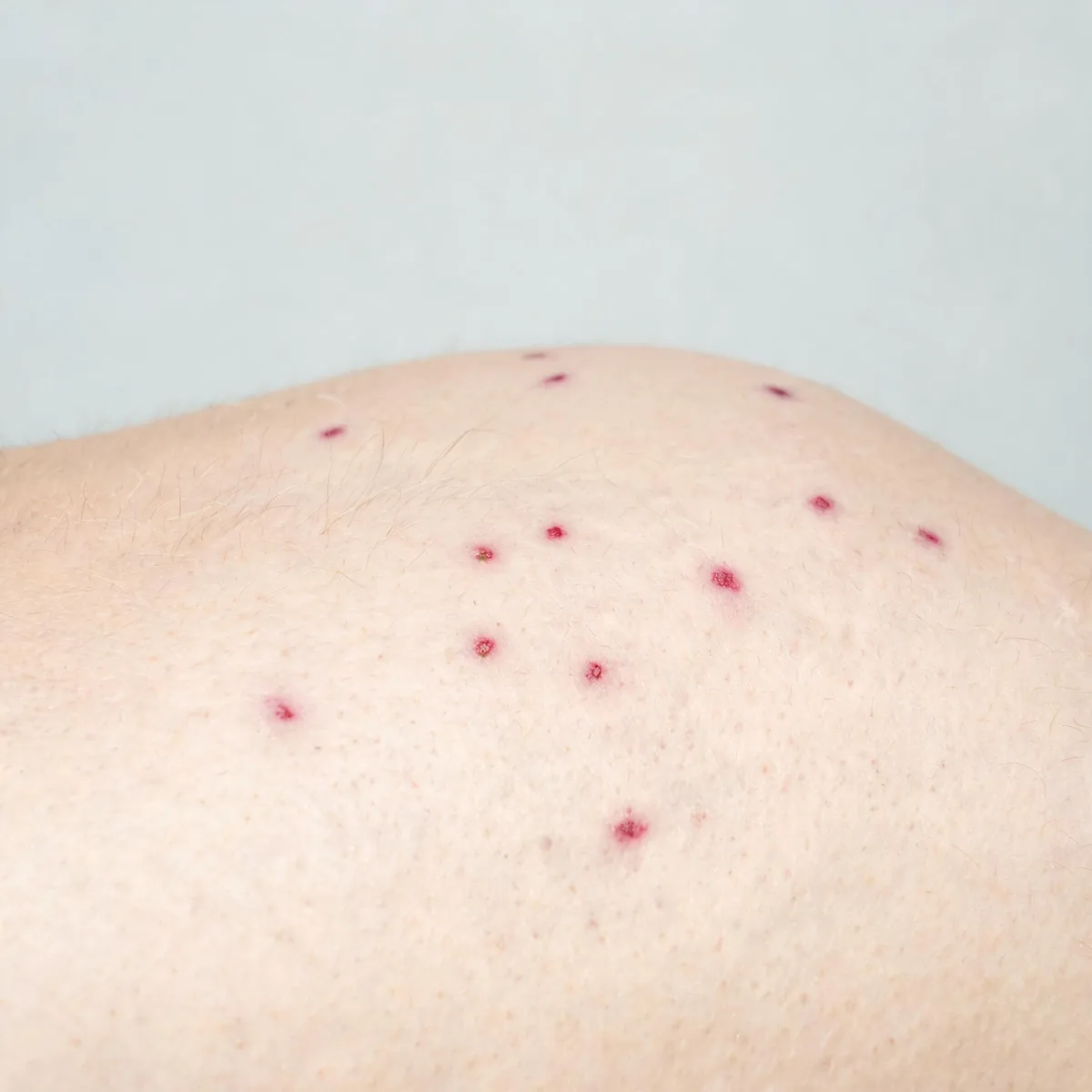
Understanding Idiopathic thrombocytopenic purpura
A source collision is recorded rather than resolved: this page and the Purpura page both carry the Chinese name 紫癜 (zǐ diàn). This page covers the immune thrombocytopenic form specifically.
The tradition describes Blood as held inside the vessels by the Spleen Qi, like a net that keeps everything contained. When the net is strong the blood circulates; when it weakens, or when something agitates the blood, it seeps out under the skin as purpura.
Heat in the Blood gives sudden bright or dark red purpura on the legs with nosebleeds, bleeding gums, blood in urine or stool, heavy menstrual bleeding and a feeling of heat. Qi not controlling Blood gives pale purpura that worsens with fatigue, with profound tiredness, a washed-out complexion and loose stools.
Empty-Heat from Yin deficiency gives dull red or pale spots with night sweats, dry mouth and a thin body frame. Blood stagnation gives dark fixed spots that do not blanch, with stabbing pain, a purplish tongue and dark circles under the eyes.
The classical literature builds the whole picture on one idea: blood stays inside the vessels because Spleen Qi holds it there, like a net drawn tight around fluid. Bruising that appears without a knock, or bleeding from the gums and nose, is read as that net slackening, or as something heating the blood until it moves too fast to stay contained. Neither reading replaces a platelet count. The count measures the raw material of clotting, while the pattern describes the condition of the vessels and the force moving blood through them, which is why the two assessments sit side by side rather than competing.
Timing matters as much as appearance. Acute purpura that erupts over hours, bright or dark red, with heat and thirst, is treated as an excess of heat that has entered the blood level. Spots that come and go over weeks, paling as energy drops, point instead to a failure of containment, and the same person may move from one picture to the other as the illness runs on. Heat drains Qi, and persistent seepage drains blood, so an acute episode can leave behind fatigue and pallor, while long-standing bruising can leave old blood congealed in the small vessels. The tongue and pulse are read at every visit because they show which of these is currently dominant, and the formula changes with them.
Conventional view
Immune thrombocytopenic purpura is a disorder in which the immune system turns on its own platelets, the cells that start clotting. The count falls while the rest of the blood count stays normal, and the visible result is easy bruising, pinpoint red or purple spots called petechiae, and sometimes bleeding from the gums, the nose or internally. Diagnosis rests on blood tests showing isolated low platelets, with a bone marrow examination used occasionally to exclude other causes. In children the illness is often acute and follows a viral infection, resolving on its own, while in adults it more often becomes chronic and lasts beyond six months. Bleeding inside the skull is the feared complication, so a sudden severe headache, confusion or vomiting is an emergency.
Standard care aims to lift the count to a level where bleeding is unlikely rather than to normalise it. Corticosteroids such as prednisone are first line, with intravenous immunoglobulin used when a rapid but temporary rise is needed. Persistent or severe cases may be treated with drugs that stimulate platelet production, such as the thrombopoietin receptor agonists, or with immunosuppressants such as rituximab, or with surgical removal of the spleen, the main site of platelet destruction. Where the count is stable and bleeding minimal, monitoring without treatment is a legitimate option.
The limits are real. Steroids, immunoglobulin and immunosuppressants raise the count quickly but bring mood swings, weight gain, thinning bones and a higher risk of infection, and many people relapse as the dose is tapered. Long-term immunosuppression does not address why immune regulation failed in the first place. Splenectomy is more permanent but carries surgical risk and a lifelong vulnerability to certain infections. That gap is where TCM is placed: not as a replacement for haematological care, but as a way of working on the constitutional weakness that conventional treatment leaves untouched.
Selected PubMed records
Real PubMed records for the conventional discussion above, selected by condition name and title relevance. They are references, not a claim that any treatment is proven for this condition.
- Recent advances in the management of immune thrombocytopenic purpura (ITP): A comprehensive review.. Medicine, 2024. PMID: 38241567.
- Idiopathic thrombocytopenic purpura.. Missouri medicine, 2009. PMID: 19245128.
How it connects
ITP rarely exists in isolation from a TCM perspective. When Heat in the Blood forces blood out of vessels, it does so wherever the vessels are weakest, so the same reckless blood that causes skin purpura also triggers bleeding gums, nosebleeds or heavy menstrual bleeding; the pathology is identical, with hot agitated blood escaping at several sites at once. In Qi not controlling Blood, the Spleen's holding function is weakened globally, which leads not only to recurrent pale purpura but also to chronic low-grade blood loss in the stool or urine or through prolonged menstruation. Over time that seepage drains Blood and Qi further, producing the anaemia and exhaustion so often seen alongside ITP, and Yin deficiency with empty-heat adds a dry hot state that damages the delicate vessels of gums and nose, giving the classic picture of dull purpura, night sweats and bleeding gums. Patterns also overlap in ITP. An acute Heat in the Blood episode can drain Qi over time, leaving fatigue with occasional bright spots, and Yin deficiency with Empty-Heat often sits alongside Qi deficiency because both come from a long-running drain on the body. Blood stagnation frequently accompanies long-standing purpura, leaving dark fixed spots even after the initial Heat or deficiency has shifted, so the pattern mix can change from month to month. A practitioner reads the tongue and pulse to clarify which pattern dominates before adjusting the formula.
How it is assessed
Medical confirmation of the platelet count comes first; then the pattern is assessed.
What a practitioner looks for
- Colour: bright red purpura with active bleeding suggests Heat in the Blood.
- Fatigue: pale purpura worsening with tiredness suggests Qi not controlling Blood.
- Bleeding sites: nose, gums, urine, stool or heavy periods increase urgency.
- Red flags: sudden severe headache, confusion, or blood in urine or black stools.
Two questions organise the consultation. The first is how the blood is behaving: whether spots appear suddenly and brightly with bleeding from the nose or gums, which suggests heat driving blood out, or gradually and palely with tiredness, which suggests the vessels are no longer being held. The second is where the blood escapes. Bleeding from several sites at once, heavy periods, blood in the urine or black stools all raise the level of concern and belong to medical assessment before any pattern is named.
The tongue and pulse then refine the picture. A red tongue with a yellow coat and a rapid, forceful pulse supports heat in the blood. A pale, puffy tongue with teeth marks and a weak pulse at the right middle position supports Spleen Qi failing to contain. A red, thin, dry tongue with little coating and a fine rapid pulse supports empty heat from Yin deficiency. A dusky or purple tongue with a choppy pulse points to stagnation, and in practice that often sits on top of one of the deficiency pictures rather than standing alone, which is why the fixed dark spots of a long-standing case are read together with the fatigue that came before them.
TCM patterns in Idiopathic thrombocytopenic purpura
Four patterns are described here, and they differ in what is moving the blood rather than in where the spots appear. Heat in the Blood is the acute picture: spots arrive quickly, sit on the legs, and come with nosebleeds, bleeding gums, a feeling of heat and thirst. Qi not controlling Blood is the opposite in tone, with pale spots that fade and return as energy falls, a washed-out complexion and loose stools. Empty-Heat caused by Yin Deficiency sits between the two, giving dull red spots that appear slowly with night sweats, dryness in the evening and a thin frame. Blood Stagnation is what a long case can leave behind, with dark spots that do not blanch and stabbing pain. Colour, speed of onset, bleeding sites, energy and the tongue and pulse are what separate them, and because heat can exhaust Qi and seepage can leave stasis, more than one may be active at once.
| Pattern | Key signs | The itch | Tongue | Main formula |
|---|---|---|---|---|
| Heat in the Blood | Sudden bright or dark red purpura, often on legs; Heavy menstrual bleeding with bright red blood | Not specified | Body: Deep red, often with red points or pricklesCoat: Thin, yellow and dry | Not specified |
| Qi not controlling Blood | Pale or light-coloured purpura; Profound tiredness and weakness | Not specified | Body: Pale and puffy with teeth marksCoat: Thin white | Not specified |
| Empty-Heat caused by Yin Deficiency | Dull red or pale purpuric spots; Dry mouth and throat worse in the evening | Not specified | Body: Red, thin and dry, often crackedCoat: Little or none; the tongue may look peeled | Not specified |
| Blood Stagnation | Stabbing pain in the spots or limbs; Dark circles under the eyes with rough scaly skin | Not specified | Body: Purple, dusky or with dark stasis spots; sublingual veins dark and distendedCoat: Often thin white; a yellow coat would suggest Heat as the cause | Not specified |
Heat in the Blood
Sudden bright red purpura with bleeding and heat signs.
Heat that has entered the blood level makes blood move faster than the vessels can direct it, so it escapes wherever the walls are thinnest. Spots arrive suddenly and are bright or dark red rather than pale, and the same process produces bleeding from the gums, the nose, the urine or the stool. Heat also consumes fluids, which is why thirst and a sense of internal heat, worse at night, accompany the rash, and why restlessness and irritability build alongside it.
The tongue is red with red spots or prickles and a thin, dry yellow coat, and the pulse runs rapid, often wiry and forceful and sometimes slippery. Spicy, fried or warming food, hot weather, anger and overexertion with late nights all add heat and worsen the bleeding, while cooling food and drink, rest and cooler weather settle it. The formula named for this pattern is Xi Jiao Di Huang Tang, with Shui Niu Jiao, Mu Dan Pi and Chi Shao doing the cooling work, and the points are Xuehai (SP-10), Hegu (LI-4), Quchi (LI-11) and Sanyinjiao (SP-6).
Signs
- Sudden bright or dark red purpura, often on legs
- Nosebleeds, bleeding gums or blood in urine or stool
- Heavy menstrual bleeding with bright red blood
- Feeling of heat
Diet and lifestyle for this pattern: Eat cooling, non-spicy food such as mung bean soup, cucumber, pear and watermelon, and avoid alcohol, chilli, lamb and fried food that add internal Heat. Gentle rest and a calm environment help settle the Blood, so avoid overexertion and emotional outbursts.
Qi not controlling Blood
Pale purpura worsening with fatigue.
Spleen Qi holds blood within the vessels the way a net holds water. Once chronic illness, overwork or poor food weakens that hold, the mesh slackens and blood seeps out slowly, which is why the spots are pale, why the bleeding is mild but persistent, and why everything worsens when energy is low. Because the root is a shortage rather than an excess, there is no heat to explain the bruising; there is only tiredness, a washed-out complexion, a poor appetite, loose stools and shortness of breath with little wish to talk.
A pale, puffy tongue marked by teeth at the edges, coated thinly in white, and a fine weak pulse that is softest at the right middle position, confirm the picture. Overwork, raw and cold or greasy food, prolonged worry and skipped meals drain the Spleen further, while rest, warm cooked meals and gentle movement rebuild it. Gui Pi Tang is the formula, supported by Huang Qi, Dang Shen and Bai Zhu, and the points are Zusanli (ST-36), often warmed with moxibustion, Xuehai (SP-10) and Qihai (REN-6).
Signs
- Pale or light-coloured purpura
- Purpura worsens with fatigue
- Profound tiredness and weakness
- Pale washed-out complexion
- Poor appetite with loose stools
Diet and lifestyle for this pattern: Eat warm, cooked, easy food such as congee, stews and root vegetables, and avoid raw, cold and greasy food that taxes the Spleen. Rest takes priority, with gentle movement such as walking or tai chi, and pushing through exhaustion does not help.
Empty-Heat caused by Yin Deficiency
Dull red spots with night sweats and a thin frame.
Once the store of Yin fluids has been drawn down over months, the cooling and moistening side of the system weakens, and a false heat arises with no external source. That empty heat stirs the blood just enough to make it leak, so the spots are dull red or pale, appear gradually, and worsen with fatigue and at night. Night sweats, heat in the palms and soles, a dry mouth and throat that is worse in the evening, a low afternoon fever and a thin frame complete the picture.
The tongue is red, thin, dry and cracked, carrying little or no coat, while the pulse reads fine and rapid. Late nights, overwork, stress, spicy or fried food and hot weather consume Yin and stir the heat, while rest, a cool quiet room, moistening food such as pear and tofu, and gentle movement conserve it. Zhi Bai Di Huang Wan is the formula, with Mu Dan Pi and Zhi Mu clearing the empty heat, and the points are Taixi (KI-3), Sanyinjiao (SP-6) and Xuehai (SP-10).
Signs
- Dull red or pale purpuric spots
- Night sweats and five-palm heat
- Dry mouth and throat worse in the evening
- Low-grade afternoon fever
Diet and lifestyle for this pattern: Eat cooling, moistening food such as pear, lily bulb, tofu and black sesame, and avoid spicy, fried and warming food such as chilli, lamb and alcohol. Rest and avoid overwork, keep a consistent bedtime ideally before eleven to preserve Yin, and keep exercise gentle without heavy sweating that depletes fluids.
Blood Stagnation
Dark fixed spots with stabbing pain that do not blanch.
In long-standing cases, blood that has leaked repeatedly can clot and lodge in the small vessels instead of clearing. Because the stasis prevents fresh blood reaching the skin, the spots turn dark and fixed and no longer blanch under pressure, the pain becomes stabbing and stays in one place, and the skin under the eyes darkens and roughens. Obstruction, not heat, is what keeps the lesions from fading.
A purple or dusky tongue with stasis spots and distended dark veins beneath it, and a choppy pulse that feels rough and uneven, point to sluggish flow. Cold, long stretches of sitting, stress and greasy food congeal blood further, while warmth, gentle daily movement, light massage and warm compresses loosen it. Tao Hong Si Wu Tang is the formula, with Tao Ren, Hong Hua and Dang Gui, and the points are Xuehai (SP-10), Geshu (BL-17) and Sanyinjiao (SP-6). Because these herbs move blood, they are used with particular care when the platelet count is low.
Signs
- Dark fixed purpuric spots that do not blanch
- Stabbing pain in the spots or limbs
- Purplish tongue with stasis spots
- Dark circles under the eyes with rough scaly skin
Diet and lifestyle for this pattern: Eat warm cooked food and include blood-moving spices such as turmeric and ginger, and avoid cold, raw and greasy food that congeals Blood. Gentle daily walking or tai chi moves Qi and Blood, and long stretches of sitting or standing are best avoided.
Treatment approach
How the tradition treats idiopathic thrombocytopenic purpura, with the herbs, formulas and points used for it.
Principles
- The platelet count and bleeding risk are the primary management; herbs are adjunct only.
- Cool the Blood and stop bleeding where purpura is bright with active bleeding.
- Strengthen the Spleen where containment is failing and fatigue dominates.
- Avoid herbs that strongly move Blood when the platelet count is low.
- Treatment is staged on the same logic as the diagnosis. Stopping the bleeding and letting the purpura fade is the branch, and it is what an acute presentation demands first; correcting the imbalance that let blood escape is the root, and it is what keeps the spots from returning. The formula is therefore chosen by pattern rather than by diagnosis: Xi Jiao Di Huang Tang for heat in the blood, Gui Pi Tang where Qi no longer contains, Zhi Bai Di Huang Wan for empty heat, and Tao Hong Si Wu Tang where stasis has set in. Acupuncture follows the same rule, with Xuehai (SP-10) for cooling and invigorating, Zusanli (ST-36) for strengthening the Spleen and Taixi (KI-3) for nourishing Kidney Yin.
Herbs used
Formulas
- Gui Pi Tang
- Zhi Bai Di Huang Wan
- Tao Hong Si Wu Tang
Acupoints
- SP-10 (Xuehai)
- LI-4 (Hegu)
- LI-11 (Quchi)
- SP-6 (Sanyinjiao)
- ST-36 (Zusanli)
- qihai-ren-6
- KI-3 (Taixi)
- BL-17 (Geshu)
What to expect
- ITP can be transient, especially in children, or chronic in adults.
- Treatment decisions depend on the count and bleeding, which is why monitoring is essential.
- Herbs do not predictably raise platelets; no such claim is made here.
- The classical literature gives a different timeline for each pattern. Acute heat pictures often settle within two to four weeks, with the purpura fading and the bleeding stopping first. Qi deficiency and Yin deficiency are slower, commonly three to six months of steady treatment before the reserves are rebuilt, and stasis from long-standing disease can take four to six months because fixed dark spots clear last. Sessions are usually weekly and herbs daily, the formula is adjusted every few weeks as the tongue and pulse change, and progress is judged on energy, bruising and blood tests together rather than on a single count.
Safety and when to get help
Seek medical help urgently for
- Sudden severe headache, confusion or vomiting - possible bleeding inside the skull.
- Blood in the urine or black tarry stools.
- Bleeding that will not stop, or widespread new bruising.
For anything severe, sudden or spreading quickly, read when a skin problem needs urgent care.
Cautions
- ITP needs a confirmed platelet count and medical monitoring.
- Avoid contact sports and blood-thinning medication unless advised.
- Herbs that move or invigorate Blood require caution when platelets are low.
Using this alongside conventional care
- This page is complementary: haematology monitoring and treatment continue, and any herb use must be discussed with the treating team because of bleeding risk.
- Herbs are used alongside haematological care, not instead of it, and the classical literature is specific about why the coordination matters. Some herbs that cool or move blood, including Dang Gui, Chi Shao and Tao Ren, can alter how platelets behave and interact with drugs that thin the blood or prevent clotting, so the full medication list has to be reviewed by both practitioners. Corticosteroids are never stopped or reduced abruptly, because they need a careful taper, and any reduction in dose is a decision for the prescribing doctor once the count allows it. Regular blood tests remain the safety net, and new bruising, bleeding or a change in the spots should be reported rather than worked around.
Diet and lifestyle
- Cooling blood-nourishing food is favoured in the heat pattern; warm Spleen-supporting food in the deficiency pattern.
- Food is chosen to match the pattern rather than the diagnosis. Across all four, the shared advice is to avoid what generates internal heat - hot peppers, deep-fried food, greasy meat and excess alcohol - and to keep well hydrated, since smoking is described as depleting Yin and damaging the vessels. Cooling, blood-nourishing food such as leafy greens, cucumber, pear and tofu suits the heat picture, where mung bean soup and watermelon are added and chilli, lamb and fried food are left out. Where Qi is failing to contain, warm cooked food does the work: congee, sweet potato, chicken broth, stews and root vegetables, with raw, cold and greasy food avoided because it taxes the Spleen. For empty heat the emphasis shifts to moistening choices, pear and lily bulb among them, plus tofu and black sesame; Chinese yam, goji berries and black sesame are all named as good for Blood and Yin.
If you're pregnant
Gestation consumes Qi and Yin, so the Qi not controlling Blood and Empty-Heat patterns tend to become more prominent during pregnancy, and the spots may become paler and more persistent. The classical literature treats Blood Stagnation with particular caution at this time, because formulas such as Tao Hong Si Wu Tang contain Tao Ren and Hong Hua, which move blood strongly and put the pregnancy at risk. If Heat in the Blood needs treating, Xi Jiao Di Huang Tang would be modified to avoid herbs that are excessively cold and might chill the uterus.
Gui Pi Tang is described as generally safe in pregnancy where Qi deficiency dominates, though Dang Gui is used with care in the opening months. Where possible acupuncture is used rather than herbs: Xuehai (SP-10) and Zusanli (ST-36) support Qi and blood, while the points strictly avoided include Sanyinjiao (SP-6) and anything on the lower abdomen, as well as Hegu (LI-4), because of their labour-inducing potential. Care belongs with a practitioner experienced in pregnancy.
If you're breastfeeding
Gui Pi Tang is described as largely safe while nursing, and may even help milk supply through tonifying Qi and blood. The bitter-cold herbs in Zhi Bai Di Huang Wan are the exception: Huang Bai and Zhi Mu enter breast milk and may bring on loose stools or colic in an infant, so milder herbs or a reduced dose under supervision are preferred where empty heat needs treating.
Xi Jiao Di Huang Tang is reserved for acute and severe flares of heat in the blood rather than for extended use while nursing. Acupuncture carries no risk of herb transmission and remains a safe option throughout, with Sanyinjiao (SP-6) and Taixi (KI-3) used to nourish Yin and settle empty heat without affecting the baby.
If treating a child
Children most often present with Heat in the Blood, particularly after a viral infection, with purpura appearing suddenly and brightly alongside fever, thirst and bleeding from the nose. The tongue is usually red and yellow-coated, and the pulse rapid. Because a child's Spleen is immature, the picture can shift quickly towards Qi not controlling Blood when the acute heat goes uncleared, or if the constitution is already weak.
Doses are cut to about a third to a half of the adult amount according to age and weight, and Xi Jiao Di Huang Tang is given in smaller quantities and short courses so as not to damage the developing Spleen. Acupressure or shallow, quick needling often takes the place of acupuncture, and dietary advice about spicy, greasy and sugary food matters more in children than in adults.
If treating an elderly patient
In older adults the deficiency patterns dominate, with Qi not controlling Blood and Empty-Heat the most common, presenting as recurrent pale purpura, tiredness, and a pulse that is thin and weak. There may also be Blood Stagnation from long-standing illness, but it is treated gently, because strong blood-moving herbs are poorly tolerated in older age. Doses are usually reduced to about two thirds of the adult amount, and the formula itself is simplified so that digestion is not burdened.
Polypharmacy is the practical concern. Many older people are on anticoagulant or antiplatelet medication, which worsens bleeding and can interact with herbs such as Dang Gui or Dan Shen, so every medication needs reviewing. Acupuncture is valuable here precisely because it avoids those interactions, and the pace is slower, aiming at gradual sustained improvement rather than rapid correction.
Urgent-sign guidance is based on standard sources: NHS anaphylaxis, NHS cellulitis, NHS Stevens-Johnson syndrome, NHS melanoma.
Evidence
Evidence status
Compiled for this page from the classical and modern literature; not a systematic review, so treat it as a pointer to sources rather than clinical guidance.
The evidence is moderate for the herb-plus-conventional-therapy approach, though most trials carry a high risk of bias. A meta-analysis of 28 randomised trials found that adding Chinese herbal medicine to standard therapy improved platelet response and reduced bleeding symptoms, and individual trials of Xi Jiao Di Huang Tang and Gui Pi Tang report faster or higher response rates alongside conventional treatment. This is adjunctive evidence only: ITP is a haematological condition requiring medical management, and bleeding needs prompt assessment.
The classical literature points to a 2017 review that pooled the trials of Chinese herbal medicine in immune thrombocytopenia. It concluded that herbs added to conventional care improved platelet counts more than conventional care alone, and it called for more rigorous placebo-controlled work. Around that review sit the individual trials, most often of Xi Jiao Di Huang Tang but also of Gui Pi Tang, and a body of Chinese-language work that is rarely blinded and often small. Acupuncture has thinner direct evidence: most studies look at steroid side effects and quality of life rather than at platelet counts. The honest reading is that the herbal literature is suggestive and adjunctive, and that nothing in it substitutes for monitoring and medical management of a bleeding disorder.
Studies often cited
Pooling 28 randomised trials with over 2,000 patients, adding Chinese herbal medicine to standard therapy significantly improved platelet response rates and reduced bleeding symptoms compared with standard therapy alone. Gui Pi Tang and Xi Jiao Di Huang Tang were among the most studied formulas, and most trials had a high risk of bias. Li Y, et al. J Ethnopharmacol. 2017;198:516-527.
In a randomised trial of 60 patients, adding the formula to prednisone produced a faster platelet rise and a higher overall response rate than prednisone alone, with better regulation of T cell subsets suggesting an immunomodulatory effect. Wang X, et al. Chin J Integr Tradit West Med. 2015;35(6):678-681.
In 80 patients randomised to the formula plus conventional therapy or conventional therapy alone, the herbal group had a higher sustained platelet response and greater improvement in fatigue and bleeding scores after 12 weeks, with no serious adverse events. Zhang L, et al. Chin J Hematol. 2019;40(3):210-214.
PubMed records for the TCM evidence
Real PubMed records for the TCM clinical evidence discussed above, selected by condition name and title relevance. They are references, not proof of benefit.
- Different Chinese herbal medicine therapy for idiopathic thrombocytopenic purpura: A protocol for systematic review and Bayesian network meta-analysis.. Medicine, 2021. PMID: 33787633.
- [Clinical study on idiopathic thrombocytopenic purpura treated with Shengxueling Granule].. Zhong xi yi jie he xue bao = Journal of Chinese integrative medicine, 2004. PMID: 15539017.
Classical record
Reckless movement of blood is mostly due to exuberant fire; fire exuberance makes the blood hot, and hot blood moves recklessly. If Qi is deficient and unable to contain the blood, it also causes blood to overflow.
- Jing Yue Quan Shu (The Complete Works of Jing Yue).
紫癜者,由风热毒气客于腠理,与血气相搏,致血溢于皮肤之间,故成紫斑。
Purpura arises when wind-heat toxin lodges in the interstices of the skin and contends with the blood and Qi, so that blood spills into the space beneath the skin and forms purple macules.
Zhu Bing Yuan Hou Lun, chapter on purpura - Classical citation: Zhu Bing Yuan Hou Lun (Treatise on the Origins and Symptoms of Diseases), chapter on purpura.
Common questions
Can herbs raise my platelet count?
This page makes no such claim. ITP requires confirmed counts and medical management; herbs are adjunct only and must be agreed with your haematologist.
What is the difference between ITP and purpura?
Purpura is the visible sign; ITP is one cause of it. This source uses 紫癜 for both pages, and both are built.
Is it dangerous?
The main risk is serious bleeding, particularly inside the skull. A sudden severe headache needs emergency care.
Which herbs should I avoid?
Herbs that strongly move Blood may increase bleeding risk; discuss every supplement with your haematologist.
How quickly can I expect to see fewer bruises?
The tradition describes new bruises reducing within two to four weeks where the pattern is acute heat, while deficiency patterns often take three to six months of steady treatment before the count steadies. Progress is judged by energy, the colour of the spots and blood tests together. Weekly acupuncture with daily herbs is the usual rhythm, and the formula is adjusted as the tongue and pulse change.
Will I need to change my diet completely?
No. The classical literature asks for avoidance of spicy, greasy and fried food and of excess alcohol, with cooling blood-nourishing food such as leafy greens, black sesame and goji berries favoured. Where the pattern is Qi deficiency, warm cooked meals that are easy to digest suit better. The aim is changes that can be kept up rather than a restrictive regime.
Can acupuncture help stop active bleeding?
It is not described as an emergency measure. Points such as Xuehai (SP-10) cool and invigorate the blood, and Zusanli (ST-36) supports containment, but active or severe bleeding needs urgent medical assessment. Acupuncture works better as regular preventive treatment that reduces how often and how severely bleeding episodes occur.
Will the purpura come back after I stop taking herbs?
The aim is to correct the imbalance so that it does not, and treatment is tapered rather than stopped abruptly. Where the constitutional tendency is deep-seated, the classical literature suggests occasional maintenance herbs or seasonal acupuncture, and it advises learning the early signs so that a recurrence is caught quickly and reviewed medically.