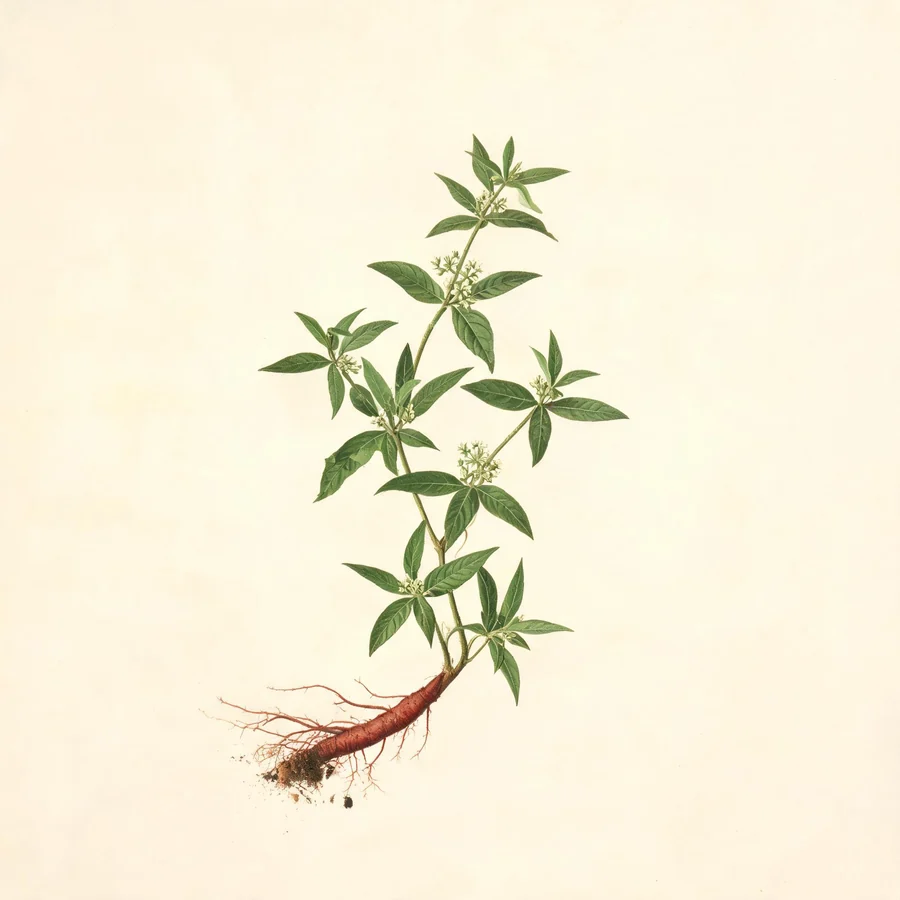
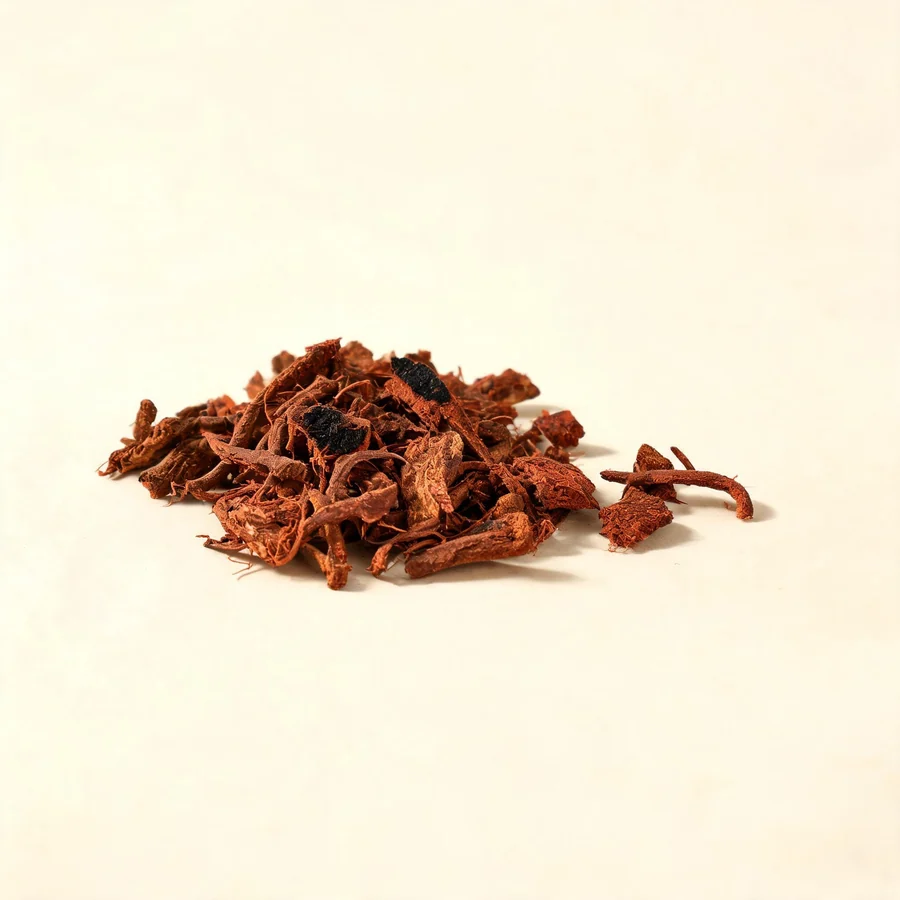
Skin profile
Where this herb sits in skin practice: the pattern it corrects, the skin signs it suits, and what it should not be used for.
Qian Cao is on a skin page for two things it does at once: it cools blood that is leaking out of its vessels and it moves blood that has stopped. That makes it the herb for purpuric spots, a stagnant bruise and the thick dusky plaque, and it makes it useless for a cold pale weeping lesion. The cold and the drying are the price, so courses are short, the digestion is reviewed, and it is set aside in pregnancy and before surgery.
Skin signs that suggest it
- Pinpoint red or purple spots that do not blanch when pressed, appearing in crops
- Bruise-like patches that come up without injury, or a bruise that stays dark and hard
- Bright red bleeding from the skin surface with heat signs, or blood-streaked scratch marks
- Tender, warm, red nodules on the shins that are painful to touch
- A purple or dusky tongue, a choppy pulse, and fixed pain in the affected skin
When it is not the right herb
Not in pregnancy: laboratory work has found the root exciting uterine muscle, and its blood-moving action is a second reason to avoid it. Not in bleeding that comes from deficiency cold, where what is lost is pale and watery, the person is spent and chilled and the pulse barely registers, because cooling a cold body only increases the loss. Not in Spleen and Stomach deficiency with loose stools and a poor appetite, and not in profuse bleeding with collapse, which is an emergency. It should also be stopped a week or two before planned surgery.
What it does for skin
Skin-relevant actions only. Each one describes a mechanism in TCM terms and what it looks like on the skin.
Cools blood that is escaping its vessels
Blood is thought to stay inside its vessels only while the temperature is right; once heat gathers, it travels faster than the walls can contain. A cold bitter root brings that heat down and the leaking stops. On the skin that shows as purpuric spots and bruise-like patches settling, and as bright bleeding from scratch marks slowing. The bleeding it suits is bright and accompanied by heat signs, not pale and accompanied by cold.
Disperses blood that has already stopped moving
A haemostatic that only astringes behaves like a plug, and the blood left stranded outside the vessels turns into stasis, with its own pain, hardness and dusky colour. Madder avoids that trap because it disperses while it cools, so a bruise softens and fades and a patch of fixed discolouration stops being fixed. This is why it appears in formulas for injury as well as for bleeding.
Cools and moves in equal measure, which suits the plaque
In psoriasis read as blood heat with stasis, cooling alone reduces the redness but leaves the thickness, and moving alone stirs the heat. The root does both, so it is added to cooling and blood-moving formulas in the static, thick, dusky phase rather than the freshly eruptive one. It is a partner rather than the leading herb, and it will not clear a plaque on its own.
Takes the heat out of a deep nodule
A tender red nodule on the shin is heat and dampness sitting deep in the tissue, and part of what keeps it there is blood that has stopped moving around the inflammation. The cold and the dispersing quality of the root address both, and it is used alongside herbs that resolve dampness and toxin. A nodule with fever, spreading redness or ulceration needs medical assessment.
Skin conditions it is used for
Mapped to the condition pages on this site. The pattern column shows what the skin is doing when this herb is the right choice.
| Condition | Pattern | Why it suits | Typical setting |
|---|---|---|---|
| Purpura | Heat in the Blood with stasis | Purpura is blood outside its vessels without a break in the skin, and the hot, bright, rapidly appearing type is read as heat making blood reckless. The root cools the blood and disperses what has already leaked, which is why it appears in the charred-substance formulas for this picture alongside skullcap, moutan and rehmannia. Pale purpura in a cold, tired person is a different pattern and needs warming tonics, not a cold root. | Shi Hui San, or a modified Xi Jiao Di Huang Tang |
| Petechiae | Heat in the Blood | Pinpoint bleeds that appear in crops, with a red tongue, thirst and irritability, are read as heat pushing blood through the vessel wall. The root is used in its charred form when the bleeding is active, and raw when stasis is also present and the spots are dusky rather than bright. Petechiae with fever, a new medicine or a low platelet count need medical assessment before any herb is considered. | Modified Xi Jiao Di Huang Tang with Qian Cao and Mu Dan Pi |
| Bruising | Blood Stagnation with Heat | A bruise is blood that has left the vessels and stopped moving, and a bruise that stays dark, hard and tender is stasis with a little heat left in it. The raw root moves and cools, which is what that state needs, and it is used with peach kernel, safflower and angelica. A bruise that spreads without injury, or one that will not fade over weeks, needs a medical explanation. | Tao Hong Si Wu Tang with Qian Cao added |
| Erythema nodosum | Toxic-Heat Stagnation in the deeper tissue | Tender red nodules on the shins are read as heat and dampness stuck deep, with blood that has stagnated around the inflammation. The root is a supporting herb in the toxic-heat formula: it cools the blood and gets the stagnant blood moving again, which is the part that makes a nodule soften. It is not a substitute for assessment, since nodules can accompany infection, drug reactions and inflammatory disease. | Modified Xue Fu Zhu Yu Tang with Qian Cao and Lian Qiao |
| Psoriasis | Heat in the Blood with Blood Stagnation | In the thick, dusky, long-standing plaque the pattern is read as heat that has congealed, and the treatment is to cool and to move at the same time. The root contributes both, and it is used in the second phase of treatment once the bright eruptive stage has settled. It is a supporting herb in that formula, and it does nothing for a plaque that is actively spreading, weeping or infected. | Modified Qing Ying Tang with Qian Cao and Mu Dan Pi |
Combinations for skin
Herbs it is paired with when the skin, not an internal organ, is the target.
| Partner | Ratio | Why the pair is used |
|---|---|---|
| Mu Dan Pi | 6 to 10 g each | Moutan cools the blood and moves it, and madder does the same with a stronger emphasis on stopping the leak, so the pair covers heat, stasis and bleeding together. For the skin this is the combination behind purpura, petechiae and the dusky plaque, and both herbs are cold enough to require a review of the digestion. It is a formula pairing rather than a home remedy. |
| Huang Qi | 15 to 30 g Huang Qi with 6 to 10 g Qian Cao | Here a cold haemostatic is made usable in someone depleted: astragalus warms and lifts so that Qi keeps blood within the vessels, while madder cools and disperses the heat and stasis behind the loss. One pulls warm and the other cold, and that tension is deliberate. The pair underlies the prescription for bleeding that drags on with fatigue. |
| Dang Gui | 6 to 10 g each | Angelica rebuilds the blood that has been lost and gently moves it, while madder clears what has become hot and stagnant. The pair suits a familiar situation: someone who has been losing blood for weeks, looks pale and feels dizzy, and still has pain in one fixed spot and dusky patches on the skin. The pairing is for stasis sitting on top of deficiency, not for stasis by itself, and the balance shifts towards angelica as the pallor deepens. |
| San Qi | 3 to 6 g San Qi with 6 to 10 g Qian Cao | Notoginseng is the stronger herb for stopping bleeding and for moving blood, and madder is colder and more specific to bleeding with heat. Together they are used for injury with swelling and for bleeding that keeps returning, and madder supplies the cooling that notoginseng lacks. Both affect clotting, so the pair should not be assembled casually by anyone on anticoagulant treatment. |
Formulas where it leads
- Shi Hui San (十灰散) - The powder of ten charred substances for bleeding with heat, in which madder is one of the ten. The charring gives the formula its astringency while the cooling herbs behind it deal with the heat, and it is the classical setting in which this root is used for bleeding that appears in the skin as well as from the orifices.
- Xue Fu Zhu Yu Tang (血府逐瘀汤) - The formula for blood stasis in the chest and upper body, with peach kernel, safflower, angelica and bupleurum. Madder is added where the stasis is accompanied by heat or by a bleeding tendency, and the skin reading is a dusky, fixed discolouration or a nodule that stays hard and tender.
Topical use
Madder has a place in traditional external treatment for injury, where a bruise has settled into a hard, dusky, tender patch. The root is applied as a cooled decoction or a paste, usually beside other blood-moving herbs, and the aim is to disperse what has stagnated rather than to dry or to disinfect. It is not a treatment for broken skin, for an open wound or for anything that might be infected, and the root stains whatever it touches, which matters for anyone using it on a visible area.
| Preparation | How and when it is used |
|---|---|
| Cooled decoction compress | Ten to fifteen grams of sliced root simmered in 300 ml of water for twenty minutes, strained, and cooled to skin temperature. Apply with clean gauze for ten minutes once or twice daily to a closed bruise, and discard the gauze afterwards. |
| Paste on a bland base | Finely ground root worked into a little water or a neutral ointment base and dabbed on a hard, dark bruise. Keep it off the face and off skin that is thin, broken or already irritated, and wash it off after twenty minutes. |
| Staining and clothing | The pigment binds to fabric and to keratin, so gloves are sensible and old cloth is used for the compress. A yellow-brown stain on the skin fades over a few days; a red streak that spreads, itches or burns is a reaction rather than a stain. |
Patch test and cautions
Patch test on a small area of normal skin for twenty-four hours before first use. Do not apply to broken, ulcerated or infected skin, or to the face, and do not use a compress on a bruise that appeared without a cause, since unexplained bruising needs assessment rather than a poultice. Stop at once if burning, stinging or spreading redness develops, and do not cover the area with an occlusive dressing. Anyone taking an anticoagulant should ask a practitioner before using a blood-moving herb, by any route.
Safety for skin use
What to check before recommending or using it, including the cautions that matter most for skin patients.
Do not use, or use with caution
- Pregnancy. Laboratory work has shown the water extract stimulating uterine muscle, and the blood-moving action adds a second reason for avoidance, so it is left out entirely rather than used in small amounts.
- Bleeding from deficiency cold: pale thin flow, exhaustion, cold limbs and a weak pulse. What has failed there is the holding power of Qi, not the restraint of heat, and a cold root deepens the problem.
- Spleen and Stomach deficiency with cold: chronic loose stool, poor appetite, a cold abdomen and a pale swollen tongue. Bitter cold medicines are exactly what damages digestion that is already feeble.
- Profuse bleeding with collapse, and unexplained bleeding of any kind. Cold limbs, a fading pulse and profuse sweating are an emergency, and new purpura or petechiae need a blood count rather than a herb.
- Planned surgery and anticoagulant treatment. The root affects platelets in laboratory work, so it is stopped before an operation where the surgeon advises it.
Pregnancy and breastfeeding
Contraindicated. A water extract of the root has been shown to stimulate isolated uterine muscle and strengthen contractions, and the blood-moving action is a concern in its own right. An active effect on the womb together with a stasis-dispersing quality puts the risk of miscarriage or early labour beyond the merely theoretical, and few herbs are avoided more firmly. It should not be used while trying to conceive either, and a woman who becomes pregnant during a course should stop it and tell her practitioner. No topical use is advised in pregnancy.
Interactions
- Warfarin, heparin, aspirin, clopidogrel and the newer anticoagulants. Laboratory work has found the root damping platelet activity, and the combination raises bleeding risk rather than altering a drug level, so bruising, bleeding gums and black stool are what to watch for.
- Other blood-moving herbs, including Dan Shen, Hong Hua, Tao Ren and E Zhu. The additive effect is intended in a formula but should be managed by a practitioner, and any such combination is stopped before surgery or after a bleed.
- Medicines that irritate the stomach, including non-steroidal anti-inflammatory drugs. A cold bitter herb adds to gastric upset, and a person with a history of gastritis should take it with food or not at all.
- Nothing has been reported between this root and medicines for blood pressure, blood sugar or mood, and no plausible mechanism has been suggested. Silence in the literature proves nothing, but it does confine the practical worry to bleeding and to the stomach.
Allergy and patch testing
Allergy to the root is not documented, and the risks that matter are bleeding and the wrong article rather than an immune reaction. Madder belongs to the coffee family, and anyone with sensitivities to related plants should be cautious. Because the root is also a dye, contact with the powder can stain the skin and the clothes, and a red stain is not a reaction; a rash, itch or swelling in its place is.
General safety references
General references for herbal hepatotoxicity and herb-drug interactions; they are not specific to this herb.
- Review article: Herbal hepatotoxicity - an update on traditional Chinese medicine preparations. Alimentary Pharmacology & Therapeutics, 2014. PMID: 24844799.
- Interactions between herbal medicines and prescribed drugs: an updated systematic review. Drugs, 2009. PMID: 19719333.
- Warfarin and food, herbal or dietary supplement interactions: a systematic review. British Journal of Clinical Pharmacology, 2021. PMID: 32478963.
Evidence
The classical record is quoted with its source. The modern note states the level of evidence plainly.
Classical record
止血,内崩下血,膀胱不足,踒跌,蛊毒。久服益精气。可以染绛。
It halts bleeding, and is used for internal breakdown with blood passing downward, for weakness of the bladder, for sprains and falls, and for poisoning. Taken over months it benefits essence and Qi. It will dye cloth a deep crimson.
Ming Yi Bie Lu (Supplement to the Classic of Materia Medica) - The first record of the haemostatic use, and the mention of sprains and falls is the classical warrant for using it on a bruise. The dyeing instruction is a reminder that the pharmacy and the dye vat drew on the same root.
茜根,气温行滞,味酸入肝而咸走血,手足厥阴血分之药也,专于行血活血。俗方用治女子经水不通,以一两煎酒服之,一日即通,甚效。
Madder root has a warm Qi that shifts stagnation; its sourness enters the Liver, its saltiness goes to the blood, and it works on the blood division of the Jue Yin channels, being devoted to quickening and moving blood. A common remedy for a woman whose periods have stopped is one liang simmered in wine and taken in a single dose, and the flow returns within the day.
Ben Cao Gang Mu (Compendium of Materia Medica), Li Shizhen, 1578 - Here Li Shizhen calls the root warm, where the oldest texts called it cold; the disagreement was never resolved. For the skin it is his insistence on moving blood that matters, since that is the half of the action the cooling herbs lack.
茜草治血,能行能止。余尝用酒制则行,醋炒则止。活血气,疏经络,治血郁血痹诸症最妙,无损血气也。配归、芍用,大能有益妇人。
Madder deals with blood in both directions, able to set it moving and able to check it. In my own practice, preparing it with wine makes it move, while frying it with vinegar makes it stop. It quickens the Qi of the blood and opens the channels, and it excels in blood depression and blood impediment without injuring either blood or Qi. Given with angelica and peony it is of great benefit to women.
Ben Cao Hui Yan (Collected Discourses on Materia Medica), Ni Zhumo, Ming dynasty - The plainest early statement that preparation decides which way the root acts, and the reason raw and charred root cannot be swapped in a skin formula.
Modern evidence
Evidence status
- Laboratory work on the anthraquinones and the root extract reports anti-platelet, anti-inflammatory and antioxidant activity. That work is a long way from a decoction treating purpura, and it does not measure skin outcomes.
- Laboratory study of a related dye plant, Rubia tinctorum, has raised concern about anthraquinones of the lucidin type, which have damaged DNA in experimental systems. The signal belongs to the relative rather than to this species, and it is recorded here rather than waved away.
- No controlled trial of Qian Cao in purpura, psoriasis or any other skin disease is cited on this page. The skin use rests on the blood-cooling and blood-moving classification, and the safety position rests on the bleeding risk rather than on any trial of the herb.
PubMed records
Selected real PubMed records for this herb's species or its constituents, chosen by species name and title relevance. They are references for the non-TCM discussion above, not proof that the herb treats any skin condition.
- Rubia cordifolia L. extract ameliorates vitiligo by inhibiting the CXCL10/CXCL9/STAT1 signaling pathway.. Journal of ethnopharmacology, 2025. PMID: 40412781 (skin-related record).
- Madder (Rubia cordifolia L.) Alleviates Myocardial Ischemia-Reperfusion Injury by Protecting Endothelial Cells from Apoptosis and Inflammation.. Mediators of inflammation, 2023. PMID: 36875688 (skin-related record).
Dose and forms
Skin-practice dosing and the preparations that suit skin complaints.
| Form | Dose and notes |
|---|---|
| Decoction, raw | Six to ten grams daily in a formula, rising to fifteen grams under supervision when bleeding is heavy. The raw root moves and cools, so it is the form for bruising and for the static plaque. |
| Charred | The same weight, fried hard until the outside chars and the inside turns brown. Charring strengthens the stopping of blood and dulls the moving quality, and this is the form for active purpura and bright bleeding. |
| Course length | One to three weeks with review, then reduce or stop as the bleeding settles or the bruise fades. Because the root is cold and drying, long courses blunt the appetite and loosen the stool. |
| Children | Not commonly used in children, and where it is, the dose is scaled down and the course kept short. It has no place in household medicine for the young. |
The choice that matters most is the preparation, not the weight. Raw root moves and cools, and suits a bruise, a static plaque or a stopped cycle; charring strips out most of the movement and adds astringency, which is what active bleeding needs; wine sits between the two and steers the herb into the channels. Six to ten grams is the working range, fifteen the supervised ceiling, and the older figure of thirty grams decocted in wine belongs to a different era of practice.
Citations and further reading
Only real sources are listed: the classical materia medica passages quoted above, and the source works behind the botanical and safety statements.
- Ming Yi Bie Lu (Supplement to the Classic of Materia Medica), Tao Hongjing - classical entry quoted above.
- Ben Cao Gang Mu (Compendium of Materia Medica), Li Shizhen, 1578 - classical entry quoted above.
- Ben Cao Hui Yan (Collected Discourses on Materia Medica), Ni Zhumo, Ming dynasty - classical entry quoted above.
- Shen Nong Ben Cao Jing (Divine Husbandman's Classic of Materia Medica) - the earliest entry, which records the root as bitter, cold and upper-grade.
- Rubiae Radix et Rhizoma monograph: Pharmacopoeia of the People's Republic of China - accepted botanical source, part used and quality requirements.
- Botanical description and identification: botanical literature on Rubia cordifolia, Rubiaceae.
Educational reference for qualified practitioners. This page is not medical advice, and skin conditions should be diagnosed by a clinician before treatment.