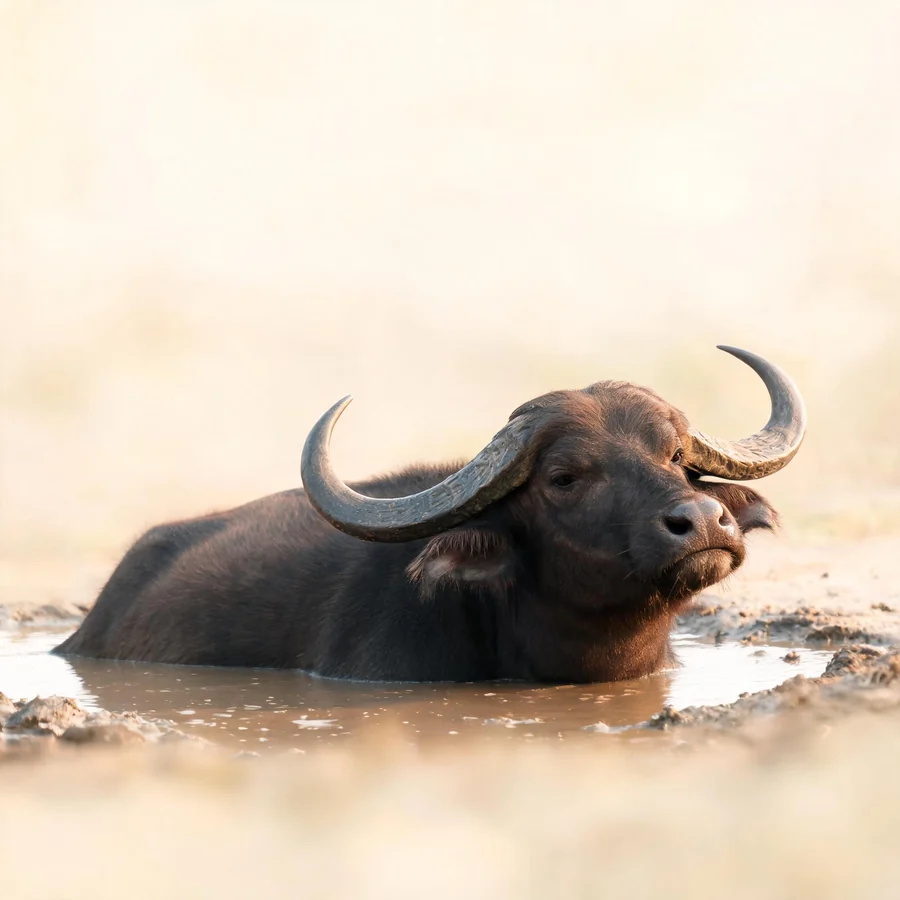
Skin profile
Where this herb sits in skin practice: the pattern it corrects, the skin signs it suits, and what it should not be used for.
Shui Niu Jiao is chosen for a rash that is dark, confluent and febrile rather than for ordinary skin inflammation. Its place is inside a serious illness being managed medically, and its practical questions are dose, decoction time and the documentation of an animal material.
Skin signs that suggest it
- A rash that is deep red or purplish, confluent, and slow to fade when pressed
- Fever with restlessness, thirst, a dry mouth and a rapid pulse
- Purple spots or small bruises in the skin appearing during a febrile illness
- Bleeding from the nose or gums with heat signs and a crimson tongue
- A crimson or deep red tongue with little coating, and a fine, fast pulse
When it is not the right herb
Not for a pale rash that blanches on pressure in a cold or depleted person, and not for skin disease without heat. A pale tongue, a weak pulse, cold limbs and a rash that fades when pressed describe a different pattern, and a substance this cold will weaken rather than help. It is wrong for chronic dry dermatoses, for cold-deficiency with loose stools, and for anyone whose fever has already resolved. A fever with a purplish rash, drowsiness, a stiff neck or a seizure is a medical emergency, and the horn is not something to try at home while waiting for help.
What it does for skin
Skin-relevant actions only. Each one describes a mechanism in TCM terms and what it looks like on the skin.
Cools the Blood at the deepest level
The defining action. Surface herbs cool the Qi level; this material is kept for heat that has reached the Blood, where the rash is dark, the fever high, the tongue crimson and the pulse fine and fast. Light, dispersing herbs do not reach that layer, which is why a dense animal substance is chosen, and its salty taste is held to draw it inward. What the skin shows is a rash that settles and darkens less quickly, rather than a surface eruption that simply dries.
Resolves toxin in a dark or purplish eruption
Toxin, in this framework, means the aspect of heat that injures tissue, and it appears as a rash that is not merely red but bruised-looking, with purple spots, a dusky centre or a confluent sheet. The horn is used for that picture in drug eruptions, in purpura and in the rashes of severe febrile illness. It is a support to the medical management of those conditions, not a substitute for it, and a rapidly spreading purpuric rash is an emergency.
Settles the spirit and eases heat-driven agitation
Restlessness, insomnia and confused speech in a hot illness are read as heat disturbing the Heart, and the horn is held to quiet that as well as the skin. The action is not a sedative effect for ordinary anxiety: it belongs to fever with agitation, and its classical setting is delirium and convulsion in febrile disease. That distinction matters, because the herb has no place in the treatment of anxiety or insomnia on their own.
Cools without congealing the Blood
Some heavy cold materials are said to stagnate the Blood, which is a problem when heat and stasis coexist and a purpuric rash is already present. The horn is described as cooling while keeping the Blood moving, and it is therefore paired with Mu Dan Pi and Chi Shao, which disperse the stagnation that intense heat leaves behind. That combination is why it appears in purpura formulas rather than only in fever formulas.
Skin conditions it is used for
Mapped to the condition pages on this site. The pattern column shows what the skin is doing when this herb is the right choice.
| Condition | Pattern | Why it suits | Typical setting |
|---|---|---|---|
| Purpura | Blood heat forcing blood out of the vessels | Purple spots and patches that do not blanch are read as heat driving blood through the vessel walls, and the traditional response is cooling and toxin-clearing rather than tonifying. The horn leads that work in formulas such as Xi Jiao Di Huang Tang, with raw rehmannia and moutan. Purpura always needs a cause found, whether platelets, a vasculitis, a drug or an infection, so a herbal formula belongs beside investigation and not before it. | Xi Jiao Di Huang Tang, with Shui Niu Jiao replacing rhinoceros horn |
| Petechiae | Fine blood-heat bleeding into the skin | Pinpoint non-blanching spots in a febrile or drug-exposed patient are the smallest visible expression of the same blood-heat picture. The horn is used where the spots are accompanied by heat signs and a crimson tongue, and it is combined with blood-cooling and blood-moving herbs. A full blood count and a clotting screen are the first steps, and the herb is not given while a serious cause is being excluded. | Modified Xi Jiao Di Huang Tang or Qing Ying Tang |
| Drug rash | Heat toxin in the Blood after a medicine | A morbilliform eruption appearing after a new medicine, with fever and a red tongue, is read as heat toxin entering the Blood, and cooling formulas are used for the hot, confluent type. The horn is one ingredient, alongside raw rehmannia, moutan bark and red peony. The medicine responsible has to be stopped and severe reactions excluded; blistering, mucosal involvement or skin peeling needs emergency care, and no herb is appropriate at that point. | Wen Qing Yin, or a modified Xi Jiao Di Huang Tang |
| Macular rash | Blood-heat rash spreading with fever | A flat red rash that spreads quickly over the trunk in a febrile illness is the classical territory of the warm-disease formulas, and the horn is used when the colour deepens and the patient is restless. It is not used for a mild viral exanthem in a well child, and it must never delay the assessment that distinguishes a self-limiting rash from meningococcal disease or another serious infection. | Qing Ying Tang or Hua Ban Tang with Shui Niu Jiao |
| Chickenpox | Heat toxin with a vesicular rash | The classical record names the rashes of measles and pox among the indications, which is the historical basis for using the horn in a febrile vesicular eruption. In practice the herb belongs only to the severe, dusky, confluent form in a patient under medical care, not to an ordinary crop of spots in a child. Chickenpox is usually self-limiting, and the exceptions, such as a compromised immune system or a secondary infection, are medical ones. | Modified Qing Ying Tang in supervised practice, alongside conventional care |
Combinations for skin
Herbs it is paired with when the skin, not an internal organ, is the target.
| Partner | Ratio | Why the pair is used |
|---|---|---|
| Sheng Di Huang | 15 to 30 g Shui Niu Jiao with 15 to 30 g Sheng Di Huang | The backbone of Xi Jiao Di Huang Tang. The horn takes care of the heat and neutralises the toxin; raw rehmannia cools the Blood, restores fluid and helps arrest bleeding from vessels that heat has damaged. Cooling on its own leaves the person drier and more restless, so the nourishing half is not optional in a deep blood-heat picture. |
| Mu Dan Pi | 15 to 30 g Shui Niu Jiao with 6 to 10 g Mu Dan Pi | Moutan cools and moves the Blood, dispersing the stagnation that intense heat leaves behind, and it is the natural partner for a purplish rash that is settling rather than spreading. The pair follows the principle of cooling the Blood while keeping it in motion, and both appear in the same classical decoctions. |
| Chi Shao | 10 to 15 g Chi Shao with 15 to 30 g Shui Niu Jiao | Red peony cools and quickens the Blood and is the workhorse for hot rashes and purpura at ordinary doses. It is paired with the horn when the picture is more than red peony can carry, and red peony is the proportionate choice when the rash is mild and the patient is not systemically unwell. |
| Shi Gao | 30 g Shi Gao with 15 to 30 g Shui Niu Jiao | Gypsum works at the Qi level while the horn works in the Blood, so the two are combined when heat burns through both layers together: fever that will not settle, great thirst, restlessness and a rash in the same patient. The pairing belongs to formula-level prescribing in serious illness, not to something assembled at home. |
Formulas where it leads
- Xi Jiao Di Huang Tang (犀角地黄汤) - The classical blood-cooling formula, originally built on rhinoceros horn together with raw rehmannia, moutan bark and red peony. Since the trade in rhinoceros horn was prohibited, buffalo horn has been used in its place at roughly ten times the weight, and the formula is now written around the substitute.
- Qing Ying Tang (清营汤) - A warm-disease formula for heat that has reached the nutritive layer, with fever worse at night, restlessness and a crimson tongue. The horn is the blood-cooling element, and the rest of the formula turns the heat back out towards the Qi level rather than driving it deeper.
Safety for skin use
What to check before recommending or using it, including the cautions that matter most for skin patients.
Do not use, or use with caution
- Cold-deficiency of the Spleen and Stomach, with loose stools, a poor appetite, a cold abdomen and a pale tongue. The material is very cold and will deepen the weakness rather than clear anything.
- A rash or fever without excess heat: a pale tongue, a weak pulse, cold limbs and a rash that blanches all point away from blood heat, and a strongly cooling substance given here weakens the upright Qi while leaving the cause untouched.
- Any picture without genuine heat, including mixed cold and heat presentations in which heat does not clearly dominate. Tradition reserves the horn for heat in excess that has reached the Blood, and where the diagnosis is in doubt another herb should be chosen.
- Undocumented animal material, or any product claiming to contain rhinoceros horn. The international trade is prohibited and the claim itself is a warning about the supplier. Species identity, paperwork for the supply chain and animal welfare all belong to the safety assessment.
- Large doses in a sensitive stomach: a full feeling high in the abdomen, queasiness, bloating and loss of appetite are the usual signal to reduce or stop.
Pregnancy and breastfeeding
Best avoided except under specialist supervision for a serious febrile illness, where the blood heat is itself the threat. It does not appear among the herbs classically prohibited in pregnancy, so the caution is relative rather than absolute: the concern is its strong cold nature and its effect on digestion, not a recorded harm to the uterus. Any use belongs to a clinician managing the fever, in the smallest effective amount and for the shortest time.
Interactions
- Anticoagulants and antiplatelet drugs. Reports conflict, some describing a shorter bleeding time with platelets rising, others an effect on coagulation, so anyone on warfarin, clopidogrel, heparin or aspirin should tell the prescriber before using it. Which way an interaction would go cannot be predicted from the literature, which is why monitoring matters.
- Sedatives and antihypertensives. Animal studies report both a drop in blood pressure and a quietening, anticonvulsant action, so an additive effect with benzodiazepines, barbiturates or blood pressure medicines is conceivable. In a seriously ill patient, where several of these drugs and a high fever coincide, that possibility carries more weight.
- Cardiac glycosides such as digoxin. Heart muscle studied in isolation responds with a cardiotonic effect, so there is a theoretical interaction to watch for; no case has been reported, yet the combination calls for monitoring rather than assumption.
Allergy and patch testing
A reaction to an animal material is possible even where the herb is not a common allergen, and a new rash, urticaria or breathlessness during treatment should be treated as a possible reaction rather than assumed to be part of the illness. Anyone with a known sensitivity to bovine material should not use it.
General safety references
General references for herbal hepatotoxicity and herb-drug interactions; they are not specific to this herb.
- Review article: Herbal hepatotoxicity - an update on traditional Chinese medicine preparations. Alimentary Pharmacology & Therapeutics, 2014. PMID: 24844799.
- Interactions between herbal medicines and prescribed drugs: an updated systematic review. Drugs, 2009. PMID: 19719333.
- Warfarin and food, herbal or dietary supplement interactions: a systematic review. British Journal of Clinical Pharmacology, 2021. PMID: 32478963.
Evidence
The classical record is quoted with its source. The modern note states the level of evidence plainly.
Classical record
凉血解毒,止衄。治热病昏迷,麻痘斑疹,吐血衄血,血热溺赤。
It cools the Blood and resolves toxin, and it arrests nosebleed. It serves for coma in febrile illness, for measles and pox eruptions, for haematemesis and nosebleed, and for urine that is dark from Blood Heat.
Lu Chuan Ben Cao (Materia Medica of Luchuan) - A regional text whose indications sit very close to modern practice, and the entry that carries the skin uses most directly.
煎汁,治热毒风及壮热。
Concentrated by boiling, it is given for Wind raised by toxic Heat, and for the high fever that accompanies it.
Ri Hua Zi Ben Cao (Materia Medica of Ri Huazi) - Here the indication shifts from seasonal fever towards heat toxin and the Wind that heat stirs up, which is the bridge to the rash and agitation picture.
疗时气寒热头痛。
It treats seasonal illness with alternating chills and fever, together with headache.
Ming Yi Bie Lu (Supplement to the Classic of Materia Medica) - A modest first notice that mentions nothing about Blood Heat, which shows how far the later indications travelled.
苦,寒,无毒。治淋破血。
Bitter and cold, with no toxicity. It is used for strangury and to break static Blood.
Ben Cao Gang Mu (Compendium of Materia Medica), Li Shizhen - A urinary and Blood-breaking indication sitting beside the cooling one, and the origin of the non-toxic rating.
Modern evidence
Evidence status
- Comparative work from the 1970s onwards set water buffalo horn beside rhinoceros horn and found the amino acid and peptide profiles broadly alike, the sterols comparable and the antipyretic behaviour in animals similar. That is the basis for the substitution, and it is a chemical and animal comparison rather than a demonstration of clinical effect in skin disease.
- There are no adequate clinical trials of the horn in purpura, drug rash or any other skin condition. Its use rests on the warm-disease tradition and on formula-level experience, and where it is used in serious illness it is one component of care rather than a treatment that has been tested on its own.
- Toxicology in animals is reassuring: a concentrated horn liquid given to mice at 25 times to 250 times the human dose produced no acute toxicity and no deaths within three days, and clinical reports describe only mild digestive upset, which settles when the dose is lowered. Species identity, paperwork and animal welfare remain the open questions rather than acute poisoning.
PubMed records
Selected real PubMed records for this herb's species or its constituents, chosen by species name and title relevance. They are references for the non-TCM discussion above, not proof that the herb treats any skin condition.
- Purification and identification of three novel antioxidant peptides from Cornu Bubali (water buffalo horn).. Peptides, 2010. PMID: 20206218 (pharmacology or review record).
- [Optimization of extraction process of total amino acid from Bubali Cornu by orthogonal test].. Zhongguo Zhong yao za zhi = Zhongguo zhongyao zazhi = China journal of Chinese materia medica, 2010. PMID: 21246820 (pharmacology or review record).
Dose and forms
Skin-practice dosing and the preparations that suit skin complaints.
| Form | Dose and notes |
|---|---|
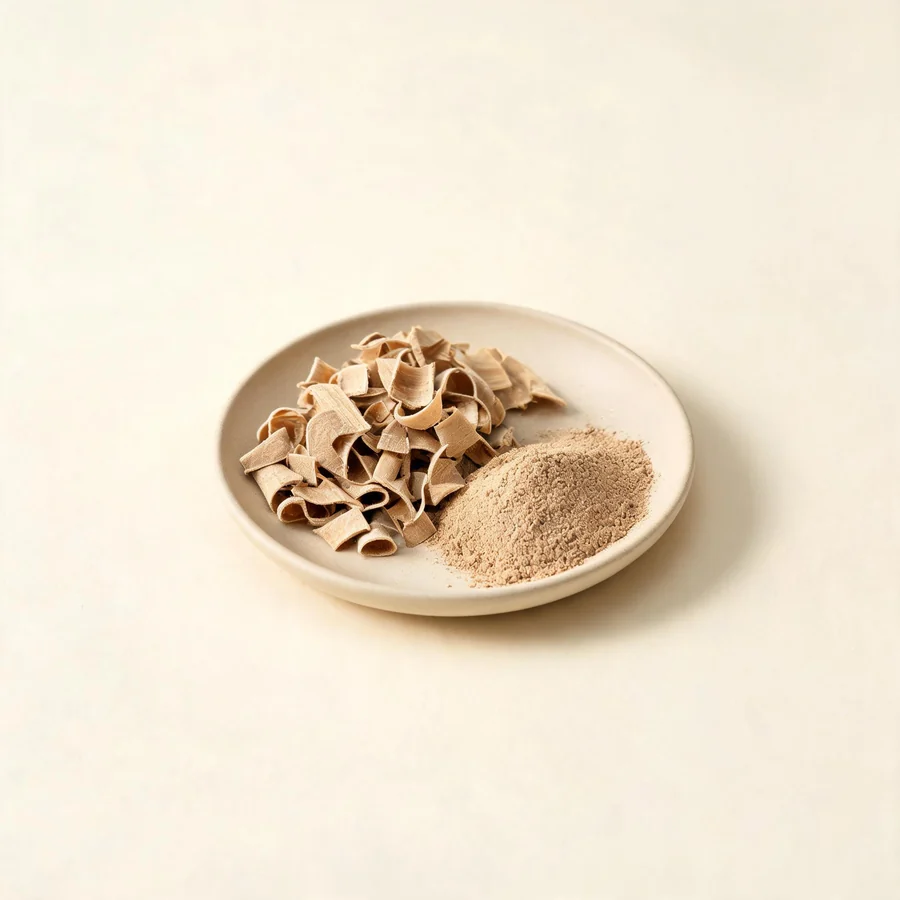
| Decoction of shavings | 15 to 30 g of thin shavings go into cold water first and simmer for three hours or more before the rest of the formula is added, since dense keratin gives up its material slowly. 60 to 120 g is on record for severe acute illness under supervision. |
| Concentrated powder | 1.5 to 3 g once or twice daily, stirred into the strained decoction or warm water. By weight the concentrate is about ten times stronger than the raw shavings; it exists mainly so that prepared medicines can carry the material. |
| Course length | Stop when the fever has broken or the rash has settled. The material is not given for maintenance, and a course beyond a few days needs a clinical reason and review. |
The amount seems large because it is dense keratin and much of it never leaves the shaving: shave it thin, soak it, and let it take the opening three hours of the boil alone. The old figures are large for a second reason too, since buffalo horn replaced rhinoceros horn at roughly ten to one, and a prescription written for a few grams of rhino horn becomes tens of grams of buffalo horn. Children take smaller amounts by age, and treatment ends when the acute picture settles rather than tapering on.
Citations and further reading
Only real sources are listed: the classical materia medica passages quoted above, and the source works behind the botanical and safety statements.
- Lu Chuan Ben Cao (Materia Medica of Luchuan), Qing dynasty - classical entry quoted above.
- Ri Hua Zi Ben Cao (Materia Medica of Ri Huazi), Five Dynasties period - classical entry quoted above.
- Ming Yi Bie Lu (Supplement to the Classic of Materia Medica), Tao Hongjing, Southern and Northern Dynasties - classical entry quoted above.
- Ben Cao Gang Mu (Compendium of Materia Medica), Li Shizhen, 1578 - classical entry quoted above.
- Cornu Bubali monograph: Pharmacopoeia of the People's Republic of China - accepted source material, part and quality requirements, and the non-toxic classification.
- Modern evidence statement: based on comparative chemistry and animal toxicology of Bubalus bubalis horn, summarised as a statement about the level of evidence rather than as a cited finding. No clinical trial is presented as proof of effect.
Educational reference for qualified practitioners. This page is not medical advice, and skin conditions should be diagnosed by a clinician before treatment.