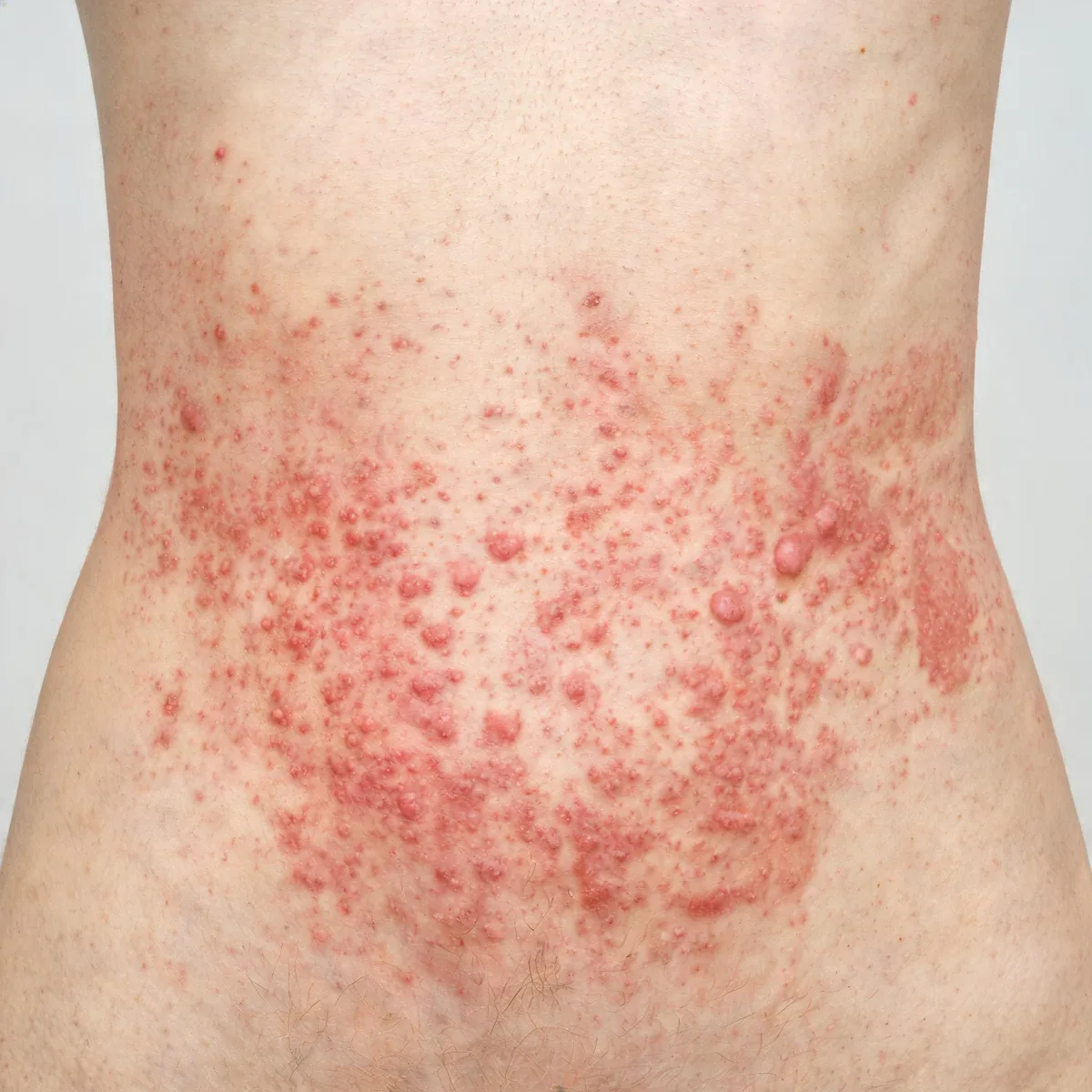
Understanding Drug rash
The tradition describes a drug rash as a clash between the drug, treated as a foreign substance with its own toxic nature, and the person internal landscape.
Depending on the drug and the person, that clash generates Heat, Dampness or Wind. Wind-Heat gives sudden red itchy wheals or papules with a burning sensation, mild fever and sore throat.
Liver and Gallbladder damp heat gives a red moist oozing rash with a bitter taste and sticky stools. Heat in the Blood gives a bright red or purplish rash with tiny bleeding points and internal heat worse at night.
Toxic-Heat is the severe pattern: high fever, burning throughout the body, and a widespread bright red rash that coalesces into large patches. The classical literature treats that as the dangerous end, and so does conventional medicine. Blood deficiency with external wind and Qi and Blood deficiency describe the lingering dry itchy phase after the acute reaction.
What makes the model useful is that it explains individual variation. The drug is the trigger, but the pattern decides the shape of the reaction: the same antibiotic can produce a dry burning eruption in one person and a weepy crusted one in another, and the difference lies in whether that system tends towards heat, dampness or dryness before the drug arrives. This is also why a rash can be predicted to recur, since the terrain that produced it is still there once the drug has cleared.
Timing carries information too. The first days usually belong to the excess patterns: Damp-Heat, Wind-Heat, heat in the blood or Toxic-Heat, which arrive quickly and change quickly. A rash still present weeks after the drug was stopped has usually changed character: heat has consumed fluids, Blood and Yin are thinner, and the skin is dry, scaly and itchy at night. That shift from clearing to nourishing is the single most important judgement in treatment, because cooling herbs given at the dry stage make the skin worse.
Conventional view
A drug rash is the skin's adverse response to a medicine, and it can be trivial or dangerous. Penicillin-type antibiotics, anticonvulsants and anti-inflammatory painkillers are the drugs most often blamed. Clinicians work from the interval between starting the drug and the eruption, together with the shape and distribution of the lesions, and a biopsy is sometimes taken. Most reactions settle once the drug is withdrawn, but a minority announce a systemic hypersensitivity reaction that can damage organs.
Management begins with withdrawing the suspected medicine. Antihistamines by mouth and a topical steroid control itch and inflammation in mild cases, and a short reducing course of oral steroid is used for more severe ones. Blistering reactions such as Stevens-Johnson syndrome need hospital admission and supportive care. None of this should wait while a herbal opinion is arranged.
What this approach does not do is explain susceptibility. Two people take the same drug, one reacts and one does not, and the steroid suppresses the eruption without touching the reason it appeared. Some patients are left with skin sensitivity or recurrent hives long after the drug has gone. TCM offers a way to identify and rebalance the internal pattern that let the reaction take hold, which may shorten recovery and reduce reactivity next time.
Selected PubMed records
Real PubMed records for the conventional discussion above, selected by condition name and title relevance. They are references, not a claim that any treatment is proven for this condition.
- Drug Reaction With Eosinophilia and Systemic Symptoms: A Systematic Review.. The journal of allergy and clinical immunology. In practice, 2023. PMID: 36893848.
- Drug-induced hypersensitivity syndrome/drug reaction with eosinophilia and systemic symptoms. Part I. Epidemiology, pathogenesis, clinicopathological features, and prognosis.. Journal of the American Academy of Dermatology, 2024. PMID: 37516359.
- Drug-induced hypersensitivity syndrome/drug reaction with eosinophilia and systemic symptoms. Part II diagnosis and management.. Journal of the American Academy of Dermatology, 2024. PMID: 37516356.
How it connects
Drug rash often appears alongside other allergic conditions because they share a common root: a constitution prone to Wind-Heat or Damp-Heat. When defensive Qi is weak, external pathogens invade easily, and the same imbalance that produces a skin eruption can also show as allergic rhinitis or atopic dermatitis. A person with Liver and Gallbladder Damp-Heat, for example, may develop a red, oozing drug rash on the trunk while also having nasal congestion and sticky mucus, as the Damp-Heat steams upward and outward to affect skin and upper airways together. Treating the root pattern tends to calm all of these at once. Allergic conditions cluster because they share a constitution. A person whose defensive Qi is weak lets external pathogens in easily, and the same tendency that produces a drug eruption also shows as allergic rhinitis with sneezing and a runny nose, or as atopic dermatitis with chronic itchy patches. Where the underlying pattern is Damp-Heat in the Liver and Gallbladder, the rash may appear on the trunk while the nose runs and the head feels heavy, since the same dampness rises to the upper body. Treating that root with a formula such as Long Dan Xie Gan Tang tends to calm all these expressions together.
How it is assessed
Medical assessment comes first; the pattern describes the skin reaction.
What a practitioner looks for
- Timing: relation to a new medication is the key clue.
- Severity: blistering, peeling, mucosal involvement or fever indicates an emergency.
- Rash type: wheals suggest Wind-Heat; oozing suggests damp heat; bright red with bleeding points suggests Heat in the Blood.
- Lingering phase: dry itchy skin after the acute reaction suggests deficiency.
The consultation starts with the medication history rather than with the skin. What was started, when, and how soon the rash followed are the first facts, because a reaction appearing within hours of a first dose points to a different mechanism from one developing after a week of treatment. The practitioner then records the lesions: flat or raised, dry or weeping, where they began and how fast they spread. Speed and spread are what separate a manageable eruption from an emergency.
Morphology then maps onto pattern. Sudden red itchy wheals or papules that move about, with a thin yellow coating and a floating rapid pulse, indicate Wind-Heat at the surface. A red moist oozing eruption on the trunk with a bitter taste, sticky stools, heaviness and a thick greasy yellow coating means Damp-Heat in the Liver and Gallbladder, with a slippery or wiry rapid pulse. A bright red or purplish rash with pinpoint bleeding, a feeling of heat that worsens at night, a deep red tongue and a rapid forceful pulse mean the heat has entered the blood level.
The remaining two patterns describe the aftermath. A dry scaly rash that itches at night after the acute phase, the tongue pale and thin, the pulse fine, is Blood Deficiency raising internal Wind. A faint recurrent rash in someone chronically tired and prone to colds, with a pale puffy tongue and a weak thin pulse, is Qi and Blood Deficiency. The pattern that must never be missed is Toxic-Heat: widespread coalescing plaques, blistering or peeling, high fever, agitation, mucosal involvement and a thick yellow or black coating with a flooding rapid pulse. That picture needs emergency care, not a herbal prescription.
TCM patterns in Drug rash
Six patterns describe drug rash, and they divide by timing and by moisture. In the first days the question is which pathogen is at work: Wind gives a moving itchy raised eruption, Dampness gives an oozing one, blood heat gives a bright red or purplish one with pinpoint bleeding, and toxin gives a coalescing blistering one with fever. Once the drug clears, the eruption turns dry and the question becomes what has been depleted. The tongue answers much of this. Redness at the tip and along the edges, with a thin yellow coat, means Wind-Heat. A thick greasy yellow coat with redder sides means Damp-Heat. A deep red tongue with prickles and a dry yellow coat means blood heat, while a dry black coat with a flooding pulse is Toxic-Heat. Mixed pictures are normal, so Wind-Heat often turns into Damp-Heat as the rash weeps, and a bright rash in a depleted person is excess and deficiency at once.
| Pattern | Key signs | The itch | Tongue | Main formula |
|---|---|---|---|---|
| Wind-Heat | Burning sensation on the skin | Sudden red itchy wheals or papules | Body: Red at the tip and edgesCoat: Thin yellow or white turning yellow | Not specified |
| Liver and Gallbladder Damp-Heat | Red moist oozing rash | Not specified | Body: Red, with redder sidesCoat: Thick, yellow and greasy | Not specified |
| Heat in the Blood | Bright red or purplish rash with tiny bleeding points | Not specified | Body: Deep red, often with red points or pricklesCoat: Thin, yellow and dry | Not specified |
| Toxic-Heat | High fever and burning sensation throughout the body; Widespread bright red rash coalescing into large patches | Not specified | Body: Red, often with raised red pointsCoat: Yellow, dry, sometimes thick | Not specified |
| Blood Deficiency with External Wind | Dry flaky or rough skin; Rashes that appear and disappear | Itching worse at night | Body: Pale and thin, sometimes slightly dryCoat: Thin, white and a little dry | Not specified |
| Qi and Blood Deficiency | Pale or light red rash | Dry rough skin with itch worse at night | Body: Pale, possibly thin or with teeth marksCoat: Thin white | Not specified |
Wind-Heat
Sudden red itchy wheals or papules with mild fever.
A drug reaction that behaves like an external invasion is read as Wind-Heat. The pathogen meets the skin and the defensive Qi at the surface, and the struggle itself produces the signs: sudden wheals and papules, heat and itch, a mild sore throat and a low fever. The pulse is floating because the battle has not gone deeper. This is why the rash moves, appearing in one area and fading in another, and why it comes on within hours to days of the drug.
The tongue shows redness at the tip and along the edges, with a thin yellow coating, and the pulse is floating and rapid. Heat, alcohol, spicy food and hot showers inflate it, while a cool room, cold drinks, mint or chrysanthemum tea and rest settle it. Xiao Feng San is the formula named, with Jin Yin Hua, Chan Tui and Bo He dispersing Wind, clearing heat and stopping the itch. LI-4 Hegu, LI-11 Quchi, SP-10 Xuehai and GB-20 Fengchi are the points.
Signs
- Sudden red itchy wheals or papules
- Burning sensation on the skin
- Mild fever and sore throat
- Thirst with worsening in heat
Diet and lifestyle for this pattern: Avoid spicy, greasy and fried food that adds Heat. Drink plenty of cool water and herbal teas such as chrysanthemum or peppermint, keep the skin cool in loose breathable clothing, avoid hot showers and saunas, and rest in a cool aired room so the body can clear the eruption.
Liver and Gallbladder Damp-Heat
Red moist oozing rash with a bitter taste.
When the reaction settles into dampness rather than staying at the surface, it becomes sticky and slow. Normally these two organs keep Qi moving and help clear toxins, and a drug can leave them with more than they can process. Dampness and heat then brew there and steam outward to the skin, giving a rash that is red and moist and oozes, and inward to digestion, giving a bitter taste and sticky stools.
The tongue is red, redder at the sides, with a thick greasy yellow coating, and the pulse is wiry, slippery and rapid. Greasy fried food, alcohol and anger feed it, while cooling bland food, plenty of water, gentle movement and a dry environment drain it. Long Dan Xie Gan Tang is the formula named, carried by Long Dan Cao, Huang Qin and Zhi Zi. LR-3 Taichong, GB-34 Yanglingquan, SP-9 Yinlingquan and LI-4 Hegu clear the Liver and drain the dampness.
Signs
- Red moist oozing rash
- Bitter taste in the mouth
- Sticky stools or loose bowels
- Yellow greasy tongue coating
- Irritability and restlessness
Diet and lifestyle for this pattern: Avoid greasy, fried, spicy and very sweet food as well as alcohol, which add Dampness and Heat. Focus on light, cooling, slightly bitter food such as mung beans, Job's tears, bitter gourd and celery, drink plenty of plain water, stay out of humid stuffy rooms, and keep moving gently to clear stagnation.
Heat in the Blood
Bright red or purplish rash with tiny bleeding points.
A stronger reaction can push heat past the surface and into the vessels. There it overheats the blood itself, so the rash becomes deep red or purplish, may show pinpoint bleeding, and burns rather than merely itches. Because blood carries the disturbance, the whole body is affected: thirst, restlessness, poor sleep and a feeling of heat that is worse at night. This is a deeper condition than Wind-Heat and takes longer to clear.
The tongue is red, deepening toward crimson, with red prickles and a thin dry yellow coat, with a pulse that is rapid, wiry and forceful. Spicy food, alcohol, coffee, lamb, fried dishes and lost sleep all make it worse, while a cool room, rest and cooling moistening food such as cucumber and watermelon help. The formula named for this pattern is the classical blood-cooling prescription used to stop bleeding, with Mu Dan Pi, Chi Shao and Zi Cao. LI-11 Quchi, SP-10 Xuehai, LR-3 Taichong and SP-6 Sanyinjiao are the points.
Signs
- Bright red or purplish rash with tiny bleeding points
- Internal heat worse at night
- Intense thirst for cold drinks
- Restlessness
Diet and lifestyle for this pattern: Avoid anything that adds Heat to the Blood: spicy food, alcohol, coffee, lamb and deep-fried dishes. Eat cooling, moistening food such as cucumber, watermelon, mung beans and leafy greens, keep the skin cool with loose clothing and tepid showers, protect sleep and manage frustration with gentle movement before it turns into Heat.
Toxic-Heat
High fever with a widespread coalescing red rash.
Toxic-Heat is what happens when the drug acts as a poison rather than an irritant. Heat and toxin build beyond what the defences can hold and then discharge into blood and skin, producing a widespread bright red eruption that merges into large plaques and may blister or peel. Fever, agitation, thirst and dark urine show that the whole system is involved. This is the pattern that can become toxic epidermal necrolysis or Stevens-Johnson syndrome, and it is a medical emergency.
The tongue is red and thorny, its coat dry and yellow, while the pulse is forceful, rapid and full, especially at the right guan position. Alcohol, spicy and fried food, heat and exhaustion feed it, and only cooling measures and urgent medical care counter it. Huang Lian Jie Du Tang is the core formula, often combined with a blood-cooling prescription, with Huang Lian, Huang Qin, Huang Bo and Zhi Zi. DU-14 Dazhui, LI-11 Quchi, SP-10 Xuehai, LI-4 Hegu and PC-6 Neiguan are the points.
Signs
- High fever and burning sensation throughout the body
- Widespread bright red rash coalescing into large patches
- Intense thirst for cold drinks
- Restlessness
Diet and lifestyle for this pattern: Eat cooling, light food such as mung bean soup, cucumber and watermelon, and strictly avoid alcohol, spicy dishes and fried food. Rest in a cool aired room and drink plenty of water to help the body clear the Heat.
Blood Deficiency with External Wind
The lingering dry itchy phase after the reaction.
A rash that lingers drains the body over time. Blood is what moistens and nourishes the skin, and as it thins the skin becomes dry, flaky and rough, which creates an internal environment the tradition calls Wind: movement without substance, felt as itch. The itch is worse at night because blood withdraws to the interior then, leaving the surface even less nourished. The rash comes and goes rather than settling, which is the signature of Wind.
The tongue is pale and thin, its sparse white coat looking a little dry, and the pulse is thin, sometimes wiry in the left middle position and floating on the right front. Dry windy weather, drafts, overwork and stress all aggravate it, while moisturising the skin, warm nourishing food, sleep and gentle movement help. Dang Gui Yin Zi is the formula named, with Dang Gui, Shu Di Huang and Fang Feng nourishing blood, moistening dryness and dispelling Wind. SP-6 Sanyinjiao, SP-10 Xuehai, LI-4 Hegu and GB-20 Fengchi are the points.
Signs
- Itching worse at night
- Dry flaky or rough skin
- Pale or sallow complexion
- Aversion to wind and drafts
- Rashes that appear and disappear
Diet and lifestyle for this pattern: Eat warm cooked food that builds Blood, such as dark leafy greens, beetroot, black sesame, bone broth and small amounts of good quality meat. Avoid raw, cold and very spicy food that dries the body, moisturise with gentle natural emollients, protect yourself from draughts and wind, and keep exercise gentle.
Qi and Blood Deficiency
Pale rash with dry skin and fatigue during recovery.
When both Qi and Blood are thin the skin is poorly nourished and the defensive barrier that should keep irritants out is weak. A drug that would barely register in a robust person provokes a pale low-grade eruption that lingers because there is not enough energy behind the reaction to clear it. The rash returns whenever fatigue or poor food lowers the reserves again, so the pattern is one of weakness and the treatment is to build.
The tongue is pale and may be thin or marked by teeth, under a thin white coating, while the pulse is fine and weak, sometimes empty or slow. Overwork, skipped meals, cold raw food, poor sleep and stress all deepen the deficiency, while rest, warm nourishing meals and gentle movement rebuild it. Ba Zhen Tang and Yu Ping Feng San are the formulas named, with Dang Gui, Shu Di Huang and Huang Qi. ST-36 Zusanli, SP-6 Sanyinjiao, BL-20 Pishu and SP-10 Xuehai are the points.
Signs
- Pale or light red rash
- Dry rough skin with itch worse at night
- Fatigue and weakness
- Pale complexion and lips
- Dizziness
Diet and lifestyle for this pattern: Eat warm cooked meals such as congee with red dates and goji berries, bone broth and lightly cooked vegetables, and avoid raw cold food and iced drinks that deplete Spleen Qi. Rest well on a regular sleep schedule, and keep movement gentle so Qi flows without draining reserves.
Treatment approach
How the tradition treats drug rash, with the herbs, formulas and points used for it.
Principles
- Stop the suspected drug and seek medical advice immediately; this is the first step in every case.
- Clear heat and resolve toxicity where the rash is widespread and hot.
- Dispel Wind and drain dampness according to the rash type.
- Nourish Blood and Qi in the lingering dry itchy phase, once the acute reaction has passed.
- Root and branch work in opposite directions depending on stage. In an acute eruption the branch has priority: clear Wind, drain Dampness, cool blood or resolve toxin, and do it quickly. In the lingering phase the root takes over and the formula is switched to building Blood and Qi, because continuing to clear would thin an already depleted body. The switch is judged by the skin rather than by the calendar: once the rash stops weeping or spreading and begins to scale, the emphasis moves from clearing to nourishing.
Herbs used
Formulas
- Xiao Feng San
- Long Dan Xie Gan Tang
- Huang Lian Jie Du Tang
- Dang Gui Yin Zi
- Ba Zhen Tang
- Yu Ping Feng San
Acupoints
- LI-4 (Hegu)
- LI-11 (Quchi)
- SP-10 (Xuehai)
- GB-20 (Fengchi)
- LR-3 (Taichong)
- GB-34 (Yanglingquan)
- SP-9 (Yinlingquan)
- SP-6 (Sanyinjiao)
- DU-14 (Dazhui)
- PC-6 (Neiguan)
- ST-36 (Zusanli)
- BL-20 (Pishu)
What to expect
- Simple drug rashes usually settle within one to two weeks after the drug is stopped.
- Severe reactions need hospital care and can be life-threatening.
- The drug should be recorded and avoided in future, and the reaction reported.
- The course is short for acute reactions and long for lingering ones. Most people take a granule or decoction two or three times daily with acupuncture once or twice a week, and the formula is revised as the rash changes rather than repeated unchanged. Itch usually settles before colour does, and dryness can persist for some weeks after the redness has gone. Recurrence after a fresh exposure is expected, and the aim there is a milder reaction rather than none at all.
Safety and when to get help
Seek medical help urgently for
- Blisters, peeling or detachment of large areas of skin.
- Rash involving the mouth, eyes or genitals, or with fever.
- Facial swelling, difficulty breathing or a rapidly spreading rash.
For anything severe, sudden or spreading quickly, read when a skin problem needs urgent care.
Cautions
- Do not restart the suspected drug.
- Record the drug name for future avoidance and tell your doctor.
- Do not use herbal treatment as a substitute for stopping the drug and getting assessed.
Using this alongside conventional care
- This page is complementary: stopping the culprit drug and medical assessment are the treatment. Herbs may help the recovery phase with medical agreement.
- The first rule is that no herb substitutes for stopping the culprit drug, and no one should stop a prescribed medicine without their doctor's agreement, even when the link seems obvious. Used alongside antihistamines and topical steroids, herbs and acupuncture can shorten the reaction and reduce the itch. Two cautions are worth naming: blood-cooling herbs such as Mu Dan Pi and Di Huang have mild anticoagulant activity, so anyone on a blood thinner needs supervision, and when systemic corticosteroids are being tapered the formula is adjusted to support adrenal recovery rather than to replace it. Both practitioners should see the full medication list.
Diet and lifestyle
- During an active rash avoid alcohol, coffee, spicy food, fried food and shellfish.
- During an active rash the aim is to remove what adds heat and Dampness and to keep digestion easy. Alcohol, coffee, chillies, fried food and shellfish are the usual triggers and the first to go, with cooling bland food taking their place: mung bean soup, cucumber and watermelon, and chrysanthemum tea. When the skin is dry and scaly the emphasis shifts to moistening foods, millet and pear among them, and to plenty of water. Pattern detail refines it further: slightly bitter foods such as bitter gourd, celery and coix seed suit Damp-Heat, warm cooked meals with red dates and goji berries suit Qi and Blood deficiency, and dairy and rich dishes are reduced when the rash oozes.
If you're pregnant
Treating a rash in pregnancy needs more caution than usual, because many heat-clearing and toxin-resolving herbs can reach the fetus. Blood-moving and toxic herbs are avoided, Mu Dan Pi and Chi Shao among them, as are large doses of Huang Qin, while gentle herbs, Jin Yin Hua together with Lian Qiao, are considered safer for a mild Wind-Heat rash. In the first trimester needling is often preferred to internal medicine, though points held to be unsuitable in pregnancy, LI-4 Hegu, SP-6 Sanyinjiao and any on the lower abdomen, are left out.
Patterns shift as pregnancy progresses, since Blood and Yin are directed toward the fetus, so a Wind-Heat rash can turn dry and lingering. A modified Dang Gui Yin Zi without Chuan Xiong and high doses of Fang Feng may be considered by an experienced practitioner. Any decision should weigh the safety of mother and child alike, and the obstetric team should know about every herb taken.
If you're breastfeeding
The main concern is transfer into milk. Bitter and cold herbs, Huang Lian, Long Dan Cao and Huang Qin among them, can pass through and cause loose stools or digestive upset in the infant, so milder alternatives such as Jin Yin Hua and Lian Qiao, or topical treatment, are preferred for heat patterns.
Where the rash stems from Blood Deficiency with External Wind, the nourishing herbs, Dang Gui and Shu Di Huang among them, are generally considered safe and may even help support lactation. Acupuncture transfers nothing and is an excellent option throughout. Supply should be watched, since some cooling herbs can reduce lactation slightly, and the formula is adjusted to protect both mother and baby.
If treating a child
A child's drug rash is usually acute and hot, and the likely patterns are Wind-Heat and Toxic-Heat, because a child's Qi is vigorous and flares into heat quickly. The rash is often intensely red and itchy with fever and irritability, and assessment relies on observation: a red tongue with a yellow coat and a rapid floating pulse, since young children cannot describe the sensation.
Doses are a third to a half of the adult amount according to age and weight, and bitter cold herbs are used sparingly to protect the developing Spleen. Acupressure or paediatric tuina at LI-11 Quchi and SP-10 Xuehai can replace needles. The culprit drug must be identified and stopped with the paediatrician, and severe reactions need emergency care.
If treating an elderly patient
In older adults a drug rash usually lands on a background of Qi and Blood Deficiency, so it tends to be paler, drier and more chronic, healing slowly and recurring after the drug has gone because there is not enough energy to clear the residue. Blood Deficiency with External Wind and Qi and Blood Deficiency predominate, and the tongue is pale and thin with a weak fine pulse.
Treatment is gentle: strong heat-clearing herbs are avoided because they further weaken the Spleen and Stomach, and formulas such as Ba Zhen Tang or Dang Gui Yin Zi are given at about two thirds of the adult dose. Polypharmacy is the real hazard, so interactions are screened carefully, and acupuncture is often the safer first line.
Urgent-sign guidance is based on standard sources: NHS anaphylaxis, NHS cellulitis, NHS Stevens-Johnson syndrome, NHS melanoma.
Evidence
Evidence status
Compiled for this page from the classical and modern literature; not a systematic review, so treat it as a pointer to sources rather than clinical guidance.
Evidence is limited and comes mainly from case series and small observational studies. Chinese literature reports positive outcomes with Xiao Feng San and Long Dan Xie Gan Tang, though rigorous methodology and blinding are usually absent. A 2022 review of TCM management of EGFR-inhibitor skin rash concluded that herbal medicine can reduce rash severity and improve quality of life, while stressing the need for better trials. Nothing here alters the rule that a severe drug reaction needs emergency care.
Evidence for drug rash remains mostly low grade. Case series and small observational studies, largely in Chinese, report good outcomes with formulas including Xiao Feng San, and with Long Dan Xie Gan Tang, but rarely with blinding or a control arm. The most specific data concern a single drug eruption: a 2022 review of TCM for skin rash caused by EGFR inhibitors concluded that Chinese herbal medicine reduced rash severity and improved quality of life, while noting that the included trials were of low quality. Work on acupuncture for allergic skin disease is broader and suggests an antipruritic and anti-inflammatory effect, though almost none of it studies drug rash directly. Conventional assessment of any suspected drug allergy remains essential regardless.
Studies often cited
Chinese herbal medicine reduced rash severity and improved quality of life in this specific drug eruption, with higher-quality trials still needed. 2022 review (as recorded in the source)
Reported positive outcomes in case series and small observational studies, with limited methodology. Case series and observational studies (as recorded in the source)
Classical record
Wherever pathogenic factors gather, the Qi there must be deficient. This principle explains why a drug rash occurs in some individuals but not others: a pre-existing weakness in defensive Qi allows the drug toxic heat to invade and manifest on the skin.
- Su Wen (Plain Questions), chapter 33, Discussion on Evaluating Heat Diseases. The Chinese original is not reproduced here: it could not be recovered reliably from the source record, and is not guessed.
肺主氣,候於皮毛;脾主肌肉。氣虛則膚腠開,為風濕所乘;內熱則脾氣溫,肌肉熱,熱氣相搏,故令身體面目皆腫,起如風團,或赤或白,癢痛。
The Lung holds charge of Qi and shows its condition in skin and body hair, while the Spleen has charge of the flesh. Where Qi is weak the pores stand open and Wind-Dampness finds its way in. Where heat is held inside, the Spleen Qi grows warm and the flesh with it, and that warmth contends with the invading pathogen, so face and body swell into raised weals, red or pale, itching and sore.
Zhu Bing Yuan Hou Lun, Volume 35, Skin Eruptions - Classical citation: which presents this passage as an early description close to a drug rash and as evidence that external invasion and internal organ imbalance were understood to act together.
Common questions
What should I do first?
Stop the suspected drug and seek medical advice. Severe reactions with blistering or mucosal involvement are emergencies.
Can herbs treat a drug rash?
Only as support in the recovery phase. The essential steps are stopping the drug and medical assessment.
Will it come back?
If the drug is taken again, yes. The reaction should be recorded and the drug avoided.
When is it an emergency?
Blistering or peeling skin, mucosal involvement, fever, or breathing difficulty.
How fast do herbs clear a drug rash?
For an acute red itchy rash from Wind-Heat or Damp-Heat, redness and itch often ease within two to three days of the right formula, and the rash may clear in five to ten days once the culprit drug has been stopped. A dry rash on a deficient constitution takes longer, usually three to six weeks of consistent treatment, because the skin has to be rebuilt rather than calmed.
Does acupuncture relieve the itch?
Yes, and it often works faster than anything else for itch. Needling calms the nervous system and clears heat from the skin, and points such as LI-11 Quchi and SP-10 Xuehai are used specifically to cool the blood and settle the surface. Many people feel the skin quieten within that first session, although two or three treatments are usually needed for lasting relief.
Can treatment keep it from returning?
It cannot change a true drug allergy, and the culprit drug must still be avoided. What it can do is reduce reactivity: treating an underlying pattern such as Liver Damp-Heat or Blood Deficiency leaves the body less likely to mount a severe response to the next medication or trigger. That matters most for people who have had several reactions or who develop hives easily.
Which foods suit a healing rash?
Avoid spicy, fried and greasy food, alcohol, coffee and shellfish while the rash is active, since all of them add heat and make the itch worse. Cooling bland food is the base: mung bean soup, cucumber and watermelon, with chrysanthemum tea. Where the skin is dry and scaly, moistening foods help, millet and pear among them, and water intake should stay up whatever the pattern.
Is this the same as hives?
They overlap closely. A large share of them behave like acute urticaria, with raised wheals that itch and come and go, and both can sit on a Wind-Heat or Damp-Heat pattern treated along similar lines. The difference is the trigger: a drug rash follows a medication and usually carries a stronger toxic element, which is why it may need additional toxin-clearing herbs and a medical review.