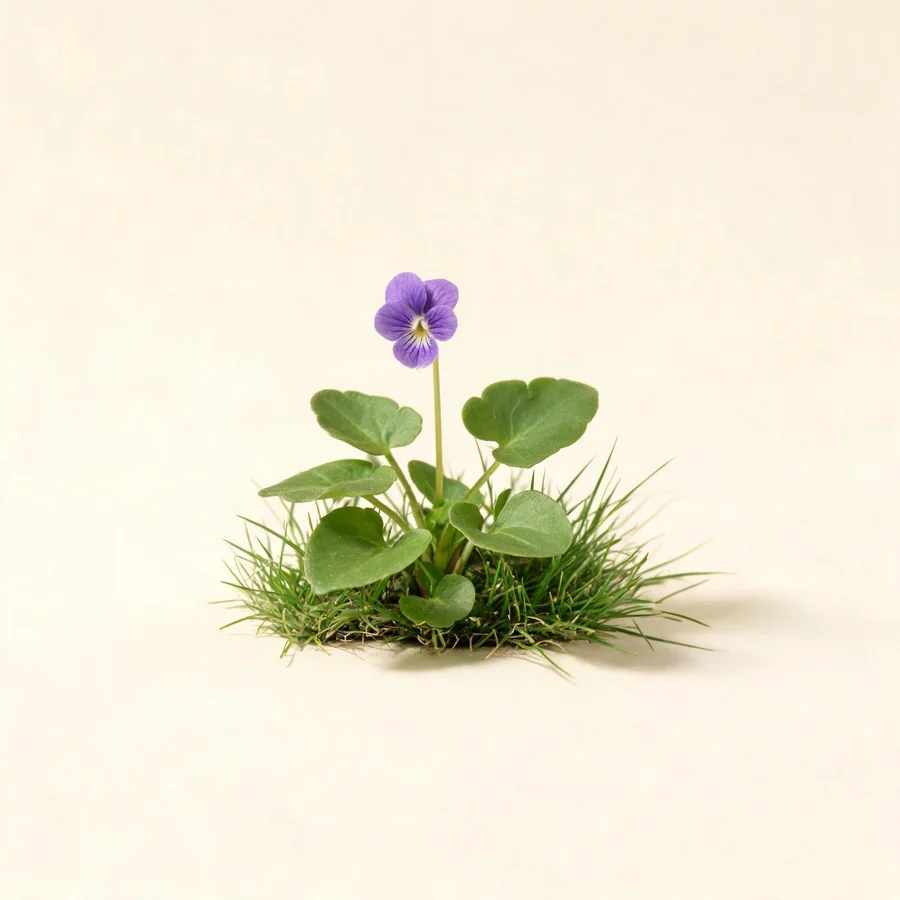
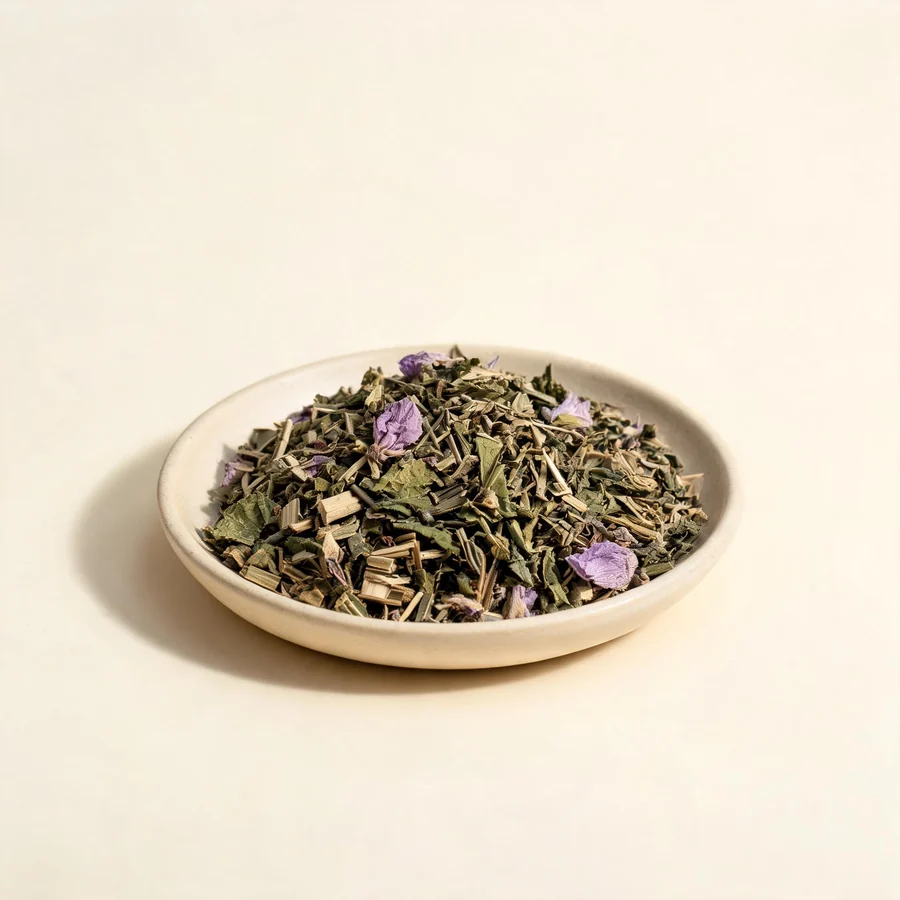
Skin profile
Where this herb sits in skin practice: the pattern it corrects, the skin signs it suits, and what it should not be used for.
Zi Hua Di Ding is chosen for a lesion that is red, hot, painful and defined: a boil, a carbuncle, an infected bite or a spreading red patch. It is gentler than its reputation suggests, and its proper place is the early and resolving stage of a heat-toxin lesion, with medical treatment covering anything that is spreading.
Skin signs that suggest it
- A boil or carbuncle with a deep, hard, tender root and a red base (heat toxin)
- A bright red, hot, sharply defined and painful patch that spreads, as in erysipelas
- Honey-coloured crusts or weeping pustules with surrounding redness (impetigo-like heat toxin)
- A hot, swollen, painful insect or snake bite with a red rim
- Firm, red, tender nodules that have not yet pointed, with heat and throbbing in the surrounding skin
When it is not the right herb
A cold, pale, deep, diffuse sore with thin watery fluid is the wrong target: cooling a cold lesion is held to aggravate it, and the same reasoning applies to an older person's leg ulcer with pale, watery ooze. Weak cold digestion - loose stool, poor appetite, a cold abdomen - is another reason to hold back, because weeks of a bitter cold herb wear the digestion down. Fever with a spreading infection is a medical matter, and a facial boil or a breast abscess needs assessment rather than a longer course.
What it does for skin
Skin-relevant actions only. Each one describes a mechanism in TCM terms and what it looks like on the skin.
Clears Heat and resolves toxin
The primary action. A boil starting as a small hard lump on red skin, whose root is deep and tender, is the type case: accumulated toxin, in the traditional reading, which is treated by draining the Heat behind it and drawing the toxin out. Strength is not what is required, because the lesion is small and the aim is direction. It goes in by mouth and on the spot as a poultice; facial boils are treated with particular caution.
Cools the Blood and reduces swelling
Once Heat has gone deeper, the whole area turns evenly red, hot and tender and begins to extend rather than staying put. The violet enters the Heart, which governs Blood, and the Liver, which stores it, and its coldness is held to lower that heat where it starts. Hence its use in erysipelas and in other hot, inflamed, extending patches that a surface cooler could never reach.
Disperses a defined swelling and helps it point
Acridity is what distinguishes this plant from the purely bitter clearers. Acrid means dispersing, so the violet both cools a hot swelling and helps a firm, well-defined lesion to point or resolve. It is picked where a boil is slow to suppurate and the surrounding tissue is hard, and it is combined with a herb that breaks nodules when hardness persists.
Settles hot, swollen surface reactions
Crushed fresh plant applied to a bite, a sting or a hot red patch is the folk form of the same action, and it survives in practice because it is cheap, cooling and locally effective. The poultice is changed often and used on intact or minimally broken skin. A bite with spreading redness, fever or systemic symptoms needs medical care, and the poultice is comfort rather than treatment.
Skin conditions it is used for
Mapped to the condition pages on this site. The pattern column shows what the skin is doing when this herb is the right choice.
| Condition | Pattern | Why it suits | Typical setting |
|---|---|---|---|
| Boils | Toxin and Heat, with a boil rooted deeply and slow to point | This is the herb's home ground. A boil with a hard root and a red base is the lesion the tradition calls a ding, and the violet is one of its standard medicines because it combines three qualities in one: bitter to drain, cold to cool and acrid to disperse. It is given internally and used as a poultice on the same lesion, and a boil that is spreading, on the face, or accompanied by fever needs medical assessment rather than a stronger poultice. | Wu Wei Xiao Du Yin, or the violet with Pu Gong Ying and Jin Yin Hua |
| Skin abscess | Toxin lodged with pus and a hard, defined border | An abscess is a larger version of the boil, with the same logic: toxin has accumulated, the tissue is indurated and the centre is working towards pus. The violet clears the Heat and cools the Blood while a nodule-breaking herb handles the hardness, which is why the two appear together in the standard sore formulas. Deep or spreading collections need medical treatment, and the herb belongs to the early and resolving stages. | Wu Wei Xiao Du Yin with Zi Bei Tian Kui Zi added for a hard, slow swelling |
| Impetigo | Damp-heat meeting on the surface, with honey-coloured crusts | Impetigo is read as dampness and heat meeting at the surface, and the honey-coloured crust is the visible sign of the heat drying the discharge. The violet is a reasonable fit because it clears heat toxin and reduces the redness around the crusts, and a cooled decoction can be used as a wash on limited areas. It is contagious and often needs an antibiotic, particularly in a child or where it is spreading, so the herb is support. | A heat-clearing formula with the violet and Lian Qiao, or a dilute wash |
| Erysipelas | Fire toxin in the skin, bright red, raised and spreading | Erysipelas is the clearest skin picture of heat that has entered the Blood: a bright red, raised, sharply bordered plaque that spreads quickly and burns. The violet's entry into the Heart and Liver and its blood-cooling action explain why it is used, and it has a long record in these formulas. The infection needs antibiotics promptly, and the herb is used at the margins and during recovery rather than as the treatment. | Supportive only, alongside antibiotics; a modified heat-clearing formula with the violet |
| Cellulitis | Toxic Heat in the deeper tissue with a hot, tender, spreading edge | Cellulitis and erysipelas share a mechanism in the tradition, and they share the same warning. A hot, tender, spreading area with fever is Toxic Heat that has gone deeper than the surface, and a cold herb that cools the Blood has a theoretical place beside the antibiotic rather than instead of it. Delay is the main risk in this condition, so the herb should never be the reason a person waits. | Supportive only, with antibiotics as the treatment |
| Pustules | Heat toxin at the surface, with pustules on a red base | Pustules that sit on a red, hot base are the smallest expression of the same toxin pattern, and the violet is used where they are few, inflamed and recurrent rather than widespread and cystic. It is a supporting herb in a formula, not the lead, and its role is to cool the base and stop the pustules from spreading. A dense pustular eruption, especially with fever, needs a diagnosis. | A heat-clearing formula with the violet and Ye Ju Hua |
Combinations for skin
Herbs it is paired with when the skin, not an internal organ, is the target.
| Partner | Ratio | Why the pair is used |
|---|---|---|
| Pu Gong Ying | 10 to 15 g each | The standard pairing for Heat-toxin and boils. Dandelion disperses a firm lump and drains dampness more strongly; the violet is better with a deep, pointed boil and with cooling Blood. One works on the mass, the other on the toxin within it. Both are mild enough for a short course in most people, and they are more often used together than separately. |
| Jin Yin Hua | 10 to 15 g Jin Yin Hua with 9 to 15 g Zi Hua Di Ding | Honeysuckle is sweeter and acts at the Qi level, clearing Heat and resolving toxin while lifting outward; the violet is colder and reaches the Blood. Between them they address surface heat and deeper toxin, which is why the standard five-herb boil formula includes both. Honeysuckle takes the larger share because it is the gentler of the two. |
| Ye Ju Hua | 9 to 12 g each | Wild chrysanthemum clears Liver Heat, resolves toxin and is directed at the head and eyes, while the violet adds blood cooling. Toxic sores of the face and scalp, and the red rim around an upper-body lesion, are where the pair is used. One supplies an upward direction, the other depth of cooling, so they are combined rather than alternated. |
| Lian Qiao | 9 to 12 g each | Forsythia clears Heat, resolves toxin and disperses nodules, which few cold herbs do, while the violet's particular strength lies in the Blood. Used together they clear a lesion from the outside in, and they suit hard, well-defined swellings. A faint aromatic quality in forsythia keeps a cold formula from turning heavy and cloying. |
Formulas where it leads
- Wu Wei Xiao Du Yin (五味消毒饮) - The drink of five ingredients for toxic sores, and the formula most closely tied to this herb. The violet joins honeysuckle, wild chrysanthemum, dandelion and unripe trichosanthes seed, and the group is still taught as the standard approach to boils and carbuncles. It is meant for an acute lesion over a short period, not as maintenance.
Topical use
The violet is applied to skin as a fresh poultice and as a cooled wash, usually alongside internal treatment for the same lesion. Crushing the fresh plant into a paste and putting it straight on the spot is the older method; a handful of dried herb steeped in hot water and left to cool is the simpler one. Topical use suits one defined lesion rather than a wide eruption.
| Preparation | How and when it is used |
|---|---|
| Fresh poultice | Crush a handful of clean fresh plant to a paste, or use 30 to 60 g of fresh herb, and apply directly to a boil or bite, covering with a clean cloth. Change it two or three times a day and stop when the lesion points or the redness settles. |
| Cooled decoction wash | Simmer 15 to 30 g of dried herb in 500 ml of water for 15 minutes, strain and cool to skin temperature. Bathe or compress the area for 10 minutes once or twice daily, and make a fresh batch each time. |
| Dilute wash for crusted patches | For impetigo-like crusts on limited areas, use a weaker decoction and soft cloths, and do not scrub the crusts. A lesion that is spreading, or that is near the eye, needs medical assessment rather than a stronger wash. |
Patch test and cautions
Patch test a poultice on normal skin before applying it to a lesion. Do not apply to deep, openly infected or facial lesions without supervision, keep the preparation away from the eyes, and stop if the surrounding skin becomes redder or more painful. A poultice should not be left on overnight, and a boil that is not improving after a few days, or is spreading, needs medical review rather than a longer course.
Safety for skin use
What to check before recommending or using it, including the cautions that matter most for skin patients.
Do not use, or use with caution
- Cold weakness of Spleen and Stomach: loose stool, little appetite, cold abdominal pain. Bitter, acrid and cold, the herb can loosen the bowel further and dull the appetite in this picture.
- A cold, indolent sore - pale, deep, diffuse, slow, with thin watery fluid. Cooling a cold lesion is held to aggravate it, and the pattern calls for warming and support instead.
- Fever with a spreading infection, a boil on the face, or a breast abscess with high temperature. Each needs medical assessment; the herb belongs to mild lesions and to recovery, never in place of treatment.
- Weeks of use in pregnancy or in a depleted person. A bitter cold herb taken long term burdens digestion when nourishment matters most, so it is given briefly and only where Heat is clear.
Pregnancy and breastfeeding
Only under a practitioner's supervision. Nothing in the classical record forbids it, and since the plant has been a spring vegetable the toxicity question is reassuring. Duration is the real issue: taken for weeks, a bitter cold medicine can unsettle the digestion that is meant to nourish the fetus, so treating a boil for a week under supervision differs from routine use across a pregnancy. Breastfeeding mothers are usually advised to keep it brief and to stop if the baby's stool loosens.
Interactions
- Anticoagulants. Laboratory work has shown the plant's constituents to have anticoagulant activity; the clinical size of that effect is unknown, but adding warfarin, heparin or an antiplatelet medicine to it brings an unquantified bleeding risk, and new bruising argues for stopping.
- Immunosuppressants. Animal and laboratory work describes immune-modulating effects that could, in theory, oppose ciclosporin, tacrolimus and other transplant drugs. Human evidence is absent in both directions, so the two should not be assumed independent.
- Antibiotics and fever medicines. Nothing has been described with common antibiotics, and the herb is often taken with them in Chinese practice. The point to hold on to is that fever plus a spreading infection is not a herbal problem: the antibiotic treats it and the herb supports.
Allergy and patch testing
Contact reactions to a fresh poultice are possible, particularly where the crushed plant is left on for hours, and the reaction can be mistaken for the lesion worsening. Patch test on normal skin first, keep the application to a limited area and a short time, and stop at once if the surrounding skin becomes redder, hotter or more itchy. A previous reaction to a herb poultice is a reason to use a cooled wash instead.
General safety references
General references for herbal hepatotoxicity and herb-drug interactions; they are not specific to this herb.
- Review article: Herbal hepatotoxicity - an update on traditional Chinese medicine preparations. Alimentary Pharmacology & Therapeutics, 2014. PMID: 24844799.
- Interactions between herbal medicines and prescribed drugs: an updated systematic review. Drugs, 2009. PMID: 19719333.
- Warfarin and food, herbal or dietary supplement interactions: a systematic review. British Journal of Clinical Pharmacology, 2021. PMID: 32478963.
Evidence
The classical record is quoted with its source. The modern note states the level of evidence plainly.
Classical record
气味:苦、辛、寒、无毒。主治:一切痈疽发背,疔肿瘰疬,无名肿毒,恶疮。
Flavour and nature: bitter, acrid, cold and without poison. It treats every kind of carbuncle and back abscess, the deep boil, scrofula, unnamed toxic swellings and foul sores.
Ben Cao Gang Mu (Compendium of Materia Medica), Li Shizhen - This is the entry that separated the violet from the other plants traded as Di Ding, and the indications it lists amount to a catalogue of the period's external medicine.
地丁专为痈肿疔毒通用之药。
For abscesses, swellings, boils and toxic sores, Di Ding is the herb used across the board.
Ben Cao Zheng Yi (Correct Meaning of Materia Medica), Qing dynasty - A late commentary that reduces the herb to a sentence, and the sentence remains the shortest accurate account of its use.
Modern evidence
Evidence status
- Laboratory work on Viola yedoensis reports flavonoids and phenolic constituents with antibacterial, anti-inflammatory and antioxidant activity in cell and animal studies. The plant has also shown anticoagulant activity in laboratory work. These findings do not establish that the herb shortens a boil or prevents spread in a person.
- No adequate clinical trial of the single herb in boils, impetigo or erysipelas was identified for this edition. Published work is generally on compound formulas in which the violet is one ingredient, so the herb's own contribution cannot be separated.
- The plant is a recognised pharmacopoeial article and has a long record as an edible spring vegetable, which supports a low toxicity profile at ordinary doses. The practical limits are the coldness of the herb and the risk of mistaking another plant sold under the same name, since several unrelated species have traded as Di Ding.
PubMed records
Selected real PubMed records for this herb's species or its constituents, chosen by species name and title relevance. They are references for the non-TCM discussion above, not proof that the herb treats any skin condition.
- Violae Herba: A comprehensive review of the traditional uses, phytochemistry, pharmacology, quality control and clinical applications.. Journal of ethnopharmacology, 2025. PMID: 40188895 (pharmacology or review record).
Dose and forms
Skin-practice dosing and the preparations that suit skin complaints.
| Form | Dose and notes |
|---|---|
| Decoction | 9 to 15 g of dried whole plant a day for a single mild boil, or as one ingredient in a larger formula. Because the material is mild, the amount is bigger than for a potent root. |
| Full pharmacopoeial range | 15 to 30 g is the accepted range for an acute lesion, and the top of it is used for a severe or deep boil under supervision. |
| Fresh plant and external use | 30 to 60 g of fresh plant where available, decocted or crushed for a poultice, or a handful steeped as a wash. Internal and external routes are often used on the same lesion at once. |
| Course length | Days, not months. Stop once the lesion settles, since weeks of a bitter cold herb start to cost digestion; a boil unchanged after a week, or spreading, calls for a diagnosis rather than a larger dose. |
Amounts are governed by how mild the material is rather than by any narrow margin: fresh whole plant is largely water and fibre, and the dried herb has been eaten as a vegetable for centuries. What limits a course is coldness and its effect on digestion, not toxicity. Internal and topical use complement each other, and combining them for one defined lesion is routine.
Citations and further reading
Only real sources are listed: the classical materia medica passages quoted above, and the source works behind the botanical and safety statements.
- Ben Cao Gang Mu (Compendium of Materia Medica), Li Shizhen, 1578 - entry quoted above.
- Ben Cao Zheng Yi (Correct Meaning of Materia Medica), late Qing period - passage quoted above.
- Pharmacopoeia of the People's Republic of China - Zi Hua Di Ding monograph: accepted species, part used, dose range and quality requirements.
- Modern evidence statement: based on laboratory literature on Viola yedoensis flavonoids, summarised as a statement about the level of evidence rather than as a cited finding. No clinical trial is presented as proof of effect.
- Botanical description and identification: botanical literature on Viola yedoensis, Violaceae, and pharmacognostic work on the several plants traded as Di Ding.
Educational reference for qualified practitioners. This page is not medical advice, and skin conditions should be diagnosed by a clinician before treatment.