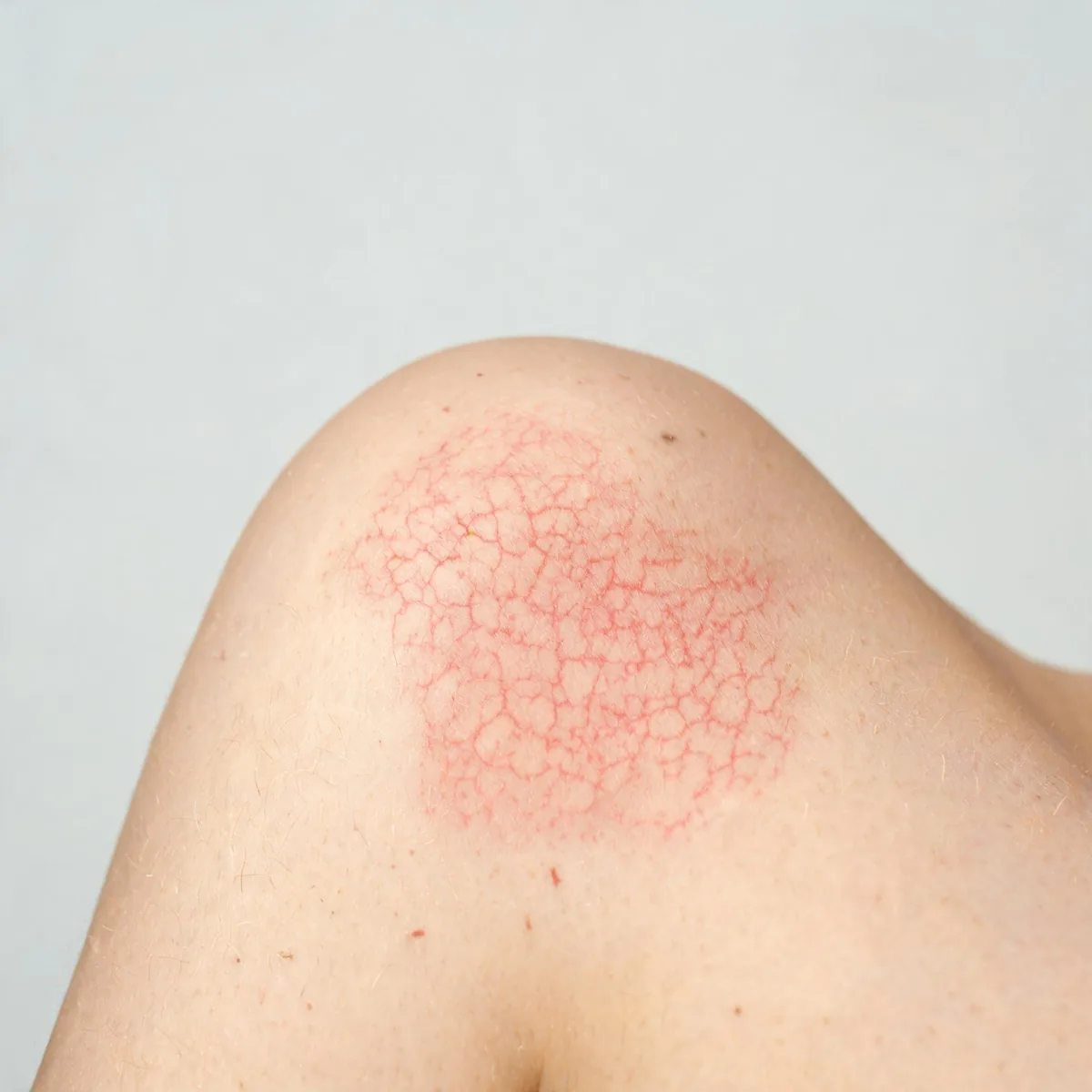
Understanding Erythema infectiosum
The tradition describes erythema infectiosum as Wind-Heat entering through the nose and mouth, lodging in the Lungs and disrupting their ability to govern the skin.
The single pattern described is Wind-Heat invading the Lungs: slapped-cheek rash with bright red cheeks, a lacy net-like rash on the trunk and limbs, mild fever with slight chills, sore or scratchy throat, cough and thirst.
The classical literature notes this is a mild childhood illness in most cases. The rash often appears after the fever settles, and it can fade and reappear with heat, exercise or sunlight.
A limitation recorded rather than resolved: the source describes only one pattern for this condition. The page keeps it rather than inventing additional patterns.
The Lungs are the organ most exposed to wind and heat arriving from outside, and they also have charge of the body surface, so a childhood rash that follows a day or two of sneezing and a scratchy throat is read as an exterior problem first.
When the pathogen is held at the level of skin and muscle rather than allowed to sink, the rash keeps changing shape instead of settling, which is why the redness can vanish in the cool of the morning and bloom again after a warm bath or a run around the garden.
Because nothing deep has been disturbed, the tongue changes are slight, a redder tip with a thin yellow coat, and the pulse is described as floating and rapid, a sign that defensive Qi is still fighting at the surface. The strategy therefore matches the depth of the illness: open the surface, let the heat out, and leave the interior alone.
Conventional view
Fifth disease, caused by parvovirus B19, is a common childhood viral illness. It typically starts with mild cold-like symptoms such as a low-grade fever, sore throat and runny nose, followed by a distinctive bright red rash on both cheeks, the slapped-cheek appearance, and after a few days a lacy pink rash may spread to the trunk and limbs. The illness is usually mild and self-limiting over about a week, diagnosis is based on the characteristic rash and clinical history, and blood tests are rarely needed.
There is no specific antiviral treatment. Management relieves symptoms with rest, plenty of fluids and over-the-counter pain relievers such as acetaminophen or ibuprofen for fever and discomfort. Most children recover fully without complications, though the rash may come and go for several weeks when the skin is exposed to heat or sunlight, and no vaccine is available.
Conventional treatment is purely supportive because no specific antiviral exists. While the illness is usually mild and self-limiting, children may feel unwell for a week or more, and there is no way to shorten the course or prevent outbreaks. TCM offers a gentle active approach that may reduce symptom severity and duration by addressing the underlying Wind-Heat imbalance rather than waiting it out.
Selected PubMed records
Real PubMed records for the conventional discussion above, selected by condition name and title relevance. They are references, not a claim that any treatment is proven for this condition.
- Erythema Infectiosum: A Narrative Review.. Current pediatric reviews, 2024. PMID: 37132144.
How it connects
Erythema infectiosum rarely appears in isolation: the bright red slapped-cheek rash is almost always accompanied by mild cold-like symptoms such as a sore throat, a low-grade fever or a dry cough. In TCM this is not a coincidence, because the Lungs govern both the skin and the respiratory passages, so a single Wind-Heat invasion can show on the face and in the throat and nose at the same time. They are two expressions of one superficial pattern, and treating the root with a formula that clears Wind-Heat often resolves the rash and the respiratory discomfort together. Erythema infectiosum rarely appears in isolation: the bright slapped-cheek rash is almost always accompanied by mild cold-like symptoms such as a sore throat, a low-grade fever or a dry cough. In TCM this clustering is not coincidental, because the Lungs govern both the skin and the respiratory passages, so a single Wind-Heat invasion can show on the face and in the throat and nose at the same time. These are not separate diseases but two expressions of one superficial pattern, and treating the root with a formula such as Yin Qiao San often resolves the rash and the respiratory discomfort together, which is why the practitioner reads the whole picture rather than chasing each symptom.
How it is assessed
The practitioner recognises the pattern from the rash distribution and the mild fever.
What a practitioner looks for
- Rash pattern: bright red cheeks with lacy trunk and limb rash is the classic picture.
- Fever: mild with slight chills and sore throat.
- Timing: rash often follows the fever and may fade and recur with heat or exercise.
- Red flags: high fever, severe headache, or the patient being pregnant or immune-suppressed.
The first question a practitioner asks is about the order of events: with fifth disease the cheeks usually flush after the fever has already settled, and the child often seems brighter than the rash would suggest.
Examination then moves to the rash itself, checking whether both cheeks are uniformly bright and warm while the trunk shows a finer net-like tracery, and whether pressure empties the redness. A look at the throat, the tongue tip and the pulse confirms whether the picture stays at the surface; thirst that cannot be quenched, dark urine or a fever that climbs despite fluids would push the reading deeper and change the treatment.
TCM patterns in Erythema infectiosum
Only one pattern is recorded for this illness, which is worth stating. The value of pattern thinking here lies less in choosing a pattern than in confirming that the picture stays superficial: bright warm cheeks, a lacy rash that comes and goes with heat, a low fever, a scratchy throat and a pulse that floats rather than sinks. A rash that turns deep purple or blisters, a fever that will not come down, joint pain or an exhausted child all suggest the illness has moved past a simple exterior invasion and needs medical review first. Comparing the picture with measles, rubella and scarlet fever is the other useful exercise, because those rashes sit deeper and carry more heat and toxicity. In practice the practitioner treats the depth of the illness rather than its name, releasing the exterior while the pathogen sits in skin and muscle and holding stronger methods until deeper heat appears.
| Pattern | Key signs | The itch | Tongue | Main formula |
|---|---|---|---|---|
| Wind-Heat invading the Lungs | Slapped-cheek rash with bright red cheeks; Lacy net-like rash on trunk and limbs | Not specified | Body: Slightly red, with a red tipCoat: Thin yellow | Not specified |
Wind-Heat invading the Lungs
Slapped-cheek rash with a lacy body rash and mild fever.
Wind and heat arrive together through the mouth and nose, and the Lungs, the first organ to meet them, lose the ability to keep defensive Qi moving outwards to the skin. Because the face and upper body are where that Qi gathers, the heat shows first on the cheeks as a sudden flush that is bright, warm and sharply outlined. The later net-like rash over the trunk and arms is described as the pathogen caught between skin and muscle, close enough to the surface to colour it, not deep enough to settle in an organ.
The tongue body stays normal, the tip looks redder than it should and the coat is thin and yellow, while the pulse floats and beats faster than normal, both confirming that the fight is still at the surface. Hot rooms, spicy or greasy food and coffee add internal heat, drafts and wind add more pathogen, and overexertion drains the Qi that is doing the pushing, so rest and cool air are the two most useful measures. Yin Qiao San is the formula recorded for this presentation, dispersing wind-heat and clearing heat with Jin Yin Hua, Bo He and Lian Qiao. The points listed for the pattern are Lieque (LU-7) with Hegu (LI-4), which open the Lung channel and drive the pathogen outwards, plus Quchi (LI-11) for heat and Fengchi (GB-20) for fever and sore throat.
Signs
- Slapped-cheek rash with bright red cheeks
- Lacy net-like rash on trunk and limbs
- Mild fever with slight chills
- Sore or scratchy throat
- Cough with thirst
Diet and lifestyle for this pattern: Rest is central, letting defensive Qi fight the pathogen, and keep the room aired without drafts. Dress in light breathable clothing, drink plenty of fluids such as water, chrysanthemum tea or pear juice, and eat light cooling food such as congee, steamed vegetables and fruit. Avoid spicy, greasy and fried food, alcohol and coffee, which can worsen Heat.
Treatment approach
How the tradition treats erythema infectiosum, with the herbs, formulas and points used for it.
Principles
- Rest, fluids and symptom relief are the main care in an uncomplicated case.
- Clear Wind-Heat and support the Lungs where symptoms are active.
- Pregnancy and blood disorders need medical advice, not herbal self-treatment.
- The rash may fade and reappear for weeks; this is expected.
- The root is a surface invasion that has not settled, so the branch work of clearing rash and fever is also the root treatment, and nothing stronger is needed unless the signs go deeper. Where the illness is uncomplicated, a short gentle course is enough, and stronger clearing is kept for a child whose fever runs high or who develops joint pain.
Herbs used
Formulas
Acupoints
What to expect
- The illness is described as mild and self-limiting in children.
- The rash can recur with heat or exertion for several weeks.
- Pregnancy and immune suppression change the risk substantially.
- In the classical literature timeline the fever and sore throat settle within two to three days of starting herbs, while the rash takes about a week to fade and can keep reappearing with warmth or exercise for several weeks after that. No long-term care is described once the illness has passed, and treatment is not continued as a preventive measure.
Safety and when to get help
Seek medical help urgently for
- High fever above 39.4 C that does not respond to medication.
- Severe headache, drowsiness or confusion.
- Exposure during pregnancy, or in someone with a blood disorder or immune suppression - seek medical advice.
For anything severe, sudden or spreading quickly, read when a skin problem needs urgent care.
Cautions
- Pregnant women exposed to fifth disease should contact their clinician.
- People with chronic anaemia or immune suppression need medical review.
- Do not assume a mild course in high-risk groups.
Using this alongside conventional care
- This page is complementary: the illness is viral and self-limiting in most children, with medical advice for high-risk groups.
- Because the illness is viral and self-limiting, herbs sit alongside supportive conventional care rather than replacing it: fever reducers such as acetaminophen or ibuprofen can be used as needed, and no interaction with the Yin Qiao San herbs is recorded. The precautions worth keeping are procedural. Tell the child's doctor and the practitioner about everything being taken, avoid giving a child several products at once without review, and let a doctor assess a rash that blisters, a fever above 39.4 degrees, or a child who is hard to rouse.
Diet and lifestyle
- Keep fluids up and favour light cooling food during the fever.
- The rule is to keep food light and cooling while the rash is active: congee, steamed vegetables, pear and chrysanthemum tea, with plenty of water, and nothing that adds heat such as chilli, fried food, coffee or alcohol. For this pattern the classical literature also stresses rest, a ventilated room without draughts, light clothing, and drinks taken little and often, because fluids that moisten the throat support the Lung's work of keeping the skin settled.
If you're pregnant
Erythema infectiosum is parvovirus B19, which can affect the fetus, so medical monitoring matters as much as treatment. From a TCM view the Wind-Heat pattern still guides treatment, but the approach is gentler: Yin Qiao San is generally considered safe short term under professional guidance, with strongly dispersing herbs such as Bo He reduced or omitted in the first trimester.
Acupuncture is often the safer first line, using points such as Lieque (LU-7) and Fengchi (GB-20) to release the exterior, while Hegu (LI-4) is avoided because it can stimulate contractions. Care should be shared with a TCM practitioner experienced in pregnancy and the appropriate medical team.
If you're breastfeeding
The Wind-Heat pattern can be treated without interrupting breastfeeding. The ingredients of Yin Qiao San, Jin Yin Hua, Lian Qiao and Bo He, are considered safe at standard doses in lactation and only trace amounts reach breast milk.
Acupuncture is safe and can be used alone if preferred. Keep the mother well hydrated, since fever and cooling herbs can slightly reduce milk supply, and the formula should be adjusted by the practitioner to the individual picture.
If treating a child
Erythema infectiosum is overwhelmingly a childhood illness, peaking between five and fifteen years. Children are described as pure yang, quick to heat up and quick to recover, so Wind-Heat invading the Lungs is the usual pattern and the illness is generally mild and self-limiting.
Observation does most of the diagnostic work: the slapped-cheek rash is unmistakable, while the red tongue tip, thin yellow coating and floating rapid pulse may be subtle. Doses are about a third to a half of the adult dose by age and weight, Yin Qiao San is given as decoction or granules and lightly sweetened if needed, and needle treatment is replaced by acupressure, paediatric tuina or non-insertive tools, focusing on LU-7, LI-4 used cautiously, and Quchi (LI-11).
If treating an elderly patient
The illness is rare in older adults, and when it appears the Wind-Heat pattern may sit on top of Qi or Yin deficiency. The cooling herbs that clear the rash can weaken the Spleen and Stomach if used too aggressively, so lower doses are used and a mild Spleen-supporting herb such as Fu Ling is often added.
The pulse may feel floating yet weak or thready, and recovery can be slower with the lacy rash lingering. Acupuncture is well tolerated and points are chosen to release the exterior while supporting the root, and a full medication review is needed because older patients often take several drugs.
Urgent-sign guidance is based on standard sources: NHS anaphylaxis, NHS cellulitis, NHS Stevens-Johnson syndrome, NHS melanoma.
Evidence
Evidence status
Compiled for this page from the classical and modern literature; not a systematic review, so treat it as a pointer to sources rather than clinical guidance.
Direct evidence is scarce and comes from traditional use plus research on the same Wind-Heat invading the Lungs pattern. Yin Qiao San has been studied extensively for acute upper respiratory infection, with randomised trials and reviews suggesting reduced fever duration and symptom severity, though quality is limited. For fifth disease specifically, no high-quality randomised trials exist, which is exactly what this page says.
The picture is the familiar one of traditional use running ahead of trial evidence. Yin Qiao San has been examined mainly in acute upper respiratory infection, where reviewers report shorter fever and milder symptoms but also small samples and weak blinding, and the same limits apply to the wider literature on wind-heat formulas. For erythema infectiosum itself no high-quality randomised trial is recorded, so the reasonable position is that treatment rests on a well-described pattern and a long record of use rather than on proof of benefit.
Studies often cited
Randomised trials and systematic reviews suggest reduced fever duration and symptom severity in viral illness, with quality often limited. Randomised trials and reviews (as recorded in the source)
No high-quality randomised controlled trials exist for erythema infectiosum. Evidence gap, as recorded in the source
PubMed records for the TCM evidence
Real PubMed records for the TCM clinical evidence discussed above, selected by condition name and title relevance. They are references, not proof of benefit.
- Clinical management of an adult with erythema infectiosum: a retrospective case report.. The Journal of the Canadian Chiropractic Association, 2019. PMID: 31057177.
Classical record
The Lungs govern the skin and body hair of the body.
- Huang Di Nei Jing, Su Wen chapter 10, Discussion on the Generation and Completion of the Five Zang. The Chinese original is not reproduced here: it could not be recovered reliably from the source record, and is not guessed.
Common questions
Why is it called fifth disease?
It was the fifth of the classic childhood rash illnesses described historically.
Is it dangerous?
Usually mild in children, but pregnancy and some blood or immune conditions make it serious.
Does the rash come and go?
Yes. It can fade and reappear with heat, exercise or sunlight for several weeks.
Why does this page have one pattern?
Because the source describes only one. The limitation is recorded rather than filled with invented patterns.
How quickly can TCM help my child's fifth disease?
The classical literature puts most of the improvement within two to three days of starting herbs, with fever and sore throat easing first while the rash needs several days longer before it clears. Since the illness is mild and self-limiting, the aim is comfort and a quicker return to normal rather than a cure.
Is acupuncture safe for children with this rash?
Licensed practitioners use very fine needles inserted shallowly, and children generally tolerate them well, particularly at points on the wrist and hand away from the rash. If a child is frightened or will not keep still, herbs can be used on their own.
Can herbs be given alongside acetaminophen or ibuprofen?
No interaction is recorded between the common fever reducers and the herbs of Yin Qiao San, so they can be used during the same illness. Inform both the child's doctor and the practitioner, and have the whole picture reviewed if the child has another condition or takes regular medicine.
Do I need to change my child's diet during fifth disease?
Yes, and the changes are simple. Keep meals light and lukewarm rather than hot and spicy, offer pear, congee and chrysanthemum tea, and avoid fried or greasy food that sits heavily in the stomach. Small frequent drinks matter more than one large glass.
Can adults get fifth disease and be treated with TCM?
Adults do catch it, though less often, and they more typically develop painful swollen joints than the slapped-cheek rash. The same wind-heat principle applies, with the formula adjusted to the adult's constitution, and acupuncture is described as particularly useful for the joint pain.