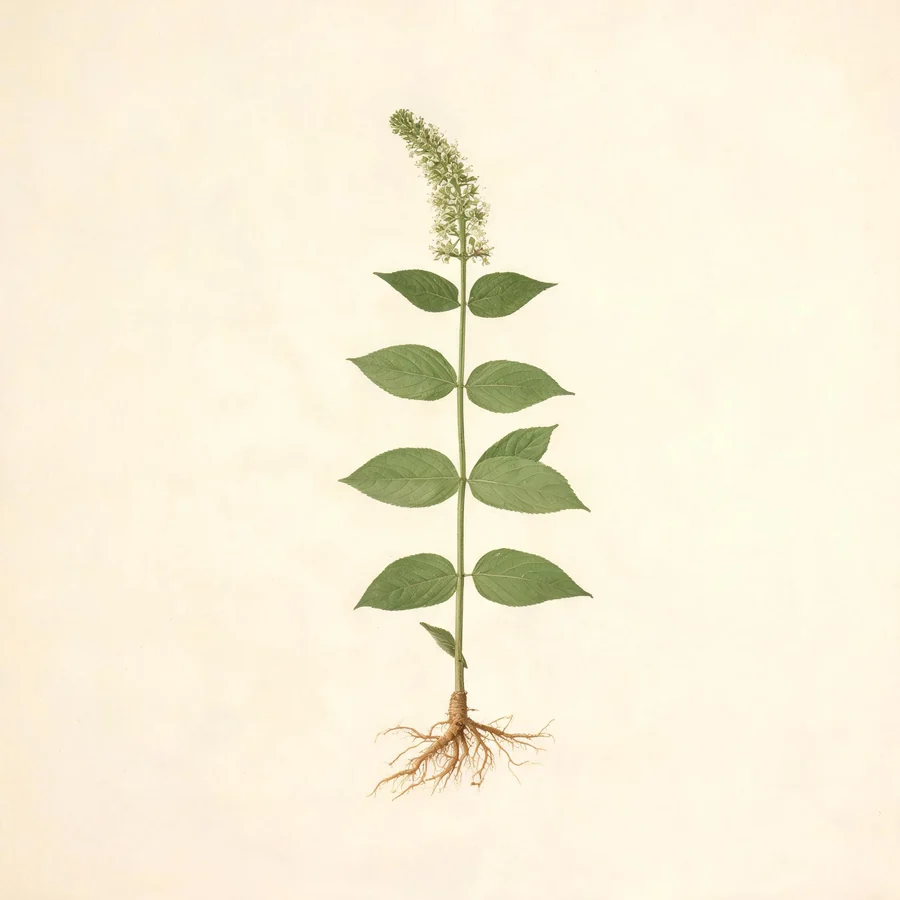
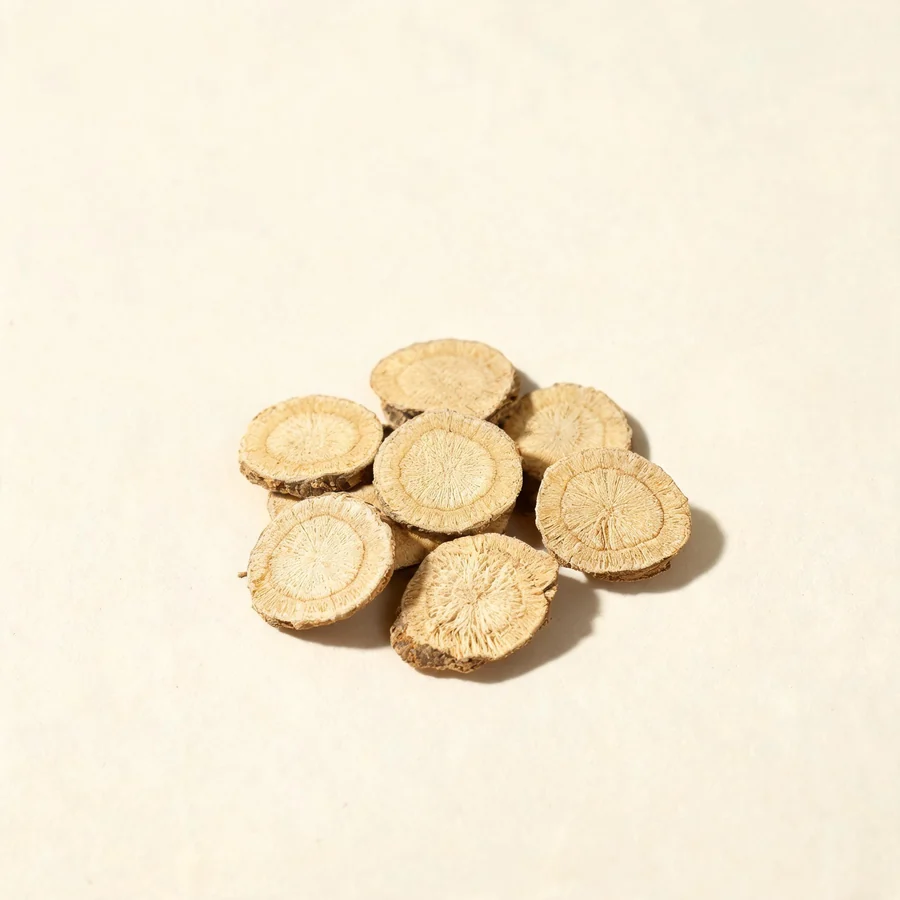
Skin profile
Where this herb sits in skin practice: the pattern it corrects, the skin signs it suits, and what it should not be used for.
Chuan Niu Xi is the stasis mover for the lower half of the body, chosen where skin has gone dusky, hard or cold rather than red and active. It is neutral, so it takes the temperature of its partners, and its downward direction is as much of its value as its blood-moving force.
Skin signs that suggest it
- Purple or dusky discolouration that persists after an injury, or bruising that is very slow to fade
- Skin that is hard, thick or board-like over an area, with fixed pain that is worse on pressure
- Red, hot, swollen feet or ankles with fixed pain, worse in damp hot weather (damp-heat pouring downward)
- Chilblains: dusky, tender swellings on the toes or heels that ache in cold damp weather
- A purple or dusky tongue with a choppy pulse, and a history of fixed rather than moving pain
When it is not the right herb
Not for skin that is pale, dry and thin from blood deficiency, where there is nothing congealed to move and a strong mover only leaves the person more tired. It is not for active bleeding without stasis, including heavy periods and bleeding gums, and it is not for the red, spreading, febrile eruption of heat in the blood, which needs cooling rather than moving. It is not a treatment for a bruise that is still swelling and hot from an acute injury, where cold, rest and elevation come first.
What it does for skin
Skin-relevant actions only. Each one describes a mechanism in TCM terms and what it looks like on the skin.
Moves congealed blood and clears fixed discolouration
The core action of the root is on blood that has stopped, and the skin shows that as colour rather than as heat: bruises that stay purple, old injury sites that remain dark, patches of pigmentation sitting over a fixed ache, and skin that has lost its normal tone. The neutral temperature means it adds neither heat nor cold, so warming or cooling partners can steer it. The pain it suits is sharp and stays in one place, unlike the ache of wind that wanders from joint to joint.
Directs its action downward to the feet and pelvis
The root is described as conducting other medicines down, and its own work concentrates in the lower half of the body: the lower back, knees, ankles and feet. On the skin that means red, swollen, tender feet and shins, and the tender nodules of the lower leg, are its territory while the face and trunk are not. It is a guide herb as much as an active one, and small amounts are used precisely for that purpose inside a larger formula.
Frees the channels where cold and damp have stiffened the skin
Where cold and damp have settled in the channels, the skin over the area becomes tight, cool and hard, and the joint beneath aches in wet weather. The root opens that obstruction and moves the blood the cold has slowed, which is why chronic joint disease with overlying skin change so often brings it into the formula. It is a slow worker given for weeks rather than days, and it is combined with warming or drying herbs according to whether cold or dampness dominates.
Breaks stasis so that a lesion can close
A chronic lesion that will not close often has a stagnant rim: dusky, hard and unresponsive, with poor new tissue at its edge. Moving the blood at that margin is the traditional reason for adding a stasis-moving root to a healing formula, and it is done cautiously, because moving blood too early in a fresh wound increases bleeding. The judgement is whether the tissue looks congested or looks empty, and the root is only for the congested picture.
Skin conditions it is used for
Mapped to the condition pages on this site. The pattern column shows what the skin is doing when this herb is the right choice.
| Condition | Pattern | Why it suits | Typical setting |
|---|---|---|---|
| Bruising | Blood stasis after injury, with fixed purple discolouration | A bruise that stays purple, feels hard and aches in one place is the plainest expression of congealed blood. The root moves it and, because it is neutral, does not add heat to a fresh injury or cold to an old one, which is why the wine-prepared form is traditional for trauma. It is used once the acute swelling has settled, since moving blood in the first day or two can increase the bleed. | Tao Hong Si Wu Tang, or a trauma formula with Hong Hua and Tao Ren |
| Chilblains | Cold and damp settling in the vessels of the extremities | Dusky, tender swellings on the toes and heels that itch and burn on rewarming are read as cold and damp obstructing the small vessels, with blood no longer moving through them. The root opens the channels and moves the congealed blood, and its downward direction takes the action to the feet where the problem sits. It is used with warming partners, and a chilblain that has ulcerated needs wound care rather than a mover. | Wine-prepared Chuan Niu Xi with Rou Gui and Dang Gui |
| Red and swollen feet | Damp-heat pouring downward with stasis | Hot, red, swollen and painful feet are read as damp-heat that has settled in the lower body, with blood stagnating where the heat and dampness collect. The root drains downward and opens the joint while bitter cold partners clear the heat, which is the reasoning behind its place in the four-ingredient formula for damp-heat in the lower limbs. The skin component is redness and swelling rather than a rash, and fever or spreading redness needs medical assessment. | Si Miao Wan with Huang Bo, Cang Zhu and Yi Yi Ren |
| Erythema nodosum | Damp-heat and stasis in the lower limbs | Tender red nodules on the shins are read as damp-heat with blood stasis in the lower limbs, and the treatment is to clear the heat while moving the blood that has pooled there. The root's downward direction and its capacity to open the channels make it a natural supporting herb, and it is given with cooling and blood-moving partners. Because erythema nodosum can accompany infection or inflammatory disease, it needs a diagnosis before herbs are used. | Si Miao Wan modified with Mu Dan Pi and Chi Shao |
| Scleroderma | Cold and damp with blood stasis hardening the skin | Hardened, tight skin with dusky colour and poor circulation is read as cold-damp obstructing the channels until the blood no longer nourishes the surface. The root frees the channels and moves the blood, and it is used inside a formula that also warms and builds, as an adjunct to specialist care rather than as a treatment in its own right. Any tightening of the skin, swallowing difficulty or breathlessness requires medical assessment first. | Formula with Huang Qi, Dang Gui and Chuan Niu Xi, as an adjunct to specialist care |
Combinations for skin
Herbs it is paired with when the skin, not an internal organ, is the target.
| Partner | Ratio | Why the pair is used |
|---|---|---|
| Hong Hua | 10 g each | Safflower activates the blood broadly while the Sichuan root steers that movement down into the joints, so stasis is broken and then conducted out of the lower body. The pair is used for bruising and for fixed lower-limb pain with dusky skin. Both are movers, so the combination is kept to a short course and avoided where bleeding is a concern. |
| Huang Bo | 10 to 15 g Chuan Niu Xi with 10 g Huang Bo | Huang Bo is a bitter, cold root that drains damp-heat from the lower half of the body, and Chuan Niu Xi steers that action downward and opens the joint, so the two together form the working core of the four-ingredient formula for red, hot, swollen feet. The pair also suits tender shin nodules. The cold partner clears the heat while the root keeps blood from stagnating in the cleared tissue. |
| Tao Ren | 10 g each | Tao Ren moistens, then breaks blood that has clotted, while the root adds a downward pull and opens the channels. The two are used for stasis in the pelvis and lower limbs, where a bruise or a fixed ache has left the skin dusky. Peach kernel softens what has set and the root carries it away, which is why the pair appears in the classical formulas for injury. |
| Du Zhong | 10 g each | Eucommia tonifies the Liver and Kidney and strengthens sinew and bone while the root moves the blood and opens the channel. One supplies what is missing, the other clears what is stuck, which suits the familiar picture of long-standing back and knee trouble with tight, dusky skin over the area. Tonifying alone leaves the obstruction, and moving alone spends a weakened body. |
| Dang Gui | 10 to 12 g each | Dang Gui builds and moves blood at the same time, so the pair shifts a stagnant picture without leaving the person paler than before. It is the safer combination for someone who is both depleted and congested, such as an older person with dusky, thin skin and slow-healing patches. The root supplies the direction and the force, the Dang Gui supplies the substance. |
Formulas where it leads
- Si Miao Wan (四妙丸) - Four ingredients for damp-heat that has poured into the lower limbs: Huang Bo and Cang Zhu clear and dry, Yi Yi Ren drains through the urine, and Chuan Niu Xi sets the blood moving and guides the whole action down to the feet. It is used where the feet and ankles are red, swollen and painful, including the tender shin nodules of the lower leg.
- Tao Hong Si Wu Tang (桃红四物汤) - The blood-building base of Dang Gui, Chuan Xiong, Bai Shao and Shu Di Huang with Tao Ren and Hong Hua added to move stasis. It is the standard formula for dusky discolouration, bruising and fixed pain with a deficient background, and a stasis-moving root such as Chuan Niu Xi is often added to direct the action to the lower body.
Safety for skin use
What to check before recommending or using it, including the cautions that matter most for skin patients.
Do not use, or use with caution
- Pregnancy: an absolute bar. The root moves blood with force, directs it downward and has been used to expel a retained placenta, and animal studies describe reduced fertility and failed implantation. Harm comes through stimulation of the uterus with increased downward flow, which threatens a pregnancy at any stage, so it is left out in anyone pregnant or trying to conceive.
- Active bleeding without stasis: heavy periods, bleeding gums, recent surgery or a bleeding disorder. A strong mover can lengthen bleeding time and increase the loss, and where the blood is already thin and the person pale, moving it leaves them worse.
- Depletion with a sinking pulse: spermatorrhoea, premature ejaculation, prolapse and chronic loose stool from Spleen deficiency. A herb that sends everything down can make worse a state where Qi is already unable to hold.
- Frail older adults and young children: paediatric guidance is scarce and the root is generally avoided before puberty; where it is used at all, the dose is reduced and the course is short.
Pregnancy and breastfeeding
Avoid entirely. This is not a herb to use cautiously in pregnancy but one to leave out, since its forceful blood-moving and descending action has historically been used to end a pregnancy, and animal work shows failed implantation. The risk is uterine stimulation with increased downward blood flow, and it applies at any stage and to anyone trying to conceive. An external preparation is no exception: where a bruise or a dusky patch needs attention in pregnancy, rest, cooling and a gentle surface herb are chosen instead.
Interactions
- Anticoagulants and antiplatelet drugs: animal work shows the root lowered whole-blood and plasma viscosity, so warfarin, heparin, aspirin and clopidogrel may combine additively. Unusual bruising should prompt a review, and the root is stopped before surgery and dental extraction.
- Antihypertensive medicines: extracts lowered blood pressure in hypertensive animals, so an additive effect is plausible and may cause lightheadedness when standing. Pressure is worth checking when the root is added to an existing regimen, especially in an older person.
- Hormonal medicines: the root carries phytoecdysteroids, plant compounds modelled on the hormones insects use for moulting. Their affinity for human receptors is low, yet an effect on oral contraceptives or hormone replacement therapy has not been ruled out, and its significance is unknown.
- Diuretics: a mild urinary effect adds to pharmaceutical diuretics, so fluid and electrolyte balance deserve attention where both are used, particularly in an older person.
Allergy and patch testing
Allergy to the root is uncommon and contact reactions are rarely reported, but it is a root of the amaranth family and anyone who has reacted to other members of that family, or to herb-containing liniments, should patch test before any external preparation. Most reactions described for roots of this kind are irritant rather than allergic, so a preparation that stings is diluted or abandoned rather than persevered with.
General safety references
General references for herbal hepatotoxicity and herb-drug interactions; they are not specific to this herb.
- Review article: Herbal hepatotoxicity - an update on traditional Chinese medicine preparations. Alimentary Pharmacology & Therapeutics, 2014. PMID: 24844799.
- Interactions between herbal medicines and prescribed drugs: an updated systematic review. Drugs, 2009. PMID: 19719333.
- Warfarin and food, herbal or dietary supplement interactions: a systematic review. British Journal of Clinical Pharmacology, 2021. PMID: 32478963.
Evidence
The classical record is quoted with its source. The modern note states the level of evidence plainly.
Classical record
祛风利湿,通经散血。治寒湿腰腿骨痛,足痿筋挛,妇女经闭及症瘕,淋病,尿血,阴痿、失溺。
Wind is dispelled and dampness freed, the menses are opened and blood is scattered. The root is used where cold and damp have settled into the bones of the lower back and legs, where the legs are weak and the sinews draw up, where periods have stopped or masses have formed, and for strangury, blood in the urine, impotence and loss of control.
Si Chuan Zhong Yao Zhi (Sichuan Materia Medica) - A regional materia medica that states both the gynaecological and the lower-limb actions in one short passage, and the clearest classical warrant for using the root on stasis in the legs and feet.
牛膝乃足厥阴、少阴之药,得酒则能补肝肾,生用则能去恶血。
The root enters the Foot Jue Yin and Shao Yin channels: with wine it builds the Liver and Kidney, and used raw it drives out stagnant blood.
Ben Cao Gang Mu (Compendium of Materia Medica), Li Shizhen - Li Shizhen writes before the Sichuan and Huai roots were split into separate drugs, and he gives the processing rule that still holds for both: wine for building, the raw root for stasis. Skin use takes whichever form matches the picture, raw where stasis stands alone and wine-prepared where cold and deficiency sit underneath.
Modern evidence
Evidence status
- Animal work on the root reports reduced whole-blood and plasma viscosity and a fall in blood pressure after extracts, and phytoecdysteroids and saponins are the constituents usually discussed. These are laboratory and animal findings, and they are the basis for the bleeding and blood-pressure cautions rather than for any claim in skin disease.
- No controlled trial of Chuan Niu Xi in a skin condition was identified for this page. The traditional indications for bruising, dusky skin and lower-limb swelling are recorded practice, and they are presented as such.
- The trade name covers more than one plant, and the pharmacopoeia treats the Sichuan and Huai roots as separate drugs with different emphases. Material should be bought by species rather than by common name, since a root chosen for its downward, stasis-moving action is not interchangeable with the nourishing one.
PubMed records
Selected real PubMed records for this herb's species or its constituents, chosen by species name and title relevance. They are references for the non-TCM discussion above, not proof that the herb treats any skin condition.
- Structure and Wound-Healing Activity of a Branched Levan-Type Fructan from Cyathula officinalis Roots.. Molecules (Basel, Switzerland), 2026. PMID: 42280282 (skin-related record).
- Cyaonoside A-loaded composite hydrogel microspheres to treat osteoarthritis by relieving chondrocyte inflammation.. Journal of materials chemistry. B, 2024. PMID: 38591180 (skin-related record).
- Cyathulae radix: A comprehensive review of botany, ethnopharmacology, phytochemistry, pharmacological effects, pharmacokinetics, safety and toxicity, processing methods, analysis methods, and quality control.. Journal of ethnopharmacology, 2026. PMID: 41260548 (safety record).
Dose and forms
Skin-practice dosing and the preparations that suit skin complaints.
| Form | Dose and notes |
|---|---|
| Decoction | Five to ten grams of dried root daily inside a formula, with up to fifteen grams for marked stasis under supervision. Five grams suffices when the root is only guiding other herbs downward or addressing mild lower-limb swelling. |
| Raw and wine-prepared | Raw root is used where blood must move and channels must open; the wine-prepared root runs warmer, for stasis with cold beneath it. Powder and medicated wine are traditional alternatives at proportionally smaller amounts. |
| Course length | Weeks rather than months. Because its work is with the blood and with how that blood moves, the course is reviewed, and the amount stays low in anyone who bruises easily or is already on a medicine that thins the blood. |
A small amount suffices when the root is guiding and a larger one when stasis itself is the target, and its neutral nature lets warming or cooling partners set the direction. Bleeding risk rather than toxicity sets the practical ceiling, so a person on anticoagulants or with a history of easy bruising is dosed lower or not at all. A bruise that is still spreading is not a reason to increase the dose.
Citations and further reading
Only real sources are listed: the classical materia medica passages quoted above, and the source works behind the botanical and safety statements.
- Si Chuan Zhong Yao Zhi (Sichuan Materia Medica), regional materia medica - classical entry quoted above.
- Ben Cao Gang Mu (Compendium of Materia Medica), Li Shizhen, 1578 - classical entry quoted above.
- Chuan Niu Xi (Radix Cyathulae) monograph: Pharmacopoeia of the People's Republic of China - source for the accepted botanical source, part used and quality requirements.
- Modern evidence statement: based on animal haemodynamic and pharmacological literature on Cyathula officinalis, summarised as a statement about the level of evidence rather than as a cited finding.
- Botanical description and identification: botanical literature on Cyathula officinalis, Amaranthaceae, and on the distinction between the Sichuan and Huai roots.
Educational reference for qualified practitioners. This page is not medical advice, and skin conditions should be diagnosed by a clinician before treatment.