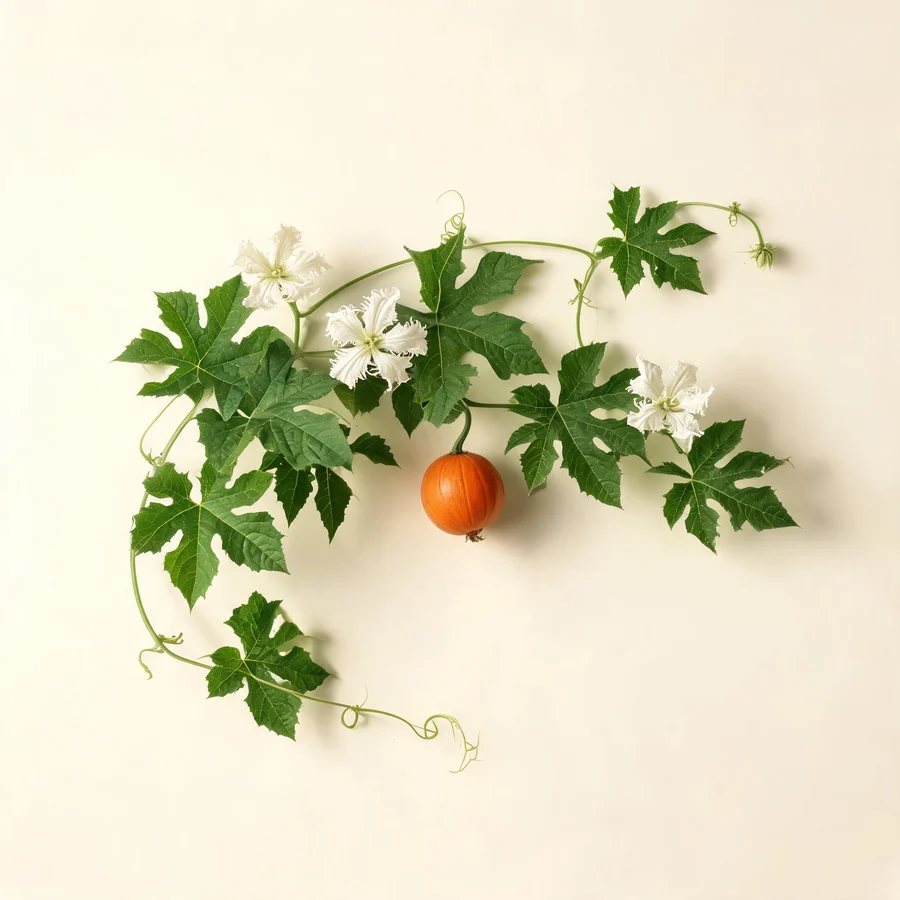
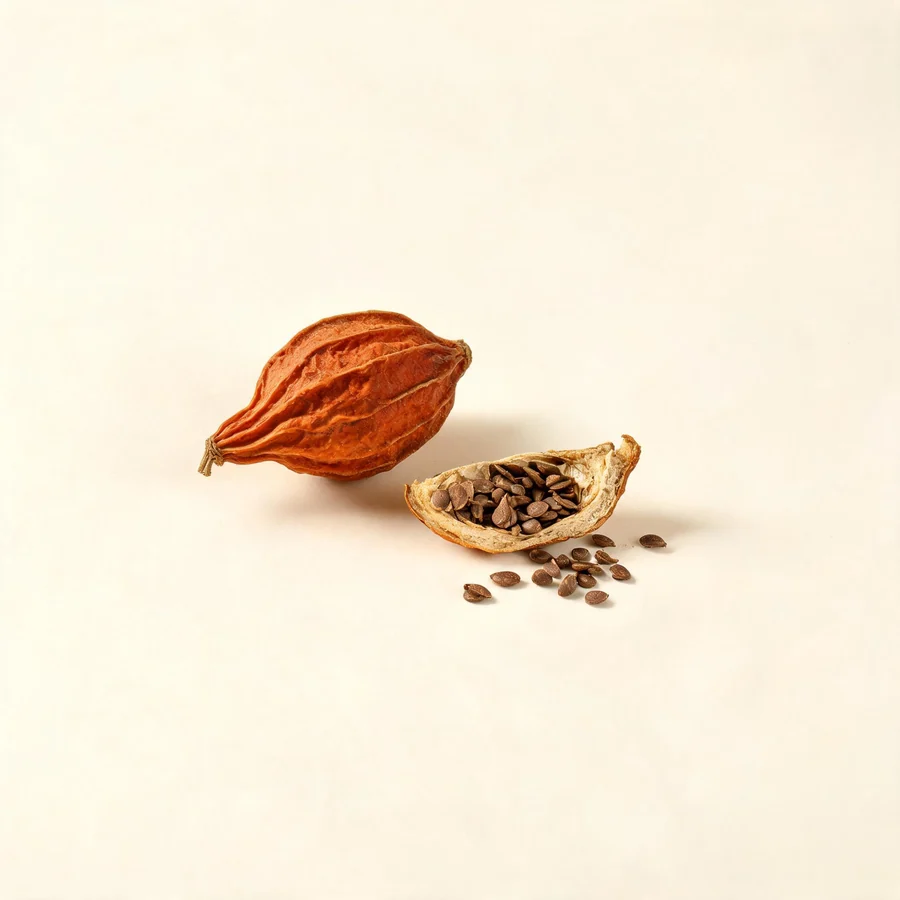
Skin profile
Where this herb sits in skin practice: the pattern it corrects, the skin signs it suits, and what it should not be used for.
Gua Lou reaches the skin through the abscess and the dry surface rather than through the chest. Its cold, oily fruit softens what Heat has hardened and moistens what Heat has dried, and its limits are the cold, wet swelling, the loose digestion it worsens, and the aconite prohibition it shares with the whole plant.
Skin signs that suggest it
- A hot, hard, tender swelling with a red margin that is slow to point or discharge
- A boil or carbuncle with a deep, firm centre and surrounding redness
- Rough, dry, finely scaled skin after a dry cough, a feverish illness or a long hot season
- Dry lips, a dry throat and thirst alongside the skin change, with a red tongue and little coating
- A tongue that is red and dry with a yellow greasy coating during the hot phase
When it is not the right herb
Not for a cold, pale, doughy swelling that is neither red nor hot, because the cold and moistening fruit makes a Cold-Phlegm swelling heavier. Not for dryness that comes from deficiency rather than from Heat, where pallor, cold limbs, a pale tongue and an absence of thirst show that cold oiliness will not restore the surface. Not for loose stools, a weak digestion or a tendency to diarrhoea. Never alongside aconite, under the Eighteen Incompatibilities.
What it does for skin
Skin-relevant actions only. Each one describes a mechanism in TCM terms and what it looks like on the skin.
Disperses hot, hard swelling
The fruit's coldness lowers the Heat that is inflaming a lesion, and its slippery, moist quality softens the firmness that Heat has cooked into the tissue. That combination is why it is chosen when a swelling feels hard and deep rather than bright and spreading, and why it is worked into pastes for a boil, a carbuncle or a breast abscess. It does not sterilise an infection; it changes the tissue that the infection has hardened.
Helps an abscess to point and discharge
A swelling that will not come to a head is read as toxin held in by hardened tissue, and the fruit is used to relax that tissue so the pus can find the surface. In practice it is joined with herbs that push the process outward, and the paste is applied around the swelling rather than pressed onto its centre. Abscesses that are deep, spreading, on the face, or accompanied by fever need drainage and antibiotics, and no poultice replaces that.
Cools Lung Heat that is drying the skin
Lung Heat is read on the skin as dryness with heat: the surface is rough and finely scaled while the person is thirsty, mildly flushed and dry-throated. The fruit cools that Heat while supplying moisture, which is the reason it is paired with Zhi Mu and used after a dry cough or a febrile illness has left the skin rough. It is the wrong herb when the dryness comes from cold or from blood deficiency, where there is pallor and no thirst.
Moistens and softens the surface
The seed oils and the mucilage of the pulp give the fruit a physical emollience that the tradition noticed and used: pounded fruit was smoothed onto the face in cold weather, and the seed oil appears in older ointments for cracked and rough skin. On its own that is a surface effect, useful for dry, tight, finely cracked skin, and it is not a substitute for treating the internal cause of the dryness.
Skin conditions it is used for
Mapped to the condition pages on this site. The pattern column shows what the skin is doing when this herb is the right choice.
| Condition | Pattern | Why it suits | Typical setting |
|---|---|---|---|
| Skin abscess | Toxic Heat congealing into a hard, tender swelling | An abscess that is hot, hard and slow to point is the picture the fruit suits, because its task is to soften the wall that holds the pus in and let the collection come to the surface. It is used internally in a formula and externally as a paste around the swelling, and it is combined with herbs that resolve toxin and push outward. The line that matters is drainage: a large, deep, facial or spreading abscess, or one with fever, needs medical care and often incision, and the herb supports that rather than replacing it. | Modified Gua Lou Niu Bang Tang with Zao Jiao Ci and Pu Gong Ying |
| Boils | Heat toxin with a firm, deep core | A boil is read as Heat and toxin pushed to a point, and the fruit is used when the lesion is hard and indurated rather than already discharging freely. Its coldness lowers the local Heat and its moistening quality softens the core so that the boil can resolve or point, and it is given with toxin-resolving herbs rather than alone. Recurrent boils, boils on the face, and boils with spreading redness or fever need medical assessment, because a pattern reading does not exclude a staphylococcal infection that requires treatment. | Gua Lou with Jin Yin Hua, Lian Qiao and Zao Jiao Ci |
| Skin swelling | Hot, indurated swelling of the skin and soft tissue | Where a swelling is hot and firm but not yet discharging, the fruit is chosen for its dispersing and softening pair of actions, and it is applied as a paste over intact skin as well as taken in a formula. It is not a herb for pitting oedema, for cold doughy puffiness, or for the swelling of injury, all of which belong to other patterns and other herbs. A rapidly spreading, painful swelling with fever is a medical problem first, and a paste on the surface should not delay assessment. | Modified Gua Lou Niu Bang Tang, or a toxin-resolving formula with Pu Gong Ying |
| Skin dryness | Lung dryness with Heat, after a cough or a febrile illness | The Lung is said to spread moisture to the skin, so when dryness appears after a dry cough or a feverish illness, the reading is that the Lung is no longer moistening the surface. The fruit cools the remaining Heat and supplies moisture without being cloying, which is why it appears in formulas for dry, rough skin with a dry throat and a red, scantily coated tongue. Dryness from cold, from blood deficiency or from a chronic scaling dermatosis is a different matter and is not treated with a cold moistening fruit. | Gua Lou with Zhi Mu, Mai Men Dong and Sheng Di Huang |
| Dry and hot skin | Heat drying the surface while fluids are low | Skin that is both dry and hot is read as two problems together, and the fruit answers both halves, since it is cold enough to lower the Heat and moist enough to soften the dryness. It is used where the skin is tight, finely rough and warm to the touch, with thirst and a dry mouth, and it is given with Yin-nourishing herbs so that the moisture has a source. Where the heat comes from depletion rather than from excess, the emphasis shifts to nourishing and the fruit is only a supporting herb. | Modified Gua Lou with Zhi Mu and Sheng Di Huang |
Combinations for skin
Herbs it is paired with when the skin, not an internal organ, is the target.
| Partner | Ratio | Why the pair is used |
|---|---|---|
| Niu Bang Zi | 12 to 15 g Gua Lou with 10 to 12 g Niu Bang Zi | The pair is the core of the classical formula for an acute breast abscess, where the fruit disperses the hard swelling and Niu Bang Zi clears Wind-Heat from the face and breast and helps the collection resolve. The two work on the same upper-body territory, and the combination is given as a decoction rather than as a topical. It is a formula pair for a hot, tender, hard swelling, and it is not used for a pale, cold or doughy lump. |
| Pu Gong Ying | 10 to 15 g each | Pu Gong Ying is the leading herb for hot, toxic swellings and for the breast in particular, and it clears Heat and resolves toxin where the fruit disperses and softens. Together they cover both halves of an abscess: the infection that drives it and the hardened tissue that holds it. Both are cold, so the pair is kept short when the digestion is weak, and neither replaces drainage of a collection that has already formed. |
| Zhe Bei Mu | 6 to 10 g Zhe Bei Mu with 10 to 15 g Gua Lou | For a firm lump beneath the skin that is not hot, the fruit is paired with Zhe Bei Mu, the stronger dissolver of Phlegm nodules, and the two are the classical answer to scrofula and to lingering subcutaneous swellings. The fruit moistens what the bulb dries, which is why the pair is used when the tissue is both knotted and dry. A lump that is new, hard, fixed or growing needs diagnosis before it is called Phlegm. |
| Zhi Mu | 6 to 10 g Zhi Mu with 10 to 15 g Gua Lou | Zhi Mu cools and moistens while the fruit disperses and softens, and the pair is used for skin that is dry and hot with a dry throat and a red tongue. It is a combination for the aftermath of Heat, when the fire has been put out but the surface has not recovered its moisture. Both herbs are cold, so the pair is avoided where the dryness comes with cold limbs and a pale tongue. |
| Zao Jiao Ci | 3 to 6 g Zao Jiao Ci with 12 to 15 g Gua Lou | Zao Jiao Ci is the herb used to push a collection toward the surface, and the fruit supplies the softening that lets it move. The pair belongs to the pointing stage of an abscess, when the swelling is hard and the pus has not yet found a way out, and it is a formula pairing rather than a topical one. A swelling that is already discharging, or one with spreading redness and fever, is not managed by pushing harder. |
Formulas where it leads
- Gua Lou Niu Bang Tang (瓜蒌牛蒡汤) - The classical formula for acute mastitis, built on the fruit with Niu Bang Zi, Jin Yin Hua, Lian Qiao, Chai Hu, Huang Qin, Zhi Zi, Zao Jiao Ci and Gan Cao. Its logic is to clear Heat from the Liver and Stomach channels, disperse the hard swelling and draw the collection outward. It is a practitioner's formula for a hot, tender breast, and a breast that is spreading, very painful or accompanied by fever needs medical assessment alongside it.
Topical use
The fruit has two recorded surface uses: a paste for a hard, hot swelling and a cosmetic paste for dry, weathered skin. Both rely on the same physical quality, a mucilaginous pulp that holds moisture against the skin, and both are kept to small areas because the material is cold, sticky and mildly irritant to some skins. A poultice never replaces drainage of an abscess, and a face paste is not applied to inflamed, broken or infected skin.
| Preparation | How and when it is used |
|---|---|
| Paste for a hard swelling | Three to five grams of powdered dried fruit is worked into a thick paste with warm water or a little rice vinegar, spread on a cloth and laid over the swelling with a margin of normal skin left clear. It stays for twenty to thirty minutes and is then removed and the skin washed, once or twice a day for a few days, and it is stopped if the skin becomes more red or sore. |
| Winter face paste | In the Ming record, women in the north pounded the ripe fruit to a paste and smoothed it on the face in cold weather, calling it Buddha makeup. A modern version uses the seed oil or the pulp in a simple cream base, applied thinly to dry, rough, weathered skin and left for a short time before washing. It is a cosmetic softener, not a treatment for a rash. |
| Seed oil for cracked skin | The seeds are rich in oil, and the oil is used on dry, cracked hands and heels in the same way as any simple emollient. It is applied sparingly to intact skin and covered loosely if at all; occlusive coverings over warm, macerated skin encourage irritation and infection. Nut and seed allergies should be excluded before a first use. |
Patch test and cautions
Patch test on a small area of normal skin for twenty-four hours before the first application, and stop at once if burning, stinging or spreading redness appears. Do not apply to broken, ulcerated or deeply infected skin, do not use an occlusive dressing, and keep the paste away from the eyes and mouth. A swelling with fever, rapid spread, severe pain or a facial site needs medical assessment rather than a poultice, and a breast abscess in a breastfeeding woman needs clinical care.
Safety for skin use
What to check before recommending or using it, including the cautions that matter most for skin patients.
Do not use, or use with caution
- Cold or Damp Phlegm without Heat: a pale, doughy, cool swelling, a white greasy tongue and no thirst. The fruit is cold and moistening, so it adds to that picture rather than dispersing it.
- Loose stools, diarrhoea or a weak digestion. The cold, oily fruit loosens the bowel further, and a course taken for skin can produce cramping and loose stool before the skin changes.
- Any form of aconite, without exception. The Eighteen Incompatibilities bar Gua Lou with Cao Wu, Fu Zi and Chuan Wu, and the ban reaches every part of the plant, from the whole fruit through the peel and seeds to the root traded under the name Tian Hua Fen.
- Pregnancy and breastfeeding, unless a practitioner has weighed it. The fruit is cold, slippery and loosens the bowel, and the root of that same vine carries trichosanthin, so a safer herb is chosen for a hot swelling in pregnancy.
Pregnancy and breastfeeding
Avoid medicinal doses in pregnancy unless a practitioner has assessed the case. The fruit is not among the herbs the pharmacopoeia prohibits, yet its nature is cold and slippery and it loosens the bowel, and the root of the same vine contains trichosanthin, a protein whose use to end pregnancies is documented. The fruit carries far less of that protein and boiling destroys much of what is present, which is why the fruit is not treated as an abortifacient; the safe course is still to choose another herb. A topical paste on a small area is a much smaller exposure, but it is checked first. While breastfeeding, a brief course at the smallest dose that works is preferred, and a breast abscess needs clinical care rather than self-treatment.
Interactions
- Anticoagulants and antiplatelet medicines such as warfarin, aspirin or clopidogrel. Fruit extracts have slowed platelet clumping in laboratory systems, so the combination is a theoretical reason for caution, particularly around surgery, and the prescriber should know the herb is being taken.
- Glucose-lowering medicines. In animal work both the fruit and the root have reduced blood glucose, so combining either with insulin or a sulphonylurea might in theory drive glucose too low, so blood sugar is watched in diabetes.
- Cardiac glycosides such as digoxin. The fruit has shown effects on coronary flow and cardiac rhythm in laboratory work, so anyone on digoxin or a similar medicine should have the combination supervised rather than assume it is inert.
Allergy and patch testing
Contact dermatitis to herb pastes and oils is well recognised, and a first application is always a patch test on normal skin for a day. People who react to other Cucurbitaceae, including melon, cucumber and pumpkin, may be more likely to react to the fruit, though cross-reactivity is not established. A reaction to a herb-containing cream should be reported, and the product stopped rather than layered with another.
General safety references
General references for herbal hepatotoxicity and herb-drug interactions; they are not specific to this herb.
- Review article: Herbal hepatotoxicity - an update on traditional Chinese medicine preparations. Alimentary Pharmacology & Therapeutics, 2014. PMID: 24844799.
- Interactions between herbal medicines and prescribed drugs: an updated systematic review. Drugs, 2009. PMID: 19719333.
- Warfarin and food, herbal or dietary supplement interactions: a systematic review. British Journal of Clinical Pharmacology, 2021. PMID: 32478963.
Evidence
The classical record is quoted with its source. The modern note states the level of evidence plainly.
Classical record
The fruit moistens a dry Lung and draws Fire down; it settles cough, clears knotted Phlegm, soothes the throat, eases thirst, frees the bowel, and disperses abscess, swelling and sore.
Ben Cao Gang Mu (Compendium of Materia Medica), Li Shizhen - It runs from the Lung at the top down to an abscess on the surface, and that is still a fair account of how the fruit is used.
Heavy with oily moisture and rich in Yin, it matches Phlegm that is hot and dry. Applied to Phlegm born of Cold, of Dampness, of deficient Qi or of undigested food, it brings no benefit and does harm.
Ben Cao Shu (Discussion of Materia Medica), Qing dynasty - Having praised the fruit for hot dry Phlegm, the same text draws a firm boundary, and later practitioners quote it when they refuse the fruit for a cold, wet swelling.
The whole fruit disperses hot Phlegm from the chest and from the Stomach's mouth; the peel by itself clears and gathers the Lung; the pulp alone enriches Yin and counters dryness; the seed alone lowers Stomach Qi and also frees the urine.
Yi Xue Zhong Zhong Can Xi Lu (Records of Tradition and Modern Medicine), Zhang Xichun - The note explains why the trade separates one fruit into three articles, and the dose section above follows that division.
Modern evidence
Evidence status
- No controlled trial of Gua Lou for a skin condition was identified for this page, and the fruit is nearly always given inside a compound formula, so a single-herb effect cannot be separated from the formula. The skin uses described here are traditional.
- Laboratory work on Trichosanthes extracts reports antibacterial, anti-inflammatory and antioxidant activity in cell and animal systems, and the seed oils are mildly laxative. That is enough to make a cooling, softening poultice plausible; it does not show that a paste resolves an abscess.
- The root and the fruit are often confused in safety discussions. Trichosanthin, a ribosome-inactivating protein with a history of use to end pregnancy, sits in the root traded as Tian Hua Fen; the fruit contains far less, and boiling destroys much of what is present. The two parts are not interchangeable, and the fruit should not be judged by the root's toxicology.
PubMed records
Selected real PubMed records for this herb's species or its constituents, chosen by species name and title relevance. They are references for the non-TCM discussion above, not proof that the herb treats any skin condition.
- Trichosanthis Fructus: botany, traditional uses, phytochemistry and pharmacology.. Journal of ethnopharmacology, 2018. PMID: 29842965 (pharmacology or review record).
Dose and forms
Skin-practice dosing and the preparations that suit skin complaints.
| Form | Dose and notes |
|---|---|
| Whole fruit | 9 to 15 g of the dried ripe fruit, cut or crushed, in a decoction inside a formula. Up to 30 g appears in the older literature for a severe hot swelling, under supervision only, and the stool is watched as the dose rises. |
| Peel and seed | The peel is given at 6 to 12 g when the surface swelling is the focus, and the crushed seed at 10 to 15 g when dryness and hardness dominate. They are separate articles with different weights, and a recipe written for one is not doubled with another. |
| Topical paste | 3 to 5 g of powdered fruit with warm water or rice vinegar, applied around a hard swelling for twenty to thirty minutes once or twice a day, on intact skin only. |
| Course length | Short courses of one to two weeks with review. Stop if loose stools, cramping or loss of appetite appear, and do not continue a cold, oily herb as maintenance. |
Dose follows the part and the purpose: the whole fruit when both hardness and dryness are present, the peel when the surface is the target, the seed when moisture is what is missing. The ceiling is set by the seed oil rather than by toxicity, since the further the stool loosens the nearer the dose is to its limit. A poultice is measured in grams of powder and in minutes of contact, not in the size of the swelling, and the surrounding skin is left clear.
Citations and further reading
Only real sources are listed: the classical materia medica passages quoted above, and the source works behind the botanical and safety statements.
- Ben Cao Gang Mu (Compendium of Materia Medica), Li Shizhen, 1578 - fruit entry on moistening the Lung and dispersing abscess and swelling.
- Ben Cao Shu (Discussion of Materia Medica), Qing dynasty - on hot dry Phlegm and on what the fruit does not suit.
- Yi Xue Zhong Zhong Can Xi Lu (Records of Tradition and Modern Medicine), Zhang Xichun, early twentieth century - on the whole fruit, peel, pulp and seed.
- Pharmacopoeia of the People's Republic of China - Trichosanthis Fructus monograph, accepted source species and quality standards.
- Eighteen Incompatibilities (shi ba fan) - the classical list that bars Gua Lou with Cao Wu, Fu Zi and Chuan Wu.
- Modern evidence statement: laboratory literature on Trichosanthes extracts and seed oils, summarised as a statement about the level of evidence rather than as a cited finding.
- Botanical description and identification: taxonomic literature on Trichosanthes kirilowii, Cucurbitaceae.
Educational reference for qualified practitioners. This page is not medical advice, and skin conditions should be diagnosed by a clinician before treatment.