Skin profile
Where this herb sits in skin practice: the pattern it corrects, the skin signs it suits, and what it should not be used for.
Ma Chi Xian is for skin that is hot, wet and angry: red, weeping, crusted or stinging. It is cooling and drying but mild enough to repeat, and the oxalate load is the one safety point worth remembering.
Skin signs that suggest it
- Red, hot, weeping or oozing patches with a burning quality (damp-heat)
- Crusting, pus or a sticky exudate around the lesion (heat toxin)
- Itch or burning that worsens in hot weather and eases with cooling
- Bleeding into the skin or bright blood from small eroded lesions (blood heat)
- A red tongue with a yellow coating, and a rapid pulse
When it is not the right herb
Not for cold, dry, scaly skin or for chronic eczema that has become pale, thick and dry. The herb is cold, sour and slippery, so it suits hot, wet, inflamed skin and sits badly in a cold or deficient picture. Avoid it when weak digestion has already loosened the stool, and keep large medicinal amounts away from people prone to oxalate kidney stones.
What it does for skin
Skin-relevant actions only. Each one describes a mechanism in TCM terms and what it looks like on the skin.
Clears heat and resolves toxin
The core action for hot, red, infected skin. Purslane is used where a lesion is inflamed and discharging, such as impetigo, infected eczema, a boil or a hot abscess, and a wash or poultice is as common as an internal dose. The cold clears the heat and the sour, astringent quality reduces the ooze and the sting.
Cools the Blood and stops bleeding
The sour taste and cold nature enter the Liver, which stores the Blood. Where heat drives blood out of the small vessels, the result can be purpura, petechiae or a lesion that bleeds easily. Purslane cools that heat and its astringency helps hold the surface, which is why it appears in washes for bleeding, eroded skin.
Dries and astringes weeping skin
Purslane is succulent, but its action on the skin is drying in the useful sense: it reduces the clear or yellow fluid that keeps a patch macerated and raw. A cooled decoction used as a compress suits the weeping phase of eczema, nappy rash and moist folds rather than dry, scaly phases.
Relieves heat and burning in the skin
For prickly heat, hot stinging rashes and mild sunburn-like redness, the fresh plant or a cooled decoction gives direct relief. The effect is cooling rather than sedating, and it is temporary: the herb lowers surface heat while the cause is addressed. It is no substitute for shade, fluids or medical care in heat illness.
Offers a food-grade topical option
Because the plant is eaten as a vegetable, it is one of the few cooling herbs that can be applied generously and repeated during the day with little risk of irritation. That makes it a reasonable first choice for a child's heat rash or an adult's itchy, weeping patch, provided the skin is not badly broken and the reaction is not spreading.
Skin conditions it is used for
Mapped to the condition pages on this site. The pattern column shows what the skin is doing when this herb is the right choice.
| Condition | Pattern | Why it suits | Typical setting |
|---|---|---|---|
| Eczema | Damp-heat with weeping and crusting | Purslane is chosen for the wet, angry phase of eczema, when the patches are red, oozing and crusted rather than dry and thickened. Its cold clears the heat, its sour astringency reduces the ooze and its food status makes a cooled wash easy to repeat. It is used alongside skin-specific herbs such as Bai Xian Pi and Ku Shen when the flare is stubborn. | Long Dan Xie Gan Tang, or a damp-heat wash with Ku Shen and Bai Xian Pi |
| Impetigo | Heat toxin with dampness producing crusted sores | Impetigo gives golden or honey-coloured crusts on red skin, usually around the nose and mouth, which is a heat-toxin picture with dampness. A dilute purslane wash is used to soften and clean the crusts while an internal formula clears the heat. It is contagious, so hands, towels and dressings need care, and extensive disease needs medical treatment. | Wu Wei Xiao Du Yin, with a dilute purslane wash |
| Boils | Heat toxin gathering in the flesh | A hot, red, tender boil is the classic heat-toxin lesion, and purslane is used both internally and as a fresh poultice. The poultice is the traditional field remedy: the crushed plant is laid on the boil to cool it and draw the inflammation. A boil with spreading redness, fever or a black centre needs medical care. | Wu Wei Xiao Du Yin or Huang Lian Jie Du Tang, plus a fresh poultice |
| Skin abscess | Toxic heat with pus and swelling | An abscess is heat toxin with a collection of pus, and purslane is a supporting treatment for the inflammation around it rather than a cure for the collection. A cooled wash or poultice is applied to the surface while an internal formula addresses the heat. Established abscesses need drainage, so the herb sits alongside medical treatment. | Xian Fang Huo Ming Yin, with a purslane wash |
| Heat rash | Summer heat and dampness trapped in the skin | Prickly heat produces small red papules in the folds and on covered skin, with itching and a burning quality. Purslane is well suited because it cools the surface and dries the moisture that keeps the rash irritated, and a dilute bath or wash is easy to use on a child. Cooling the room and loosening clothing matter as much as the herb. | A cooling wash of Ma Chi Xian and Bai Xian Pi; Qing Shu Yi Qi Tang in severe heat exhaustion |
| Itchy skin | Heat and dampness provoking the itch | When itch comes with warmth, redness and slight moisture, purslane reduces the heat and the ooze that drive it rather than numbing the sensation. It is combined with Bai Xian Pi and Ku Shen in washes for generalised itchy, hot skin. Dry, cold or neuropathic itch is a different picture and does not suit the herb. | Ma Chi Xian with Bai Xian Pi and Ku Shen as a wash |
| Diaper rash | Damp-heat and friction in the nappy area | Nappy rash is warm, moist and inflamed, and purslane's cooling and astringent qualities suit it well. A dilute cooled wash is used at each change, followed by a plain barrier cream, and the nappy is left off for short periods. Broken, bleeding or rapidly spreading skin, or a rash with satellite pustules, needs medical review. | A dilute purslane wash, or Zi Cao oil where the skin is eroded |
| Anal irritation | Damp-heat with engorged vessels and bleeding | Itch, moisture and bright bleeding around the anus from engorged haemorrhoids are read as damp-heat pouring downward. A cooled purslane decoction used as a sitz bath cools and astringes the area, and an internal formula addresses the heat. Bleeding that continues, changes character or comes with weight loss needs investigation. | A cooled purslane sitz bath, with Huang Qin and Ku Shen internally where damp-heat is clear |
Combinations for skin
Herbs it is paired with when the skin, not an internal organ, is the target.
| Partner | Ratio | Why the pair is used |
|---|---|---|
| Bai Xian Pi | 10 to 15 g Bai Xian Pi with 15 to 30 g fresh Ma Chi Xian | Bai Xian Pi clears heat, dries dampness and quiets itch, and it is a standard herb for stubborn damp skin. Purslane contributes a cooler, more moistening quality that suits the weeping stage, and the two are used together either as a wash or lightly worked into an ointment for itchy, oozing patches. |
| Ku Shen | 6 to 10 g each in a wash | Ku Shen dries damp-heat more strongly, in the skin and in the lower body, while purslane, which is soothing and food-grade, tolerates generous application. Between them they cover the infection and the weeping, with Ku Shen restricted to short use on broken skin or large areas. |
| Huang Lian | 3 to 6 g Huang Lian with 15 to 30 g fresh Ma Chi Xian | Among the gut herbs, coptis is the coldest and most bitter, and it dries dampness intensely, while purslane cools and astringes without that harshness. The pair is used where a hot, damp skin lesion also involves gut heat, and purslane allows the combination to be continued without further irritating the Stomach. |
| Huang Qin | 6 to 10 g Huang Qin with 15 to 30 g fresh Ma Chi Xian | Huang Qin drains damp-heat from the upper body and clears toxin, and purslane adds surface cooling and astringency. The pair suits red, weeping lesions on the face, scalp and trunk, and it can be used internally with a purslane wash on the skin. |
| Zi Cao | 6 to 10 g Zi Cao with 15 to 30 g fresh Ma Chi Xian | Zi Cao cools the Blood and heals damaged skin, while purslane clears surface heat and dries ooze. The pair is used where an eroded, weeping lesion has a dusky or purplish edge, combining a surface wash with a blood-cooling internal formula. |
Topical use
Purslane is applied to the skin as a fresh poultice, a cooled wash or a compress, and this is arguably its strongest skin role. The fresh plant is pounded to a paste for a single hot lesion, while a stronger decoction is used for larger itchy or weeping areas. It is cheap, widely available and mild enough to repeat, which is why it remains a household remedy for heat rash, insect bites and weepy eczema.
| Preparation | How and when it is used |
|---|---|
| Fresh poultice | A handful of clean fresh plant is washed, pounded to a soft paste and spread on clean gauze. Apply to the lesion for 15 to 20 minutes, once or twice daily, and discard the paste after each use. Do not apply to broken skin that is deep or clearly infected. |
| Cooled wash | 30 to 60 g of fresh plant, or 15 to 30 g of dried herb, is simmered in 500 ml of water for 15 minutes. Strain, cool to skin temperature and use as a compress or a rinse for itchy, hot or weeping areas. Make it fresh each day. |
| Dilute bath | For widespread heat rash or itching, add a litre of the strained decoction to a lukewarm bath and soak for 10 to 15 minutes. Pat the skin dry rather than rubbing, and apply a plain moisturiser afterwards if the skin feels tight. |
Patch test and cautions
Patch test on a small area first, and stop if the skin stings, reddens further or develops new bumps. Do not use a poultice on a wound that is deep, punctured or spreading, and do not cover a treated area with an airtight dressing. The wash is for external use only and should not be kept beyond the day it is made.
Safety for skin use
What to check before recommending or using it, including the cautions that matter most for skin patients.
Do not use, or use with caution
- Cold or weak digestion: loose stools, poor appetite, a cold abdomen or a long history of chill-type diarrhoea. A cold, slippery herb makes these worse, and chill-type diarrhoea is a different problem from hot dysentery.
- Pregnancy and breastfeeding, except on practitioner advice: this plant is cooling and slippery, and laboratory work has reported uterine contraction.
- Oxalate kidney stones in the past, or reduced kidney function: both the fresh plant and the decoction carry a substantial oxalate load, so large or frequent amounts are best avoided.
- Cold-type skin with no heat: pale, dry or thickened skin and cold eczema do not need a cooling astringent and may become drier.
Pregnancy and breastfeeding
Avoid it in every form during pregnancy, even as a vegetable on the plate. The classical literature says it makes the fetus slippery, and laboratory work has confirmed uterine contraction, in some studies as powerfully as a drug given after birth to contract the womb. No culinary amount can be recommended as safe. During breastfeeding, small food amounts probably do not matter, though a medicinal course should be discussed with a practitioner and the infant's digestion watched.
Interactions
- The plant supplies potassium salts and traces of norepinephrine, and laboratory work reports falls in blood pressure and blood glucose. Anyone on antihypertensives, insulin or metformin should monitor readings if they begin taking it regularly.
- Because the herb has a blood-moving reputation, a medicinal dose should be raised before surgery and with warfarin, heparin, aspirin or clopidogrel; the effect is probably small, but the conversation is still worth having.
- Its oxalates matter to people on a stone-prevention diet who keep oxalate low, and calcium eaten alongside binds some of them in the gut.
- Because laboratory work shows uterine stimulation, it is unwise to combine it with oxytocin or other uterine-contracting drugs.
Allergy and patch testing
A reaction to purslane is uncommon but possible, and a person who has reacted to another succulent or to a herbal wash should patch test first. Stop the preparation if the skin becomes more irritated, and do not use a wash that has been kept for more than a day.
General safety references
General references for herbal hepatotoxicity and herb-drug interactions; they are not specific to this herb.
- Review article: Herbal hepatotoxicity - an update on traditional Chinese medicine preparations. Alimentary Pharmacology & Therapeutics, 2014. PMID: 24844799.
- Interactions between herbal medicines and prescribed drugs: an updated systematic review. Drugs, 2009. PMID: 19719333.
- Warfarin and food, herbal or dietary supplement interactions: a systematic review. British Journal of Clinical Pharmacology, 2021. PMID: 32478963.
Evidence
The classical record is quoted with its source. The modern note states the level of evidence plainly.
Classical record
Purslane, also called horse tooth herb, is acrid in taste, cold in nature and non-toxic. It treats swellings and warts when pounded and rubbed on, and the juice taken as a drink treats vomiting, urinary disorders and bleeding from wounds, breaks up blood masses, and is especially good for children.
Xin Xiu Ben Cao (Newly Revised Materia Medica) - The Tang pharmacopoeia sets internal and external use next to each other, and the pounded application for swellings is the ancestor of the fresh poultice still used for hot skin lesions.
It disperses blood and reduces swelling, frees the intestines and makes the fetus slippery, resolves toxin and promotes urination, and treats the spontaneous sweating of the postpartum period.
Ben Cao Gang Mu (Compendium of Materia Medica), Li Shizhen - The remark that it makes the fetus slippery is the origin of the pregnancy prohibition repeated today, and the toxin-resolving line supports the skin use.
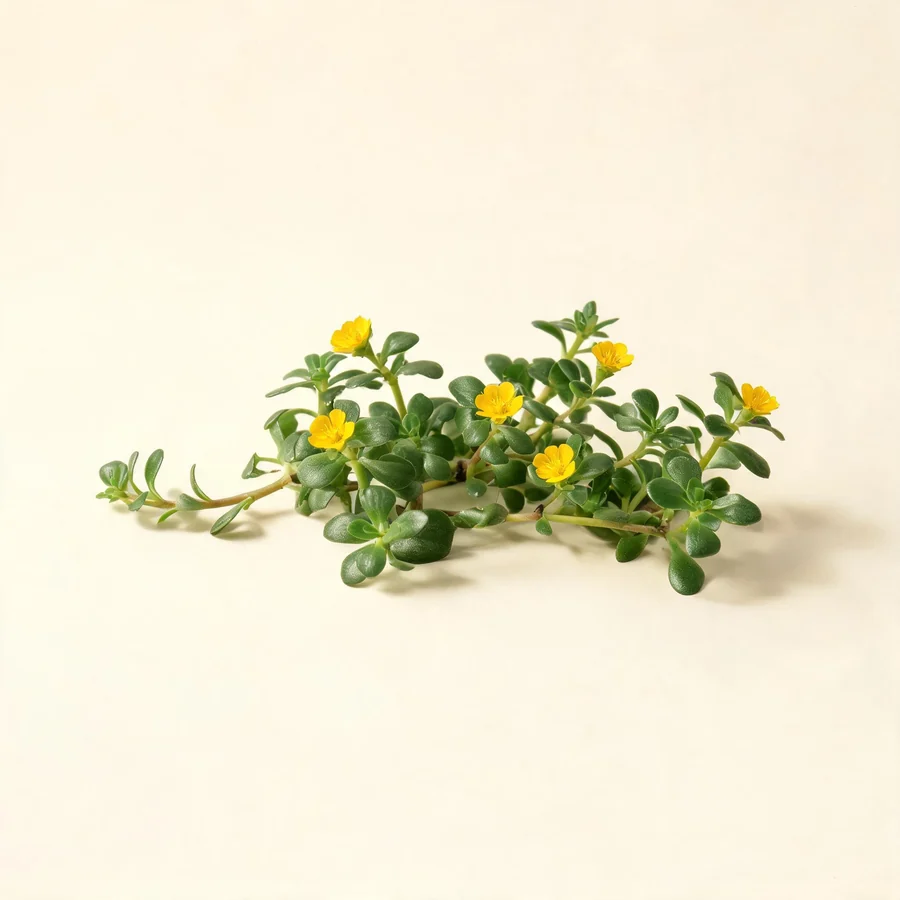
Purslane is also called the five element herb, because its leaves are green, its stems red, its flowers yellow, its roots white and its seeds black.
Ben Cao Jing Ji Zhu (Collected Commentaries on the Materia Medica) - Tao Hongjing, writing around 500 CE, gave the herb its most poetic alias. Readers took the five colours as a sign that it acted on several systems at once.
Modern evidence
Evidence status
- Laboratory work reports antibacterial, anti-inflammatory and antioxidant activity in purslane extracts, together with a high content of omega-3 fatty acids, vitamin C and flavonoids. These are mostly cell, animal and food-composition studies.
- Clinical trial evidence for purslane in skin disease is very limited; small studies exist in other areas, but no adequately powered dermatological trial of the single herb was identified. The traditional topical use is not proof of effect.
- Food safety: the plant is widely eaten, and the main documented concern is its oxalate load, roughly comparable to spinach. Blanching lowers it, and the herb should not be presented as a treatment for infection that needs antibiotics.
PubMed records
Selected real PubMed records for this herb's species or its constituents, chosen by species name and title relevance. They are references for the non-TCM discussion above, not proof that the herb treats any skin condition.
- Therapeutic potential of traditional Chinese medicine in the prevention and treatment of digestive inflammatory cancer transformation: Portulaca oleracea L. as a promising drug.. Journal of ethnopharmacology, 2024. PMID: 38447616 (skin-related record).
Dose and forms
Skin-practice dosing and the preparations that suit skin complaints.
| Form | Dose and notes |
|---|---|
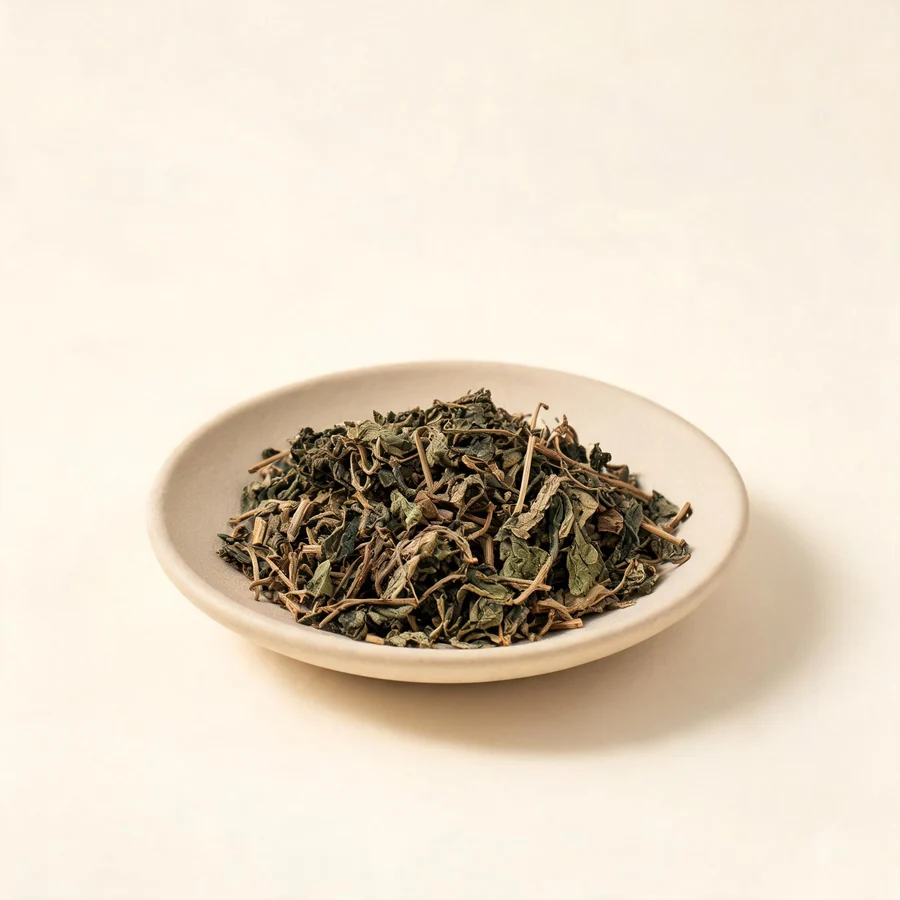
| Decoction (internal) | 9 to 15 g of dried herb daily, or 30 to 60 g of fresh plant, in a short course for hot, damp skin. The fresh plant is preferred where available and is often juiced. |
| Fresh poultice or wash | Enough fresh plant to pound into a paste, or a strong cooled decoction, applied to the affected area once or twice daily. There is no fixed weight for external use. |
| Culinary use | Blanched as a vegetable, a serving is food rather than medicine; blanch for 30 to 60 seconds and discard the water to reduce oxalate. |
| Course length | Three to seven days for an acute hot, weeping flare, with review. Stop if the skin dries and tightens or the stools loosen. |
Doses overlap with food use, and the span is broad because the plant serves as vegetable and as medicine. The oxalate load is the variable to respect: blanching reduces it, and anyone who forms stones should keep large daily amounts low. Fresh material is considered stronger for both internal and external use, and a poultice uses as much as is needed to cover the area.
Citations and further reading
Only real sources are listed: the classical materia medica passages quoted above, and the source works behind the botanical and safety statements.
- Xin Xiu Ben Cao (Newly Revised Materia Medica), Tang dynasty - classical entry quoted above.
- Ben Cao Gang Mu (Compendium of Materia Medica), Li Shizhen, 1578 - classical entry quoted above.
- Ben Cao Jing Ji Zhu (Collected Commentaries on the Materia Medica), Tao Hongjing, around 500 - classical entry quoted above.
- Ma Chi Xian monograph: Pharmacopoeia of the People's Republic of China - source for the accepted botanical source, part used and quality requirements.
- Modern evidence statement: based on laboratory and food-composition literature on Portulaca oleracea, summarised as a statement about the level of evidence rather than as a cited finding.
- Botanical description and identification: botanical literature on Portulaca oleracea, Portulacaceae.
Educational reference for qualified practitioners. This page is not medical advice, and skin conditions should be diagnosed by a clinician before treatment.