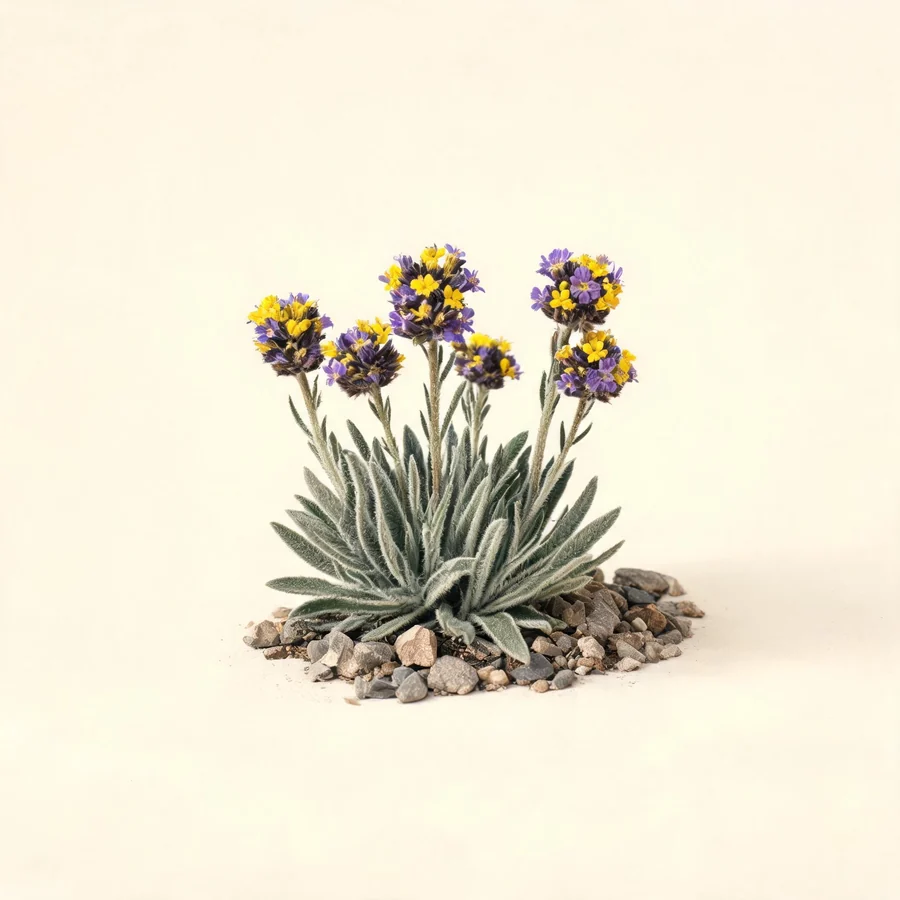
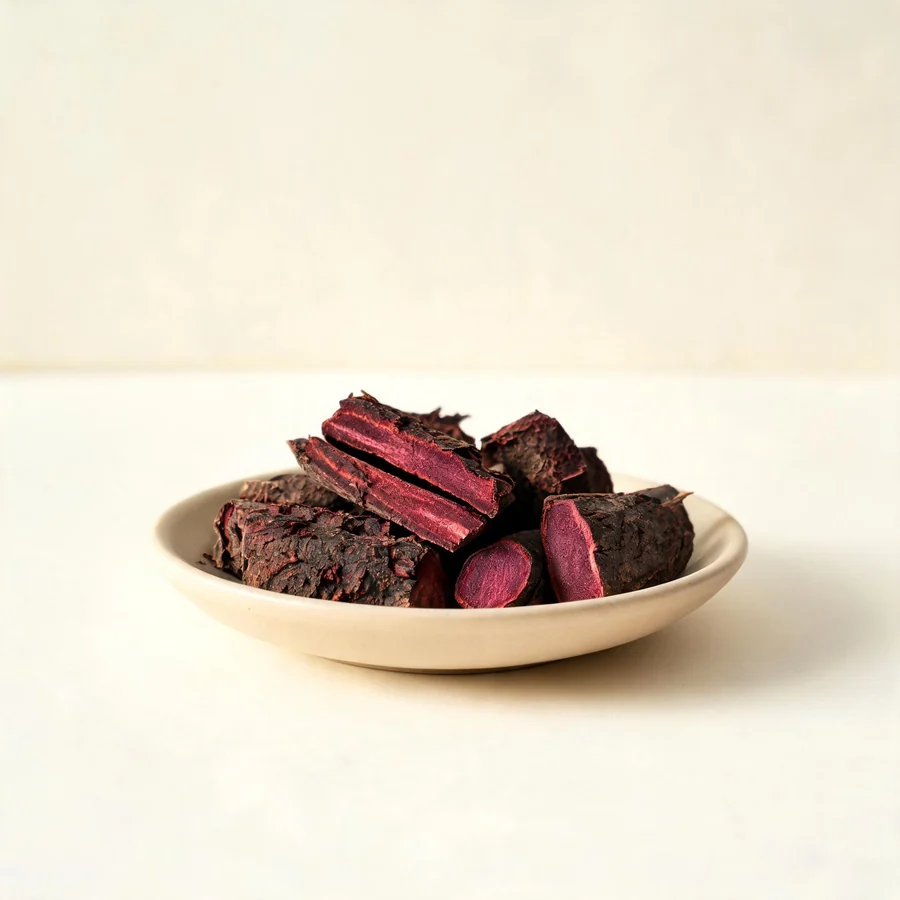
Skin profile
Where this herb sits in skin practice: the pattern it corrects, the skin signs it suits, and what it should not be used for.
Zi Cao is used when heat has gone deeper than the surface: the lesions are dusky or purple, the rash will not come out, or damaged skin is failing to heal. Its topical oil and ointment tradition matters as much as its internal use.
Skin signs that suggest it
- Dark red or purplish patches, purpura or bruise-like spots that do not blanch (blood heat with stasis)
- A rash that has erupted incompletely, leaving dusky or congested skin (rash failing to vent)
- Burns, scalds and heat-damaged skin with redness and raw surfaces
- Slow-healing ulcers, cracked heels and wounds that stay inflamed (heat toxin with poor repair)
- A red tongue with a deep red body, and a rapid pulse
When it is not the right herb
Not for cold, pale, dry skin with no heat, and not for chronic eczema of the cold-deficiency type, where a cold Blood-cooling herb adds nothing and may leave the skin drier. Set it aside once a rash has fully erupted and is spreading, because the venting action is meant for the incomplete stage. Use caution where digestion is weak or the stools are already loose, since the root is cold and mildly laxative, and stop if diarrhoea develops.
What it does for skin
Skin-relevant actions only. Each one describes a mechanism in TCM terms and what it looks like on the skin.
Cools the Blood and clears deep heat
This is the defining action. Where heat has entered the Blood level, the skin shows it as dusky, purple or deeply red lesions rather than a bright surface rash. Zi Cao lowers that deeper heat, which is why it is chosen for purpura, for the dark centre of a target lesion and for the confluent rash of a febrile illness. It works on the colour and congestion of the skin, not only on its surface temperature.
Resolves heat toxin in sores and ulcers
Zi Cao addresses the toxin that keeps a lesion from settling: boils and carbuncles that recur, infected eczema, and ulcers with an inflamed rim and a base that will not heal. The cold clears the heat, while the sweet and salty nature is held to soften and draw out what is lodged. In practice it is a supporting herb in toxin-clearing formulas and a leading one in topical preparations.
Vents an incomplete rash
In eruptive illness the tradition expects the rash to emerge fully, in a healthy red colour. When the eruption is incomplete or the spots are dark, Zi Cao is used to encourage the rash outward while cooling the heat behind it. The window is narrow: the herb suits the stage before the rash is complete, and is set aside once it has fully expressed.
Invigorates the Blood and settles stasis
The root moves the Blood gently as well as cooling it, so heat does not leave behind fixed congestion, purple discolouration or a hard, thickened patch. This is why it appears with blood-moving and wound-healing herbs in ointments for burns and chronic sores. The movement is mild, and it is no substitute for stronger stasis-moving herbs in deep or painful swelling.
Heals damaged skin when applied
Zi Cao is one of the few internal herbs with a strong topical role. Infused in oil or made into an ointment, it is applied to burns, scalds, cracked and fissured skin, and ulcers that are slow to close. The traditional claim is tissue regeneration: it calms the surface heat, keeps the wound clean and encourages new skin, and this use keeps the root in modern Chinese burn and skin practice.
Skin conditions it is used for
Mapped to the condition pages on this site. The pattern column shows what the skin is doing when this herb is the right choice.
| Condition | Pattern | Why it suits | Typical setting |
|---|---|---|---|
| Purpura | Blood heat with stasis under the skin | Purpura is the clearest skin expression of blood heat: non-blanching purple or red spots appear because heat has damaged the small vessels and blood has leaked into the skin. Zi Cao cools the Blood, resolves the toxin driving the leak and moves the resulting stasis, so the spots fade rather than settling into brown staining. It is used when the spots are bright or purple and the person is hot, restless or thirsty, not in pale, cold, deficient bruising. | Xi Jiao Di Huang Tang, modified with Zi Cao and Mu Dan Pi |
| Petechiae | Heat forcing blood out of the vessels | Pinpoint bleeding into the skin is read as the same process at a smaller scale: heat accelerating and damaging the vessels so that blood escapes. Zi Cao is a standard addition to blood-cooling formulas for heat-type petechiae, particularly when they appear on the limbs with a red tongue and a rapid pulse. New, unexplained or spreading petechiae need medical assessment before any herb is used. | A blood-cooling formula with Sheng Di Huang and Mu Dan Pi |
| Macular rash | Blood heat with an eruption that is slow to express | A flat red or dusky rash that appears with fever is treated according to whether it has come out fully. Zi Cao suits the incomplete stage, when the spots are sparse, dark or slow to appear, and it is paired with herbs that release the surface so the rash can spread. Once the eruption is complete and fading, the herb is no longer needed. | Zi Cao with Niu Bang Zi and Chan Tui for an incomplete eruption |
| Skin burns | Heat and fire damaging the skin, with heat toxin in the raw surface | Burns are the topical indication for which Zi Cao is best known. The oil infusion and the traditional ointments are applied to cool the surface, ease pain and support the growth of new skin. It is used for superficial and partial-thickness burns and scalds, not for full-thickness or extensive burns, which need urgent hospital care and fluid replacement. | Zi Yun Gao or Sheng Ji Yu Hong Gao applied topically |
| Boils | Heat toxin with blood stasis in the flesh | A boil is a localised collection of heat toxin, and when it is dark red, hard and slow to point, the blood level is involved. Zi Cao adds blood cooling and stasis-moving to the toxin-clearing herbs, and it is also applied topically in ointments that draw the lesion and promote healing. A boil with spreading redness, fever or a central black area needs medical review. | Wu Wei Xiao Du Yin with Zi Cao, plus a topical ointment |
| Skin erosion | Heat toxin damaging the surface, with failure to heal | Erosions are raw, weeping or glazed areas where the surface skin has been lost. Zi Cao is used when the surrounding skin is red and hot and the erosion is slow to cover, because it cools the inflammation and supports tissue repair. Its oil and ointment forms are the practical choice, applied gently to the affected area rather than rubbed in. | Zi Cao oil or Sheng Ji Yu Hong Gao applied gently |
| Erythema multiforme | Blood heat and toxin producing a targetoid eruption | The target lesion with a dusky or purple centre is a blood-heat and toxin picture, and Zi Cao is included in the cooling and toxin-resolving formulas used for it. Its role is to clear the deep heat and move the stasis that leaves the centre dark. Erythema multiforme, and especially any mucosal involvement or blistering, needs urgent medical assessment rather than herbal self-treatment. | A modified Qing Ying Tang with Sheng Di Huang and Mu Dan Pi |
| Drug rash | Heat toxin in the Blood after a reaction to medication | A drug eruption that is widespread, dusky and itchy is read as heat toxin entering the Blood. Zi Cao is used in the cooling formulas for such rashes, particularly when the colour is deep, the skin is swollen and the reaction is settling slowly. The first step with any drug rash is to stop the suspected medicine and seek advice; a rash with fever, blistering or mucosal sores is an emergency. | A blood-cooling formula with Sheng Di Huang, Mu Dan Pi and Gan Cao |
Combinations for skin
Herbs it is paired with when the skin, not an internal organ, is the target.
| Partner | Ratio | Why the pair is used |
|---|---|---|
| Sheng Di Huang | 6 to 10 g Zi Cao with 10 to 15 g Sheng Di Huang | Raw Rehmannia cools the Blood and restores the fluids, while Zi Cao cools and moves it. Together they treat a hot, dry, dusky rash where clearing alone would leave the skin parched. The pair is the backbone of blood-cooling formulas for purpura and drug eruptions. |
| Mu Dan Pi | 6 to 10 g each | Mu Dan Pi cools the Blood, clears deficiency heat and moves stasis, and it is the natural partner for Zi Cao in purple lesions that persist after the acute heat has passed. Together they address both the heat and the fixed discolouration, which is why they recur in formulas for purpura and chronic inflamed skin. |
| Dang Gui | 6 g Zi Cao with 15 to 30 g Dang Gui in ointment formulas | Dang Gui nourishes and moves the Blood while Zi Cao cools it and resolves toxin. The pairing is the core of traditional wound-healing ointments for burns, chronic sores and cracked skin, where the aim is to clear residual heat without leaving the tissue undernourished. |
| Niu Bang Zi | 5 g Zi Cao with 10 g Niu Bang Zi | Niu Bang Zi releases Wind-Heat at the surface and vents rashes from the Qi level, while Zi Cao works from the Blood level. Together they suit an eruptive rash that is slow to come out, especially with fever and a sore throat, and they cover the surface and the deeper layer at once. |
| Chi Shao | 10 g each | Chi Shao clears Liver fire and breaks up stasis with more force than Zi Cao, which contributes the rash-venting and toxin-resolving side. The pair is chosen when a rash is purple-black rather than bright red, or when purpura has left hard, tender patches. |
Formulas where it leads
- Sheng Ji Yu Hong Gao (生肌玉红膏) - A classical wound-healing ointment built on Zi Cao with Dang Gui, Bai Zhi and other herbs in a sesame oil and beeswax base. It is applied to burns, chronic ulcers and slow-healing wounds, and the Zi Cao component is credited with cooling the surface and promoting new tissue.
- Zi Yun Gao (紫云膏) - A simpler ointment of Zi Cao in sesame oil with beeswax, used for burns, cracked skin, nappy rash and minor wounds. Its reputation rests on the topical tradition rather than on trial evidence, and it is a reasonable example of how the root is used at home in East Asia.
- Xi Jiao Di Huang Tang (犀角地黄汤) - The classical blood-cooling formula for deep heat with purpura and bleeding. Modern practice adds Zi Cao when the spots are purple and slow to resolve, and the traditional horn ingredient is now replaced with water buffalo horn.
Topical use
Zi Cao is applied to the skin more often than it is swallowed. The root is infused in a vegetable oil, usually sesame, until the oil takes on a deep red colour, and the strained oil is used alone or set with beeswax into an ointment. It is the traditional treatment for burns, scalds, cracked skin and chronic ulcers, and it is also used in nappy rash and infantile eczema. The preparations below are for limited areas of intact or lightly damaged skin; deep, extensive or infected wounds need medical care.
| Preparation | How and when it is used |
|---|---|
| Oil infusion | 20 to 40 g of coarsely ground dried root is covered with 250 ml of sesame oil and warmed gently, without smoking, for 30 to 60 minutes, then left to stand overnight. The oil is strained through muslin into a clean dark bottle and kept cool. Apply a thin film to the affected area once or twice daily. |
| Ointment | The strained infusion is warmed with 20 to 30 g of beeswax per 250 ml of oil until the wax melts, then poured into shallow jars to set. The result is a soft ointment that stays on the skin longer than the oil and is easier to use on hands, heels and the nappy area. |
| Dilute wash | A decoction of 10 to 15 g of root in 500 ml of water, simmered for 20 minutes, strained and cooled, can be used as a compress for inflamed, crusted or weeping areas. Use clean gauze, keep the compress cool rather than cold, and discard the liquid after each session. |
Patch test and cautions
Patch test a small area of normal skin for 24 hours before first use, and do not apply to deep, heavily contaminated or freely bleeding wounds. Stop if burning, spreading redness or a new rash develops, which may be contact sensitivity to the herb or the oil base. Do not apply near the eyes or to large areas of broken skin without clinical advice, and keep the preparation away from children.
Safety for skin use
What to check before recommending or using it, including the cautions that matter most for skin patients.
Do not use, or use with caution
- Cold or deficient skin without active heat: pale, dry, thin or chronically cold skin, and cold-type eczema, do not benefit from a cold Blood-cooling herb and may become drier.
- Loose stools, poor appetite or a cold abdomen: the root is cold and mildly laxative, and it can worsen digestive weakness; stop if diarrhoea develops.
- A rash that has already erupted fully and is spreading: the venting action belongs to the incomplete stage, and using the herb later may disturb the picture rather than help it.
- Long courses without review: the herb is given for defined heat patterns in short courses, not as indefinite maintenance, particularly when taken internally.
Pregnancy and breastfeeding
Avoid internal use in pregnancy unless a practitioner takes responsibility for it. Animal work on oral Zi Cao reports suppression of the oestrous cycle, reduced ovarian weight and lowered pituitary gonadotrophin release, and these effects reverse when the herb is stopped. That, together with its Blood-moving quality, makes routine internal use inappropriate. Topical use on small areas is generally considered lower risk, but it should still be discussed with a practitioner, and it is not applied to the breasts during breastfeeding.
Interactions
- Zi Cao affects platelet function and coagulation in laboratory work, and shikonin may in theory add to warfarin, heparin, aspirin or clopidogrel; anyone on these medicines should not start a regular course without telling their prescriber.
- Shikonin has been reported to influence several cytochrome P450 enzymes, so medicines cleared by those pathways could in theory change in level; this matters most for narrow-therapeutic-index drugs and concentrated extracts.
- The anti-gonadotrophic activity seen in animals raises a theoretical concern with hormonal contraception, hormone replacement and fertility treatment, and with drugs that contract the uterus.
- Applied alongside a prescription steroid cream, the two are best used at different times of day to avoid diluting or irritating the skin.
Allergy and patch testing
Contact dermatitis to herbal oils and ointments is well recognised. The Boraginaceae family includes borage and comfrey, and a person who has reacted to those plants may react to Zi Cao. Patch test first, keep applications to limited areas, and stop at once if the skin becomes more irritated rather than calmer.
General safety references
General references for herbal hepatotoxicity and herb-drug interactions; they are not specific to this herb.
- Review article: Herbal hepatotoxicity - an update on traditional Chinese medicine preparations. Alimentary Pharmacology & Therapeutics, 2014. PMID: 24844799.
- Interactions between herbal medicines and prescribed drugs: an updated systematic review. Drugs, 2009. PMID: 19719333.
- Warfarin and food, herbal or dietary supplement interactions: a systematic review. British Journal of Clinical Pharmacology, 2021. PMID: 32478963.
Evidence
The classical record is quoted with its source. The modern note states the level of evidence plainly.
Classical record
主心腹邪气,五疸,补中益气,利九窍,通水道。
It governs pathogenic Qi in the chest and abdomen, the five types of jaundice, supplements the middle and boosts Qi, opens the nine orifices and frees the water passages.
Shen Nong Ben Cao Jing (Divine Husbandman's Classic of Materia Medica) - The oldest record describes internal uses before the skin and rash applications developed, which is useful context for a herb now used mainly on the skin.
治斑疹、痘毒,活血凉血,利大肠。
It treats maculopapular rashes and pox toxins, invigorates and cools the Blood, and frees the Large Intestine.
Ben Cao Gang Mu (Compendium of Materia Medica), Li Shizhen - This line sets out the three actions that matter on the skin: venting the rash, cooling the Blood and gently opening the bowel.
Modern evidence
Evidence status
- Laboratory studies of shikonin and related naphthoquinones report anti-inflammatory, antibacterial, antifungal and wound-healing activity in cell and animal models. These findings are consistent with the traditional topical use but do not establish benefit in people.
- Clinical trial evidence for Zi Cao in skin disease is very limited, and no adequately powered trial of the single herb in burns, eczema or purpura was identified. Most published material is small, Chinese-language or part of a multi-herb formula study.
- Regulatory status: the dried root is an accepted herbal substance in the Chinese Pharmacopoeia, with shikonin content used as a quality marker. This page describes traditional practice and the current state of the evidence; it is not a claim that the herb is proven to work.
PubMed records
Selected real PubMed records for this herb's species or its constituents, chosen by species name and title relevance. They are references for the non-TCM discussion above, not proof that the herb treats any skin condition.
- Phytochemical constituents, distributions and traditional usages of Arnebia euchroma: A review.. Journal of ethnopharmacology, 2021. PMID: 33524510 (pharmacology or review record).
- Systematic Screening of Chemical Constituents in the Traditional Chinese Medicine Arnebiae Radix by UHPLC-Q-Exactive Orbitrap Mass Spectrometry.. Molecules (Basel, Switzerland), 2022. PMID: 35565981 (pharmacology or review record).
Dose and forms
Skin-practice dosing and the preparations that suit skin complaints.
| Form | Dose and notes |
|---|---|
| Decoction (internal) | 5 to 10 g of dried root daily in a formula for blood-heat rashes and purpura. Up to 15 g is used in acute blood heat under supervision, and higher historical figures belong to monitored hospital practice. |
| Extract and granules | Standardised extracts vary widely in shikonin content; follow the manufacturer's label and a practitioner's direction rather than converting from the raw dose. |
| Topical oil or ointment | A 2 to 40 per cent infusion is traditional; for home use, 20 to 40 g of root per 250 ml of oil is a common strength. Apply thinly once or twice daily to limited areas. |
| Course length | Short courses of one to two weeks for an acute rash, with review. Stop if loose stools, poor appetite or new skin irritation develop. |
The root is cold and mildly laxative, so internal courses are kept short and are usually combined with herbs that protect digestion. The stir-baked form is milder on the Stomach, and the beeswax-processed form is used for ointments. Because shikonin content varies greatly between sources, the colour of the oil or the depth of the root is a poor guide to strength, and a standardised product is easier to dose.
Citations and further reading
Only real sources are listed: the classical materia medica passages quoted above, and the source works behind the botanical and safety statements.
- Shen Nong Ben Cao Jing (Divine Husbandman's Classic of Materia Medica), attributed compilation of the Han period - classical entry quoted above.
- Ben Cao Gang Mu (Compendium of Materia Medica), Li Shizhen, 1578 - classical entry quoted above.
- Zi Cao monograph: Pharmacopoeia of the People's Republic of China - source for the accepted botanical sources, part used and shikonin quality requirement.
- Modern evidence statement: based on laboratory literature on shikonin and related naphthoquinones, summarised as a statement about the level of evidence rather than as a cited finding.
- Botanical description and identification: botanical literature on Arnebia euchroma and Lithospermum erythrorhizon, Boraginaceae.
Educational reference for qualified practitioners. This page is not medical advice, and skin conditions should be diagnosed by a clinician before treatment.