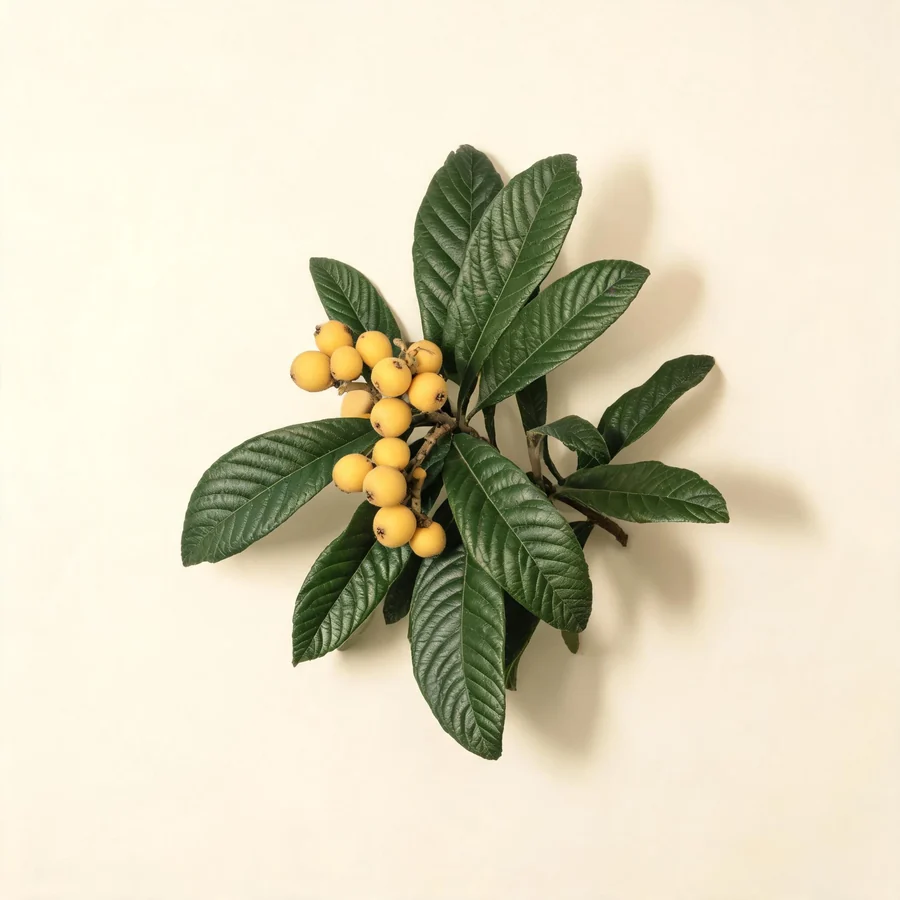
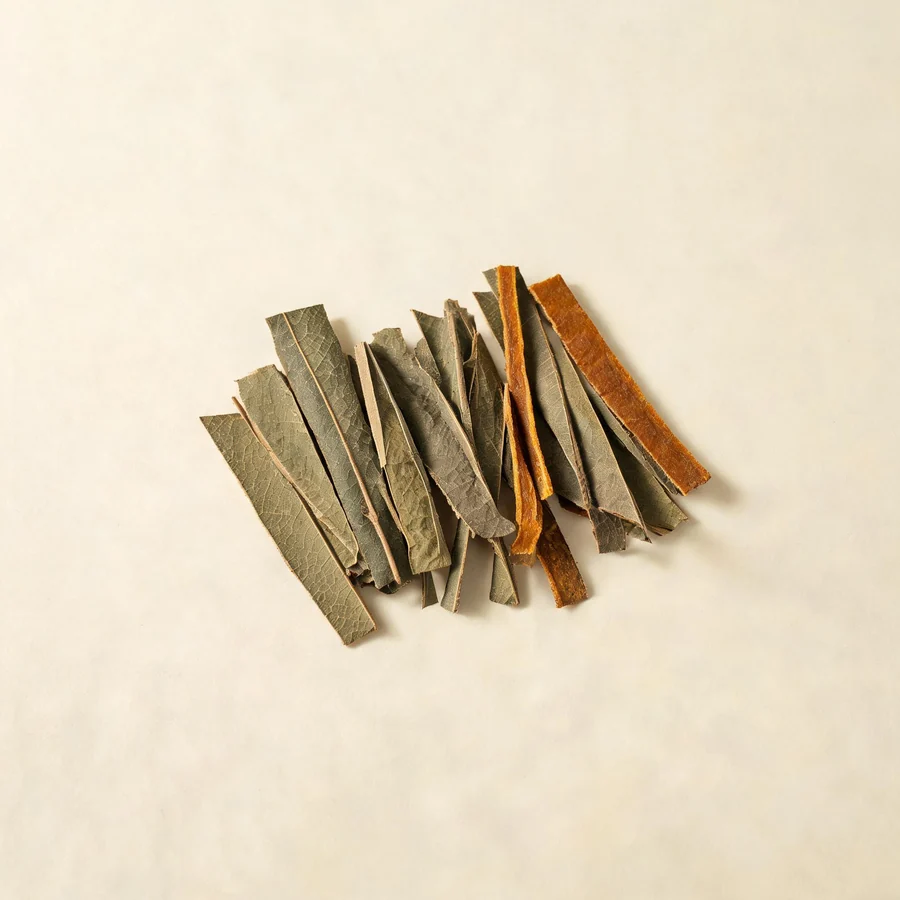
Skin profile
Where this herb sits in skin practice: the pattern it corrects, the skin signs it suits, and what it should not be used for.
Pi Pa Ye treats heat that rises to the face and the scalp. It is the chief herb of the classic acne formula, and it is chosen for the oily, papular, flushing picture rather than for cold, dry or scarred skin.
Skin signs that suggest it
- Oily skin with red papules and pustules on the forehead, nose and cheeks
- A nose and cheeks that flush with heat, alcohol or spicy food and stay red
- Greasy yellow or white scaling on the scalp, eyebrows or nasolabial folds, with redness underneath
- A dry, itchy, burning scalp with fine white flakes
- A red tongue tip with a thin yellow coat, and a floating, rapid pulse
When it is not the right herb
Not for a cold, pale, dry face, and not for deep, dusky, indurated acne that is read as blood stasis, where bringing Lung heat down does nothing. It is not for the late, thickened and nodular stage of a red nose. It is not for a person with a cold Stomach, a poor appetite and loose stools, in whom a cool leaf taken for weeks dulls digestion. Leaf still carrying its hairs must never be used in any form, because the trichomes irritate the throat and the skin.
What it does for skin
Skin-relevant actions only. Each one describes a mechanism in TCM terms and what it looks like on the skin.
Clears Lung heat from the face
The face is the Lung's territory in this reading, and heat held there shows as oil, redness and small pustules on the forehead, nose and cheeks. The leaf clears that heat, and because it is bitter and cool it also dries the oil that feeds the lesions. It is the chief herb of Pi Pa Qing Fei Yin, and it is combined with mulberry root bark and skullcap to strengthen the same action on the same territory.
Brings fire and oil down with the Qi
Qi in the Lung and in the Stomach is meant to travel downward, and a cough or a flare of facial heat is read as that direction reversing. A bitter leaf is held to descend of its own nature, so the heat is brought down rather than pushed out through the skin. That is why one leaf serves both a hot cough and a hot face, and why the classical line says that when Qi goes down, fire subsides and phlegm follows it.
Dries dampness and greasy scale
Bitterness dries as well as clears, and the greasy yellow scale of a hot scalp or a seborrhoeic fold is read as dampness that has been cooked by heat. The raw leaf is the drying form, chosen where the scale is thick, the skin is oily and the redness underneath is bright. The honey-fried leaf is the opposite: gentler, moister and suited to a dry, fine-scaled, burning scalp.
Harmonises the Stomach so the face clears
The face is also the Stomach's territory, and a flushed nose with bad breath, a greasy tongue coat and a flare after rich food is read as Stomach heat. The leaf settles the Stomach as well as the Lung, which is why it is used where acne, flushing and digestive heat appear together. Food and alcohol still have to be reduced, and no leaf will outrun a diet that keeps feeding the heat.
Skin conditions it is used for
Mapped to the condition pages on this site. The pattern column shows what the skin is doing when this herb is the right choice.
| Condition | Pattern | Why it suits | Typical setting |
|---|---|---|---|
| Acne | Lung heat with wind-heat in the skin: oily papules and pustules on the face | The adolescent picture of oily skin with red papules and pustules across the forehead, nose and cheeks, worse in heat and after spicy food, is read as wind-heat trapped in the Lung's territory. The leaf is the chief herb of Pi Pa Qing Fei Yin, the formula named for this pattern, and it works with mulberry root bark and skullcap to clear the Lung and cool the skin. It suits the inflammatory papular stage; nodular and cystic acne needs a different approach, and painful deep lesions belong with a dermatologist. | Pi Pa Qing Fei Yin |
| Rosacea | Lung and Stomach heat rising to the nose and cheeks | Flushing on the nose and cheeks that worsens with heat, spice, alcohol and stress, with papules and a warm sensation, is read as heat rising along the Lung and Stomach channels to the face. The leaf is used through Pi Pa Qing Fei Yin, which clears the Lung and brings the heat down, and it is best for the flushing and papular stage. The late stage, with thickened skin and visible vessels, is not reversed by it, and a red painful eye with rosacea needs medical review. | Pi Pa Qing Fei Yin |
| A red, thickened nose | Lung heat with blood stasis in the nose | The bulbous, red, thickened nose is read as heat present for years that has congealed the blood in the area, and the leaf alone cannot undo it. It is used in the earlier flushing stage to clear the Lung heat that drives it, and it is combined with blood-moving and heat-clearing herbs once the skin has thickened. Surgery and laser treatment remain the effective options for established rhinophyma, and the herb is at best adjunctive. | Pi Pa Qing Fei Yin with Mu Dan Pi and Dan Shen |
| Dandruff | Lung and Stomach heat with a dry, red, burning scalp | A dry, itchy, burning scalp with fine white flakes and red patches, in a hot, thirsty person, is read in one pattern as blood heat with wind, and Pi Pa Qing Fei Yin is named for it. The leaf cools the upper body and brings the heat down, and it is supported by moutan and cicada slough. Greasy yellowish flakes with a greasy tongue coat are a different, damp-heat picture, and there the leaf is only a minor part of the formula. | Pi Pa Qing Fei Yin with Mu Dan Pi and Chan Tui |
| Seborrhoeic dermatitis | Damp-heat in the Stomach and Spleen rising to the face | Red, greasy, yellow-scaled patches in the nasolabial folds, eyebrows and scalp, with a heavy body and a greasy tongue coat, are read as damp-heat rising to the face. The leaf's contribution is to bring Stomach and Lung heat down while the drying and damp-draining herbs deal with the grease, so it supports the formula rather than leading it. Antifungal treatment for the Malassezia yeast is the conventional mainstay, and the herb is used alongside it. | With Huang Lian, Huang Qin and Yi Yi Ren |
Combinations for skin
Herbs it is paired with when the skin, not an internal organ, is the target.
| Partner | Ratio | Why the pair is used |
|---|---|---|
| Sang Bai Pi | 9 g of each | Mulberry root bark is colder and drains Lung heat downward, and its diuretic effect gives the heat a second route out. The leaf is gentler and brings a Stomach action the bark lacks. Together they cover a hot face with a thick cough, and they form the pair inside the acne formula, where the same Lung heat shows on the face rather than in the chest. |
| Huang Qin | 6 to 10 g Huang Qin with 9 g Pi Pa Ye | Skullcap clears heat and dries dampness, weighted towards the upper body and towards heat toxin, while the leaf brings that heat down from the face. Together they are the core of Pi Pa Qing Fei Yin for red, oily, papular skin, and skullcap adds the toxin-resolving action the leaf does not have. |
| Mu Dan Pi | 9 to 12 g Mu Dan Pi with 9 g Pi Pa Ye | Moutan cools the Blood and clears heat that has entered the vessels, which is the deeper half of a red, burning face or scalp. The leaf works on the Qi level and the moutan on the Blood, so a flush that has become persistent and a scalp that burns at night are both addressed, and neither herb is strong enough alone for the late stage. |
| Chan Tui | 3 to 6 g Chan Tui with 9 g Pi Pa Ye | Cicada slough releases wind-heat from the surface and is used for itch and for rashes that will not settle. The leaf clears the internal heat behind it, so the pair treats an itchy, red, dry scalp or face where the surface and the inside are both involved. The slough is light, so it is given at a smaller weight. |
| Yi Yi Ren | 15 to 30 g Yi Yi Ren with 9 g Pi Pa Ye | Job's tears drains dampness through the urine and is the workhorse for greasy, heavy, damp-heat skin. The leaf supplies the cooling and the descending direction, and the pair is used for seborrhoeic skin where oil and heat appear together. The grain is given at a much larger weight because it works by accumulation rather than by force. |
Formulas where it leads
- Pi Pa Qing Fei Yin (枇杷清肺饮) - The classic formula from the Golden Mirror of Medicine for Lung heat with a red, oily, papular face, and the model for using the leaf in acne and in a flushed nose. The leaf clears and descends, mulberry root bark drains the Lung downward and skullcap dries and clears, so the heat is dealt with at three levels. It is a formula for the inflammatory stage, not for scarring or for a cold face.
Safety for skin use
What to check before recommending or using it, including the cautions that matter most for skin patients.
Do not use, or use with caution
- Cold, pale skin without heat, and a cold-type picture generally: a cooling leaf drives the cold deeper and does nothing for a face that is already cold.
- A cold Stomach with a poor appetite, loose stools and a tendency to feel chilly. An ordinary dose in a formula is usually tolerated, but weeks of a cool leaf can dull digestion further.
- Leaf with the hairs still attached: the trichomes are a mechanical irritant to the throat, airway and skin and must be brushed off before use in any form.
- Deep nodular acne, established rhinophyma, and any lesion that is changing, bleeding or ulcerating: these need dermatological assessment, not a cooling leaf.
Pregnancy and breastfeeding
Generally considered acceptable at standard decoction doses. It even has a traditional place in pregnancy, being used for the queasiness of early pregnancy, which is unusual for a cooling herb and rests on its descending action rather than on hormones. Neither uterine stimulation nor teratogenicity has been reported. Digestion is the limiting factor: a woman whose Spleen runs cold should not take a cooling leaf for weeks on end, and concentrated extracts remain unstudied in pregnancy. While breastfeeding, standard doses are regarded as compatible, and the infant's stools are the thing to watch.
Interactions
- Glucose-lowering medicines: triterpene acids from the leaf lowered glucose in animal work, so insulin, metformin or a sulphonylurea may act more strongly. Test more often and tell the prescriber rather than altering a drug dose.
- Sedatives and opioid cough suppressants: the small amount of amygdalin in the leaf liberates a little cyanide and mildly depresses the breathing centre, so benzodiazepines, opioids or dextromethorphan could add to that effect. At ordinary doses the effect is small, but the combination is best avoided in a frail or elderly person.
- Anticoagulants: laboratory work suggests a mild anti-inflammatory effect that might in theory strengthen an anticoagulant, although no clinical reports exist. Tell the prescriber if you are on warfarin.
Allergy and patch testing
Loquat is in the rose family, so a person who reacts to apple, peach, plum or almond may react to it. Contact reactions to leaf washes and to herb-containing creams are well recognised. Patch test any topical preparation for a day, and stop if the skin becomes more irritated rather than calmer; the hairs, not the chemistry, are the commonest cause of irritation from this leaf.
General safety references
General references for herbal hepatotoxicity and herb-drug interactions; they are not specific to this herb.
- Review article: Herbal hepatotoxicity - an update on traditional Chinese medicine preparations. Alimentary Pharmacology & Therapeutics, 2014. PMID: 24844799.
- Interactions between herbal medicines and prescribed drugs: an updated systematic review. Drugs, 2009. PMID: 19719333.
- Warfarin and food, herbal or dietary supplement interactions: a systematic review. British Journal of Clinical Pharmacology, 2021. PMID: 32478963.
Evidence
The classical record is quoted with its source. The modern note states the level of evidence plainly.
Classical record
主卒啘不止,下气。
It governs sudden, unceasing retching and hiccuping, and it sends Qi downward.
Ming Yi Bie Lu (Supplement to the Classic of Materia Medica), Tao Hongjing - The earliest entry is narrow, and it says nothing about cough, the use most people now attach to the leaf.
枇杷叶,治肺胃之病,大都取其下气之功耳。气下则火降痰顺,而逆者不逆,呕者不呕,渴者不渴,咳者不咳矣。
The leaf treats disease of the Lung and Stomach, and almost always through its power to take Qi downward. When Qi descends, fire subsides and phlegm moves freely, so what was rebellious becomes orderly, the vomiting stops, the thirst eases and the cough settles.
Ben Cao Gang Mu (Compendium of Materia Medica), Li Shizhen, 1578 - The most quoted passage on the herb, and the source of the descending-Qi explanation used for the face as well as the chest.
入肺,止咳嗽,止喘促,消痰。久咳,喉中如曳锯之声。
It enters the Lung to stop cough and breathlessness and to resolve phlegm. In a long-standing cough the throat makes a sawing sound, and the leaf is said to cut the strands of stubborn phlegm and quiet the wheeze.
Dian Nan Ben Cao (Materia Medica of Yunnan), Lan Mao, 1436 - A regional materia medica that gives the leaf a firmer place in chronic than in acute cough, which is where the drying and descending qualities show most clearly.
Modern evidence
Evidence status
- Corosolic acid, ursolic acid, flavonoids and a trace of amygdalin are among the constituents identified in the leaf. Corosolic acid has lowered glucose in animal experiments, and the trace amygdalin is behind the slight sedation of the breathing centre that is said to help a cough settle.
- A thirteen-week rat study reported no changes attributable to treatment at daily doses up to 1000 mg per kg, and a genotoxicity panel showed no mutagenic activity. No clinical trial of the leaf in acne, rosacea or seborrhoeic dermatitis was identified.
- Safety status: the leaf is classed as non-toxic, and the practical hazard is mechanical rather than chemical, because the underside hairs irritate the throat and airway if they are not removed. Regulatory status: the dried leaf is an accepted article in the Chinese Pharmacopoeia under Eriobotryae Folium.
PubMed records
Selected real PubMed records for this herb's species or its constituents, chosen by species name and title relevance. They are references for the non-TCM discussion above, not proof that the herb treats any skin condition.
- Antioxidative effect of loquat (Eriobotrya japonica Lindl.) fruit skin extract in soybean oil.. Food science & nutrition, 2015. PMID: 25648044 (skin-related record).
- Influence of extraction techniques on antioxidant properties and bioactive compounds of loquat fruit (Eriobotrya japonica Lindl.) skin and pulp extracts.. Food science & nutrition, 2015. PMID: 25987992 (skin-related record).
Dose and forms
Skin-practice dosing and the preparations that suit skin complaints.
| Form | Dose and notes |
|---|---|
| Decoction | 6 to 10 g of dried leaf daily, with 9 to 12 g when the face or scalp is the main target. The hairs are brushed off first, and the cut leaf goes into the decoction inside a cloth bag. |
| Honey-fried leaf | The form for a dry, burning, fine-scaled picture: it is moister and gentler, and it strengthens the Lung-directed action. Used at 6 to 10 g, and preferred for a child's dry itchy scalp. |
| Raw or ginger-processed leaf | The drying, descending form, used for the oily, papular, greasy picture and for Stomach heat with nausea. Ginger processing adds an anti-emetic action without adding heat. |
| Fresh leaf | 15 to 30 g of fresh leaf, with the hairs removed, when fresh material is available. It is heavier, so the weight is roughly double the dried. |
The number matters less than the form. Honey-frying makes the leaf a moistening, Lung-directed medicine for a dry burning scalp or face, while the raw or ginger-processed leaf is the drying, descending one for oil, papules and Stomach heat, and the two are not interchangeable. Hairs are removed before anything else, the cut leaf is tied into cloth for boiling, and a course for skin runs four to eight weeks with review rather than indefinitely.
Citations and further reading
Only real sources are listed: the classical materia medica passages quoted above, and the source works behind the botanical and safety statements.
- Ming Yi Bie Lu (Supplement to the Classic of Materia Medica), Tao Hongjing - classical entry quoted above.
- Ben Cao Gang Mu (Compendium of Materia Medica), Li Shizhen, 1578 - classical entry quoted above.
- Dian Nan Ben Cao (Materia Medica of Yunnan), Lan Mao, 1436 - classical entry quoted above.
- Eriobotryae Folium monograph: Pharmacopoeia of the People's Republic of China - accepted source, part and quality requirements, and the processing expectation.
- Modern evidence statement: based on published work on triterpene acids, flavonoids and trace amygdalin, and on animal toxicology; no clinical trial in skin disease is presented as proof.
- Botanical description and identification: botanical literature on Eriobotrya japonica, Rosaceae.
Educational reference for qualified practitioners. This page is not medical advice, and skin conditions should be diagnosed by a clinician before treatment.