Skin profile
Where this herb sits in skin practice: the pattern it corrects, the skin signs it suits, and what it should not be used for.
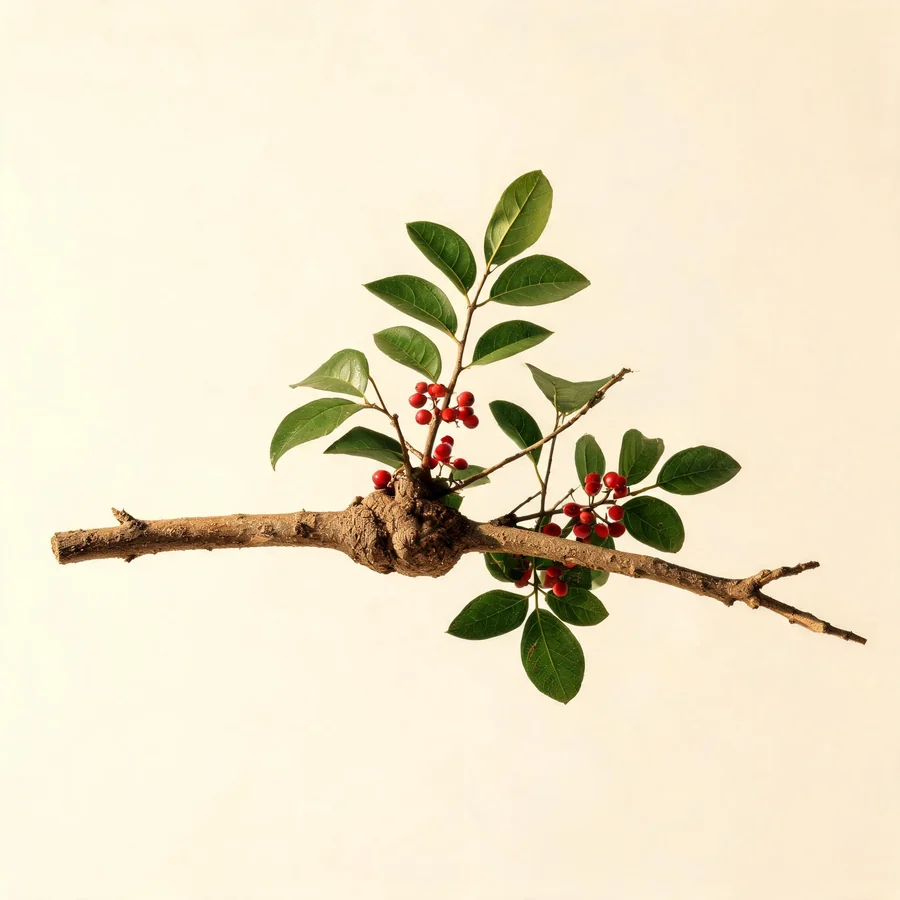
Sang Ji Sheng is chosen when the skin is undernourished rather than inflamed, and when the itch arrives with aching joints or a weak lower back. The species and the host tree are part of the prescription, so buy material that names both.
Skin signs that suggest it
- Dry, thin, pale or papery skin with fine scaling, worst on the shins, forearms and lower legs
- Itch without much redness that worsens at night, in cold weather or after overwork
- Skin that bruises or heals slowly in a person with a sore lower back and weak knees
- An eruption that keeps company with heavy, aching, weather-sensitive joints
- Thinning hair, dry nails and a dull complexion alongside the dry skin
- A pale tongue with a thin coat and a fine, weak pulse
When it is not the right herb
Not for an acute flare, and not for skin that is red, hot, weeping, pustular or spreading: those need cooling and draining, not building. It is wrong where Dampness or Damp-Heat dominates, with a greasy coating, oozing lesions and a heavy body, because the sweet richness adds to what is already congested. It is also unsuitable in a robust person with an acute excess pattern, such as a hot swollen joint, and it is used cautiously where the digestion is weak and the stool loose. Material gathered from an unnamed or toxic host tree should not be used at all.
What it does for skin
Skin-relevant actions only. Each one describes a mechanism in TCM terms and what it looks like on the skin.
Rebuilds the Blood that fills out the skin
Blood deficiency shows on the surface as thinness, pallor, a dull grey cast and fine scaling, and the sweet taste of this herb is read as building the Blood that moistens the skin and hair. The classical commentary reasons that hair depends on Blood, so the same action that keeps the hair from withering keeps the skin from going papery. It is a slow effect, given over weeks with Dang Gui or Gou Qi Zi, and it works alongside emollients rather than instead of them.
Clears Wind-Dampness from the skin and the channels beneath
Wind-Dampness at the surface gives itch that migrates, a heavy or doughy feel to the skin, and flares that follow humid or cold weather. The same pathogen in the channels gives aching, stiffness and weather-sensitive joints. Because the herb is neutral and only mildly drying, it can be given for months where a warming or strongly drying wind herb could not, and it is paired with Fang Feng or Qin Jiao when the surface component dominates.
Settles itch that comes from dryness rather than heat
Itch in pale, dry, unbroken skin, worse at night and after washing, is read as Wind arising from a deficient surface rather than Wind-Heat arriving from outside. Sang Ji Sheng treats the deficiency that let the Wind in, so the itch reduces as the skin gains substance, and the effect is measured in weeks. It is not a sedating antipruritic, and where the skin is red and warm the itch needs a cooling herb instead.
Strengthens the structural base under the skin
Sinews are the province of the Liver and bones of the Kidney, and in this tradition feeding those organs is understood to restore the resilience of the tissue beneath the surface. In practice this is the reason the herb is chosen for thin, easily damaged skin over a weak lower back and unsteady knees, and for the skin involvement that accompanies joint disease such as psoriatic arthritis. The claim is structural and slow, and it does not replace treatment of the joint disease itself.
Skin conditions it is used for
Mapped to the condition pages on this site. The pattern column shows what the skin is doing when this herb is the right choice.
| Condition | Pattern | Why it suits | Typical setting |
|---|---|---|---|
| Chronic Urticaria | Wind-Dampness on a background of Blood and Kidney deficiency | Chronic wheals that are pale or only mildly pink, that come and go for months, and that worsen at night, in damp weather or when the person is tired, are read as Wind-Dampness sitting on a depleted base rather than as acute Wind-Heat. Sang Ji Sheng clears the Wind-Dampness while rebuilding the Blood and Kidney that should have kept the surface resistant, which is why it suits the relapsing case in a depleted person. Acute red, heat-provoked hives are a different pattern and need cooling herbs first. Antihistamines and identification of triggers remain the medical mainstay. | Modified Dang Gui Yin Zi with Sang Ji Sheng, Fang Feng and Bai Xian Pi |
| Senile Pruritus | Liver and Kidney depletion with Wind from dryness | Itch in later life, in dry scaly skin, with a dull complexion, a sore lower back and broken sleep, is read as Blood and Yin failing to reach the surface so that Wind moves through it. Sang Ji Sheng addresses the depletion underneath: it nourishes the Liver and Kidney, and the Blood those organs govern, while dispelling the Wind that the dryness has allowed in. It is given as a supporting herb in a nourishing formula over months. Persistent generalised itch still needs a medical review for systemic causes. | A Blood-nourishing base with Dang Gui, Bai Shao and Fang Feng, with Sang Ji Sheng added |
| Skin Dryness | Blood deficiency failing to moisten and fill the skin | Dry, rough, finely scaled skin in a pale, tired person, worse in winter and after washing, is the surface sign of Blood deficiency. The old record credits this herb with building the Blood that fills out skin and hair, which is why it appears in formulas for dryness that has a systemic cause rather than a product reaction. The effect takes weeks and is modest on its own; emollients, a humidifier and less frequent washing do more in the short term, and the herb works on the underlying picture. | Si Wu Tang with Sang Ji Sheng and Gou Qi Zi |
| Wrinkled And Shrunken Skin | Liver and Kidney Essence deficiency: thin, lax, dry skin | Wrinkling and thinning that run ahead of age, in someone with a sore lower back, weak knees and thinning hair, are read as Essence and Blood no longer filling the skin. Sang Ji Sheng feeds both organs and is used as a slow builder there, at a moderate dose over months, alongside the richer tonics. The effect is on the whole constitution rather than on the face alone, and no herb reverses photoageing; sun protection remains the single most effective measure. | Within a Liver and Kidney tonic formula with Gou Qi Zi and Shu Di Huang |
| Psoriatic Arthritis | Wind-Dampness obstructing the channels with Liver and Kidney deficiency | Psoriatic arthritis gives plaques and joint disease together, and the joint picture is often one of Wind-Dampness on a depleted base: aching, stiffness, swelling and weather sensitivity in a person who tires easily. Sang Ji Sheng sits in the classical formula for exactly that combination, where it clears the Wind-Dampness while nourishing the Liver and Kidney. It treats the joint component and the general depletion rather than the plaques themselves, and it belongs beside, not instead of, rheumatological care. | Du Huo Ji Sheng Tang |
| Neurodermatitis | Blood deficiency with Wind: thickened, itchy, lichenified plaques | Plaques that thicken and groove from repeated scratching, with night itch and no oozing, are read as Blood deficiency with Wind, and the rule in this tradition is to treat the Blood before the Wind. Sang Ji Sheng contributes the nourishing half of that strategy and is combined with Dang Gui, Bai Shao and wind-diffusing herbs. Breaking the scratch cycle, with emollients and coverings at night, is what makes the herbal part work, and the plaques take months to soften. | A Blood-nourishing base with Dang Gui and Bai Shao, with Fang Feng and Sang Ji Sheng |
Combinations for skin
Herbs it is paired with when the skin, not an internal organ, is the target.
| Partner | Ratio | Why the pair is used |
|---|---|---|
| Du Zhong | 10 to 15 g each in decoction | Both herbs feed the Liver and Kidney, both firm up sinews and bone, and they are usually prescribed together when the lower back is weak and aching. Du Zhong runs warm and favours Kidney Yang, while its partner is neutral and also disperses Wind-Dampness, so between them they cover the cold depleted picture and the damp, weather-sensitive one. On the skin they are used where thin, dry, slow-healing skin sits over that constitutional weakness. |
| Dang Gui | 10 g each | Dang Gui builds and moves the Blood, and Sang Ji Sheng builds the Liver and Kidney that the Blood depends on, so the pair works on the source as well as on the substance. It is used for dry, dull, pale skin with night itch and for skin that heals slowly after injury or illness. Dang Gui is warm and moistening and the mistletoe is neutral, so together they are less cloying than a formula built on the richer tonics alone. |
| Fang Feng | 6 to 10 g each | Fang Feng releases Wind from the surface while Sang Ji Sheng treats the deficiency that allowed the Wind to settle, which is the pairing for itch that moves from place to place without much redness. It suits chronic urticaria and the dry itch of later life, and it is one of the commonest ways the herb enters a skin formula. Fang Feng is dispersing, so it is kept to a modest share where the person is clearly depleted. |
| Gou Qi Zi | 10 to 15 g each | Both enter the Liver and Kidney, and both build the Yin and Blood that the surface draws on. Gou Qi Zi is sweeter and more moistening, while Sang Ji Sheng is neutral and adds the Wind-Damp action, so together they suit dry skin with dry eyes, a dull complexion and a sore lower back. The pair is given over months, and it is a better long-term choice than a warming tonic in someone who runs warm. |
Formulas where it leads
- Du Huo Ji Sheng Tang (独活寄生汤) - The classical answer to long-standing painful obstruction when the Liver and Kidney are depleted: aching, heavy joints in a person with little reserve, with Du Huo, Qin Jiao and Fang Feng clearing Wind-Dampness while Du Zhong, Niu Xi and Sang Ji Sheng rebuild the lower body. In this edition it is the formula context for psoriatic arthritis, where skin disease and joint disease arrive together, and it is given over weeks rather than days.
Safety for skin use
What to check before recommending or using it, including the cautions that matter most for skin patients.
Do not use, or use with caution
- Acute excess with Heat: a red, hot, swollen joint, a spreading red rash or a feverish eruption. A tonic given during an acute excess is held to prolong it, and the skin needs clearing before any building.
- Dampness or Damp-Heat with oozing lesions, a greasy coating and a heavy body. The sweet, slightly cloying quality of the herb can add to the congestion and leave the skin more damp, not less.
- Weak digestion with a poor appetite, bloating and loose stools. A rich tonic taken at dose can sit heavily, and the dose should be reduced or the herb left out until the digestion is steadier.
- Material from an unnamed or toxic host tree. Being hemi-parasitic, the plant takes up water and dissolved substances from the tree it lives on, and material raised on oleander or lacquer tree may hold compounds that do not belong in a medicine.
Pregnancy and breastfeeding
Its record as a herb that steadies a pregnancy is a long one, and it is part of Shou Tai Wan, the classical formula for that purpose, with Xu Duan, Tu Si Zi and E Jiao. That use belongs to a practitioner: a single experimental report has raised a question about high-dose exposure early in pregnancy, so the amount used should stay within the ordinary range and the decision should not be made alone. For a skin complaint in pregnancy the whole decision belongs to a practitioner, and a short course at an ordinary dose is the most that would be attempted. During breastfeeding the herb is traditionally regarded as compatible at ordinary doses, and any reaction in the infant is a reason to stop.
Interactions
- Antihypertensive medicines: animal studies have recorded a modest lowering of pressure, so a person already treated for hypertension may find the effect adds up and should have readings taken once the herb is started rather than assuming nothing will shift.
- Diuretics and a tendency to low potassium: a flavonoid in the herb has produced a diuretic effect in animals, which may compound a prescribed diuretic and the electrolyte loss that goes with it; checking potassium is sensible when the herb is taken at dose for several weeks.
- Anticoagulants and antiplatelet drugs: the flavonoid quercetin has shown a mild antiplatelet effect in laboratory work, so anyone on warfarin, aspirin or clopidogrel should raise the herb with their prescriber before starting a regular course and watch for unexplained bruising.
Allergy and patch testing
Contact reactions to herb-containing washes and creams are well recognised, and a patch test on a small area of normal skin for 24 hours is sensible before any preparation is applied. A person who reacts to other members of the mistletoe family, or who has had a reaction to a herbal wash before, should be cautious. Stop at once if the skin becomes more irritated rather than calmer, and do not apply a wash to broken or ulcerated skin.
General safety references
General references for herbal hepatotoxicity and herb-drug interactions; they are not specific to this herb.
- Review article: Herbal hepatotoxicity - an update on traditional Chinese medicine preparations. Alimentary Pharmacology & Therapeutics, 2014. PMID: 24844799.
- Interactions between herbal medicines and prescribed drugs: an updated systematic review. Drugs, 2009. PMID: 19719333.
- Warfarin and food, herbal or dietary supplement interactions: a systematic review. British Journal of Clinical Pharmacology, 2021. PMID: 32478963.
Evidence
The classical record is quoted with its source. The modern note states the level of evidence plainly.
Classical record
This later Han collection lists damage from trauma, painful obstruction, flooding in women, internal injury with deficiency, lingering complaints after childbirth and a poor flow of breast milk.
Ming Yi Bie Lu (Supplement to the Classic of Materia Medica) - The entry on wounds is the earliest warrant for applying the herb to damaged skin, and the use after childbirth explains why it sits in formulas that rebuild a mother.
Bitter and sweet in flavour, even in nature and neither cold nor hot, it is therefore held to be free of toxicity; and since it draws its actions from the mulberry that bears it, it is held to surpass mulberry itself.
Ben Cao Jing Shu (Commentary on the Classic of Materia Medica) - The clearest early statement that the host tree shapes the medicine, and the origin of the preference for mulberry-grown material.
It is praised as a leading remedy for the Kidney and for the Blood. Bone belongs to the Kidney and hair is sustained by Blood, so the bitter taste is said to enter the Kidney and strengthen sinew and bone, while the sweet taste makes Blood so that hair does not wither.
Ben Cao Qiu Zhen (Truth Sought in the Materia Medica) - The hair and bone reasoning is where the skin and hair uses come from: the surface is read as the visible state of the Blood.
Modern evidence
Evidence status
- No clinical trial of Sang Ji Sheng in a skin condition was identified for this page. Laboratory work on Taxillus chinensis describes flavonoid constituents, including avicularin and quercetin, with antioxidant and anti-inflammatory activity, mostly in cell and animal models.
- Blood pressure and diuretic effects have been measured in animal experiments, and that work is the origin of the interaction cautions rather than of any claim about skin disease.
- Identity and sourcing are the practical evidence problem. The herb is a hemi-parasite whose chemistry varies with its host, and the related northern mistletoe is sold as or mixed with it, so a named species and a named host are part of what is being bought.
PubMed records
Selected real PubMed records for this herb's species or its constituents, chosen by species name and title relevance. They are references for the non-TCM discussion above, not proof that the herb treats any skin condition.
- Taxillus chinensis (DC.) Danser: a comprehensive review on botany, traditional uses, phytochemistry, pharmacology, and toxicology.. Chinese medicine, 2022. PMID: 36482376 (safety record).
Dose and forms
Skin-practice dosing and the preparations that suit skin complaints.
| Form | Dose and notes |
|---|---|
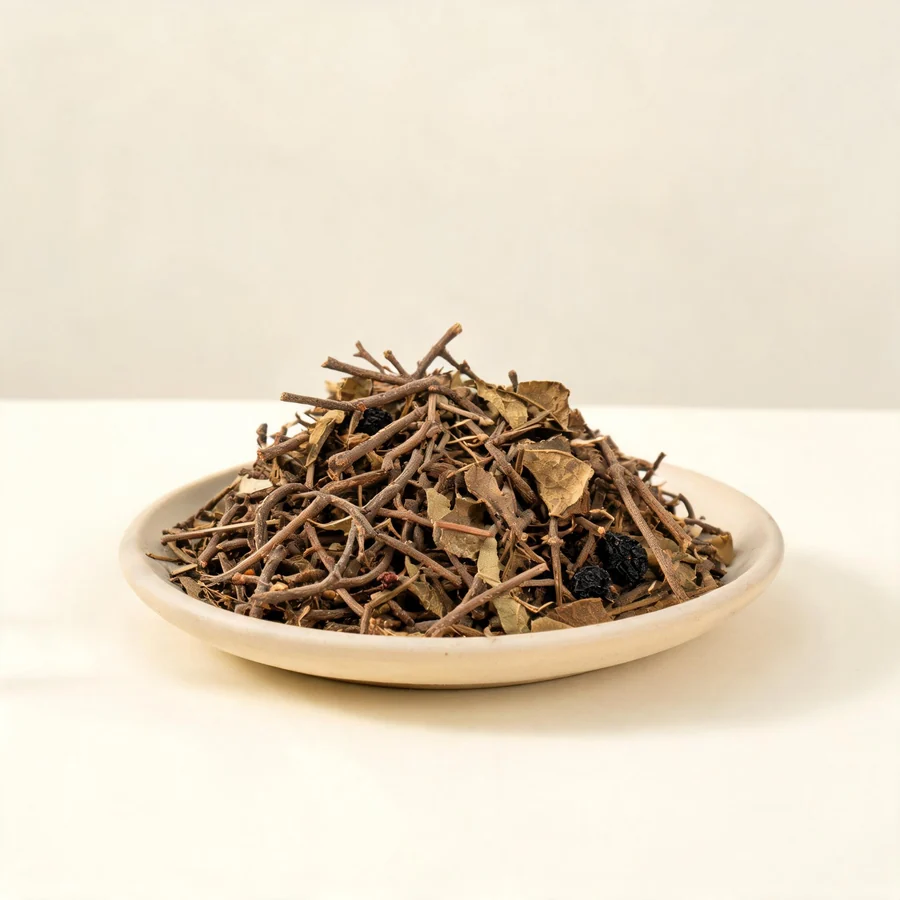
| Decoction | 9 to 15 g of dried stem and leaf daily, in a formula rather than alone. The lower end suits a supporting role beside a Blood tonic, and 15 to 20 g is used for a chronic deficiency with aching joints and dry skin. |
| Granules and extracts | Standardised granules follow the manufacturer's label and a practitioner's direction, because concentrations differ widely between products and the dried herb weight is not equivalent. |
| Course length | Weeks to months, because the herb builds rather than clears. Review every few weeks, and reduce or stop if bloating, loose stools or a heavy feeling develops. |
The dose is modest because the action is slow and cumulative, and the herb is nearly always given inside a formula. Two things set it: how depleted the person is, and how well the digestion copes with a sweet tonic. For skin use the practical question is often not the dose but the material, since a named mulberry host and clean leafy stems are what make the herb reproducible; bare, grey, thick stems and material of unknown origin are a poor buy whatever the label says.
Citations and further reading
Only real sources are listed: the classical materia medica passages quoted above, and the source works behind the botanical and safety statements.
- Ming Yi Bie Lu (Supplement to the Classic of Materia Medica), attributed to Tao Hongjing, Southern and Northern Dynasties - the entry on trauma, painful obstruction and lactation is given in translation above.
- Ben Cao Jing Shu (Commentary on the Classic of Materia Medica) - the passage on taste, nature and the host tree is given in translation above.
- Ben Cao Qiu Zhen (Truth Sought in the Materia Medica) - the passage on the Kidney, the Blood and the hair is given in translation above.
- Pharmacopoeia of the People's Republic of China, Herba Taxilli monograph - source for the accepted botanical source, part used and quality requirements.
- Botanical literature on Taxillus chinensis, Loranthaceae, including its hemi-parasitic dependence on the host tree - source for the description of the material and of its variation.
- Modern evidence statement: based on laboratory literature on Taxillus chinensis flavonoids and on the absence of identified skin trials, stated as a level of evidence rather than as a cited finding.
Educational reference for qualified practitioners. This page is not medical advice, and skin conditions should be diagnosed by a clinician before treatment.