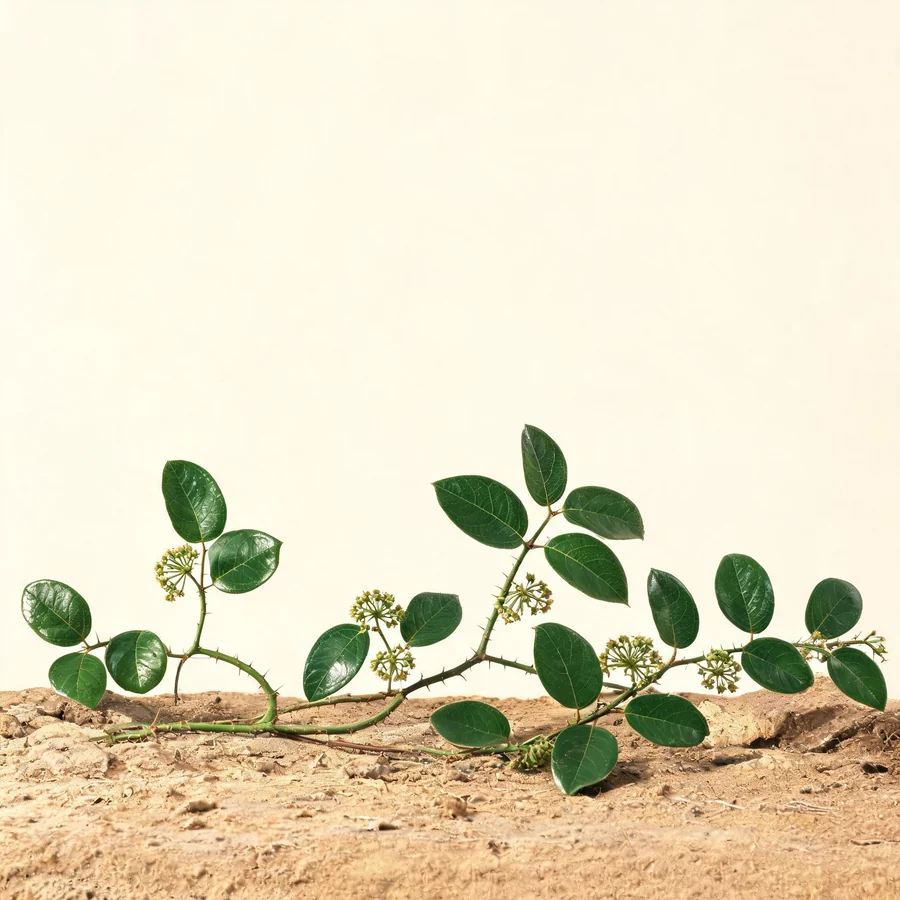
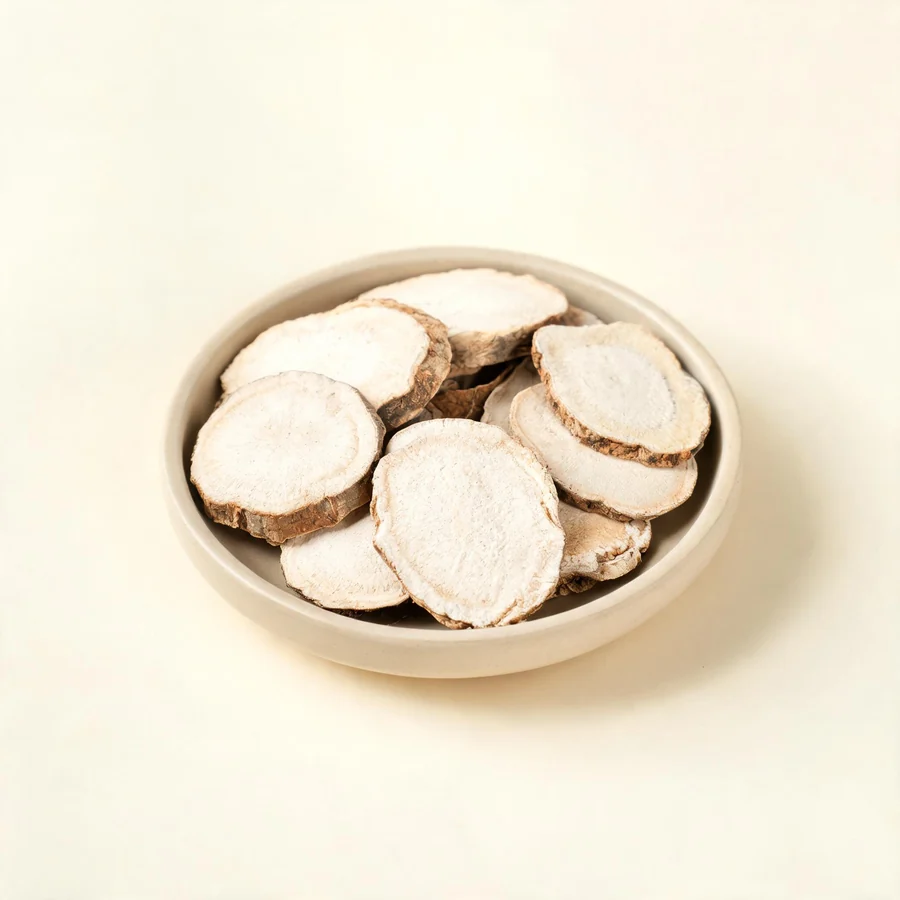
Skin profile
Where this herb sits in skin practice: the pattern it corrects, the skin signs it suits, and what it should not be used for.
Tu Fu Ling is for damp-heat that has settled in and will not shift: chronic weeping eczema, greasy skin, recurring boils and moist itchy folds. It is the long-course herb of the group, chosen because it drains without chilling the digestion.
Skin signs that suggest it
- Chronic, stubborn eczema that weeps or crusts and keeps returning (damp-heat toxin)
- Greasy yellow scale or a sticky coating on the skin (dampness)
- Boils, abscesses or follicular lesions that are slow to settle
- Itch and maceration in skin folds or the genital area (damp-heat below)
- A red tongue with a greasy yellow coating, and a slippery pulse
When it is not the right herb
Not for dry skin with no dampness, and not for Yin-deficient skin that is thin, dry and itchy with a red tongue that has little coating. The herb drains fluid as it drains dampness, so it can leave a dry person drier. Avoid it in cold, pale, weeping skin of the deficiency type, and stop if dryness of the mouth or scanty urine appears.
What it does for skin
Skin-relevant actions only. Each one describes a mechanism in TCM terms and what it looks like on the skin.
Resolves damp-heat toxin
The defining action. Damp-heat toxin is the pattern behind skin that is both inflamed and moist, and that keeps returning: chronic eczema, infected patches, boils that discharge and settle only to recur. Tu Fu Ling draws the toxin out while draining the dampness, and its neutral temperature means it does not add cold to an already tired digestion.
Drains dampness through the urine
The bland taste percolates rather than purges. Moisture is directed to its ordinary exit, so the herb serves dampness that appears in the skin and the lower body at the same time. In skin practice this translates into less ooze, less maceration and less of the heavy, boggy quality that keeps a lesion wet.
Clears heat without cooling the middle
Most heat-clearing herbs for skin are cold, and long courses can leave the digestion cold and the stools loose. Tu Fu Ling is neutral, so it clears lingering heat while being far less likely to disturb the Stomach. That is what allows the longer courses that chronic damp-heat skin conditions need.
Settles stubborn sores and swellings
For boils, abscesses and nodules that are slow to resolve, the herb works by drawing out what is lodged rather than by forceful purging. It is used with honeysuckle and other toxin-clearing herbs in the early phase, and continued as the lesion settles. A lesion that is spreading, deep or accompanied by fever needs medical assessment.
Relieves damp-heat itch in the folds
Itch with moisture in the skin folds, the groin or the genital area is read as damp-heat pouring downward. Tu Fu Ling drains that dampness and resolves the toxin, and it is often paired with Bi Xie, which separates the clear from the turbid. It is a supporting herb here rather than a rapid antipruritic.
Skin conditions it is used for
Mapped to the condition pages on this site. The pattern column shows what the skin is doing when this herb is the right choice.
| Condition | Pattern | Why it suits | Typical setting |
|---|---|---|---|
| Eczema | Chronic damp-heat with stubborn oozing | Tu Fu Ling is chosen for eczema that has become chronic, with lesions that weep, crust and recur rather than settling between flares. Its neutral, draining action reduces the moisture and the lingering inflammation without the drying coldness of the bitter herbs. It is usually combined with Bai Xian Pi and Ku Shen for the itch, and with Yi Yi Ren for the underlying dampness. | Bi Xie Shen Shi Tang, or Tu Fu Ling with Bai Xian Pi and Ku Shen |
| Atopic dermatitis | Damp-heat flaring on a background of Spleen weakness | In atopic dermatitis the acute flare is treated and the underlying tendency supported. Tu Fu Ling suits the damp-heat phase because it drains without weakening digestion, and it can be combined with Spleen-supporting herbs such as Bai Zhu and Yi Yi Ren. It is less appropriate once the skin has become dry, lichenified and pale. | Tu Fu Ling with Yi Yi Ren and Bai Zhu during the damp-heat phase |
| Seborrhoeic dermatitis | Damp-heat with greasy yellow scale | The greasy yellow scale and red base of seborrhoeic dermatitis are a damp-heat picture, and the scalp, eyebrows and nasolabial folds are common sites. Tu Fu Ling drains the dampness that produces the grease and resolves the low-grade toxin, and it is often paired with Huang Qin or Ku Shen. A medicated wash is a useful addition for the scalp. | Tu Fu Ling with Huang Qin and Ku Shen |
| Acne | Damp-heat with greasy skin and inflamed papules | Acne with oiliness, red papules and pustules is read as damp-heat in the skin. Tu Fu Ling is a gentler choice than the bitter cold herbs and is used where the skin is greasy and the lesions are persistent rather than violently inflamed. It is combined with Huang Qin and Zhi Zi when heat is prominent. | Tu Fu Ling with Huang Qin and Zhi Zi |
| Boils | Damp-heat toxin lodged in the flesh | A boil that is slow to resolve, or one of a recurring crop, points to toxin that has not been fully cleared. Tu Fu Ling draws it out over a longer course and is paired with honeysuckle for the acute phase. A boil with spreading redness or fever needs medical treatment. | Wu Wei Xiao Du Yin with Tu Fu Ling |
| Skin abscess | Toxic dampness with pus and induration | Where an abscess is indurated and slow to settle after drainage, the residual dampness and toxin keep the tissue boggy. Tu Fu Ling is used to drain that residue and support resolution, usually in a formula with Jin Yin Hua and Gan Cao. It does not replace drainage or antibiotics for an established collection. | Xian Fang Huo Ming Yin with Tu Fu Ling |
| Itchy genitalia | Damp-heat pouring downward | Itch, moisture and discharge in the genital area are a damp-heat picture, and Tu Fu Ling's draining action reaches the lower body. It is combined with Bi Xie to separate the clear from the turbid and with Ku Shen for the itch. Persistent or unexplained genital itch needs examination, because infection and skin disease both present this way. | Tu Fu Ling with Bi Xie and Ku Shen |
Combinations for skin
Herbs it is paired with when the skin, not an internal organ, is the target.
| Partner | Ratio | Why the pair is used |
|---|---|---|
| Bi Xie | 15 to 30 g each | Bi Xie separates clear from turbid and drains dampness below, while Tu Fu Ling adds toxin resolution and broader drainage. The pair is the standard response to damp-heat with cloudy urine, discharge or itchy moist skin in the folds, and it is neutral enough to continue in a person with a delicate digestion. |
| Yi Yi Ren | 15 to 30 g each | Coix seed drains dampness and supports the Spleen, addressing where the dampness is produced, while Tu Fu Ling clears the toxin and drains it at the site. The pair is used for chronic eczema, heavy limbs and joint swelling; both herbs are mild enough for a long slow course. |
| Bai Xian Pi | 10 to 15 g Bai Xian Pi with 15 to 30 g Tu Fu Ling | Bai Xian Pi is the skin-specific herb for damp-heat itch and fungal rash, and Tu Fu Ling supplies the longer, deeper drainage. Together they suit chronic itchy eczema and moist, thickened patches, and the pair can be used internally and as a wash. |
| Jin Yin Hua | 10 to 15 g Jin Yin Hua with 15 to 30 g Tu Fu Ling | Honeysuckle clears heat and resolves toxin, acting at the surface in the acute phase, and Tu Fu Ling acts deeper and more gradually. Between them they reach the surface and the deeper tissue, which is why the pair appears in formulas for boils and carbuncles. |
| Sheng Di Huang | 10 to 15 g Sheng Di Huang with 15 to 30 g Tu Fu Ling | Raw Rehmannia cools the Blood and restores fluids; Tu Fu Ling draws out dampness and toxin. The pair is used where a long-standing hot skin condition has both weeping and thickening, and the tongue is red and dry. The first clears what remains while the second repairs what has been lost. |
Topical use
Tu Fu Ling is used on the skin as a wash and, in traditional practice, as a powder mixed with vinegar for toxic sores. A strong decoction is applied to weeping, itchy or macerated areas, and the sliced rhizome is sometimes added to a bath. Because it is neutral and bland, the wash is mild enough for repeated use, which suits chronic conditions better than a harsh astringent.
| Preparation | How and when it is used |
|---|---|
| Decoction wash | 30 to 60 g of sliced dried rhizome is simmered in 1 litre of water for 30 minutes, strained and cooled to skin temperature. Use as a rinse or a compress on weeping or itchy areas once or twice daily. The liquid keeps for a day in the refrigerator. |
| Vinegar paste | Finely ground rhizome is mixed with a little rice vinegar to a soft paste and applied sparingly to a boil or a toxic swelling, covered with gauze. Change it once or twice daily and stop if the skin stings or breaks down. Do not use on an open, deep or freely bleeding lesion. |
| Bath addition | A litre of the strained decoction added to a lukewarm bath is used for widespread itchy or moist skin. Soak for 10 to 15 minutes, pat dry and moisturise while the skin is still damp. Rinse the bath afterwards and do not share the water. |
Patch test and cautions
Patch test first, and avoid the eyes, mouth and genital mucosa. Do not apply a vinegar paste to broken skin, and do not use occlusive dressings over it. Stop if itching, redness or new papules appear, which may be the allergic reaction recognised for this herb, and seek advice if a lesion is spreading or accompanied by fever.
Safety for skin use
What to check before recommending or using it, including the cautions that matter most for skin patients.
Do not use, or use with caution
- Liver and Kidney Yin deficiency: dryness of the mouth, a red tongue with scant coating, night sweating and dark scanty urine mean the fluids are already low, and a draining herb can deplete them further.
- Dry skin with no dampness, and chronic dry eczema or ichthyosis, where there is nothing for the draining action to remove.
- Known allergy to Tu Fu Ling: generalised itching and scattered red papules after taking it are the reaction on record, and a repeat course is unwise after any reaction.
- Long high-dose courses without review: the herb is draining, and continued use can leave the mouth dry and the urine scanty even in someone who tolerates it initially.
Pregnancy and breastfeeding
Classical sources do not forbid it and no action on the womb is known; the rhizome is neutral and non-toxic. The hesitation is about its draining nature, which may further thin the fluids of a mother who is already dry, so pregnancy use is limited to ordinary doses, a clear indication, professional supervision and a short course. While breastfeeding, normal doses are unlikely to cause trouble, but a prolonged high-dose course could reduce the mother's fluids, so keep the dose moderate and the course defined.
Interactions
- In laboratory work, astilbin and other flavonoids in the rhizome have acted on immune function in both suppressive and modulating ways, so there is a theoretical concern about additive suppression with ciclosporin, tacrolimus or methotrexate.
- The herb inhibits xanthine oxidase and influences kidney transporters that handle uric acid, so it may add to allopurinol or febuxostat; anyone taking those drugs should have uric acid levels checked and not assume the combination is straightforward.
- Because it is draining, it may add to the fluid loss caused by diuretic medicines, and anyone on these should keep fluids up and watch for dryness.
- The old instruction not to decoct the herb in iron, and to avoid strong tea during a course, is about loss of effect rather than toxicity, but it is easy to observe and worth following.
Allergy and patch testing
Allergic reactions to Tu Fu Ling are recognised: generalised itching and scattered red papules that settle when the herb is withdrawn and return on a repeat dose. Anyone who has reacted once should avoid it. Topical use can also sensitise, so patch test a wash or paste before applying it to a larger area.
General safety references
General references for herbal hepatotoxicity and herb-drug interactions; they are not specific to this herb.
- Review article: Herbal hepatotoxicity - an update on traditional Chinese medicine preparations. Alimentary Pharmacology & Therapeutics, 2014. PMID: 24844799.
- Interactions between herbal medicines and prescribed drugs: an updated systematic review. Drugs, 2009. PMID: 19719333.
- Warfarin and food, herbal or dietary supplement interactions: a systematic review. British Journal of Clinical Pharmacology, 2021. PMID: 32478963.
Evidence
The classical record is quoted with its source. The modern note states the level of evidence plainly.
Classical record
It settles the middle, gives strength to the sinews and bones, drives out wind and dampness, opens the joints and checks diarrhoea. Cramping pain in the bones, stubborn sores and swellings all respond, and it neutralises the toxicity of mercury and of cinnabar.
Ben Cao Gang Mu (Compendium of Materia Medica), Li Shizhen - Li Shizhen gathers the digestive, joint and deep-toxin uses into one entry, and the line about stubborn sores is the basis of the skin application.
It clears heat and drains dampness, and it reaches into the fine vessels to hunt down toxin that damp-heat has lodged deeply. Its effect on mercury and calomel comes from leading downward rather than pushing upward, which explains why it is the chosen remedy for syphilitic sores that have worked their way along the channels, leaving joints painful and skin ulcerated.
Ben Cao Zheng Yi (Correct Meaning of the Materia Medica) - A Qing account of the downward-draining logic: the toxin is led out through the lower route rather than pushed back to the surface.
Its roots sit joined like cups, half above the ground, with a bark like Fu Ling and a red, astringent flesh. People gathered it in place of grain so that hunger did not trouble them, and it settles the middle and stops diarrhoea.
Ben Cao Shi Yi (Supplement to the Materia Medica) - A Tang description that covers the food use as well as the early name, which is why the herb is regarded as safe enough for long courses.
Modern evidence
Evidence status
- Laboratory studies report that astilbin and other flavonoids in the rhizome have immunosuppressive, anti-inflammatory and antioxidant activity, and that extracts inhibit xanthine oxidase, an enzyme involved in uric acid production. These are mainly cell and animal studies.
- Clinical trial evidence for Tu Fu Ling in skin disease is very limited, and no adequately powered trial of the single herb in eczema or acne was identified. Most reports are small, Chinese-language, or embedded in multi-herb formula studies.
- Regulatory status: the dried rhizome is an accepted herbal substance in the Chinese Pharmacopoeia. This page sets out traditional practice and the current state of the evidence; it does not claim that the herb is proven effective.
PubMed records
Selected real PubMed records for this herb's species or its constituents, chosen by species name and title relevance. They are references for the non-TCM discussion above, not proof that the herb treats any skin condition.
- Sihe Tufuling formula alleviates imiquimod-induced psoriasis-like skin lesions in mice by modulating the HIF-1 signaling pathway.. Phytomedicine : international journal of phytotherapy and phytopharmacology, 2026. PMID: 41825206 (skin-related record).
Dose and forms
Skin-practice dosing and the preparations that suit skin complaints.
| Form | Dose and notes |
|---|---|
| Decoction (internal) | 15 to 30 g of dried rhizome daily for chronic damp-heat skin, rising to 30 to 60 g under supervision for stubborn cases. A weight this large is ordinary for a bland starchy root. |
| Tablets and granules | Concentrated granules are dosed by the manufacturer's equivalent; follow the label rather than converting directly from the raw weight. |
| Topical wash | 30 to 60 g simmered in 1 litre of water for 30 minutes, used cooled as a rinse or compress once or twice daily. |
| Course length | Two to six weeks for chronic skin conditions, with review. Stop if the mouth turns dry or the urine becomes scanty. |
The herb is given in large weights because it is starchy and bland, and a large dose does not mean a stronger medicine. It should not be decocted in iron, and strong tea is avoided during a course on the traditional view that both reduce its effect. Because it drains fluid, it is stopped if dryness develops, and it is not used as a long-term tonic.
Citations and further reading
Only real sources are listed: the classical materia medica passages quoted above, and the source works behind the botanical and safety statements.
- Ben Cao Gang Mu (Compendium of Materia Medica), Li Shizhen, 1578 - classical entry quoted above.
- Ben Cao Zheng Yi (Correct Meaning of the Materia Medica) - classical entry quoted above.
- Ben Cao Shi Yi (Supplement to the Materia Medica), Tang dynasty - classical entry quoted above.
- Tu Fu Ling monograph: Pharmacopoeia of the People's Republic of China - source for the accepted botanical source, part used and quality requirements.
- Modern evidence statement: based on laboratory literature on astilbin and xanthine oxidase inhibition, summarised as a statement about the level of evidence rather than as a cited finding.
- Botanical description and identification: botanical literature on Smilax glabra, Smilacaceae.
Educational reference for qualified practitioners. This page is not medical advice, and skin conditions should be diagnosed by a clinician before treatment.