Skin profile
Where this herb sits in skin practice: the pattern it corrects, the skin signs it suits, and what it should not be used for.
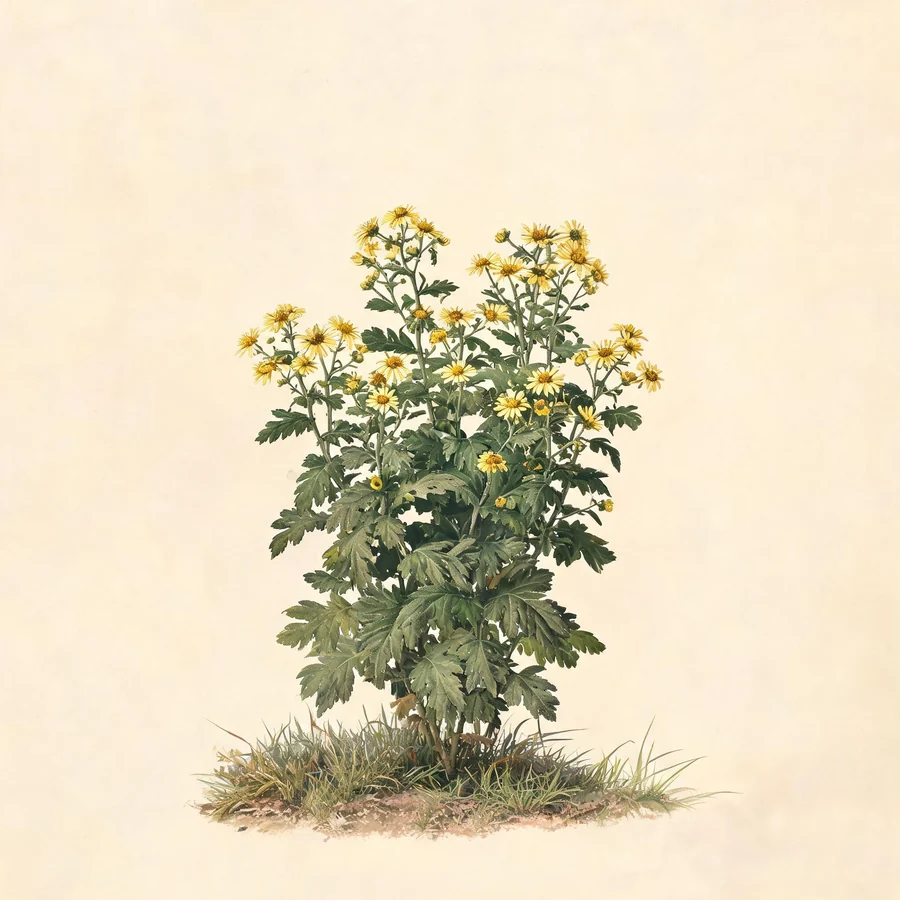
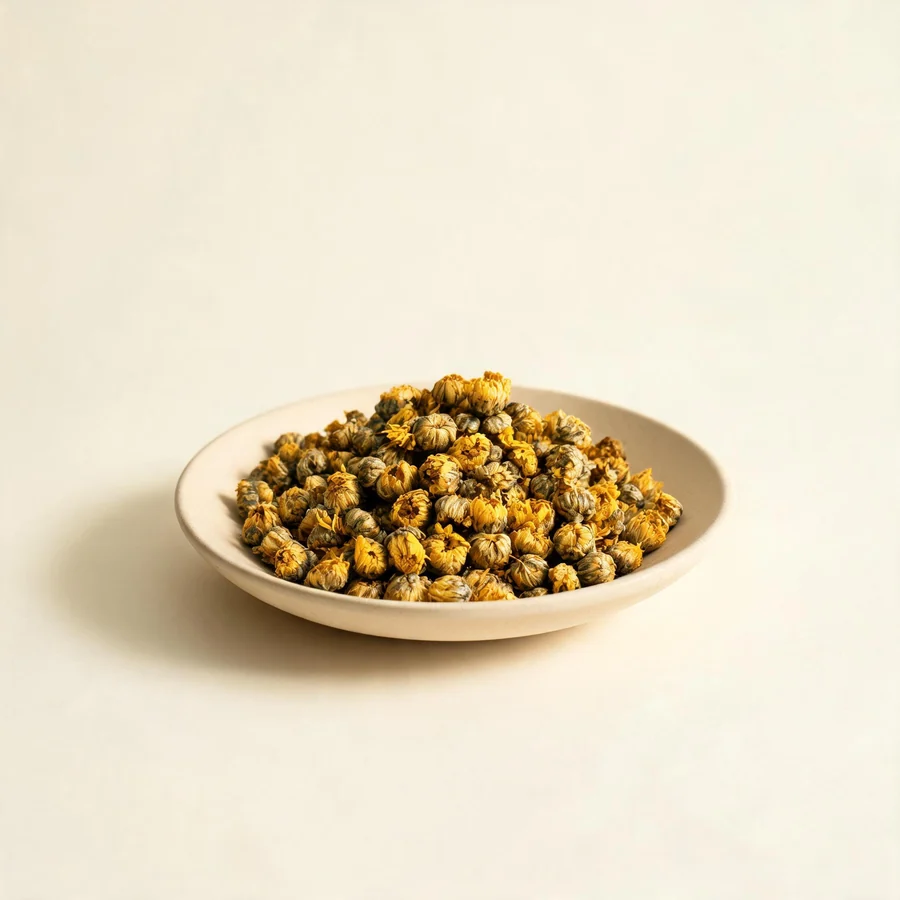
The wild flower is the strongest of the chrysanthemums against heat toxin and the least suited to daily drinking. It is used on short, sharp, red and swollen lesions.
Skin signs that suggest it
- A red, hot, hard swelling with a sharp central point, particularly on face, neck or scalp (fire toxin)
- A crop of inflamed follicles or pustules, with redness and tenderness spreading around them
- Burning cheeks with visible capillaries and acne-like bumps that flare with stress or drink (Liver fire rising)
- A vivid red plaque with a sharp border that advances and feels hot (dan toxin)
- A red tongue carrying a yellow coat, a wiry rapid pulse, and a bitter taste in the mouth
When it is not the right herb
Not for swellings that are pale, cold and woody, which want warming and resolving rather than cooling. Not for someone whose hands and feet are always cold, whose stool is loose and whose appetite is poor, since more bitterness will weaken that digestion further. Not for depleted skin with no heat, where dryness, fine scaling and a dull complexion tell the opposite story. And not as an everyday tea, however pleasant the taste.
What it does for skin
Skin-relevant actions only. Each one describes a mechanism in TCM terms and what it looks like on the skin.
Clears fire toxin and resolves a hot swelling
This is the central action. A boil, an inflamed follicle or an advancing red plaque is heat that has concentrated into toxin, and the bitter cold flower disperses it. Its reputation attaches especially to the deep, hard-rooted boils the texts call ding and to lesions of the face and scalp, where the flower's lightness carries its effect upward. It is given by mouth and applied as a wash, often with honeysuckle and viola.
Drains Liver fire from the face and head
The flower enters the Liver channel, and Liver fire here rises: flushing, burning cheeks, red eyes, headache, irritability. Cooling that fire at source is why it features in rosacea-like redness and in acne that flares with stress, alcohol or lost sleep. It acts on the heat behind the flush rather than on the vessels, so for fixed redness it is a helper rather than a cure.
Disperses wind-heat from the surface
Being acrid as well as bitter, the flower can move outward as well as down, which lets it join an early hot eruption that still has a surface component. In skin work that means an itchy red rash arriving with a sore throat or a feverish cold, where one heat is expressing in two places. It is a secondary action, and the garden chrysanthemum or honeysuckle usually carries the surface part of the job.
Dries and clears a weeping, infected surface as a wash
A wash is the oldest use on record for the flower, credited with clearing scabs and itch while expelling wind and destroying parasites. In practice a cooled decoction goes on boils, crusted impetiginised patches and hot weeping lesions, to reduce surface heat and bacterial load. It does not sterilise anything and cannot replace antibiotics when infection is spreading.
Skin conditions it is used for
Mapped to the condition pages on this site. The pattern column shows what the skin is doing when this herb is the right choice.
| Condition | Pattern | Why it suits | Typical setting |
|---|---|---|---|
| Boils | Fire toxin with a hot, hard, painful swelling | A boil that is red, raised, hard and tender, above all on the face or neck, is the picture the flower was recorded for. It is used early, while the swelling is still hard and has not pointed, to scatter the heat that is gathering. A boil with advancing redness or fever, or one on the face, needs medical assessment, because such lesions can become serious. | Wu Wei Xiao Du Yin, or Ye Ju Hua with Jin Yin Hua and Pu Gong Ying |
| Folliculitis | Heat toxin at the follicles, often multiple and tender | A crop of inflamed follicles, each on a red base with a small pustule, reads as heat toxin that has not yet massed into a single boil. The flower's dispersing quality suits many small lesions better than a strongly binding herb would, and it can be washed on as well as swallowed. Recurrent crops call for treatment of the underlying pattern, not endless short courses. | Ye Ju Hua with Lian Qiao and Huang Qin, or as a diluted wash |
| Acne | Heat toxin with Liver fire, inflamed papules and pustules | Inflammatory acne, with red bumps, pustules and a flushed face, fits the fire-toxin action, particularly where lesions are angry and sore and clearly worsen with stress, alcohol or poor sleep, which is the Liver fire element. It is a supporting herb within a formula, not a single-herb answer to acne. Comedonal acne with no inflammation is a different problem. | Modified Qing Shang Fang or Pi Pa Qing Fei Yin with Ye Ju Hua and Lian Qiao |
| Rosacea | Liver fire and heat in the face with flushing and papules | Persistent facial redness with burning, bumps and a tendency to flush is treated by cooling the fire that rises to the face. Because the flower enters the Liver and tends upward, it fits the flushing element, and it works alongside herbs that clear heat from the Blood and Stomach. It is not for the dry, light-sensitive form without heat signs, and it does not erase capillaries already there. | Ye Ju Hua with Mu Dan Pi, Zhi Mu and Lian Qiao |
| Erysipelas | Dan toxin with a bright red, spreading, hot plaque | The classical text names epidemic fire poison and dan outright, and the lesion it points to is the vivid red, sharply bordered plaque that spreads fast. The flower is a supporting herb there, given with stronger toxin-clearing medicines, and it never replaces the antibiotics erysipelas requires without delay. Its business is the heat and the swelling, not the infection itself. | Ye Ju Hua with Jin Yin Hua, Lian Qiao and Chi Shao in a toxin-clearing formula |
| Eczema | Acute red and itchy eczema with heat | An acute flare that is red, hot and itchy without much weeping gives the flower a place for its heat-clearing and a little surface movement. It is a secondary herb in that formula rather than a leader, and it is dropped once the flare dries out. For a limited area a wash often makes more sense than an internal dose. | Ye Ju Hua with Ku Shen and Bai Xian Pi, internally or as a wash |
Combinations for skin
Herbs it is paired with when the skin, not an internal organ, is the target.
| Partner | Ratio | Why the pair is used |
|---|---|---|
| Jin Yin Hua | 10 to 15 g each | The classic pair for heat toxin. Honeysuckle clears toxic heat through a wide spread of channels while the wild flower concentrates on the Liver, the face and the hard, swollen lesion. They are used together for boils, carbuncles and hot infected skin, by mouth and in washes. Honeysuckle has the broader reach; the chrysanthemum disperses more. |
| Lian Qiao | 10 to 15 g each | Forsythia clears heat, resolves toxin and lifts the exterior as well, while the wild flower works deeper on the Liver and Heart. Between them they reach an infection with a surface component and a deeper one, which is why both are used for early abscesses that have not pointed. Forsythia is the lighter herb; the chrysanthemum carries more of the detoxifying weight. |
| Pu Gong Ying | 10 to 15 g each | Both are heat-clearing, toxin-resolving herbs, used on hot red swellings. Dandelion scatters a lump more effectively and reaches the breast and urinary tract; the wild flower is the better choice for fire in head and eyes. A facial boil or a hot red eye calls for the chrysanthemum, a breast lump for the dandelion. |
| Xia Ku Cao | About 15 g each | Prunella softens hardness and dissolves the knotted quality that Liver fire produces, while the wild flower cools the fire behind it. The pair suits trouble centred on the head and eyes, with a tender, bunched quality to the swelling, including tender neck glands alongside an inflamed throat. It is an upper-body pairing rather than one for the limbs. |
| Zi Hua Di Ding | 15 g each | Viola cools at the Blood level and suits the dusky, hard sore that sits deep, whereas the chrysanthemum disperses more and belongs clearly to the head and Liver. Both sit in the five-herb toxin formula. Where the two are combined, the violet handles the deeper layer and the chrysanthemum lifts the fire above. |
Formulas where it leads
- Wu Wei Xiao Du Yin (五味消毒饮) - The five-herb formula for boils, carbuncles and hot swellings, in which wild chrysanthemum sits beside dandelion, viola, honeysuckle and forsythia. It is the standard setting for this flower in skin work, taken as a decoction and sometimes with the same liquid used as a wash.
- Huang Lian Jie Du Tang (黄连解毒汤) - The classical fire-purging formula for severe heat toxin, built on coptis, scutellaria, phellodendron and gardenia. In skin practice the wild flower is added to it for facial and follicular heat toxin, so it appears as a modification rather than as one of the original ingredients.
Topical use
The flower is applied as a wash and a poultice for hot, red, infected skin, and the classical text describes precisely that: a wash to clear scabs and itch. Fresh flower heads can be crushed onto a boil, and a cooled decoction is used as a compress on inflamed follicles, crusted patches and hot eczema. It is a comfort and a surface treatment, not an alternative to antibiotics when infection is spreading.
| Preparation | How and when it is used |
|---|---|
| Decoction wash | Simmer 15 to 30 g of dried flower heads in 500 ml of water for 10 minutes, strain and cool. Use as a compress or a rinse on inflamed areas for 10 minutes, once or twice a day, and make it fresh. |
| Fresh poultice | Crush a handful of fresh flower heads to a paste and lay it on a single early boil under a clean cloth for 20 minutes. Keep it to unbroken skin, and stop if redness spreads beyond the lesion. |
| Combined wash | About 10 g each of wild chrysanthemum, honeysuckle and dandelion, decocted and used cooled. It is the external counterpart of the five-herb toxin formula and suits a crop of small inflamed follicles. |
Patch test and cautions
Test a patch before the first wash, because contact allergy in the daisy family is common. Keep it off deep, open or spreading infection, away from the eyes, and off a boil that has begun to drain. Stop if burning or advancing redness appears, and keep the liquid away from mouth and eyes. Do not seal a poultice under an occlusive dressing.
Safety for skin use
What to check before recommending or using it, including the cautions that matter most for skin patients.
Do not use, or use with caution
- Cold and weak digestion, with hands and feet that are always cold, unformed stool, no appetite and discomfort after cold food. More bitterness adds to the cold and can bring nausea and further looseness.
- Qi deficiency with no heat sign at all: tiredness, pallor, breathlessness on exertion and a tendency to catch colds, with nothing red or hot anywhere. A draining herb in that state scatters what little is left.
- Long courses and daily brewing. This flower is more bitter and colder than the garden chrysanthemum, and that degree of bitterness injures the Stomach and Spleen over weeks, so it is used for days or a few weeks and stopped once the heat signs have gone.
Pregnancy and breastfeeding
Avoid it unless a practitioner has prescribed it for a definite indication. The pharmacopoeia places the flower in the use-with-caution group for pregnancy, and the older slight-toxicity grading gives a second reason to hold back. Its cold, bitter character is said to drain the Spleen and Stomach Yang that supports a pregnancy, and there are safer routes to clearing heat. A small topical area carries less risk but should still be checked.
Interactions
- Anticoagulants and antiplatelet drugs. The flowers carry flavonoids, including quercetin and luteolin, which laboratory work suggests may mildly thin the blood, so anyone on warfarin, aspirin or clopidogrel should raise it with their prescriber before taking the herb regularly. No trial has measured the combination in people.
- Blood pressure medicines. Animal studies describe a fall in blood pressure, which could add to a prescribed antihypertensive, so blood pressure is worth watching at the start of a course.
- Iron and mineral supplements. The flowers contain tannins and organic acids that bind metals in the gut, so keep herb and supplement about two hours apart.
Allergy and patch testing
Daisy-family allergy is the specific concern here. Someone who reacts to ragweed, chrysanthemums, daisies or marigolds may react to this flower too. The usual signs are rash, itch or contact dermatitis, and a wash is the likelier trigger. Patch test for a day before using a wash over a larger area, and stop at once if the skin becomes more irritated.
General safety references
General references for herbal hepatotoxicity and herb-drug interactions; they are not specific to this herb.
- Review article: Herbal hepatotoxicity - an update on traditional Chinese medicine preparations. Alimentary Pharmacology & Therapeutics, 2014. PMID: 24844799.
- Interactions between herbal medicines and prescribed drugs: an updated systematic review. Drugs, 2009. PMID: 19719333.
- Warfarin and food, herbal or dietary supplement interactions: a systematic review. British Journal of Clinical Pharmacology, 2021. PMID: 32478963.
Evidence
The classical record is quoted with its source. The modern note states the level of evidence plainly.
Classical record
破血疏肝,解疔散毒。主妇人腹内宿血,解天行火毒丹疔。洗疮疥,又能去风杀虫。
It quickens Blood and frees the Liver, disperses boils and neutralises toxin. Its uses include old static Blood in a woman's abdomen, epidemic Fire-poison and the deep nail-like sore. Applied as a wash it clears scabs and itch, and it drives out Wind and destroys parasites.
Ben Cao Hui Yan (本草汇言) - The clearest classical account of the flower's two halves: an internal action on Liver and Blood, and an external wash for skin.
真菊延龄,野菊泄人。
True chrysanthemum lengthens life; wild chrysanthemum drains the person.
Mu Shu Xian Tan (牧竖闲谈) - A Song dynasty aphorism separating the gentle garden flower brewed as tea from the bitter wild flower used as medicine, and warning against treating the wild one as a tonic.
利五脉、调四肢,治头风热、脑骨肿痛、养目血、去翳膜、主肝气不足。
It benefits the five vessels and keeps the four limbs in order, clears Wind-Heat from the head along with swelling and pain of the skull bones, nourishes the Blood that serves the eyes, lifts films from the eye and treats a Liver Qi that is insufficient.
Ben Cao Gang Mu (本草纲目) - Li Shizhen gives the flower a place in the head and eyes alongside the skin, so the modern account keeps the sore and the red eye side by side.
Modern evidence
Evidence status
- Laboratory work on the flower and its flavonoids describes antibacterial, anti-inflammatory and antioxidant effects in cell and animal models, and flavonoid fractions have been examined for their effect on blood pressure. These are laboratory observations, not evidence of clinical benefit in skin disease.
- Trial evidence in skin conditions is very thin. Chinese-language reports place the flower mainly inside compound formulas for boils and acne, and this page found no adequately controlled trial of the single herb.
- Regulatory position: the flower head holds a monograph in the Chinese Pharmacopoeia, where it is graded slightly toxic, and the sources disagree about that grading. Animal data cited in the literature record no deaths at high oral doses in mice, which suggests a wide margin at ordinary doses; the practical caution is duration and digestion.
PubMed records
Selected real PubMed records for this herb's species or its constituents, chosen by species name and title relevance. They are references for the non-TCM discussion above, not proof that the herb treats any skin condition.
- Anti-inflammatory chemical constituents of Flos Chrysanthemi Indici determined by UPLC-MS/MS integrated with network pharmacology.. Food & function, 2020. PMID: 32608438 (skin-related record).
Dose and forms
Skin-practice dosing and the preparations that suit skin complaints.
| Form | Dose and notes |
|---|---|
| Decoction | 9 to 15 g of dried flower heads a day. The lower figure is for mild cases such as a sore throat or sore eyes, the upper one a boil, an abscess or marked inflammation, and the course is short. |
| Fresh flower | 30 to 60 g of fresh flower heads for acute heat toxin, under supervision. The dried herb is rarely taken above 15 g. |
| External wash | 15 to 30 g simmered in 500 ml of water for compresses and rinses. The external quantity is not fixed in grams, since the liquid is applied and not swallowed. |
| As a drink | 1 to 2 g infused for occasional use, well below the garden chrysanthemum, because both taste and action are stronger. It is not a daily tea. |
The slight toxicity rating shows itself in the gut rather than as poisoning, so dose and duration have to be judged together. Large or repeated doses bring nausea, loss of appetite and loose stool, and a long course drains the Spleen and Stomach. The pattern is short courses at the standard range, stopped once redness and swelling have settled instead of continued out of habit.
Citations and further reading
Only real sources are listed: the classical materia medica passages quoted above, and the source works behind the botanical and safety statements.
- Ben Cao Hui Yan, Ming dynasty - classical passage quoted above.
- Mu Shu Xian Tan, Song dynasty - classical passage quoted above.
- Ben Cao Gang Mu, Li Shizhen, 1578 - classical passage quoted above.
- Pharmacopoeia of the People's Republic of China, Chrysanthemi Indici Flos monograph - basis for source species, plant part and toxicity grading.
- Botanical identification: taxonomic literature on Chrysanthemum indicum in the Asteraceae, including how it differs from the garden chrysanthemum.
- Modern evidence: a summary of laboratory work on the flower's flavonoids, offered as an assessment of the level of evidence rather than as a cited result.
Educational reference for qualified practitioners. This page is not medical advice, and skin conditions should be diagnosed by a clinician before treatment.