Understanding Bruising easily
Note a source overlap recorded rather than resolved: this page and the Bruising page both concern bruises. This page focuses on the tendency to bruise easily, which is a different clinical question.
The tradition describes the Spleen as responsible for holding blood within the vessels. When Spleen Qi is weak it cannot contain the blood, which leaks into the skin and produces bruises from minimal pressure.
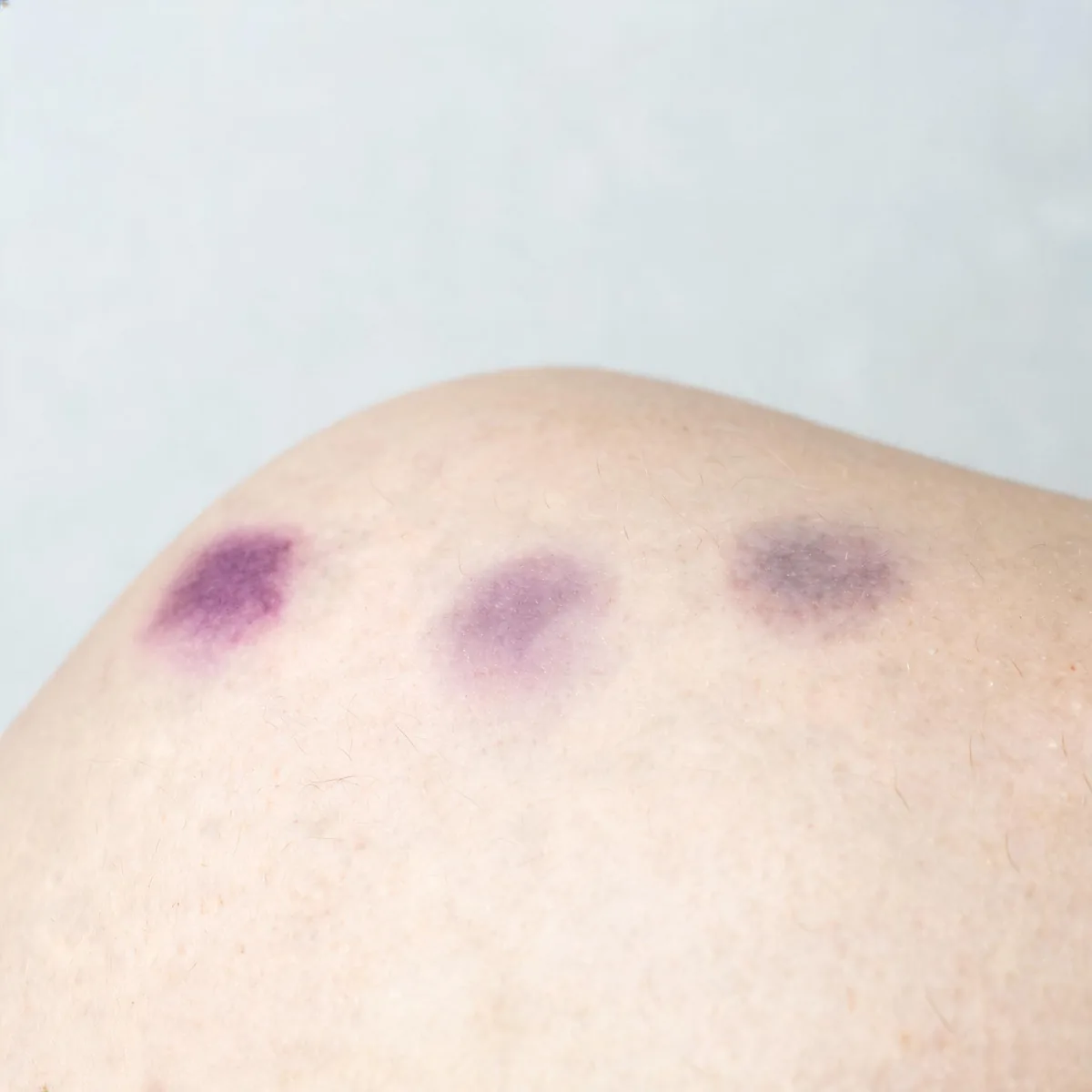
Spleen not controlling Blood is the most common pattern: bruises from minimal pressure or spontaneously, deep dragging fatigue, a pale or sallow complexion, poor appetite, loose stools and heaviness.
Qi deficiency causing Blood stagnation gives dark purplish bruises with little or no trauma, constant fatigue even after rest and a pale complexion with a greyish tinge. Blood Stagnation gives dark purple bruises in fixed locations that are tender and painful with a dusky complexion.
Holding blood inside the vessels is described as an active job rather than a passive one, and the Spleen is the organ given that job. Its Qi keeps the walls of the small vessels competent, so when it thins, vessels leak under the least provocation and a mark appears without a remembered knock. Because the Spleen is also the source of manufactured Qi and Blood, the same weakness shows elsewhere: tiredness that rest does not clear, a poor appetite, loose stools, a pale or sallow face and heaviness in the limbs.
The second thread is movement. Qi pushes blood, so when Qi is insufficient the flow turns sluggish, and sluggish blood both leaks more readily and clears more slowly. A bruise in this picture is usually pale purple rather than black, sits for weeks, and turns up in someone visibly worn out. A third possibility is stagnation without deficiency, where the blood itself is thick and obstructed and the vessel walls are fragile because of it; those marks are dark, fixed and tender. The distinctions matter because the treatments pull in opposite directions. Strengthening the Spleen, warming and moving, and breaking stubborn stasis are not interchangeable, and a strong moving formula given to a depleted person can leave them worse.
It helps to see the tongue and pulse as the tie-breaker. A pale, puffy tongue with a weak pulse favours the Spleen picture, a pale tongue carrying purple spots favours deficiency with stasis on top, and a dusky tongue with a choppy pulse favours stagnation alone. The same three patterns can therefore look identical on the skin and be treated quite differently.
Conventional view
Easy bruising, medically termed purpura simplex, occurs when small blood vessels leak blood into the skin after minimal or no injury. It is often benign and more common in women and older adults, and Western diagnosis involves blood tests to rule out clotting disorders, low platelets or vascular fragility. In many cases no underlying disease is found and the bruising is considered idiopathic.
When no serious condition is present, conventional treatment is limited: doctors may recommend vitamin C or K if deficiency is suspected, or advise avoiding aspirin and other blood-thinning medicines. Otherwise there is no standard therapy to reduce bruising frequency or speed healing.
Western medicine often finds no specific cause after ruling out bleeding disorders, and treatment is usually limited to reassurance or vitamin supplements. This does not address the constitutional weakness or stagnation TCM identifies, and when bruising is linked to fatigue, poor digestion or stress, conventional care may overlook the imbalance that leaves the skin prone to bruising.
Selected PubMed records
Real PubMed records for the conventional discussion above, selected by condition name and title relevance. They are references, not a claim that any treatment is proven for this condition.
- The terminology of skin disorders. Primary Care, 2000. PMID: 10815043.
How it connects
Easy bruising seldom stands alone because the Spleen sits at the centre of several functions: holding blood in the vessels, extracting nourishment from food and producing the Blood that steadies the mind. A weak Spleen therefore tends to bring fatigue, a poor appetite and pallor along with the marks, and anaemia can follow when enough Blood is never made. The same weakness that lets blood seep into the skin can also produce bleeding gums or heavy periods. Insomnia and anxiety are common companions as well, since the Heart needs a steady supply of Blood to steady the mind, and when Spleen Qi fails to produce it the result is restless sleep and palpitations. Treating the root deficiency with a formula such as Gui Pi Tang often improves the bruising, the tiredness, the appetite and the sleep together.
How it is assessed
The practitioner establishes that the bruising is not a medical red flag, then assesses the pattern.
What a practitioner looks for
- Pattern of bruising: bruises from minimal pressure suggest Spleen not controlling Blood.
- Fatigue: deep dragging fatigue supports Qi deficiency.
- Location and tenderness: fixed tender dark bruises suggest Blood Stagnation.
- Red flags: spontaneous large bruises, bleeding gums or nosebleeds, or a family history of bleeding.
The examination starts with the bruises and how they look. Dark, purplish marks in fixed spots that hurt when touched suggest simple stagnation, and the tongue often looks dusky or purple with stasis spots while the pulse feels choppy or wiry. If the marks are pale, arrive without any remembered knock and come with deep tiredness and a poor appetite, the Spleen failing to hold blood is the stronger candidate, with a pale puffy tongue and a thin weak pulse. Where easy bruising sits alongside a washed-out complexion but also dull aches and marks that feel fixed, the reading shifts to Qi deficiency allowing stagnation, with a weak pulse that feels a little rough.
Other bleeding signs then decide the question. Heavy or drawn-out periods, or blood in the stool, suggest the Spleen, while fatigue of long standing with aching limbs leans towards Qi deficiency sitting behind the stagnation. The practitioner asks about medications that thin the blood, about a family history of bleeding, and about bleeding gums or nosebleeds, because widespread or spontaneous bruising belongs with a doctor before it belongs with herbs. Where the cause is unclear, treatment works alongside that assessment rather than instead of it.
TCM patterns in Bruising easily
Three patterns account for most easy bruising, and two of them are deficiency pictures. The task is to establish how much is a failure to contain blood, how much a failure to move it, and how much obstruction on its own. Digestion is the clearest line. When bruising comes with a poor appetite, loose stools, bloating and a dragging tiredness, the Spleen is not holding blood and the deficiency is central. When the person is tired but the digestion is sound and the marks are pale and slow rather than dark, Qi may be too weak to drive the flow. When the marks are dark, fixed and tender in someone robust, stagnation is the whole story. Tenderness helps: stagnant bruises hurt on pressure, deficient ones often do not. The three overlap freely, and an exhausted person with a pale tongue and purple spots carries both halves at once, so treatment supports the root before it moves blood.
| Pattern | Key signs | The itch | Tongue | Main formula |
|---|---|---|---|---|
| Spleen not controlling Blood | Not specified | Not specified | Body: Pale, puffy and tender with teeth marksCoat: Thin white | Not specified |
| Qi Deficiency causing Blood Stagnation | Not specified | Not specified | Body: Pale-dark or pale-purple, teeth-marked, possibly with stasis spots and dark sublingual veinsCoat: Thin white | Not specified |
| Blood Stagnation | Stabbing or fixed pain in the bruised area | Not specified | Body: Purple, dusky or with dark stasis spots; sublingual veins dark and distendedCoat: Often thin white; a yellow coat would suggest Heat as the cause | Not specified |
Spleen not controlling Blood
Bruises from minimal pressure with dragging fatigue and loose stools.
The Spleen is described as holding blood within the vessels, so its Qi acts as the seal on the small vessels. When that Qi is weak the seal fails and blood oozes into the skin under very little pressure. The same weakness means less Qi and Blood are manufactured, so the person is drained, pale and uninterested in food, and the stools are loose. This is the commonest explanation for bruising that appears without a knock in someone who also looks unwell.
The tongue is pale and puffy, tender, with teeth marks at the edges, under a thin white coat, and the pulse is fine and weak, weakest at the right middle position. Overwork, irregular eating, worry, cold raw food and skipped meals all drain the Spleen further, while rest, warm cooked meals, gentle walking and keeping warm support it. Gui Pi Tang is the formula named, with Huang Qi, Dang Shen and Bai Zhu as the key herbs. The points are Zusanli (ST-36), Sanyinjiao (SP-6), Pishu (BL-20) and Xuehai (SP-10).
Signs
- Bruises from minimal pressure or spontaneously
- Deep dragging fatigue and exhaustion
- Pale or sallow complexion
- Poor appetite with loose stools
- Heaviness
Diet and lifestyle for this pattern: Eat warm, cooked meals and avoid raw, cold or iced food that further weakens the Spleen. Rice porridge, sweet potato, squash and small amounts of well-cooked meat are easy to digest and build Blood, while gentle movement such as walking or tai chi keeps Qi circulating without draining you, and rest gives the Spleen time to recover.
Qi Deficiency causing Blood Stagnation
Dark purplish bruises with no trauma and constant fatigue.
Here the weakness is in the propulsion. Blood is carried along by Qi, so when Qi is low the flow becomes sluggish and stagnant blood leaks out beneath the skin, producing marks from injuries so slight they are barely noticed. Because the root is deficiency rather than obstruction, the person is constantly tired even after sleep, pale with a greyish or dusky cast, and short of breath on exertion. The bruising is a symptom of a body that has run short of fuel.
The tongue is pale-dark or pale-purple, possibly with stasis spots and teeth marks, under a thin white coat, and the pulse is deep, fine or weak and choppy. Overwork, emotional strain, cold raw food and long sedentary stretches worsen it, while rest, warm meals and gentle movement rebuild Qi and encourage circulation. Bu Yang Huan Wu Tang is named for this pattern, using Huang Qi to drive blood with Dang Gui and Chuan Xiong to move it. The points are Zusanli (ST-36), Sanyinjiao (SP-6) and Xuehai (SP-10).
Signs
- Bruises appear with little or no trauma, often dark purplish
- Constant fatigue even after rest
- Pale complexion with greyish or dusky tinge
- Shortness of breath
Diet and lifestyle for this pattern: Choose warm cooked food such as congee, soups and stews, with rice, oats, sweet potato and a little lean meat to build Qi. Avoid raw, cold and iced food that weakens digestion, keep movement gentle and daily, and put rest ahead of overwork.
Blood Stagnation
Dark purple tender bruises in fixed locations.
When blood flow is obstructed, the vessel walls themselves become fragile and leak into the surrounding tissue. The pooled blood then sits under the skin as a mark that is dark purple, fixed in one place and tender when touched. Because the problem is obstruction rather than shortage, the person may have good energy and still bruise, and the marks always appear in the same few places.
The tongue is dark purple or dusky with possible stasis spots and distended veins beneath, under a thin white coat, and the pulse is choppy or wiry. Prolonged inactivity, cold exposure and stress all congeal the flow further, while gentle movement, a warm compress and acupuncture unblock it. Xue Fu Zhu Yu Tang is the formula named here, with Dang Gui to nourish and repair, Chuan Xiong to move blood towards the skin and Tao Ren to break up static blood. The points are Xuehai (SP-10), Geshu (BL-17) and Taichong (LR-3).
Signs
- Bruises dark purple in fixed locations
- Bruises tender to pressure
- Stabbing or fixed pain in the bruised area
- Dark or dusky complexion and lips
Diet and lifestyle for this pattern: Keep warm and avoid cold food that congeals Blood. Daily walking or tai chi keeps it moving, and blood-moving food such as turmeric, black fungus and a little vinegar supports circulation.
Treatment approach
How the tradition treats bruising easily, with the herbs, formulas and points used for it.
Principles
- Exclude a bleeding disorder medically first; easy bruising is a symptom that needs a cause.
- Strengthen the Spleen to hold Blood where the pattern is deficiency.
- Move Qi and Blood where stagnation dominates, without over-drying.
- Review medications that increase bleeding risk with the prescriber.
- The root and the branch are handled in sequence or together: blood that is leaking or pooling is settled by whichever measure fits, and the reason it happened is treated underneath. For a Spleen picture the emphasis is on Huang Qi and Dang Shen, with blood moved only gently so as not to scatter it. For Qi deficiency with stagnation, Bu Yang Huan Wu Tang tonifies Qi first and moves blood second. For pure stagnation, Tao Ren and Chuan Xiong are used more freely.
Herbs used
Formulas
Acupoints
What to expect
- The tradition describes gradual improvement over weeks to months with constitutional treatment.
- Underlying bleeding disorders need medical management, not herbs alone.
- Bruising may persist while the cause remains.
- Simple stagnation often responds within two to four weeks, whereas rebuilding a deficient constitution takes one to three months of herbs and acupuncture before the frequency and size of new marks clearly fall, and severe depletion can take three to six months. Fluctuation is expected, with bruising returning during illness, travel or a run of poor sleep. Once the pattern is corrected, occasional maintenance sessions at seasonal changes help hold the gain.
Safety and when to get help
Seek medical help urgently for
- Sudden appearance of many large bruises without injury.
- Bruising with bleeding gums, nosebleeds or blood in urine or stool.
- Bruising with fever, weight loss or feeling very unwell.
For anything severe, sudden or spreading quickly, read when a skin problem needs urgent care.
Cautions
- Easy bruising needs blood tests to exclude platelet and clotting disorders.
- Herbs that move Blood may increase bleeding risk; discuss with a doctor.
- Anticoagulant and antiplatelet medication should be reviewed, not stopped.
Using this alongside conventional care
- This page is complementary: medical assessment of the cause comes first, and herbs must be agreed with the treating doctor where bleeding risk exists.
- Conventional assessment comes first, since easy bruising has causes that herbs do not address: low platelets, a clotting disorder, liver disease or a new medication. Once that has been looked at, TCM can run alongside treatment without interfering. The caution is bleeding risk. Dang Gui, Chuan Xiong and other moving herbs can add to warfarin, aspirin or clopidogrel and other antiplatelet drugs, so the prescriber needs to know what is being taken and doses may need adjusting or particular herbs avoiding. Supplements that affect clotting belong on the same list. Prescribed medicines should never be stopped to accommodate a formula, and any sudden crop of large bruises needs medical review before treatment continues.
Diet and lifestyle
- Eat warm easily digestible food that strengthens the Spleen, such as rice congee and cooked vegetables.
- The general principle is to eat warm, cooked, easily digested food that strengthens the Spleen and supplies the raw material for blood, such as rice congee, sweet potato, squash, well-cooked vegetables, dark leafy greens, a few dates or goji berries, beetroot and small amounts of lean meat or liver where appropriate. Raw, cold and iced food is the main thing to reduce, along with greasy fried dishes and heavy sugar, which are said to create dampness and burden digestion. Pattern additions are straightforward: for a Spleen picture, porridge, sweet potato and squash with nothing chilled; for Qi deficiency with stagnation, congee, oats and a little lean meat to support Qi while gentle movement does the rest; for pure stagnation, turmeric, black fungus and a little vinegar, with warmth rather than cold. Regular meal times matter more than any single food.
If you're pregnant
Pregnancy raises the demand for Blood and Qi and often unmasks a latent Spleen Qi deficiency, so easy bruising can become more pronounced, especially in the second and third trimesters. The Spleen not controlling Blood pattern is the most common cause in pregnancy.
Herbs that strongly move Blood, such as Tao Ren and Hong Hua, are contraindicated because they may stimulate uterine contractions. Formulas such as Gui Pi Tang are generally considered safe under professional guidance, gently tonifying Qi and Blood without moving stagnation aggressively, and acupuncture is a preferred first line, especially in the first trimester, with points such as Zusanli (ST-36) and Sanyinjiao (SP-6) used cautiously.
If you're breastfeeding
Breastfeeding places a continuous drain on the mother's Qi and Blood, so Spleen and Blood deficiency patterns are common and easy bruising may persist or appear for the first time. Treatment still tonifies the Spleen and nourishes Blood.
Most gentle tonics such as Dang Gui and Huang Qi are safe during lactation and can even support milk supply, while strong blood-moving herbs and bitter-cold herbs are avoided because their constituents may pass into milk and affect the infant. Acupuncture is widely used throughout lactation, although trial evidence in this group is limited; treatment should be arranged with a practitioner experienced in postnatal care.
If treating a child
In children easy bruising most often reflects an immature Spleen Qi not yet strong enough to hold Blood in the vessels, the Spleen not controlling Blood pattern, often with picky eating, loose stools and a pale complexion. Because children may not articulate symptoms, practitioners rely on tongue and pulse diagnosis and on parents' observations of energy and appetite.
Doses are reduced to a quarter to a half of the adult dose by age and weight, Gui Pi Tang is often prescribed in a paediatric formulation, and paediatric tuina and gentle acupuncture are effective. Congenital bleeding disorders must be ruled out before treatment begins.
If treating an elderly patient
In older people easy bruising is extremely common and almost always rooted in deficiency: the Spleen and Kidneys weaken with age, leading to Qi deficiency causing Blood stagnation or the Spleen not controlling Blood, and the skin becomes thinner and more fragile so bruises appear with slight contact.
Treatment is gentle, at about two-thirds of the adult dose to avoid overwhelming a weakened digestion, and polypharmacy is a significant concern, so interaction with blood thinners such as warfarin must be screened. Acupuncture is often better tolerated than herbs and can stand alone, though progress is gradual.
Urgent-sign guidance is based on standard sources: NHS anaphylaxis, NHS cellulitis, NHS Stevens-Johnson syndrome, NHS melanoma.
Evidence
Evidence status
Compiled for this page from the classical and modern literature; not a systematic review, so treat it as a pointer to sources rather than clinical guidance.
Direct research on easy bruising as a symptom is scarce. Most evidence concerns diseases where bruising is central, such as immune thrombocytopenia and Henoch-Schonlein purpura. A 2018 systematic review and meta-analysis of TCM for ITP found that herbal medicine, particularly Gui Pi Tang-based formulas, significantly improved platelet counts and reduced bleeding symptoms compared with conventional treatment alone, while noting methodological weaknesses in many trials.
Direct trials of TCM for easy bruising as a symptom barely exist. The research that does exist looks at conditions where bruising is a defining feature, notably immune thrombocytopenia and Henoch-Schonlein purpura, and most of it comes from China. Those studies use formulas such as Xue Fu Zhu Yu Tang and Gui Pi Tang in small randomised trials, with reported improvements in platelet counts, bleeding scores and recurrence rates. The recurring limits are small samples, unclear randomisation and little blinding, and independent replication outside China is rare. Read carefully, the evidence supports these formulas as an adjunct to conventional care in conditions that cause bruising, not as a general treatment for a tendency to bruise.
Studies often cited
Gui Pi Tang-based formulas improved platelet counts and reduced bleeding versus conventional treatment alone, with methodological limits in included trials. 2018 systematic review and meta-analysis (as recorded in the source)
Evaluated in small Chinese randomised trials for ITP and HSP, the conditions where easy bruising is a primary feature. Small randomised controlled trials (as recorded in the source)
Sixty patients with chronic immune thrombocytopenia took modified Gui Pi Tang for three months. Platelet counts rose and bruising and petechiae fell further than in the group given prednisone alone, and the formula was tolerated without serious adverse events. Zhang L, Li H, Wang Y. Chinese Journal of Integrative Medicine. 2012;18(8):607-611.
Eighty patients with recurrent Henoch-Schonlein purpura were randomised to standard care with or without Xue Fu Zhu Yu Tang. The herbal group cleared skin lesions faster and had fewer recurrences of purpura at six month follow up than those given standard care alone. Wang J, Chen X, Liu S. Journal of Traditional Chinese Medicine. 2014;34(3):289-293.
Classical record
In the five exhaustions with extreme emaciation, abdominal fullness and inability to eat - whether from dietary injury, emotional injury, drink injury, sexual injury, hunger injury or overwork - the channels and the protective and nutritive Qi are damaged, causing dry Blood within, scaly skin and dark circles under the eyes.
- Jin Gui Yao Lue, chapter on blood stasis. The Chinese original is not reproduced here: it could not be recovered reliably from the source record, and is not guessed.
Common questions
Why do I bruise so easily?
The classical literature reads it as Spleen Qi failing to hold blood in the vessels. Conventional medicine checks platelets, clotting and medication effects, which should be done first.
Are there herbs that stop bruising?
The tradition describes strengthening the Spleen and Qi. It does not claim to correct a bleeding disorder, and those need medical management.
Should I worry about easy bruising?
Widespread, spontaneous bruising or bruising with other bleeding needs prompt medical review.
Is it related to my medication?
Possibly. Anticoagulants and antiplatelets commonly increase bruising and should be reviewed with your prescriber.
Can acupuncture help with easy bruising?
It can, and it is often the first choice where herbs are a concern. Sanyinjiao (SP-6) and Zusanli (ST-36) are used to build Qi and Blood, and Xuehai (SP-10) to settle stagnant blood. Most people see fewer new marks once a few weeks of regular treatment have passed.
How long does treatment take to reduce the bruising?
It depends on the pattern. Stagnation may ease within a few weeks, while deficiency pictures usually need one to three months of steady herbal treatment and acupuncture before the Spleen and its Blood are rebuilt. The change tends to show first as fewer and smaller new marks rather than as faster fading of old ones.
Are there foods that help stop the bruising?
Warm cooked food that supports the Spleen comes first: congee, soups and stews, with dark greens, red dates, black sesame and goji berries to nourish Blood. Raw and cold food, iced drinks and large amounts of dairy are best reduced because they are said to weaken the Spleen.