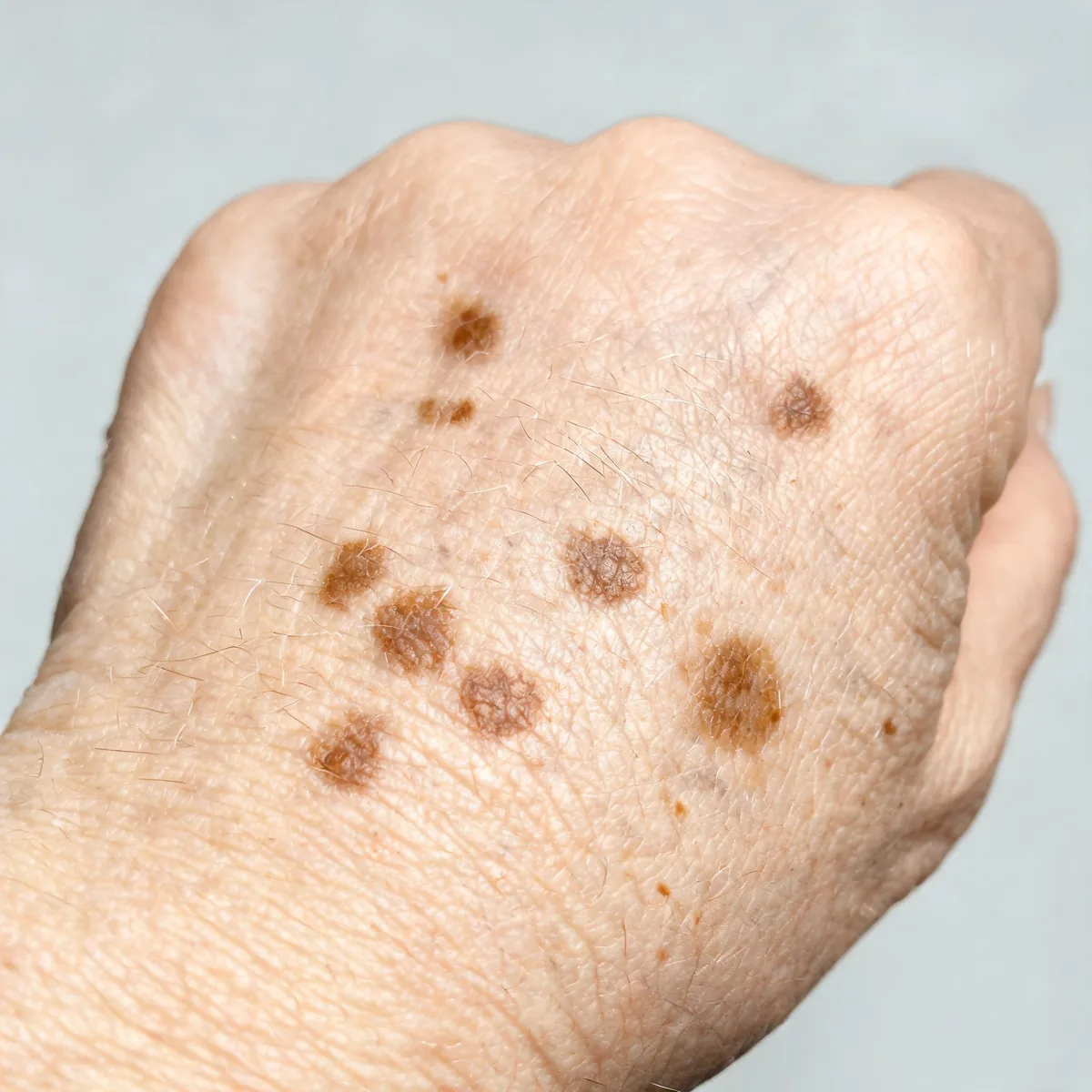
Understanding Age spots
The tradition describes age spots as an outward sign of deeper changes, most often a decline in Kidney and Liver Yin, sluggish Blood circulation, or accumulation of dampness and phlegm.
Kidney and Liver Yin deficiency gives deep-brown spots with a dull dry complexion, dizziness, ringing in the ears, dry eyes, night sweats and heat in the palms and soles. Kidney Yin deficiency with Empty-Heat blazing gives deep brown spots on face and hands with thin dry skin, night sweats and afternoon heat.
Blood stagnation gives dark purplish or brown spots with a dusky complexion and fixed stabbing pain elsewhere. Qi and Blood stagnation gives dark purplish spots with chest tightness, rib distension and irritability. Qi and Blood deficiency gives light-brown spots with pallor, fatigue and dizziness - the lighter, deficiency-driven picture.
Damp-Phlegm gives thick raised spots with a greasy sheen, heavy limbs, sticky loose stools and brain fog. Raised spots with a greasy sheen are exactly the kind that need dermatological review rather than a herbal diagnosis.
Age spots are read as the visible edge of changes that take years: the thinning of the body's cooling and moistening reserves, a circulation that moves more slowly, and the slow accumulation of turbid fluids. None of these produces an isolated blemish. Each alters the condition of the skin as a whole, which is why the marks appear where sun and age have already thinned the surface, and why they multiply rather than arrive singly.
The spot itself therefore becomes a diagnostic object. A dry, deep brown mark points to depletion of Yin, a dark purplish one to blood that has stopped moving, and a thick raised mark with a greasy sheen to phlegm congesting the fine channels. Treatment follows that reading rather than the appearance alone, aiming to restore the systems that keep skin supple, so fading is expected as a consequence rather than as the target.
Conventional view
Age spots, also called solar lentigines or liver spots, are harmless flat patches of darkened skin that appear most often on the face, hands, shoulders and arms, the areas that collect the most sun over a lifetime. They come from overproduction of melanin as skin ages and is repeatedly exposed to ultraviolet light. A doctor usually recognises them on sight; they are benign and need no treatment, though many people seek to fade them for cosmetic reasons.
Conventional options focus on lightening or removing the visible spots: topical creams with hydroquinone, retinoids or mild steroids, and procedures such as cryotherapy, laser therapy, intense pulsed light and chemical peels. These can fade existing spots but do not stop new ones forming, and sun protection is always advised alongside.
Most of these treatments address the spot, not the reason it appeared. They can cause temporary redness, peeling or even post-inflammatory hyperpigmentation, especially in darker skin tones, spots often return if sun protection is imperfect, and the ageing process behind them, gradual decline in cellular renewal and accumulated oxidative stress, continues untouched.
Selected PubMed records
Real PubMed records for the conventional discussion above, selected by condition name and title relevance. They are references, not a claim that any treatment is proven for this condition.
- Treatment of Solar Lentigines: A Systematic Review of Clinical Trials.. Journal of cosmetic dermatology, 2025. PMID: 40145274.
- Sun-induced freckling: ephelides and solar lentigines.. Pigment cell & melanoma research, 2014. PMID: 24517859.
How it connects
Age spots are usually the visible edge of a wider picture. Deep brown patches with lower back ache, tinnitus and night sweats point to Kidney Yin deficiency, the same exhaustion of cooling and moistening reserves that disturbs sleep and weakens the bones and ears. Lighter spots with heavy fatigue suggest Qi and Blood deficiency, where poor Spleen transformation leaves the skin dull and the bowels slow. Purplish spots in a stressed, irritable person point to Qi and Blood stagnation, with chest tightness and mood swings sharing the Liver Qi blockage that leaves blood stuck at the surface. Read together, these clusters tell a practitioner where to begin rather than what to treat one by one. When the spots and the fatigue improve on the same formula, the underlying deficiency was the right target; when the complexion brightens as the stools firm up, the Spleen was the bottleneck. This is also how progress is judged in a condition where the visible change is slow, since better sleep, steadier energy and less back soreness usually move first. Treating the root is expected to help the skin and the accompanying complaints together, and a lack of movement in either is a signal to reconsider the pattern.
How it is assessed
The practitioner checks the lesion first, then the constitutional pattern.
What a practitioner looks for
- Spot quality: flat brown spots are typical; raised, greasy or irregular spots need medical review.
- Colour: light brown suggests deficiency; dark purplish suggests stagnation.
- Constitutional signs: dizziness and night sweats suggest Yin deficiency; brain fog and heaviness suggest phlegm.
- Red flags: rapid change, irregular borders, multiple colours or bleeding.
The practitioner starts with colour and texture, then asks about heat. Deep brown marks with hot palms, night sweats and a dry mouth place the case in the Yin deficiency group. Within that group the balance of signs decides which one. Drenching sweats, a flushed face and a tongue that is red with almost no coating indicate Kidney Yin deficiency with Empty-Heat blazing, whereas dizziness, dry eyes and a sore lower back with only occasional night sweats point to Liver and Kidney Yin deficiency together, the common picture as both systems decline.
Marks that are distinctly dark purple, or that feel fixed and stubborn, suggest stagnation. If chest tightness, irritability or a stressful stretch clearly came first, the diagnosis is Qi and Blood stagnation, with Liver Qi stuck and Blood unable to follow it. If no emotional trigger is obvious but the tongue shows purple stasis spots and the pulse is choppy, the reading shifts to Blood stagnation, where sluggish circulation is itself the driver.
Pale, light brown marks in someone drained, pale-faced and with a weak pulse indicate a shortage of Qi and Blood, in which the face is simply not being nourished; this matters because the treatment is tonifying rather than moving or cooling. Thick, raised or greasy-looking marks, with a heavy body, a thick tongue coat and sticky stool, point to Damp-Phlegm, where a weak Spleen cannot manage fluids. A spot that is changing colour, bleeding, itching or growing quickly is not a pattern question and needs dermatological review.
TCM patterns in Age spots
Differentiation in age spots rests on three things that can be seen or asked about: the shade of the mark, its texture, and the constitution carrying it. Shade separates congestion from depletion, with deep brown marks on dry thin skin pointing to deficiency, pale light-brown marks to a shortage of Qi and Blood, and dark purplish marks to blood that has stopped moving. Texture adds a layer, since a mark that is thick, raised and greasy sits on phlegm rather than on simple stasis. The third layer is what accompanies the skin: heat in the palms and soles, night sweats and lower back soreness favour a Yin pattern; fatigue, pallor and dizziness favour a shortage of Qi and Blood; chest tightness, irritability and fixed stabbing pain favour constraint; heaviness, sticky stool and brain fog favour dampness. Patterns differ in tempo as well, blockage clearing faster than depletion rebuilds.
| Pattern | Key signs | The itch | Tongue | Main formula |
|---|---|---|---|---|
| Kidney and Liver Yin Deficiency | Deep-brown spots with a dull dry complexion; Dry eyes and blurred vision | Not specified | Body: Red, thin and dry, often crackedCoat: Little or none; the tongue may look peeled | Not specified |
| Kidney Yin Deficiency With Empty-Heat Blazing | Skin looks dry and thin | Not specified | Body: Red, thin and dry, often crackedCoat: Little or none | Not specified |
| Blood Stagnation | Fixed stabbing pain elsewhere | Not specified | Body: Purple, dusky or with dark stasis spots; sublingual veins dark and distendedCoat: Often thin white; a yellow coat would suggest Heat as the cause | Not specified |
| Qi And Blood Stagnation | Chest tightness or distending rib pain | Not specified | Body: Purple or dark, with stasis spots; sublingual veins dark and distendedCoat: Thin white | Not specified |
| Qi and Blood Deficiency | Not specified | Not specified | Body: Pale, possibly thin or with teeth marksCoat: Thin white | Not specified |
| Damp-Phlegm | Not specified | Not specified | Body: Pale, swollen and teeth-marked, wet-lookingCoat: Thick, white and greasy | Not specified |
Kidney and Liver Yin Deficiency
Deep brown spots with a dry complexion and night sweats.
Kidney essence and Liver blood are the deep reserves that keep skin supple, and both thin with age. When they fall, the face loses its source of moisture, the complexion turns dry and dull, and pigment settles into deep brown marks. Because the shortage is systemic, the marks arrive with dizziness, ringing ears, dry eyes, night sweats and a sore lower back rather than on their own.
The tongue is red and thin, cracked and dry with little or no coating, and the pulse is fine, rapid and a little wiry, and it is weak at the Kidney position. Overwork, late nights, spicy or fried food, chronic stress and hot dry weather worsen it, while sleep, a temperate climate, moistening foods and gentle regular movement help. Liu Wei Di Huang Wan is the foundation, with Er Zhi Wan often added, and KI-3 Taixi, SP-6 Sanyinjiao, BL-23 Shenshu and BL-18 Ganshu are the points.
Signs
- Deep-brown spots with a dull dry complexion
- Dizziness and ringing in the ears
- Dry eyes and blurred vision
- Night sweats and heat in palms and soles
Diet and lifestyle for this pattern: Build Yin with black sesame, walnuts, goji berries, mulberries and eggs. Avoid spicy, fried and very heating food that burns through fluids, keep hydrated with warm water or mild herbal teas, protect rest, and choose gentle exercise such as tai chi or yoga over hard training.
Kidney Yin Deficiency With Empty-Heat Blazing
Deep brown spots on thin dry skin with afternoon heat.
Here the decline of Kidney Yin has gone far enough that the cooling reserve no longer holds heat down. Empty-heat rises and scorches the surface, so the complexion becomes thin and dry and deep brown marks form on the face and hands. The same heat disturbs the interior, producing night sweats, heat in the palms and soles, restlessness and waking in the night, with a dry throat and thirst for small sips.
The tongue is red, thin and dry with little or no coating, sometimes cracked, and the pulse is fine and rapid. Overwork, late nights, spicy or fried food, frustration, hot weather or saunas and excessive sexual activity aggravate it, while a cool quiet room, adequate rest, pear and black sesame, and gentle exercise that does not cause sweating relieve it. Zhi Bai Di Huang Wan clears the deficiency heat while nourishing Yin, and KI-3 Taixi, BL-23 Shenshu and SP-6 Sanyinjiao are the points.
Signs
- Deep brown spots on face and hands
- Skin looks dry and thin
- Night sweats and afternoon heat
- Hot palms and soles with low back soreness
Diet and lifestyle for this pattern: Concentrate on cooling, moistening food such as pear, cucumber, tofu, black sesame and goji berries, and avoid spicy, fried and warming food that stokes empty-heat. Hold to a consistent bedtime, because late nights deplete Kidney Yin, and keep movement gentle so it circulates without overheating.
Blood Stagnation
Dark purplish spots with a dusky complexion.
Circulation slows with age, particularly when Qi is not moving freely. Waste and pigment that should be carried away instead settle in the skin, and because the congestion is fixed rather than shifting, the marks are dark and purplish or brown while the complexion looks dusky. This is often the final common route by which other imbalances, whether constraint or deficiency, end up producing visible spots.
The tongue is dark purple with stasis spots and distended dark sublingual veins, and the pulse is choppy or wiry. Long sitting, cold weather or cold food, frustration and heavy greasy meals worsen it, while gentle daily movement, warmth, turmeric or ginger in cooking, and massage or gua sha ease it. Tao Hong Si Wu Tang moves the Blood, and SP-10 Xuehai, BL-17 Geshu and LR-3 Taichong are the points.
Signs
- Dark purplish or brown spots
- Dark or dusky facial complexion
- Fixed stabbing pain elsewhere
- Dark menstrual blood with clots
Diet and lifestyle for this pattern: Keep blood moving with daily walking, tai chi or yoga and avoid long stretches of sitting. Choose warming, blood-nourishing food such as dark leafy greens, beetroot and a little turmeric or ginger in cooking, stay hydrated with warm fluids, and go easy on cold raw food that can congeal blood.
Qi And Blood Stagnation
Dark purplish spots with chest tightness and irritability.
Emotional tension that never resolves stops the Liver from keeping Qi in smooth motion. Blood depends on that motion, so it too stalls, and dark purplish pigment is deposited in the skin. The same blockage shows above the diaphragm as chest tightness or distending rib-side pain, and in the mood as irritability and swings, with dark lips and a purplish cast to the complexion.
The tongue is purple or dark with stasis spots and distended sublingual veins, and the pulse is wiry and choppy. Stress, long sitting, greasy heavy meals and suppressed emotion worsen it, while gentle exercise, stress reduction, a warm compress on the abdomen and slow breathing relieve it. Tao Hong Si Wu Tang is the primary formula, usually with Liver-soothing additions such as Chai Hu and Xiang Fu, and LR-3 Taichong, LI-4 Hegu and SP-10 Xuehai are the points.
Signs
- Dark purplish spots on face and hands
- Chest tightness or distending rib pain
- Irritability or mood swings
- Worse with emotional stress
Diet and lifestyle for this pattern: Stay gently active with walking, yoga or tai chi, and unwind through meditation or slow breathing. Eat dark leafy greens, turmeric and small amounts of black vinegar to nudge Blood along, and avoid heavy greasy meals that weigh digestion down and add to the stagnation.
Qi and Blood Deficiency
Light-brown spots with pallor and fatigue.
Qi and Blood are the body's basic nourishment, and when they run short the skin loses its lustre and cannot renew itself. The Spleen fails to make enough of either to reach the face, so pale light-brown marks appear where circulation is weakest. Unlike stasis, nothing is congested here, which is why the marks stay light rather than dark or purple, and why fatigue and a pale complexion dominate the picture.
The tongue is pale, sometimes thin or tooth-marked, with a thin white coat, and the pulse is fine and weak, especially at the right middle position. Overwork and exhaustion, skipped meals, raw or cold food and prolonged stress worsen it, while rest, warm cooked meals, blood-nourishing foods such as red dates and liver, and gentle walking help. Ba Zhen Tang tonifies Qi and Blood, often with Ejiao and Huang Qi added, and ST-36 Zusanli, SP-6 Sanyinjiao and REN-6 Qihai are the points.
Signs
- Light-brown spots, not dark or purple
- Pale or sallow complexion
- Persistent fatigue and weakness
- Dizziness or light-headedness
Diet and lifestyle for this pattern: Eat warm, nourishing food such as red dates, black sesame, walnuts and iron-rich greens, and avoid raw or cold food that weakens the Spleen. Keep exercise gentle and regular, and put rest and recovery ahead of overwork.
Damp-Phlegm
Thick raised spots with a greasy sheen and brain fog.
A weak Spleen does not transform fluids, and they gather first as internal Dampness and then as Phlegm. This turbid material obstructs the channels and collaterals of the face, so Qi and Blood stall behind it and the marks that form are thick, raised and greasy-looking rather than flat. It is seen most often in people carrying extra weight with a sluggish metabolism, and the heaviness, brain fog and sticky stools belong to the same accumulation.
The tongue is pale and swollen with teeth marks under a thick white greasy coat and a wet surface, and the pulse is slippery, like beads rolling in oil, sometimes soggy at the right middle position. Humid weather, overeating, greasy or sweet food, long sitting and late-night meals worsen it, while light warm meals, moderate exercise, a dry environment and regular meal times help. Er Chen Tang dries Dampness and transforms Phlegm, Gui Zhi Fu Ling Wan is added where the spots are thick and raised, and ST-40 Fenglong, ST-36 Zusanli, SP-9 Yinlingquan and LI-4 Hegu are the points.
Signs
- Thick raised spots with a greasy sheen
- Heavy sensation in limbs and body
- Sticky or loose stools
- Brain fog
Diet and lifestyle for this pattern: Choose warm, cooked, light meals and go easy on dairy, greasy, sweet and raw cold food, which all feed Dampness. Barley, adzuki beans and winter melon help drain it, and gentle daily movement keeps Qi from stagnating.
Treatment approach
How the tradition treats age spots, with the herbs, formulas and points used for it.
Principles
- Have any changing or raised spot assessed dermatologically before treatment.
- Nourish Kidney and Liver Yin where the spots are deep with dry thin skin.
- Move Blood and resolve stasis where spots are dark purple.
- Transform phlegm where the spots are raised with a greasy sheen, alongside medical review.
- Treatment works on two levels at once: internal rebalancing through a formula, and local stimulation through needling or a topical application, with the shared aim of restoring the free movement of Qi and Blood in the face. Which comes first depends on the pattern. Deficiency calls for nourishment of Kidney and Liver Yin or for building Qi and Blood, while stagnation calls for moving Qi, invigorating Blood and resolving Phlegm. Because deficiency and stagnation usually coexist, most formulas are built to do both, nourishing the root while gently moving what has settled, and the proportions are adjusted as the spots respond. Any mark that is raised, changing or bleeding is examined medically before it is needled or treated cosmetically.
Herbs used
Formulas
- Liu Wei Di Huang Wan
- Er Zhi Wan
- Zhi Bai Di Huang Wan
- Tao Hong Si Wu Tang
- Ba Zhen Tang
- Er Chen Tang
- Gui Zhi Fu Ling Wan
Acupoints
- KI-3 (Taixi)
- SP-6 (Sanyinjiao)
- BL-23 (Shenshu)
- BL-18 (Ganshu)
- SP-10 (Xuehai)
- BL-17 (Geshu)
- LR-3 (Taichong)
- LI-4 (Hegu)
- ST-36 (Zusanli)
- qihai-ren-6
- ST-40 (Fenglong)
- SP-9 (Yinlingquan)
What to expect
- The tradition describes gradual change over months; most age spots persist.
- Cosmetic removal remains a conventional option.
- Any spot that changes needs review rather than treatment by assumption.
- Weekly sessions are common for the first six to eight weeks, with a daily formula alongside, and the interval lengthens to fortnightly or monthly as things settle. Progress tends to arrive in a fixed order: the skin feels better hydrated and sleep improves, then new spots stop appearing, and only after that do existing marks lighten. Topical herbal pastes or masks may be added to support the process. Because the marks took years to form, a course of months is normal, and the realistic aim is fewer new spots and a more even complexion rather than the disappearance of every mark.
Safety and when to get help
Seek medical help urgently for
- A spot that changes colour, size or shape rapidly.
- A spot that becomes very dark, develops irregular borders or multiple colours.
- A spot that bleeds, itches or crusts.
For anything severe, sudden or spreading quickly, read when a skin problem needs urgent care.
Cautions
- Any changing lesion needs dermatological assessment.
- Sun protection limits new spots.
- Do not use unregulated lightening creams.
Using this alongside conventional care
- TCM is described as complementary to conventional care: dermatological assessment comes first, with herbs for the constitutional pattern.
- Topical creams and daily sunscreen can be continued alongside herbal formulas and acupuncture, since the two approaches do not compete for the same ground. Where prescription retinoids, laser treatment or a peel are planned, both the dermatologist and the TCM practitioner should know, because herbs that invigorate Blood, such as Dang Gui and Tao Ren, may in theory raise the risk of bruising or bleeding around an invasive procedure, and the formula can be paused briefly around those dates. A full list of medicines and supplements should go to both clinicians, and no prescribed treatment is stopped abruptly.
Diet and lifestyle
- Emphasise foods that build Yin and Blood and keep circulation moving, with deeply coloured vegetables and whole grains.
- A skin-friendly way of eating in this framework builds Yin and Blood while keeping circulation moving. That means deeply coloured vegetables, black sesame, walnuts, goji berries and a moderate amount of good-quality protein, with meals cooked and warm so the Spleen can turn them into nourishment without extra work. Greasy, fried and heavily spiced food is limited because it generates Dampness or Heat and can deepen pigmentation, and alcohol and smoking are best avoided since they draw down Yin and leave Blood stagnant. Pattern modifies the detail: cooling moistening foods for Yin deficiency, a little turmeric and ginger for stasis, and no raw or cold food where the Spleen and Yang are weak.
If treating an elderly patient
Age spots are by definition a condition of ageing, so treatment in older people has to respect the predominance of deficiency. Kidney Yin and Kidney Essence decline naturally, and even where Blood stasis or Damp-Phlegm is present, the root is almost always a deficiency that cannot sustain vigorous circulation.
Strong blood-moving herbs such as Tao Ren and Hong Hua are used cautiously and at lower doses, generally about two-thirds of the adult dose, to avoid injuring Qi and Blood further. Polypharmacy is a real concern, since many older patients take blood thinners, so herbs that strongly invigorate Blood such as Dan Shen and Chuan Xiong need careful monitoring.
Acupuncture and gentle external therapies such as gua sha or herbal masks are often better tolerated and can be used first. The timeline is longer, with noticeable improvement taking three to six months of consistent care, and the aim is often to slow progression and improve skin vitality rather than erase the spots.
Urgent-sign guidance is based on standard sources: NHS anaphylaxis, NHS cellulitis, NHS Stevens-Johnson syndrome, NHS melanoma.
Evidence
Evidence status
Compiled for this page from the classical and modern literature; not a systematic review, so treat it as a pointer to sources rather than clinical guidance.
The evidence is modest: small trials and case series, mainly in Chinese-language journals, often combining a formula with acupuncture or external masks. Reported outcomes are reduced spot size and improved colour, but most studies lack blinding, placebo controls and standardised measures, so confidence is low.
The record for age spots is thin, and it is honest to say so. What exists consists of small trials and case series, largely in Chinese-language journals, often testing a formula such as Liu Wei Di Huang Wan or Tao Hong Si Wu Tang alongside acupuncture or an external herbal mask, and reporting smaller and lighter marks. Reviews covering cosmetic needling suggest that treating the face together with body points may improve skin texture and pigmentation, while rating the overall quality of evidence as low. No large randomised trial with objective skin measurement is named in the material behind this page, so the case rests on consistent clinical observation rather than on proven effect.
Studies often cited
Studies of Liu Wei Di Huang Wan and Tao Hong Si Wu Tang, usually combined with acupuncture or external herbal masks, report smaller spots and improved colour. Small clinical trials and case series (as recorded in the source)
Systematic reviews of acupuncture for facial rejuvenation describe local needling effects on circulation and skin appearance, while noting weak study design. Systematic reviews (as recorded in the source)
Classical record
Dark facial spots arise when Kidney water is deficient and cannot control fire, and blood is weak and unable to nourish the flesh, causing fire to dry and congeal into black spots.
- Wai Ke Zheng Zong (Orthodox Manual of External Diseases), chapter on facial pigmentation. Paraphrased in our own words; the Chinese original is not reproduced because the source record could not be relied on for the characters.
Common questions
Are age spots dangerous?
Most are benign, but any spot that changes rapidly, bleeds, or has irregular borders needs checking.
Can herbs fade them?
The tradition describes nourishing Yin and moving Blood, with gradual change over months; most spots persist.
Why do they appear with age?
The classical literature reads them as declining Kidney and Liver Yin plus slower Blood circulation.
Should I use sun protection?
Yes. Sun exposure drives new spots in both frameworks.
Does treatment have to include needles in the face?
Not necessarily. Fine needles are sometimes placed around the marks themselves to encourage local circulation, but most of the work is done on points of the legs, feet and back, which address the organ imbalance behind the spots. Facial needling is gentle and seldom painful, and it is used as an addition rather than as the core of treatment.
How does TCM sit alongside creams or laser work?
Usually without difficulty. Creams and daily sun protection sit comfortably alongside herbs and acupuncture. If a laser or chemical peel is planned, tell both the dermatologist and the TCM practitioner, because some Blood-moving herbs can increase bruising and the formula may be paused for a few days around the procedure. Nothing prescribed should be stopped without the prescriber's agreement.
Do the marks return once treatment stops?
Some can, because ageing continues and the triggers do not disappear. Correcting the underlying pattern makes fresh spots less likely and slows the ones already present, but a return to poor sleep, a stagnant routine or unprotected sun will eventually produce new pigment. Many people keep a maintenance formula or occasional sessions, and treat sun protection as a permanent habit rather than as part of a course.