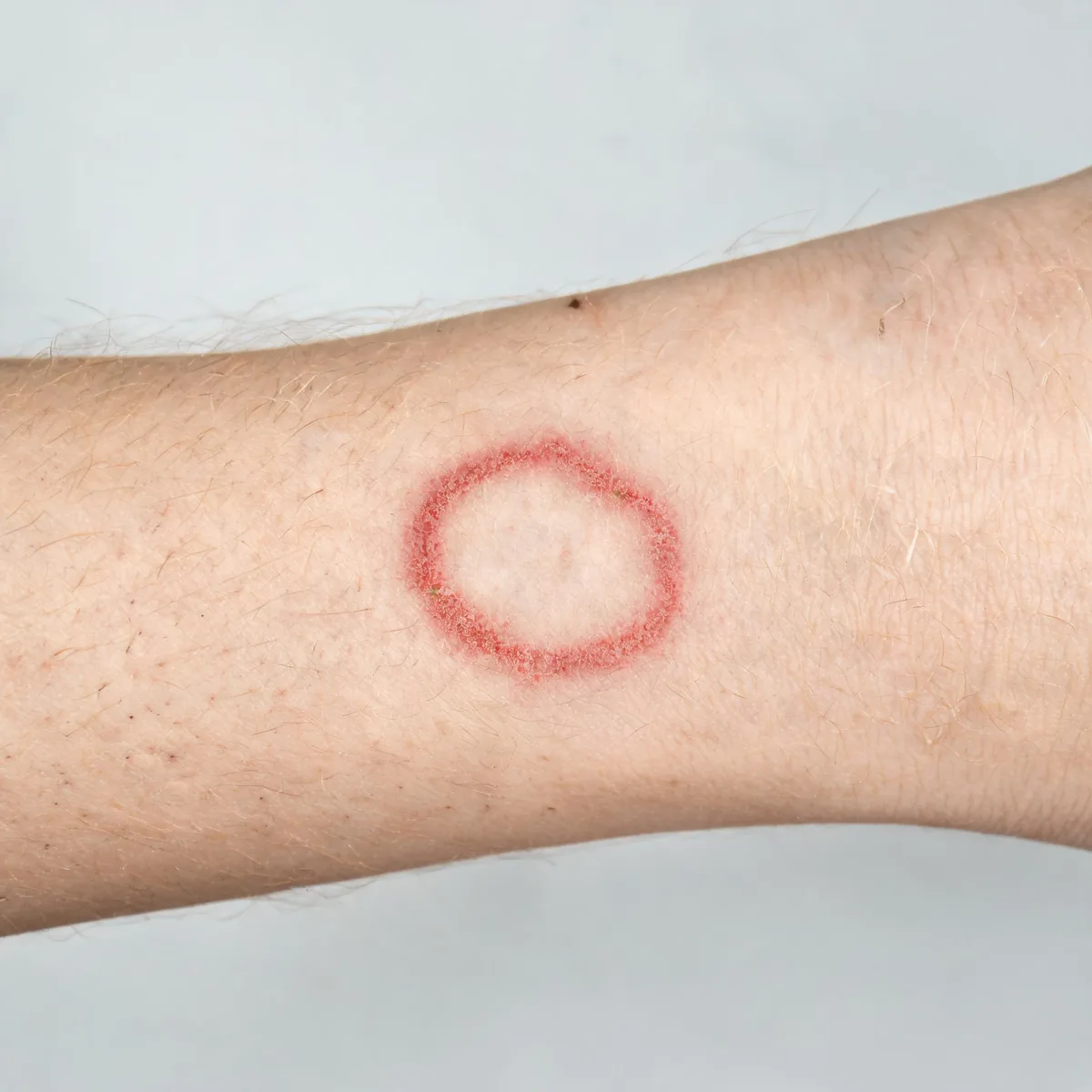
Understanding Fungal infection
A source collision is recorded rather than resolved: this page and the Tinea page both carry the Chinese name 癣 (xuǎn). This page covers fungal infection generally; the Tinea page covers the ringworm-type presentation.
The tradition describes a fungal infection as a visible sign that the internal environment has become hospitable to pathogens, usually through accumulated dampness and heat, with the Spleen at the centre of fluid transformation.
Damp-Heat gives oozing of clear or yellow fluid, macerated soggy skin in folds or between the toes, yellowish crusting and worsening in hot humid weather. Heat in the Blood gives bright red well-defined itchy patches with burning and internal heat.
Blood deficiency with external wind gives dry rough scaly patches with night itch and a pale complexion. Blood stagnation gives dark purplish thickened leathery plaques that do not spread. Spleen deficiency with dampness gives recurrent infections in moist folds with loose stools and bloating, and Toxic-Heat gives widespread redness, pus-filled blisters and fever, which needs urgent care.
The practical consequence is that two rashes which look alike under a lens may need opposite strategies, because one is fed by damp heat and the other by dryness and thin Blood. A practitioner therefore treats the terrain as well as the visible patch, pairing an internal formula with an external wash or soak so that the surface is calmed while the internal imbalance is corrected. Recurrence is described as far less likely when that second step is taken.
The classical literature also separates an acute hot presentation from a chronic dry one. In the first, dampness and heat dominate and the skin weeps; in the second, dryness and depletion dominate and the skin scales. Between them sits a third possibility, stagnation, where thickened dark plaques stop responding to treatment that only clears heat or dampness. Which of these is present, and whether the Spleen is failing behind it, decides the formula.
Conventional view
Fungal skin infections are caused by dermatophytes, yeasts and moulds that digest keratin in skin, hair and nails. Athlete's foot and ringworm are the familiar forms, along with jock itch and candidiasis. They usually show as patches that are red, scaly and itchy, frequently with a raised edge, and may crack or weep between the toes and in skin folds. A doctor may confirm the diagnosis by examining a skin scraping under a microscope or sending it for culture.
Treatment is with antifungal creams, ointments and powders applied to the skin, which kill the organism or slow its growth, and with oral antifungals for extensive, stubborn or nail involvement, sometimes for weeks or months. Clean, dry skin is the mainstay of prevention, alongside not sharing towels and avoiding shared damp surfaces such as changing-room floors.
The limits are important. Creams and tablets clear the visible infection but do not explain why one person is reinfected while another is not, and recurrence is common, particularly where the constitution is damp or immunity is reduced. Topical agents penetrate thick scaly plaques poorly, and prolonged oral treatment puts strain on the liver. The conventional model treats the organism as the whole problem, which leaves the internal conditions that permitted it unaddressed.
Selected PubMed records
Real PubMed records for the conventional discussion above, selected by condition name and title relevance. They are references, not a claim that any treatment is proven for this condition.
- Diagnosis and treatment of dermatophytosis in dogs and cats.: Clinical Consensus Guidelines of the World Association for Veterinary Dermatology.. Veterinary dermatology, 2017. PMID: 28516493.
How it connects
Fungal infections of the skin often do not occur in isolation. When the Spleen is weak and fails to transform fluids properly, internal Dampness accumulates, and the same Dampness can show on the skin as a fungal rash while also causing bloating and a heavy, tired feeling; the root imbalance is Spleen Qi deficiency with Dampness, which creates the environment for fungus to thrive inside and out. Many people with recurrent fungal infections also report afternoon fatigue and heaviness, a classic sign of Dampness obstructing the flow of Qi: the Spleen's energy is lowest in the afternoon, so the sluggishness becomes more pronounced. Treating the Spleen and draining Dampness clears the skin and restores energy and digestive comfort together.
How it is assessed
The practitioner examines moisture, scale and distribution, and asks about recurrence.
What a practitioner looks for
- Moisture: soggy macerated skin suggests Damp-Heat; dry scaly patches suggest Blood deficiency.
- Colour: bright red spreading patches suggest Heat in the Blood; dark leathery plaques suggest stagnation.
- Recurrence: repeated infections in moist folds point to Spleen deficiency.
- Red flags: widespread redness, pus or fever suggests bacterial superinfection.
The examination starts with the skin itself: how moist or dry it is, where the rash sits, how sharply its edge is defined, and whether it weeps, crusts, scales or has thickened. Distribution matters as much as appearance, since folds, groin and toe webs point to dampness while dry exposed patches point to depletion.
Tongue and pulse confirm what the skin suggests. A red tongue carrying a thick yellow greasy coat, with a slippery rapid pulse, supports Damp-Heat; a deep red tongue with a thin dry yellow coat and a rapid pulse supports Heat in the Blood; a pale thin tongue with a fine pulse supports Blood deficiency with Wind; a purple tongue with distended sublingual veins and a choppy pulse supports stagnation.
Recurrence is a diagnostic clue in its own right. Someone who clears repeatedly and relapses, especially with bloating, loose stools and tiredness, is read as Spleen deficiency with dampness rather than as a purely local infection. Widespread redness with pus, fever or facial swelling is not a pattern question at all, and needs urgent medical assessment.
TCM patterns in Fungal infection
Six patterns are described for fungal infection, and they are not variations on one theme so much as different starting points. Three are excess patterns built on moisture and heat: Damp-Heat, where the skin weeps and macerates; Heat in the Blood, where bright red patches spread quickly; and Toxic-Heat, where redness is widespread and pustules form. The other three explain why an infection lingers: Blood deficiency with external Wind, where dry scaly skin cracks and itches; Blood Stagnation, where plaques thicken and darken; and Spleen deficiency with dampness, where recurrence follows from weak fluid transformation. Differentiation rests on moisture, colour, border, itch timing, and the tongue and pulse. One person can move between patterns as the infection dries out or flares, which is why the formula is reviewed rather than fixed.
| Pattern | Key signs | The itch | Tongue | Main formula |
|---|---|---|---|---|
| Damp-Heat | Skin oozes clear or yellow fluid; Macerated soggy skin in folds or between toes | Not specified | Body: Red, often swollen with teeth marksCoat: Yellow, greasy and thick, usually in the middle and at the root | Not specified |
| Heat in the Blood | Bright red well-defined patches appearing quickly | Intense itching with burning | Body: Deep red, often with red points or pricklesCoat: Thin, yellow and dry | Not specified |
| Blood Deficiency with External Wind | Dry rough or scaly skin patches | Itching worse at night or when tired | Body: Pale and thin, sometimes slightly dryCoat: Thin, white and a little dry | Not specified |
| Blood Stagnation | Dark purplish thickened plaques; Lesions feel hard or leathery | Itch worse at night | Body: Purple, dusky or with dark stasis spots; sublingual veins dark and distendedCoat: Often thin white; a yellow coat would suggest Heat as the cause | Not specified |
| Spleen Deficiency with Dampness | Recurrent fungal infections in moist skin folds | Not specified | Body: Pale and swollen, often with teeth marks along the edgesCoat: White, greasy and moist, thick in the middle | Not specified |
| Toxic-Heat | Widespread redness and burning pain; Pus-filled blisters or pustules | Not specified | Body: Red, often with raised red pointsCoat: Yellow, dry, sometimes thick | Not specified |
Damp-Heat
Oozing macerated skin in folds, worse in humid weather.
Dampness and heat arrive together, either from a diet of greasy, sweet and spicy food that overloads the Spleen or from a hot humid climate the body cannot shed. The two combine into a turbid, sticky quality that sinks to the warm folds of the body, so the groin, the armpits and the spaces between the toes are affected first. Dampness softens and macerates the skin, heat reddens it, and the itch is intense but relieved by cooling.
The tongue is red with a thick yellow greasy coat that is hard to scrape, and the pulse is soggy and rapid, or slippery and rapid when heat dominates. Humidity, sweat and heavy meals worsen it, while a dry cool room, breathable cotton and bitter foods ease it. Long Dan Xie Gan Tang drains damp heat from the Liver and Gallbladder, Er Miao San gives a simpler drying base, and Long Dan Cao and Huang Qin carry most of the clearing. SP-9 (Yinlingquan), SP-6 (Sanyinjiao) and ST-40 (Fenglong) are the points chosen.
Signs
- Skin oozes clear or yellow fluid
- Macerated soggy skin in folds or between toes
- Yellowish crusting or sticky scales
- Worse in hot humid weather or after sweating
Diet and lifestyle for this pattern: Avoid greasy, fried, sugary and dairy-rich food that creates internal Dampness, and cut out alcohol and spicy food that add Heat. Eat cooling, drying food such as barley, mung beans, celery and bitter greens, keep affected skin clean and dry in loose breathable cotton, change out of sweaty gear promptly, pat dry after bathing rather than rubbing, and avoid thick occlusive ointments that trap moisture.
Heat in the Blood
Bright red well-defined patches with burning itch.
Here heat has moved inward from the surface and entered the blood level, where it agitates the Blood and pushes it outward. Patches appear quickly, are bright red and well defined, and burn as well as itch. Heat makes the Blood move recklessly, so the flare spreads fast, and it is worst at night, when Yin should be at its fullest but is overwhelmed by internal fire.
A deep red tongue, sometimes with red prickles and a thin dry yellow coat, together with a rapid pulse that is wiry or slippery, supports the pattern. Spicy food, alcohol, coffee and anger all feed it, while a cool room, cold compresses and light meals calm it. Qing Ying Tang cools the nutritive level and clears heat from the Blood, with Mu Dan Pi and Chi Shao cooling the Blood and resolving the red patches, and treatment uses SP-10 (Xuehai), DU-14 (Dazhui) and SP-6 (Sanyinjiao).
Signs
- Bright red well-defined patches appearing quickly
- Intense itching with burning
- Internal heat worse at night
- Thirst for cold drinks
Diet and lifestyle for this pattern: Eat cooling, Yin-nourishing food such as mung beans, cucumber, watermelon and chrysanthemum tea, and avoid spicy, greasy and deep-fried food as well as alcohol and coffee, which add Heat and stir the Blood. Keep the body cool and avoid hot showers, and manage stress with walking or meditation, since emotional upset agitates internal Fire.
Blood Deficiency with External Wind
Dry rough scaly patches with night itch.
Long-standing depletion leaves the skin thin, dry and poorly nourished. Small cracks open in the surface, and external Wind enters through them, stirring up itching that is worse at night and when the person is tired. The infection persists because the terrain is dry and fragile rather than because heat remains, so clearing heat again does nothing and may deepen the dryness.
The tongue is pale and thin with a thin white, slightly dry coat, and the pulse is fine; it reads wiry at the left middle and floats at the right front. Wind, cold dry weather, stress and overwork all aggravate it, while rest, humidified air, nourishing soups and natural oils help. Dang Gui Yin Zi nourishes Blood and moistens dryness while dispersing Wind, with Dang Gui, Shu Di Huang and Bai Shao supplying the nourishment, and treatment uses SP-6 (Sanyinjiao), ST-36 (Zusanli), SP-10 (Xuehai) and GB-20 (Fengchi).
Signs
- Dry rough or scaly skin patches
- Itching worse at night or when tired
- Pale complexion and lips
- Dizziness or light-headedness
- Brittle nails
Diet and lifestyle for this pattern: Prioritise blood-building food such as dark leafy greens, black sesame, red dates and moderate amounts of organic liver or bone broth. Moisturise the skin with gentle natural oils, avoid long hot showers that strip moisture, shield the body from wind and cold with a scarf or light layers, and protect restful sleep so Blood can regenerate.
Blood Stagnation
Dark leathery plaques that do not spread.
When the infection has lasted a long time, repeated inflammation and scratching damage the small vessels and slow local circulation. Blood congeals in the skin in the way a bruise fails to clear, and the patch stops behaving like an active rash. It becomes dark, thick and leathery, stays exactly where it is, and no longer answers treatment that only clears heat or dampness, because the blockage is now physical.
A purple or dusky tongue, sometimes with stasis spots and distended dark sublingual veins under a thin white coat, and a choppy pulse like a knife scraping bamboo, confirm it. Cold, inactivity, frustration and rich greasy food worsen it, while gentle movement, warmth and light massage ease it. Xue Fu Zhu Yu Tang invigorates Blood and dispels stasis, carried by Hong Hua and Tao Ren, and treatment uses SP-10 (Xuehai) and BL-17 (Geshu).
Signs
- Dark purplish thickened plaques
- Lesions feel hard or leathery
- Fixed location that does not spread
- Itch worse at night
Diet and lifestyle for this pattern: Gentle daily walking or stretching keeps Blood flowing and prevents further stagnation, and long periods of sitting work against it. Warm the body without overheating the skin directly, include small amounts of blood-moving food such as dark leafy greens, turmeric and a splash of vinegar in dressings, and avoid excessive cold or raw food that can congeal Blood.
Spleen Deficiency with Dampness
Recurrent infections in moist folds with bloating.
The Spleen transforms and transports fluids, and when its Qi is weak that transformation stalls. Dampness collects internally and rises to the skin, keeping the folds moist and creating the warm heavy environment in which fungi return. The visible rash is therefore the surface expression of a digestive weakness, which is why it clears and then comes back.
A pale swollen tongue with teeth marks and a white greasy moist coat, with a soggy slow pulse that lacks force, point to this. Damp weather, raw and cold food, dairy, heavy meals and overwork all worsen it, while warmth, dry air, light cooked meals and gentle exercise help. Shen Ling Bai Zhu San tonifies the Spleen, drains dampness and firms the stool, with Bai Zhu, Fu Ling and Yi Yi Ren doing the work, and treatment uses ST-36 (Zusanli), SP-9 (Yinlingquan), SP-6 (Sanyinjiao) and BL-20 (Pishu).
Signs
- Recurrent fungal infections in moist skin folds
- Loose unformed stools
- Abdominal bloating worse after eating
- Heaviness in the body
- Poor appetite
Diet and lifestyle for this pattern: Eat warm cooked food such as soups, stews and congees, and avoid cold drinks, raw salad, dairy, greasy food and sugary food, which create more Dampness. Gentle daily walking helps the Spleen move fluids, and keeping skin folds dry plus changing out of damp clothes promptly makes a real difference.
Toxic-Heat
Widespread redness with pus and fever.
When dampness and heat are left unresolved they can intensify until the heat turns toxic and breaks out across the skin. This is no longer a surface problem: the fire burns tissue, producing widespread redness, burning pain and pus-filled blisters, and the whole body may answer with fever, thirst and restlessness while toxin spreads inward.
The tongue is red with prickles and a dry yellow coat, and the pulse is rapid and forceful, often full or slippery. Fried and spicy food, alcohol, overwork and hot humid weather feed it, while cool compresses, rest and cooling drinks such as chrysanthemum or mung bean ease it. Wu Wei Xiao Du Yin clears heat and resolves toxin, with Jin Yin Hua and Pu Gong Ying, and DU-14 (Dazhui), SP-10 (Xuehai) and LI-11 (Quchi) are needled with a reducing method. This presentation needs prompt medical assessment.
Signs
- Widespread redness and burning pain
- Pus-filled blisters or pustules
- High fever
- Intense thirst for cold drinks
- Restlessness
Diet and lifestyle for this pattern: Avoid all spicy, greasy and fried food as well as alcohol and coffee, which add fuel to the fire. Drink plenty of cooling fluids such as chrysanthemum tea, dandelion tea or mung bean soup, keep the skin clean and dry without harsh scrubbing, and rest, since overexertion stirs up Heat.
Treatment approach
How the tradition treats fungal infection, with the herbs, formulas and points used for it.
Principles
- Use antifungal treatment as required; herbs do not replace it.
- Drain dampness and clear heat in the moist patterns, treating the Spleen as the source.
- Nourish Blood where the skin is dry and thickened.
- Address the environment: keep skin folds dry, rotate footwear, manage blood sugar.
- The strategy is always two-handed: clear the pathogen that is active while supporting the organ system that has become weak, then keep treating the root after the surface has settled. That is why the formula follows the pattern rather than the diagnosis, and why an external wash is added to an internal formula in almost every case. Where the pattern shifts during treatment, from damp heat towards dryness for instance, the formula is changed with it.
Herbs used
Formulas
- Long Dan Xie Gan Tang
- Er Miao San
- Qing Ying Tang
- Dang Gui Yin Zi
- Xue Fu Zhu Yu Tang
- Shen Ling Bai Zhu San
- Wu Wei Xiao Du Yin
Acupoints
- SP-9 (Yinlingquan)
- SP-6 (Sanyinjiao)
- ST-40 (Fenglong)
- SP-10 (Xuehai)
- DU-14 (Dazhui)
- ST-36 (Zusanli)
- GB-20 (Fengchi)
- BL-17 (Geshu)
- BL-20 (Pishu)
- LI-11 (Quchi)
What to expect
- Moist patterns are described as improving within two to four weeks.
- Recurrence is common unless the environment and Spleen pattern are addressed.
- Nail and scalp involvement need specific medical treatment.
- Acute hot patterns are described as settling within two to four weeks, while dry deficient and damp patterns usually need eight to twelve weeks, and thickened stasis plaques may take longer still. Expect fluctuation rather than a straight line, since sweating, humidity and diet can each cause a brief flare. Continued care for several months after the rash clears is what lowers the chance of recurrence.
Safety and when to get help
Seek medical help urgently for
- Rapidly spreading redness with fever or chills.
- Pus-filled blisters with severe pain or a foul smell.
- Fungal infection in someone who is immune-suppressed.
For anything severe, sudden or spreading quickly, read when a skin problem needs urgent care.
Cautions
- Fungal infection is contagious: avoid sharing towels and footwear.
- Diabetes makes infection harder to control and needs review.
- Do not use strong steroid creams, which can worsen fungal infection.
Using this alongside conventional care
- TCM is described as complementary to conventional care: antifungal treatment continues alongside herbs.
- Topical antifungal creams and powders sit comfortably alongside herbal washes and internal formulas, and many people find the combination works faster than either alone. The caution is oral antifungal treatment: because some herbs are processed by the liver, a practitioner should know about it and the prescriber may wish to monitor liver enzymes. Blood-cooling and blood-moving herbs, Mu Dan Pi and Hong Hua among them, need care alongside anticoagulants, and prescribed treatment is never stopped abruptly.
Diet and lifestyle
- Avoid foods that create dampness and heat: sugar, refined flour, dairy, fried food and alcohol.
- The general principle is to reduce what creates dampness and heat and to support the Spleen, so sugar, refined flour, fried food, dairy and alcohol are limited while barley, adzuki beans, mung beans and celery are favoured, along with bitter greens lightly cooked. Pattern additions matter: cooling foods such as cucumber and watermelon suit Heat in the Blood and Toxic-Heat, blood-building foods such as black sesame, red dates and bone broth suit Blood deficiency, and warm cooked meals with ginger suit Spleen deficiency. Cooling foods are balanced so that they do not weaken digestion.
If you're pregnant
Fungal infections are described as more common in pregnancy because dampness and heat increase, but treatment has to be cautious. Strong bitter-cold formulas, Long Dan Xie Gan Tang above all, are avoided. Mild herbs that drain dampness, Yi Yi Ren and Fu Ling among them, are used only under professional guidance. Herbal washes with Ku Shen are considered safer because they act locally, and acupuncture is often preferred, with LI-4, SP-6 and BL-67 avoided. Any plan should be supervised by a practitioner experienced in pregnancy.
If you're breastfeeding
Herbs taken by mouth can reach breast milk, so bitter-cold ones, Huang Qin and Long Dan Cao among them, are avoided because they may cause diarrhoea in the baby. Milder food-grade herbs such as Yi Yi Ren drain dampness gently, and external herbal washes are considered safe because little is absorbed. Acupuncture is also considered safe during lactation. Spleen deficiency is common after childbirth, so the first step is often to support digestion with diet.
If treating a child
Tinea capitis and nappy-area candidiasis are the common presentations in children, and Spleen deficiency with dampness is often the pattern found, because the Spleen is held to be immature in the young. Doses are scaled to weight, usually between a quarter and a half of the adult dose, and bitter herbs are poorly tolerated, so topical treatment and dietary change are preferred. With infants, mild herbs may be taken by the nursing mother so that the child receives them through milk. A practitioner who treats children should guide the plan.
If treating an elderly patient
In older people chronic infection often coexists with Blood deficiency and dryness, because ageing skin is thinner and less nourished. Damp-Heat is often less prominent, and the skin tends to scale rather than ooze, so nourishing formulas such as Dang Gui Yin Zi are often more suitable than strong damp-heat clearing. Doses are lower, kidney function is considered because some herbs are taxing on it, and acupuncture with dietary support for the Spleen is a gentle option.
Urgent-sign guidance is based on standard sources: NHS anaphylaxis, NHS cellulitis, NHS Stevens-Johnson syndrome, NHS melanoma.
Evidence
Evidence status
Compiled for this page from the classical and modern literature; not a systematic review, so treat it as a pointer to sources rather than clinical guidance.
Evidence is growing but limited relative to conventional antifungals. Chinese randomised trials report herbal washes and internal formulas improving symptoms and reducing recurrence alongside standard care, and a systematic review of Chinese herbal medicine for tinea pedis found herbal treatment may be as effective as topical antifungals, with generally low study quality. Expert consensus guidance, such as the 2019 TCM treatment consensus, also informs practice.
Two sources are recorded. A 2017 systematic review, published in the Journal of Ethnopharmacology by Liu and colleagues, pooled randomised trials of herbal treatment for tinea pedis and found efficacy similar to conventional antifungals with fewer side effects, although the studies were small and poorly blinded. A 2019 expert consensus issued by the dermatology committee of the Chinese Association of Integrative Medicine sets out pattern-based protocols for tinea pedis, including formulas and external washes. Both point the same way: encouraging, not definitive.
Studies often cited
The 2019 expert consensus sets out pattern differentiation and treatment protocols for tinea pedis, including herbal formulas and external washes for Damp-Heat and for Blood Deficiency with Wind-Dryness, standardising clinical practice and serving as a guideline for practitioners. Chinese Association of Integrative Medicine Dermatology Committee. Expert consensus on TCM treatment of tinea pedis. Chinese Journal of Dermatology of Integrated Traditional and Western Medicine. 2019;18(1):85-88.
The systematic review compared internal and external Chinese herbal medicine with conventional antifungals for tinea pedis and found similar efficacy with fewer side effects, but the overall evidence quality was low because of methodological flaws, and the authors called for larger better-designed studies. Systematic review of Chinese herbal medicine for tinea pedis.
PubMed records for the TCM evidence
Real PubMed records for the TCM clinical evidence discussed above, selected by condition name and title relevance. They are references, not proof of benefit.
- Antifungal and Immunomodulatory Ingredients from Traditional Chinese Medicine.. Antibiotics (Basel, Switzerland), 2022. PMID: 36671249.
- New antifungal strategies: Drug combination and co-delivery.. Advanced drug delivery reviews, 2023. PMID: 37211279.
Classical record
Tinea is caused by four factors: wind, heat, dampness and parasites. Its shape varies, round or irregular, with varying degrees of itching and pain.
- Wai Ke Zheng Zong (Orthodox Manual of External Medicine), chapter on Xuan. The Chinese original is not reproduced here: it could not be recovered reliably from the source record, and is not guessed.
癣者,风湿邪气客于腠理,复值寒湿,与气血相搏,则气血否涩,发此疾也。
Tinea arises when wind and dampness lodge in the interstices of the skin and cold dampness is added, so that they contend with Qi and Blood, which then become stagnant and give rise to this illness.
Zhu Bing Yuan Hou Lun, chapter on Xuan - Classical citation: Zhu Bing Yuan Hou Lun (Treatise on the Origins and Symptoms of Diseases), chapter on Xuan.
Common questions
Is fungal infection the same as tinea?
This source uses 癣 for both. This page covers fungal infection generally; the Tinea page covers the ringworm-type presentation. Both are built and both record the shared name.
Can herbs clear a fungal infection?
The tradition describes changing the internal environment to reduce recurrence. Antifungal treatment is still needed to clear the infection.
Why does it keep coming back?
Because the damp environment and reinfection sources, such as towels and footwear, remain.
When is it urgent?
Rapidly spreading redness with fever, or pus and severe pain.
How long before I notice a change?
Itching and redness are often the first things to ease, usually within one to two weeks. Acute hot rashes tend to clear over four to eight weeks, while dry, thickened or long-standing patches may need three to six months, and rebuilding the body's reserves against recurrence takes longer again.
Will my diet have to change?
Diet is treated as part of the treatment, because much of the internal dampness that feeds a fungal rash is created by what is eaten. Cutting back on greasy, sweet and dairy-heavy food and adding barley, mung beans and bitter greens is described as speeding recovery, and the pattern decides whether warming or cooling foods are needed.
Is acupuncture helpful for skin fungus?
Acupuncture is not usually applied to the rash itself. It is used on points that drain damp heat, cool the Blood or build the Spleen, so that the internal conditions allowing the infection are changed, and it works best alongside herbs and dietary change rather than instead of them.
Can I keep my antifungal cream or tablets?
In most cases yes. Creams and powders can be used with herbal washes and internal formulas, but oral antifungals should be disclosed to both practitioners because some herbs influence liver function. Nothing prescribed is stopped abruptly, and a full list of treatments is brought to each consultation.