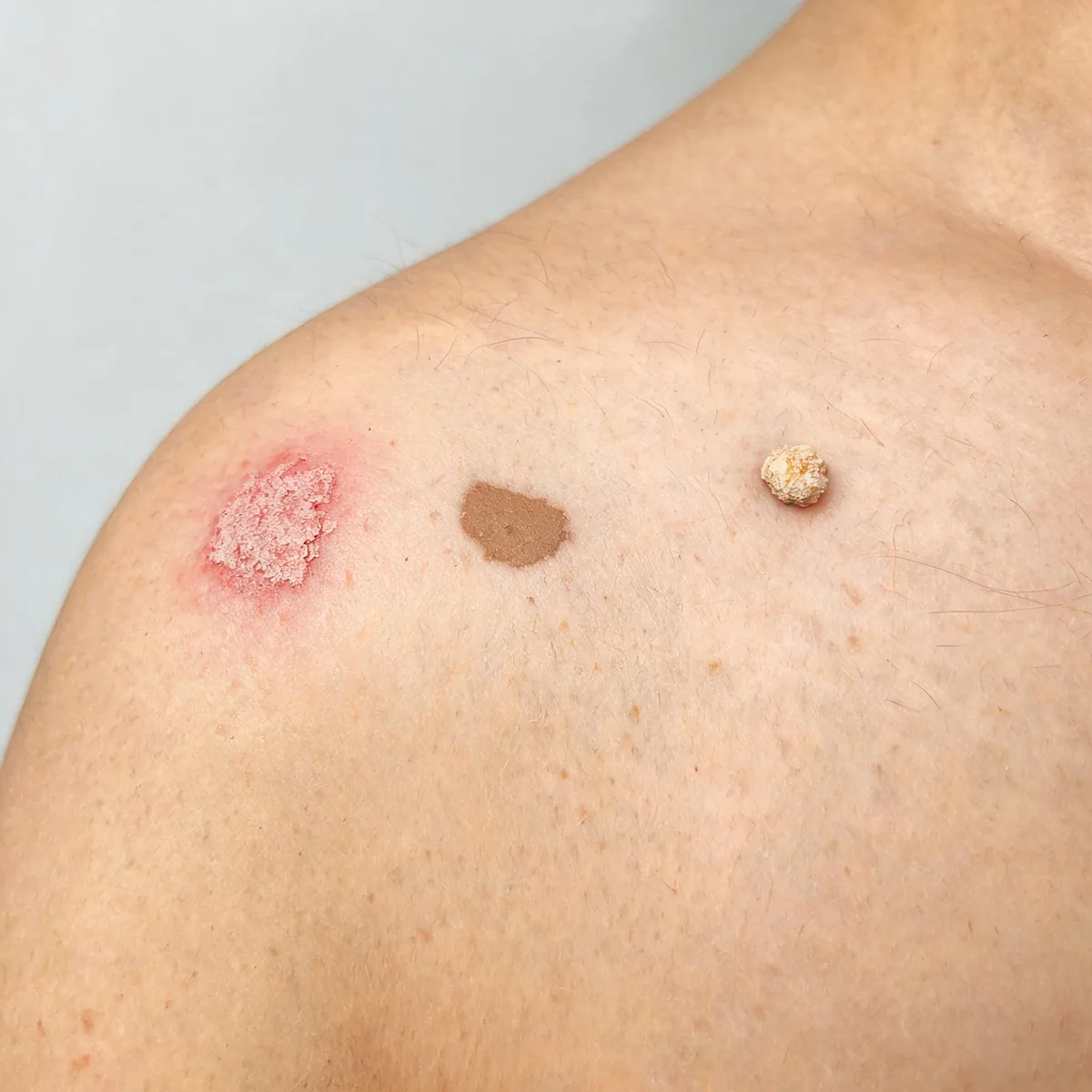
Understanding Skin lesions
The tradition describes the skin as an extension of the internal organs, particularly the Blood, the Liver and the Spleen.
When Blood is overheated, by stress or spicy food, the heat is said to push outward and produce bright red, hot, itchy patches. When the Liver channel carries damp heat, the lesions tend to burn and ooze, often in the groin or inner thighs, and come with a bitter taste and irritability.
The dry picture is different: rough, flaky skin with itch that worsens at night, a pale complexion and brittle nails, read as Blood deficiency with external wind. Dull, pale lesions with little oozing and a bloated, tired digestion are read as Spleen deficiency with dampness.
Dark purplish or brown lesions with fixed stabbing pain are read as Qi and Blood stagnation. The classical literature treats that as the pattern behind lesions that have been present a long time and do not change.
The classical literature starts from the skin as a visible edge of the internal organs, which is why it reads a lesion before it names one. Blood is what keeps skin soft and supplied, so when it is heated the surface turns red and irritable, and when it is thin the surface dries and cracks. The Spleen is what keeps fluids moving, so a sluggish Spleen leaves them to pool and seep. The Liver, which stores Blood and keeps Qi in motion, explains why a rash can appear along one side of the body and why frustration makes it worse. None of these organs is being called damaged; the point is that the skin is where their work becomes visible.
A lesion also carries a history. What begins bright red and hot can dry into scaling as the heat uses up the Blood that should moisten the skin, and a patch that weeps can settle into a brown mark once the fluid clears. The classical literature reads those changes as movement between patterns rather than as a new disease, which is why the formula is revised as the skin changes. It also explains why two people with an identical-looking patch may be given quite different prescriptions: one is cooling an excess, the other is topping up a lack.
Conventional view
Western dermatology defines a lesion as a patch of skin that has changed in appearance, whether it stands proud of the surface or lies flat, whether it is red, brown or pale, and whether it itches, weeps or hurts. Causes include infection, allergy, autoimmune reaction and chronic inflammation. The assessment is by inspection and history, with a biopsy or allergy testing where the picture is unclear.
Standard care is directed at the visible problem: topical corticosteroids to settle inflammation, oral antihistamines for itch, and emollients to repair the barrier. Infection is treated with antibiotic or antifungal cream, phototherapy is used for some chronic rashes, and oral immunosuppressants or biologic drugs are reserved for severe disease.
These measures calm flares well but do not always prevent the next one, because the trigger inside the body is not addressed. Strong steroids used for long periods thin the skin and create dependence, systemic drugs carry substantial side effects, and many people find the rash returns soon after the cream stops. That gap is where the classical literature places TCM, as an addition to dermatological care rather than a substitute for it.
Selected PubMed records
Real PubMed records for the conventional discussion above, selected by condition name and title relevance. They are references, not a claim that any treatment is proven for this condition.
- S2k guideline: Laser therapy of the skin.. Journal der Deutschen Dermatologischen Gesellschaft = Journal of the German Society of Dermatology : JDDG, 2022. PMID: 36098675.
- Skin Cancer Diagnosis by Lesion, Physician, and Examination Type: A Systematic Review and Meta-Analysis.. JAMA dermatology, 2025. PMID: 39535756.
How it connects
Skin lesions rarely arrive alone, and the classical literature reads the company they keep as part of the pattern. Damp-heat in the Liver channel is described alongside herpes zoster and moist eczema, which are the same process seen in a named disease. Blood deficiency shows in the menstrual cycle as scanty, pale periods and in the nails as brittleness, while stagnation shows as painful periods with dark clots. A weak Spleen shows as bloating and loose stools, and long-standing irritation shows as a short temper and broken sleep. Because these run together, treating the pattern often eases several complaints at once.
How it is assessed
The practitioner reads colour, moisture and hardness, then asks what else is happening internally.
What a practitioner looks for
- Colour: bright red and hot suggests heat in the Blood; pale suggests Spleen deficiency; dark purple suggests stagnation.
- Moisture: oozing and blistering suggest Damp-Heat; dry and flaky suggests Blood deficiency.
- Behaviour: lesions that appear and disappear suggest wind; fixed lesions that do not change suggest stasis.
- Systemic signs: fever, confusion, or blistering and peeling skin need emergency assessment.
Colour and moisture are only the first pass. The practitioner then looks for the signs that belong to one pattern rather than another: a red tongue body with a thin yellow dry coat and a rapid, sometimes wiry pulse for heat in the Blood; a yellow greasy coat with a slippery, rapid pulse for damp-heat; a pale, thin, slightly dry tongue with a fine pulse for Blood deficiency; a pale swollen tongue with teeth marks, a white greasy coat and a soft, slow pulse for a weak Spleen; a purple tongue with dark spots and a choppy pulse for stagnation.
The behaviour of the lesion is read alongside the body. Patches that appear and vanish, or that move from place to place, are attributed to Wind, while a patch that stays exactly where it is and thickens is attributed to stasis. Where it sits matters too, because the Liver channel runs through the groin, the inner thighs and the sides of the chest, so oozing lesions there are read as damp-heat in that channel rather than as a general skin complaint. Itching that wakes the person at night is taken as a sign that Blood is failing to hold the surface.
TCM patterns in Skin lesions
Five patterns are set out here, and they are separated by three observations rather than by the name of a skin disease. The first is colour: bright red points to heat, pale lesions to a Spleen that is not moving fluids, and a dusky purple that has been present for months to blood that is not moving. The second is moisture: blistering and weeping mean dampness, while dryness, flaking and cracking mean the Blood is too thin to reach the surface. The third is what else is happening in the body, such as a bitter taste and a short temper with damp-heat in the Liver channel, bloating and loose stools with a weak Spleen, or periods that are scanty and pale with Blood deficiency and painful with clots in stagnation. The tongue and pulse settle the reading, and because lesions change as they heal, the pattern is reassessed rather than fixed.
| Pattern | Key signs | The itch | Tongue | Main formula |
|---|---|---|---|---|
| Heat in the Blood | Bright red skin eruptions | Intense itching and burning | Body: Deep red, often with red points or pricklesCoat: Thin, yellow and dry | Not specified |
| Damp-Heat in the Liver Channel | Burning oozing vesicles or blisters; Lesions in groin, genitals or inner thighs | Not specified | Body: Red, with redder sides and edgesCoat: Yellow and greasy, thicker at the centre and root | Not specified |
| Blood Deficiency with External Wind | Dry flaky rough skin | Itch worse at night | Body: Pale and thin, sometimes slightly dryCoat: Thin, white and a little dry | Not specified |
| Spleen Deficiency with Dampness | Pale or light-coloured lesions; Little oozing or weeping | Not specified | Body: Pale and swollen, often with teeth marks along the edgesCoat: White, greasy and moist, thick in the middle | Not specified |
| Qi And Blood Stagnation | Dark purplish or brownish lesions; Fixed stabbing pain at the site | Not specified | Body: Purple or dark, with stasis spots; sublingual veins dark and distendedCoat: Thin white | Not specified |
Heat in the Blood
Bright red, hot, itchy eruptions with internal heat.
Heat that has entered the Blood is read as an excess pushing outward, which is why the eruption is bright, hot and maddening to scratch. The classical literature traces it to two sources: Wind-Heat arriving from outside, or strong emotion producing Fire inside, with the Heart and Liver named because they house the spirit and store the Blood. Because the heat travels with the blood, it is worse at night, when the body is warm and still, and it comes with a flushed face, a thirst for cold drinks and a restlessness that makes sleep difficult.
The tongue is red with red spots or prickles and a thin yellow dry coat, and the pulse is rapid, wiry, slippery and forceful. Spicy and fried food, alcohol, coffee, hot showers and saunas, wind and heat all provoke it, while a cool room, cool drinks and rest settle it. The formula named is Xiao Feng San, with Mu Dan Pi, Chi Shao and Zi Cao to cool and move the Blood, and the points are Quchi (LI-11), Xuehai (SP-10), Dazhui (DU-14) and Hegu (LI-4).
Signs
- Bright red skin eruptions
- Intense itching and burning
- Internal heat worse at night
- Thirst for cool drinks
- Restlessness with a flushed face
Diet and lifestyle for this pattern: Avoid spicy, greasy and fried food, alcohol and coffee. Eat cooling food such as cucumber, watermelon and mung beans, and drink chrysanthemum tea, keep the skin cool and avoid hot showers or saunas, and keep exercise gentle such as walking or yoga so Qi circulates without overheating.
Damp-Heat in the Liver Channel
Burning oozing blisters, often in the groin or inner thighs.
This is the weeping pattern. When dampness and heat collect in the Liver channel they follow its course and surface along it, so the lesions cluster where that channel runs: the groin, the genitals, the inner thighs and the lower abdomen. Heat gives the redness, the swelling and the burning, while dampness gives the vesicles, the clear or yellow fluid and the tendency to keep oozing. The classical literature names herpes zoster and moist eczema as the kinds of presentation it has in mind.
The tongue body is red with redder sides, and the coat is yellow and greasy, thickest at the centre and the root; the pulse is wiry, slippery and rapid. Greasy and spicy food, alcohol, humid weather and bottled-up frustration all feed it, while a dry room, a bland diet and rest calm it. Long Dan Xie Gan Tang is the formula named, with Long Dan Cao and Huang Qin to drain the channel and dry the dampness, and the points are Taichong (LR-3), Xingjian (LR-2) and Yinlingquan (SP-9).
Signs
- Burning oozing vesicles or blisters
- Lesions in groin, genitals or inner thighs
- Bitter taste in the mouth
- Irritability or short temper
- Yellow greasy tongue coating
Diet and lifestyle for this pattern: Avoid greasy, fried, spicy and sugary food as well as alcohol, which all create Dampness and Heat. Eat more cooling, Dampness-draining food such as mung beans, celery, cucumber and lightly cooked greens, manage emotional stress with gentle exercise and relaxation, since bottled-up frustration can fan Liver Heat, and keep the affected skin clean and dry.
Blood Deficiency with External Wind
Dry rough skin with itch that worsens at night.
Here the surface is undernourished rather than inflamed. Blood is what moistens skin, so when it is deficient the skin turns rough, flaky and cracked, and the barrier that should keep Wind out becomes porous. Wind then moves across the dry surface, which is why the itch wanders, comes and goes, and is worst at night: the classical literature reasons that night is the yin part of the day, and Blood, being a yin substance, is least able to hold the surface then. The same lack shows elsewhere as a pale face, dizziness and brittle nails.
The tongue is pale and thin with a thin white, slightly dry coat, and the pulse is fine and small, wiry over the left guan position, sometimes floating at the surface. Dry and windy weather, overwork, spicy and fried food, alcohol and the night hours make it worse, while sleep, warm but not hot baths, a humidifier and nourishing food help. Dang Gui Yin Zi is the formula named, built on Dang Gui, Bai Shao, Fang Feng and He Shou Wu, and the points are Xuehai (SP-10), Quchi (LI-11), Sanyinjiao (SP-6) and Fengchi (GB-20).
Signs
- Dry flaky rough skin
- Itch worse at night
- Pale or sallow complexion
- Aversion to wind and drafts
- Dull or brittle nails
Diet and lifestyle for this pattern: Eat blood-nourishing food such as black sesame, goji berries, dark leafy greens and bone broth, and avoid spicy, greasy and overly drying food that consumes Blood. Protect the skin from wind and dry air with a humidifier and gentle fragrance-free moisturiser, and manage stress and protect sleep to support Blood production.
Spleen Deficiency with Dampness
Pale lesions with little oozing and a heavy digestive picture.
This pattern looks mild and behaves stubbornly. The Spleen turns food and drink into usable energy and separates off what should leave the body; when it is weak, that separation falters and fluid collects. The pooled fluid has to go somewhere, and the tradition describes it overflowing into the skin as pale, faintly red patches that ooze little but return whenever digestion is under strain. The bloating, the loose stools and the poor appetite are not a separate complaint but the same weakness seen from the inside.
The tongue is pale and swollen with teeth marks, a white greasy coat and a wet surface, and the pulse is soggy and slow, soft and without force. Raw, cold and greasy food, overeating, humid weather, long stretches of sitting and worry all weaken it further, while warm cooked meals, rest and gentle daily walking restore it. Shen Ling Bai Zhu San is the formula named, with Bai Zhu, Fu Ling, Yi Yi Ren and Shan Yao, and the points are Zhongwan (REN-12), Sanyinjiao (SP-6), Yinlingquan (SP-9) and Zusanli (ST-36).
Signs
- Pale or light-coloured lesions
- Little oozing or weeping
- Poor appetite with bloating
- Loose unformed stools
- Heaviness with fatigue
Diet and lifestyle for this pattern: Eat warm cooked food such as congee, soups and stews, and avoid raw, cold and greasy food that burdens the Spleen. Gentle daily walking moves Qi and dries Dampness without exhausting you.
Qi And Blood Stagnation
Dark, fixed lesions with stabbing pain.
The last pattern is the one that leaves a mark. Frustration and stress stop the Liver from keeping Qi in smooth motion, and Qi that does not move allows Blood to slow and settle. What results is fixed rather than shifting: dark purple or brown patches, thickened skin, nodules, and a stabbing pain in the lesion itself that is worse under pressure. The classical literature notes that this picture often follows earlier inflammation, so it can be the end point of a rash that was once red and hot.
The tongue is dark purple with stasis spots and distended dark veins beneath it, and the pulse is wiry and choppy, described in the classical literature as a taut string scraping bamboo. Cold weather, sitting still, heavy greasy meals, stress and the days before a period all worsen it, and gentle movement, a warm compress, warm cooked food and calm ease it. Xue Fu Zhu Yu Tang is the formula named, with Dan Shen, Chi Shao and Chuan Xiong, and the points are Hegu (LI-4), Sanyinjiao (SP-6) and Jianjing (GB-21).
Signs
- Dark purplish or brownish lesions
- Fixed stabbing pain at the site
- Worse with pressure
- Irritability or mood swings
- Painful periods with dark clots
Diet and lifestyle for this pattern: Eat warming, blood-moving food such as turmeric, ginger, black fungus and a moderate amount of lean red meat, and avoid cold raw food and iced drinks that congeal Blood. Gentle daily walking or yoga moves Qi and Blood, and stress-reduction practice prevents Liver Qi stagnation from worsening the lesions.
Treatment approach
How the tradition treats skin lesions, with the herbs, formulas and points used for it.
Principles
- Cool the Blood where lesions are bright red and hot.
- Drain damp heat where they burn and ooze, particularly along the Liver channel.
- Nourish Blood and settle Wind where the skin is dry and itchy at night.
- Move Blood and resolve stasis where lesions are dark, fixed and painful.
- The strategy is set by whether the problem is excess or deficient. Where heat or damp-heat is driving the eruption the aim is to clear and drain, and the formula is chosen for the channel involved; where Blood or Spleen is lacking the aim is to nourish and strengthen so that the surface is supplied again; where Blood is stuck the aim is to move it. External washes and ointments are often added to soothe the skin while the internal work continues, and because a lesion can move from heat towards dryness, the formula is revised as it does.
Herbs used
Formulas
Acupoints
- LI-11 (Quchi)
- SP-10 (Xuehai)
- DU-14 (Dazhui)
- LI-4 (Hegu)
- LR-3 (Taichong)
- LR-2 (Xingjian)
- SP-9 (Yinlingquan)
- SP-6 (Sanyinjiao)
- GB-20 (Fengchi)
- zhongwan-ren-12
- ST-36 (Zusanli)
- GB-21 (Jianjing)
What to expect
- Acute hot or damp lesions are described as improving within weeks.
- Dry and stagnant patterns take longer, and pigmentation may persist after the lesion settles.
- A lesion that changes, bleeds or grows needs dermatological review rather than herbal treatment.
- The classical literature gives rough timings: acutely hot and red lesions often settle within two to four weeks, lesions that have been dry or weeping for months usually need three to six months of rebuilding, and dark nodular patches soften over six to eight weeks. Formulas are taken every day while needling is usually weekly, and progress is judged by itch, sleep and the colour of the patch rather than by the calendar alone.
Safety and when to get help
Seek medical help urgently for
- Sudden widespread blistering or peeling skin.
- Lesions with fever, chills or confusion.
- A new or changing lesion that bleeds, ulcerates or grows rapidly.
For anything severe, sudden or spreading quickly, read when a skin problem needs urgent care.
Cautions
- Do not apply strong topical preparations to broken skin without advice.
- Persistent lesions should be medically diagnosed, not only treated.
- Long-term internal herbs should be supervised.
Using this alongside conventional care
- TCM is described as complementary to conventional care: prescribed topical treatment can continue alongside herbs, and any suspicious lesion needs dermatological assessment.
- Herbal treatment sits alongside dermatology rather than replacing it. Topical steroids, antihistamines and moisturisers can be continued, and the practitioner needs to know about all of them, because blood-moving herbs, Dang Gui and Chuan Xiong among them, may add to the effect of anticoagulants. Any steroid should be reduced slowly and only under the prescribing doctor's direction. Topical herbal applications are usually compatible with conventional creams, though they are best separated in time so that neither is washed off immediately.
Diet and lifestyle
- Avoid spicy, deep-fried and sugary food, alcohol and rich dairy, and favour cooked warm meals.
- The general rule is to remove what feeds heat and dampness and to add what the pattern lacks. Spicy, fried and sugary food, alcohol, coffee and rich dairy are the common fuels and are best reduced whatever the pattern. Beyond that the classical literature is specific: cooling foods such as cucumber, watermelon, mung beans and chrysanthemum tea for heat in the Blood; celery, mung beans, lightly cooked greens and cucumber for damp-heat; goji berries, black sesame, bone broth and dark leafy greens for Blood deficiency; congee, soups and stews for a weak Spleen; and turmeric, ginger, black fungus and a little lean red meat where Blood is stagnant.
If you're pregnant
Pregnancy tends to bring out the dry pattern. The growing fetus draws on the mother's Blood, so dry, scaly lesions with itching that wakes her at night can appear or worsen. Formula choice matters more than usual: strong blood-moving formulas such as Xue Fu Zhu Yu Tang are avoided outright because they can threaten the pregnancy, and bitter-cold herbs that drain damp-heat, Long Dan Cao among them, are used only with specialist supervision. Acupuncture, external washes and dietary adjustment are the usual first choices, with Sanyinjiao (SP-6) and Hegu (LI-4) both left out of the first trimester.
Where a formula is judged necessary, the classical literature prefers mild ones that cool the Blood gently and soothe the skin, Xiao Feng San among them, prescribed by a practitioner experienced in pregnancy care rather than chosen from a shop.
If you're breastfeeding
Herbs that are bitter and cold, the kind used to clear heat and dry dampness, can enter the milk, and a nursing baby may then pass looser stools or suffer colic. Formulas such as Long Dan Xie Gan Tang are therefore generally avoided while nursing, with milder heat-clearing options, needling and topical applications used instead. Acupuncture is considered safe during lactation and can address the dry pattern and the pale, oozing pattern without touching milk supply.
Ointments and washes that are not swallowed are a further option, and the practitioner should be told about nursing at the first visit so that the plan is built around it.
If treating a child
In children the two common pictures are a weak Spleen with dampness and an acute heat in the Blood. A child's digestion is described as immature, so fluids pool easily and surface as pale, mild rashes that keep returning, while bright red itchy lesions tend to follow a new food or exposure to wind. Doses are reduced to roughly a quarter to a half of the adult dose according to age and weight, and formulas such as Shen Ling Bai Zhu San, or a gentler Xiao Feng San, are adapted rather than given whole.
Needles are often difficult with young children, so paediatric tuina, acupressure and external washes are preferred, and the assessment relies on watching the lesion and the child's behaviour and on the parent's account of sleep and digestion.
If treating an elderly patient
In older patients the dry pattern and the weak Spleen pattern dominate, because ageing is described as depleting Blood and Yin, leaving skin thin and slow to hold moisture, and as weakening the digestive fire, so dampness collects and weeps. Doses are usually about two thirds of the adult dose to avoid burdening digestion, and interactions with the several medicines an older person may take need checking.
Acupuncture is often tolerated better than herbs and can carry the treatment, nourishing formulas such as Dang Gui Yin Zi suit this group, and timelines are longer because repair is slower.
Urgent-sign guidance is based on standard sources: NHS anaphylaxis, NHS cellulitis, NHS Stevens-Johnson syndrome, NHS melanoma.
Evidence
Evidence status
Compiled for this page from the classical and modern literature; not a systematic review, so treat it as a pointer to sources rather than clinical guidance.
The evidence is good for one lesion type. A sham-controlled randomised trial in 330 adults with chronic spontaneous urticaria found that active acupuncture produced significantly greater reductions in itch severity and wheal size than sham, with benefits persisting at follow-up. That is among the strongest single trials available for any skin presentation here, though it covers hives rather than lesions in general.
Studies often cited
In 330 adults with chronic spontaneous urticaria, active acupuncture produced significantly greater reductions in itch severity and wheal size than sham acupuncture after four weeks, with benefits persisting at follow-up. Li Y, et al. Annals of Internal Medicine. 2017;167(10):693-702. doi:10.7326/M17-0337
Classical record
When pathogenic factors strike the channels, the body itches and develops urticaria.
- Jin Gui Yao Lue (Essential Prescriptions of the Golden Cabinet), chapter on wind-dampness diseases.
風勝則癢
When Wind predominates, itching occurs.
Huang Di Nei Jing (Su Wen), Chapter 5 - Classical citation: which uses this line to explain why itching is attributed to Wind on the skin rather than to heat alone.
Common questions
Can TCM tell me what my lesion is?
No. It describes a pattern, not a diagnosis. Any new, changing or non-healing lesion needs medical assessment first.
Why do dark lesions take longer?
Dark fixed lesions are read as Blood stagnation, which the tradition describes as slower to resolve than acute heat.
Can herbs fade pigmentation after a lesion heals?
The framework expects gradual change, but it does not promise clearance. Persistent pigment change should be reviewed.
When is a lesion urgent?
Blistering or peeling skin, a lesion with fever, or one that bleeds or grows rapidly.